Showing posts with label China. Show all posts

Thursday, January 13, 2022

Blog Tour: Playing with Lanterns by Wang Yage, illustrated by Zhu Chengliang, translated by Helen Wang

 
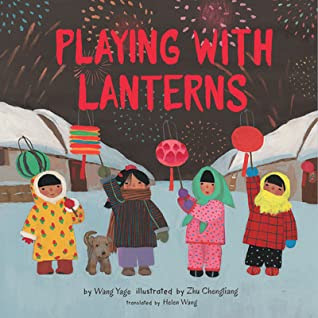
Playing with Lanterns by Wang Yage,
illustrated by Zhu Chengliang, translated by Helen Wang
Amazon Crossing Kids, 2022, 40 pages

The 15 day Lunar New Year celebration is right around the corner (February 1, 2022) and what better way to prepare for and enjoy it than with this charming book based on a New Year tradition enjoyed by children in Shaanxi Province, China. Traditionally, on the first day of the new year, families stay at home and celebrate together. On the second day, even though it is usually cold and snowy in the northern village where young Zhao Di lives, it doesn't deter anyone from going out and visiting with family and friends, a very impart of the Lunar New Year.

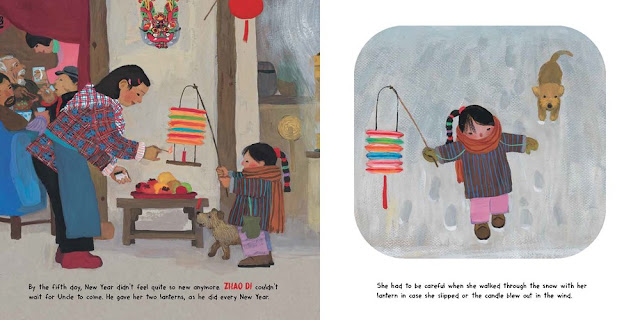
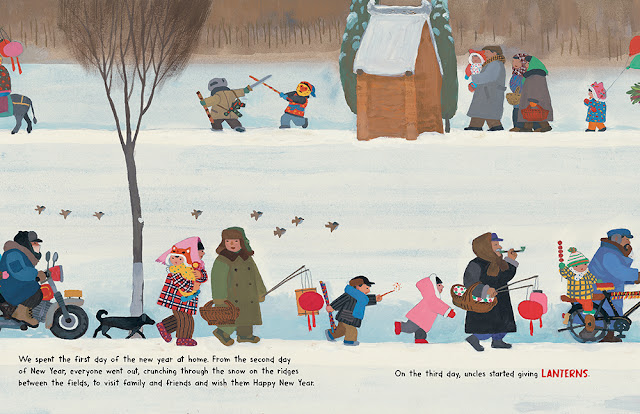
On the third day of the New Year, uncles give their nieces and nephews lanterns. This year, Zhao Di's uncle gives her an accordion shaped lantern complete with a bunch of candles to light the dark evening throughout the New Year observance. Now, she can join the other kids carrying their own bright lanterns. 

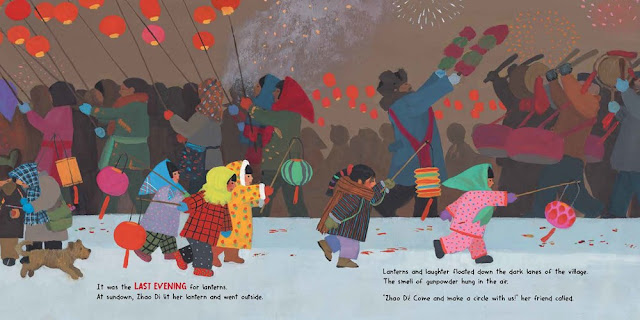
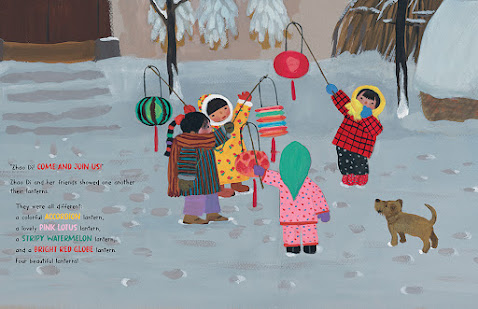
There are lanterns is all different shapes and colors, and everyone must be careful not to let their candle go out when the wind blows. When some rowdy boys charge Zhao Di and her friends, they hold their lanterns high until the boys run off. Zhao Di and her friends have fun walking through their village with their lit lanterns every night for the rest of of the New Year, but before they know it, the fifteenth and last day has arrived. Zhao Di wakes up to the sound of fireworks popping and cracking. That night she lights her lantern and heads out to join her friends for the last time. They form a circle and sing a lantern song as they follow tradition and smash their lanterns before the candles go out, then letting them burn to ash.
According to the Author's Note, smashing the lanterns is a folk tradition in Shaanxi province that dates back as far as the Han Dynasty  (202 BCE-220 CE) but, if the candle goes out before the lantern is smashed, the uncle who gave it to his niece or nephew will develop pink eye in the coming year.

Playing with Lanterns is such a delightful look at one child's experience of this important holiday. The author has really captured Zhao Di's anticipation at the coming New Year, her excitement at being a part of it and playing with lanterns with her friends despite the cold and snow, and her sadness at the end of the 15 days and the loss of her lantern mixed in with good memories of the time, and her happiness as she remembers that there will be another New Year next year. 

Complimenting the text are Zhu Chengliang's colorful engaging gouache illustrations. Not only do they express the range of emotions and feelings that the  kids have, but they also give some insight into the kind of life Zhao Di lives. And, as you can see, she has dressed the children in bright clothing as they carry equally brightly colored lanterns, a nice contrasts to the darkness of the night sky and the silvery whiteness of the snow.  
And I loved that Zhao Di's puppy dog celebrates throughout the 15 days of Lunar New Year. with her. 

Reviews of Playing with Lanterns:

“A colorful wintry tale ushers in Chinese New Year over two weeks…A charming illustration of childhood memories during the holiday season.” Kirkus Reviews

“Quiet, elegant passages stud the text…Tenderly detailed gouache paintings by Zhu render the children as small, patterned bundles frolicking against expanses of snow…A quiet celebration of a Northwestern Chinese tradition.” Publishers Weekly

Meet the Author: Wang Yage was born in Shaanxi, a central and historical province of China, where the custom of playing with lanterns was once a popular Chinese New Year tradition. A doctor of classical Chinese literature, she teaches at the University of Tibet. Playing with Lanterns is her first picture book. First published in China, the book made the prestigious White Ravens international book list.

Meet the Illustrator: Zhu Chengliang is an award-winning Chinese illustrator. Born in Shanghai and raised in Suzhou, he studied at the Department of Fine Art, Nanjing University, and has worked as an author, illustrator, editor, and designer. He was nominated for the Hans Christian Andersen Award in 2016, which is the highest international distinction given to authors and illustrators of children's books. His books have been named one of the Ten Best Illustrated Books by the New York Times and to the IBBY Honor List.


Meet the Translator: Helen Wang is a writer and translator from the UK. In 2017 she was given a Special Contributor of the Year honor as part of the Chen Bochui International Children's Literature Awards for her work in bringing Chinese children’s literature to English-speaking audiences. Wang has translated novels, picture books, and graphic novels, including Cao Wenxuan’s Bronze and Sunflower, which won the Marsh Christian Award for Children’s Literature in Translation.


Amazon Crossing Kids aims to increase the diversity of children’s books in translation and encourage young reading from a range of cultural perspectives.

This book was gratefully received from Barbara Fisch at Blue Slip Media

Monday, August 21, 2017

Bronze and Sunflower by Cao Wenxuan, translated by Helen Wang


Bronze and Sunflower is set in communist China during Mao Zedong’s Cultural Revolution (1966-1976). The goal of the cultural Revolution was to eliminate traditional Chinese life and thought, to replace it with communist ideology and get rid of any opponents. Artists and other intellectual were sent to remote Cadre Schools, where they did heavy manual labor during the day, and attended political re-education meetings at night. 

Sunflower, 7, and her father have been living in the country, in a Cadre School for a while. Her father is an artist, a sculptor, well-known for his beautiful sunflowers cast in bronze. Sunflower is the only child at the school and very lonely. Since she doesn't go to school, she often watches the children across the river playing and laughing. When her father dies unexpectedly, women from the Cadre School take Sunflower across the river, to the small village of Damadai, to see if anyone would take her in.

Only Bronze's family, the poorest in the village, is willing to accept Sunflower and make her their own. Bronze, a few years older than Sunflower and just as lonely, hasn't spoken since he was 5 and witnessed what was to him a traumatic event.

Bronze and Sunflower are soon inseparable, seeming to understand each other without the need to speak. Over time, the now-siblings and their loving, but poor family, endure and survive many hardships such as famine, locusts, bitter cold winters, and a fire that destroys their home. The children share not just friendship, but many adventures and good times, as well, like punting little boats on the river, riding to school together on Bronze's water buffalo, even though only Sunflower is a student,  or Bronze letting Sunflower sit on his shoulders so that she is high enough to see the circus over everyone else's head, and even working together as a family making reed shoes to sell in the January market to pay for Sunflower's schooling or grandmother Nainai's medical needs.

Bronze and Sunflower is a beautifully written story about the many sacrifices that were made by Bronze's family when they decided to take in Sunflower, how they lived poor but with great dignity and love, and how they continued to do that even when forced to make the greatest sacrifice of all.

Chinese life during the cultural revolution is not a usual subject for a children's book, but Cao has managed to present a picture of rural life that neither sugarcoats nor romanticizes it. In fact, he has produced such a heartwarming story that it has a feeling of timelessness about it despite the time it is actually sent in, mainly because Mao's China takes a backseat to the traditional values of family that the book really demonstrates.

Cao grew up during the 1960s and 1970s and experienced China at that time first hand, which give his novel a real feeling of authenticity. His descriptions, though beautifully rendered, are often heartbreaking at the same time.

Bronze and Sunflower is a large book, 400 pages long. It is a story of day to day survival, so there is not really a big central conflict. I have to wonder if it will appeal to young readers as much as it appeals to adults. My 12 year old self would have loved getting immersed in the lives of Bronze and Sunflower, but I didn't grow up with as many distractions as kids have today (video games, screens, instant gratification, etc. I'm not putting these things down, just pointing out how life has become faster). Though I highly recommend it for its thematic portrayals of community, family, loyalty, and poverty.

On a personal note: my Kiddo has been home visiting and when I asked her if her husband's parents, who both grew up in the midst of the cultural revolution, ever talk about it, she said not, never. They refuse to say anything, but her husband's grandparents did tell her about how hard life was in those days. I'm guessing they would have really appreciated Bronze and Sunflower.

Bronze and Sunflower won the 2016 Hans Christian Anderson award and was translated from Mandarin by Helen Wang, who won the 2017 Marsh Award for Children's Literature in Translation for it.

Original Chinese Cover 
You can find out more about Cao Wenzuan in a New York Times interview HERE

And Zoe at Playing by the Book has a wonderfully informative interview with Helen Wang HERE

If an interest in translated children's Chinese books has been kindled, you
might be interested in Helen Wang's blog Chinese Books for Young Readers

Classroom and Home School teachers can find a useful PDF discussion guide
HERE

This book is recommended for readers age 9+
This book was an EARC received from NetGalley

Sunday, October 16, 2016

When the Sea Turned To Silver written and illustrated by Grace Lin


The Tiger Emperor, disguised as a soldier, is going around to all the mountain villages and kidnapping men to help build a Vast Wall around his entire kingdom. When the Emperor arrives in Pinmei's village, not only does he take all the men, but he also takes Amah, her elderly grandmother known as the Storyteller.  Amah had hidden Pinmei in a large empty wine vessel to keep her safe.

Before the soldiers leave, young Yishan arrives at the hut and demands they not take Amah, but the Emperor only laughs.  Tossing him aside, he tells Yishan that he can have her back when he brings the Tiger Emperor a Luminous Stone That Lights The Night.  As they leave, the soldiers set fire to the little hut Pinmei and Amah lived in.

Pinmei and Yishan decide to go rescue Amah and set out on a quest to find a Luminous Stone That Lights The Night, traveling from their home on the Never-Ending Mountain through deep snows in what seems to be a never ending winter to the City of Bright Moonlight. Along the way they are given much help in exchange for one of Amah's story, which Pinmei knows by heart.

Pinmei and Yishan are not in the City of Bright Moonlight long before they must journey to the Crystal Palace at the bottom of the sea to seek the help of the Sea King and then back to the Capital City to try to get Amah released from the Tiger Emperor's dungeon.  Along the way, Pinmei begins to suspect that Yishan is hiding something from her as his demeanor begins to change to a more confident person when dealing with all the obstacles they meet on the quest to rescue Amah.  Her suspicions aren't without foundation, providing one of the big surprises at the end of the story.

Besides Pinmei and Yishan's journey, there are parallel chapters of Amah in a dungeon with a fellow prisoner, a stonecutter, as well as the plight of the entrapped Black Tortoise of Winter, both adding to the mystery and enchantment of Pinmei's adventure. At the heart of this cleverly woven tale is the Tiger Emperor's desire for invincibility but also for immortality and he is willing to do anything to achieve that. But why did the Tiger Emperor kidnap Amah, the Storyteller? Why did he ask for a Luminous Stone That Lights The Night? And why can't the Black Tortoise move on so that winter can end?  How can they help the Emperor achieve what he wants?

The answers to these questions can be found in the stories that Pinmei and Amah tell and which are strategically interspersed throughout the book (of course, I didn't realize the strategic part on my first reading of When the Sea Turned To Silver).  Though rooted in traditional Chinese folktales, Grace Lin has given them her own spin to support the story of Pinmei, Amah, Yishan and the selfish Tiger Emperor.

I was really looking forward to reading When the Sea Turned To Silver and I wasn't disappointed. It is an adventure with lots of twists and turns, where nothing is as it seems and there are a few surprises along the way  The tales fit smoothly and relevantly into the framing story, so the reader doesn't experience any disjunction or lose track of Pinmei and Yishan journeys.

When the Sea Turned To Sliver is the third companion in the trilogy that so far includes When the Mountain Meets the Moon and Starry River of the Sky but you don't need to have read these two previous tales to enjoy this third one.  Although there are references to the past narratives, this one does stand alone.

I found the writing to be clear and clean, but not quite as lyrical or poetic as Lin's two previous novels.  In fact, sometimes I thought Yishan sounded a little colloquial.  None of this takes away from the loveliness of the basic story, but I was surprised by it.

When the Sea Turned To Silver is an enchanting work and Lin has invented an imaginative ancient Chinese world that is at times rather dark in tone and at other times is just beautiful. And she has provided the reader with illustrations that will take your breath away, beginning with the cover, and continuing with the full color images throughout the book and the two-tone vignettes at the start of each chapter.
    
This illustration is one of my personal favorites.  I love the way Lin frames her illustrations like her stories with what appears to be her version of traditional Chinese designs that fit her story. You can see that Lin really puts a lot of care and  thought into what she creates.  In this first full color illustration in the story, you can almost feel the bitter cold of the winter that is going on and on, and the isolation in which Pinmei, Amah and Yishan live (Yishan lives alone in a different hut since his Aunty Meiya died).

When the Sea Turned To Silver is a eminently readable, spellbinding tale that is sure to please fans of Grace Lin, young readers who enjoy good fantasy, and everyone who likes to read.

This book is recommended for readers age 9+
This book was purchased to send to my Kiddo, but I read it first.

Marvelous Middle Grade Monday is a weekly event hosted by Shannon Messenger at Book Ramblings, and Plenty of Shenanigans

Friday, September 19, 2014

#Diversiverse Review: Alvin Ho: Allergic to the Great Wall, The Forbidden Palace, and Other Tourist Attractions by Lenore Look

It's Christmas vacation and Alvin Ho, 7 year old Chinese American second grader, is back for another adventure and this time he's leaving his home in Concord, MA and traveling half way around the world to visit family in Beijing, China.

For most kids, a trip to China would be an exciting, fun adventure, but most kids aren't Alvin.  For Alvin, it means packing your PDK (Personal Disaster Kit), and climbing into a tin can to fly half way around the world, accompanied by his dad, his mom, older brother Calvin, younger sister Anibelly and baby sister Claire, and oh, yes, all his allergies.  You see, Alvin is allergic to all kinds of scary things, and on a trip to a foreign country, he will be able to add all kinds if fears like flying, heights, and elevators to his repertoire of allergies.

Once in China, Alvin does manage to visit the Great Wall, lose his father's passport (NOT something you want to have happen in China), go through the Forbidden Palace and, my personal favorite, end up in a Chinese hospital.

But anyone familiar with Alvin's previous adventures in fear will remember he is allergic to girls (#1: Alvin Ho is Allergic to Girls School and Other Scary Things), so when his cousin Katie shows him the Christmas tree she decorated with angels bearing the wishes of girls living in an orphanage, Alvin thinks it is a swell idea until the angel he picks says Friend on it.  How do you give a friend?  And to a girl, no less?  It is a conundrum, but Alvin works out with some surprising results.

Although Alvin's obsessive nature sometimes got on my nerves, I think the real benefit of the Alvin Ho books is that they address the many fears that kids often have, and may even provide a kind of relief for the reader when they realize they are not alone.

I also laughed my way though most of Alvin Ho: Allergic to the Great Wall, The Forbidden Palace, and Other Tourist Attractions, partly because so much of what happens is so spot on (right down to Calvin's I Climbed the Great Wall t-shirt, the same t-shirt my Kiddo came home wearing from her first trip to China).

I've always like Lenore Look's books because he manages to get so much information into the story that you don't even realize you just learned something new about China and Chinese culture.  For example, I didn't know that Chinese buildings don't have a 4th, 14th and 24th floor because 4 is an unlucky number in China and they don't have a 13th floor because that is an unlucky number in Western countries.  And I didn't know that the purpose of acupuncture is to more your stuck Chi (Qi) or energy to help you feel better.  These are just part of Alvin's story and are worked into it so seamlessly.

I chose Alvin Ho: Allergic to the Great Wall, The Forbidden Palace, and Other Tourist Attractions for my first book in the A More Diverse Universe Reading Challenge because so often children's books written by people of color are overlooked and there are so many more that there used to be and so many are wonderful.


Tuesday, June 24, 2014

The Year of the Fortune Cookie by Andrea Cheng, illustrated by Patrice Barton

This is the third book in the Anna Wang series by Andrea Cheng.  In the first book, The Year of the Book, Anna was in 4th grade and her best friend Laura now has different BFFs.  Feeling like an outsider, Anna loses herself in books, but it is also the year that she begins to develop empathy for other people, including Laura.  And Anna finds a new best friend in Camille, another Chinese girl.

In The Year of the Baby, Anna's parents have adopted a new baby sister from China, but Kaylee, an otherwise happy baby, isn't eating.  So 5th grade friends Anna, Camille and Laura develop a science project that they hope will entice baby Kaylee to eat more.

Now, in The Year of the Fortune Cookie, Anna has moved on to 6th grade and middle school.  It looks like Anna and Camille are the only Chinese students there, until Anna meets Andee when she signs up for an after school club.

In English, the teacher Mrs. Smith is teaching the kids how to write a proper paragraph and coordinates her lesson with the social studies topic of Who Am I?  This gets Anna to thinking a lot about who she is and about who baby sister Kaylee is.

Anna and her mother are invited by her 5th grade teacher Ms. Sylvester to accompany her and her husband to Beijing, China as they adopt they own baby girl.  When it turns out that Mrs. Wang isn't able to make the trip, it's decided that Anna would go with the Sylvesters anyway.  In order to miss two weeks of school in December, however, Anna needs the signature of all her teachers.

Her English teacher is reluctant to sign and instead hands her back a paper Anna had written about what makes her who she is with suggestions for a rewrite.  Eventually Anna hands in a satisfactory paper and gets permission to go to China.  It is Anna's hope that going there will give her a better understanding of who she is.

At the same time, the students in Anna's after school group decide to bake and sell fortune cookies to raise money to give to the Lucky Family Orphanage that Kaylee and the Sylvester's new baby were adopted from.  They also knit hats for the babies still there.  It's Anna wish to talk to the women who cared for her sister, but the prospects of that don't look very good.  Then, just when Anna thinks she will never to see the orphanage, she is pleasantly surprised.

This is a gentle story with lots happening, but with none of the dramatics usually associated with middle school novels.  The action may happen in middle school, but this is a better book for kids who are not there quite yet, making it a nice introduction to this time for readers.  Anna frets about all the usual things that going to a new school brings up - friends, work, being different, being accepted, but the main theme of identity and what makes us who we are is really the stuff of this book and of middle school.

Adult readers may wonder why the Sylvesters take Anna with them to Beijing, but younger readers won't be bothered by it.  I didn't dwell on the time Anna spent in Beijing, even though it takes up a fair amount of space, mainly because there is so much to it.  I admired Anna tenacity there when it looks like the woman from the orphanage is trying to get out of taking her to visit, but Anna was determined to do this for her sister.

The whimsical black and white illustrations by Patrice Barton add much to this heartwarming story and will provide continuity to readers who will recognize them from The Year of the Baby, which Barton also did.

The character of Anna grows a lot in this book and I wonder if Cheng is going to bring her from chapter book to middle grade novel for her fans who are growing up as well.  I think it is a nice book for kids around 9 or 10 who are soon facing middle school.

Anna is still learning Chinese and there is a pronunciation guide and character list at the beginning of the book of all the words and phrases used in The Year of the Fortune Cookie.  And even though we learn that fortune cookies don't exist in China, there is a recipe at the back of the book for making them.

This book is recommended for readers age 7+
This book was borrowed from a friend

Monday, September 9, 2013

Jasper's Story: Saving Moon Bears by Jill Robinson and Mark Bekoff, illustrated by Gijsbert van Frankenhuyzen

I have to be honest and confess that until I read Jasper's Story I had never heard of a Moon Bear.  Moon Bears, like the panda, are native to Asia and are, sadly, captured and put into extraction cages so that the bile produced by their liver can be extracted and used to make herbal medicine.

Jasper's Story is about one Moon Bear, who was rescued from its captivity and brought to the Moon Bear Rescue Centre in Chengdu, China.  In this lovely picture book, Jill Robinson, founder of the centre, shows how, little by little, Jasper is slowly introduced to the people who will care for him and nurse him back to good health and how, as he becomes used to his new den, he is able go out and play with the other rescued bears.  In fact, Jasper seems to have quite a playful side to his personality.

Jasper's life as an extraction bear is given coverage, and there are some illustrations of the small, confining cages that he was kept in, but much to Jill Robinson's credit, this is done skillfully and tastefully so that it doesn't scare or upset young readers.  Robinson focuses most of Jasper's Story on the time that Jasper spends at the rescue centre, his recovery and his newly gained freedom.

Teaching young readers about the exploitation and mistreatment of animals can be a real slippery slope for writers, but Robinson has done an exceptional job of it in this picture book for older readers.  In addition, Jasper's Story has been realistically illustrated by Gijsbert van Frankenhuyzen in rich earth and sky tones that betrayal his own love of nature and wildlife.

Jasper has become the face of successful moon bear rescue and efforts to stop bile extraction in Asia.  There is also interesting and informative back matter about Jasper in particular and moon bears in general, written by Robinson, van Frankenhuyzen and Marc Bekoff, an animal behavior specialist and Professor Emeritus that shouldn't be missed.

Jasper today

This book is recommended for readers age 7+
This book was borrowed from the NYPL

Nonfiction Monday is hosted this week by Wendie's Wanderings


This is book 10 of my Nonfiction Picture Book Reading Challenge hosted by Kid Lit Frenzy


Wednesday, May 1, 2013

Paper Son: Lee's Journey to America by Helen Foster James and Virginia Shin-Mui Loh, illustrated by Wilson Ong

It is 1926 and Fu Lee has just been told by his grandmother that he will be going to America in three weeks as a "paper son" to have a better life than the one he would have if he stayed in his small village in China with his grandparents.

To prepare Lee, his grandparents give him a coaching book which tells him everything he needs to know to convince the immigration authorities in San Francisco that he is really the son of Fu Ming, an American citizen.  The book includes such minute details as the number of windows and doors in Fu Ming's house and where they keep their rice bin.

Each night for three weeks, PoPo quizzes Lee to make sure he has learned the information in his coaching book.  Finally, Lee sails for America.  He continues studying his coaching book, but throwing it overboard just before disembarking.

In San Francisco, Lee and the other Chinese passengers are taken to the Angel Island Immigration Station, given physicals and, if their health is good, they are given a bunk bed in a dormitory until they are called for questioning.

And when he is called, Lee is subjected to hours and hours of interrogation more than once.

What is a paper son, you might be wondering.  Basically, it was a way for Chinese people to emigrate to the US at a time when our borders were closed to them due to the Chinese Exclusion Act of 1882.  But after the earthquake of 1906, records were lost so no one really knew who was born in the US and who wasn't.  This enabled many Chinese immigrants to claim they were related to an American citizen of Chinese descent - for a price.  In Fu Lee's case, it cost $100.00 for each year of his life, in other words, $1200.00, not a small sum for poor farmers like Gong Gong and PoPo.  Of course, there is an explanation at the back of the book about this and about Angel Island, the West Coast equivalent of Ellis Island.

Paper Son is one of those historical picture books for older readers that presents an aspect of history in fictional form.  I really like these kinds of books for classroom use, but I wonder if an 8 or 9 year old would read this on their own.

That said, this is really a very informative, well-researched book.  The text is complimented on every page by the soft, almost muted though expressive paintings of Wilson Ong, which convey what Lee must have been feeling from trading in his real identity for one that isn't real, to being alone in a strange country, never knowing who to trust.

I have only one criticism of Paper Son- the Chinese words aren't clearly defined.  I could figure out that Gong Gong means grandpa and PoPo means grandma (and that would be on the mother's side of the family) and that Gum Saan refers to the United States, but could a young reader?  I wonder.  Regardless, I definitely love this book and highly recommend it.

This book is recommended for readers age 6+
This book was obtained from the publisher.

Tuesday, April 2, 2013

Where the Mountain Meets the Moon by Grace Lin


From her own Chinese roots, Grace Lin has created a wonderful  modern day folktale for children of all ages in Where the Mountain Meets the Moon.  It is the story of young Minli who lives in a small village with her parents Ba and Ma in the shadow of Fruitless Mountain. Everyday, all the villagers must toil away in the mud that forms where Fruitless Mountain meets Jade River to plant and harvest just enough rice to live.  Fruitless Mountain is a dull brown color because nothing grows there.

In the evening, as the family eats their rice, Minli loves to have her father tell her stories.  One of her favorites is The Story of Fruitless Mountain.  When Minli asks if anything will ever grow on this barren mountain again, Ba tells her that is a question for the Old Man of the Moon.

The next day, returning from the field to begin making the day's rice meal, Minli runs into the Goldfish Man.  Knowing how hard her parents must work everyday, and wanting nothing more than to change their fortune, Minli buys a goldfish from the man, who tells her that goldfish means "plenty of gold" and that one in the house will bring gold and jade there, or really good fortune.

That night, Minli asks Ba what they need to do the bring fortune back to their village, he again says it is a question for The Old Man of the Moon who can be found on Never-Ending Mountain.  However, Ma is so angered that Minli spent one of her two coins on a goldfish and that Ba has given up a few precious grains to his rice to feed it, that Minli decides to let the goldfish go.  But before swimming away in the Jade River, the goldfish tells Minli how to find The Old Man of the Moon.

And so leaving a note for Ma and Ba, Minli begin her quest, and along the way she meets is a dragon who cannot fly and has been tied up by monkeys to keep in out of their peach orchard.  Minli frees the dragon and they decide to travel together to seek The Old Man of the Moon so the dragon can ask why he cannot fly like other dragons.  Minli and the dragon have many adventures, meeting others along the way who also tell them stories that help to to get Minli to her destination.

Enchanting - that is the word that most often came to my mind when I read Where the Mountain Meets the Moon.  Lin has created a fantasy world where fish can tell you how to find your way, dragons can help get you there and the tales you hear along the way serve as your guideposts.

When my Kiddo was young, we read lots of Chinese myths together, so I really loved the way Lin worked her myths so easily within the frame work of Minli's quest.  It gave the whole story a feeling of being very old and wise.  Lin understanding of the symbols in Chinese myth is very apparent: there are goldfish for luck and affluence, dragons that have power over water, rainfall, and floods and symbolize power and strength, tigers and even kite flying, flown high for prosperity and to avoid bad luck.

Ba's stories may have inspired Minli to seek The Old Man of the Moon, but her mother always thought they were a waste of time: "Another story! Our house is bare and our rice hardly fills our bowls, but we have plenty of stories." Ma sighed again. "What a poor fortune we have!" (pg 10)  But even she saw how happy Ba's stories made Minli.  On of the things I did like in this novel is that Minli's adventure is interspersed with sections about her parents - readers see them missing her, and when Ba tells her stories to comfort her, Ma's attitude towards them changes just as the stories change her.

There is a definite lesson to be learned from Where the Mountain Meets the Moon, but to tell it would be to spoil the ending, so just let me say that this is a novel that should not be missed and is a wonderful read aloud book for kids of any age.

Lin did her own illustrations for this novel and they are spectacular.  Be sure to pay close attention to them as you read along.  There is much to be found there.

This book is recommended for readers age 9+
This book was purchased for my personal library

An excellent Educator's Guide is available for Where the Mountain Meets the Moon here.

Where the Mountain Meets the Moon is a 2010 Newbery Honor Book.  It is book 3 of my 2013 Award Winning Reading Challenge hosted by Gathering Books.

Friday, March 15, 2013

Red Kite, Blue Kite by Ji-Ji Jiang, illustrated by Greg Ruth

Historical fiction is one of my very favorite genres, especially when it is based on real events or people.  Lately, I have been reading a lot of historical fiction picture books and I have been loving them.  Not only do they introduce young children to important events or people in history, they add so much to older kids' understanding to what they may be learning/reviewing in school.  Picture, especially in the hands of a skillful illustrator, can provide a detailed visualization, in the same way a map helps us find our way.

Red Kite, Blue Kite is a picture book that begins just before takes the Cultural Revolution in China that occurred during the 1960s.  Tai Shan and his Baba (father) like to fly their kites from the rooftop of their home.  Tai Shan's kite is red, his father's is blue.  Kite flying is a special time for Tai Shan, because on the roof they feel free and Baba tells lots of stories.

"Then, a bad time comes."  Tai Shan's school is closed and he is sent to live with a farmer when his father is sent to a labor camp.  Granny Wang is good to Tai Shan, but he still dreams of being back home with his Baba and their kites.  But, at least, Baba can visit every Sunday, walking the long distance so they can be together and fly their kites.

One Sunday, Baba tells Tai Shan he will not be able to visit for a while.  He tells Tai Shan to fly his red kite every morning and Baba will answer this by flying his blue kite in the evening.  It will be their secret signal.

But one day, Baba tells Tai Shan he will not be able to fly his blue kite anymore.  He gives it to Tai Shan and tells him to fly both of them for him to see.  The men with the red armsbands are taking Baba to a difference labor camp because of his ideas.  Will Tai Shan ever see him Baba again?

Red Kite, Blue Kite is a book that can be read on two distinctly different levels.  First and foremost, it is a beautifully written story about the strong relationship and bond that exist between a father and his son, a bond so strong nothing can break it, not even separation.  It would be an excellent book for any child that has suffered and had to cope with separation from a parent for any reason.

The political aspects of the story are never really spelled out, since this is a story are told from Tai Shan's point of view, understood as a child would understand political events going on around them.  For example, the treatment of dissidents like Baba is not really spelled out, but it is there if it is wanted as a history/cultural lesson.

Complementing the text are Greg Ruth's realistically detailed watercolor illustrations.  Here, too, the political aspects of the story have been kept in the background by giving them a rather shadowy effect, while the more colorful elements of the illustrations, placed at the forefront, focus on Tai Shan and/or Baba:


I have to agree with what Pamela Paul wrote in her February 20, 2013 NY Times review of Red Kite, Blue Kite: [It] offers narratively strong, visually arresting and moving examples of why and how picture books can convey with immediacy and resonance the impact of profound historical events."  I couldn't have said this any better, and completely agree with it.

Just imagine the lesson plans you could come up with using historical fiction picture books.

This book is recommended for readers age 5+
This book was provided by the publisher
 
Imagination Designs