Showing posts with label Illness. Show all posts

Sunday, March 20, 2022

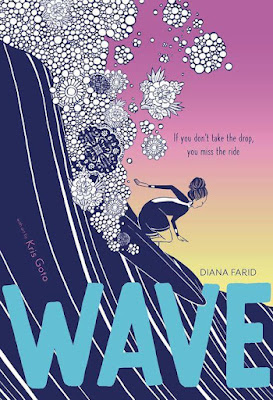
Wave by Diana Farid


Wave by Diana Farid,
illustrated by Kris Goto
Cameron Kids, 2022, 320 Pages
Available March 29, 2022
Wave is a novel-in-verse narrated in the first person by Ava, a thirteen-year-old Persian American living in southern California who is mildly OCD. Set in the 1980s, Ava is looking forward to graduating from eight grade and a summer of hanging out at the beach surfing with Phoenix and best friend Naz before school begins again. Ava's parents are divorced, her dad lives in Paris with his new family, and her Iranian born mom is an OB/GYN doctor at the local hospital. Her mom is hoping Ava will follow her into medicine, and signs her up to be a volunteer on Saturdays for the summer, something she isn't too happy about. 

At the hospital, Ava meets patient, Mr. Cameron, in room 509 and discovers that they share a love of poetry by the Persian poet Rumi

At school, Ava, who loves music, sings in the choir and her teacher announces that they have been invited to sing at the Fourth of July Freedom Festival, with Ava having a solo part. It means rehearsals even after school ends.  

At the beach, Ava is confronted by a racist volleyball player more than once who instantly dislikes her for her dark olive skin. This is a difficult experience for her since the beach is the one place Ava has always felt she like she fit in since her skin tone could pass for tan. And it's at the beach that she begins to notice small changes in Phoenix. He had been diagnosed with Hodgkins Lymphoma as a child, but has been in remission. Now his cancer has returned and his prognosis isn't very good. 

Then, Ava slips and falls at the hospital, breaking her leg. Since her summer of surfing is now curtailed, her mother signs her up for a medicine for teens class every Monday and Wednesday, a class that begins June 29th, which Ava resents since she has made it clear to her mother that she has no interest in medicine and needs to prepare for her solo at the Freedom Festival. 

There's a lot happening in this novel and yet none of it feels unrealistic or overwhelming. Instead, it is a poignant coming-of-age story about identity, friendship, love, loss and grief. But it is also about how music and poetry can help us process life's more difficult challenges, as summed up in the song that Ava wrote about her life.
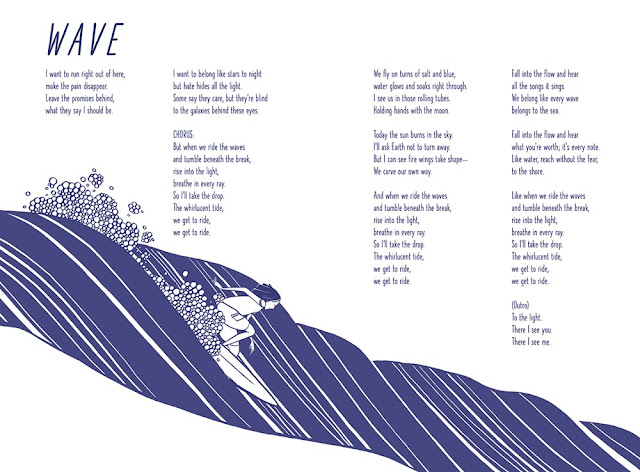
Farid has included lots of different aspects of Iranian culture throughout the novel and it is interesting that she set her novel in a time when anti-Iranian feelings were running high in this country. The poetry gives the reader not just a sense of waves building as they come in and crash at the shoreline, then draw back out to sea again, but they are so symbolic of the highs and lows of Ava's life that fateful year (the timeline goes from March to November).

Sprinkled throughout the novel are lovely spot illustrations relating to Ava's life. I chuckled when I saw the one with Ava's new walkman. I know exactly how she felt when she received it, I still have mine and yes, it still works. And to go with that walkman, Farid has included a playlist of Phoenix's songs for Ava, and Ava's songs for Phoenix - all very 80s.

Wave is a poignant novel and though some may see it as historical fiction, it will no doubt resonate for today's readers. 

Thank you to Barbara Fisch at Blue Slip Media for providing me with an ARC of Wave.

Meet the Author:

Diana Farid is the author of When You Breathe, named a 2021 Notable Poetry Book by the National Council of Teachers of English; it was also awarded the California Reading Association’s 2021 EUREKA! Gold Award for nonfiction children’s book. She is a poet and a physician at Stanford University. Wave is her first middle grade novel. For more information, visit dianafarid.com.


Twitter and Instagram: @_artelixir

Be sure to check out the other Marvelous Middle Grade Monday offerings, 
now being carried on by Greg at Always in the Middle

Sunday, January 5, 2020

Stargazing by Jen Wang


Christine Hong is a quiet, reserved Chinese American girl concerned with her grades, church, going to Chinese school, and playing the violin, who nevertheless always feels inadequate in her more traditional Chinese family where hard work and doing well are so highly valued.

When her parents learn that a single Chinese American woman, YuWen Lin and her daughter Moon, are having money problems, they offer them their extra apartment. Moon is Christine's age but the two girls couldn't be more different. Moon is confident, loud, loves listening to K-pop, is vegetarian and Buddhist, and does not attend Chinese school. Moon is also quick with her fists when someone gets in her face. At first, Christine tries to keeps her distance from Moon. Yet, despite their differences, the two girls become best friends and little by little Moon begins to broaden Christine's interests, interests that Christine gladly embraces.

Now that Moon is going to the same school as Christine, she soon begins to make other friends and becomes quite popular. Still, the two friends hang out together, listening to music and dancing. Then, one day, Moon confides in Christine that she believes she is actually a celestial being who doesn't belong on earth and that someday the angel people she constantly draws are going to come for her. Christine seems to accept this but when her grades slip, she starts to distance herself from Moon again. Now, Moon's popularity is causing Christine to feel jealous and at a birthday party for one of the other kids, she leaves Moon's private notebook with her angel people drawings in it for the other kids to see. When they make fun of Moon, she settles things with her fists. Leaving the party, Moon collapses and ends up in the hospital with a serious illness requiring brain surgery.

While Moon is recovering in the hospital, Christine has a lot to think about, including her own feelings and actions. But after all is said and done, is it possible for these two girls to remain friends?

There are a number of things in this graphic novel that I really liked:

First, the illustrations are very appealing. They are simple  and clean and capture the different characters personalities and emotions with clarity, and there is no mixing up characters, which can sometimes happen in graphic novels. Perhaps all this is due to Wang using pencil and ballpoint pen to draw the illustrations, then coloring them in digitally. What do you think?
The first time Christine sees Moon at a church recital
I think that Wang has created a Chinese American community that is very true to life and that by creating such different girls, one raised traditionally, one raised more unconventionally, she is able to show some of the difficulties kids like Christine have navigating their lives as second generation kids and coming to terms with who they really are.

Ultimately, though, Stargazing is a wonderful example of the ups and downs of middle grade friendships and how volatile they can sometimes be. Incorporating Moon's brain tumor creates a really transformative event for both girls as they become their more authentic selves. This is a poignant, realistic story that should appeal to all middle grade readers.

This book is recommended for readers age 9+
This book was borrowed from the NYPL

Be sure to check out the other Marvelous Middle Grade Monday offerings, now being carried on by Greg at Always in the Middle. 

Sunday, November 3, 2019

MMGM: More to the Story by Hena Khan


**May Contain Spoilers**
This re-imagining of Louisa May Alcott's 1868/69 novel Little Women has been wonderfully updated for today's readers. It is still the story of the four sisters and their parents, the Mirza family of Pakistani Americans Muslims, no longer living in 19th century New England, but in present day Atlanta, Georgia. And hurray, Laurie isn't gone either, he is now a British Pakistani boy named Ali, 14, sent to the US from London by his mother, who hopes to soon follow him to Atlanta with his sister. Ali is  living with the honorary Auntie and Uncle of the Mirza sisters.

The novel is narrated by Jameela, 13 and an aspiring writer and author of a family newsletter called Mirza Memos and hoping to be the new Editor of the school newspaper. The story begins on Eid, and Jam, sisters Aleeza, 10, Bisma, 11, and Maryam, 15, are upset at the news that their father won't be there for the first time. Baba had recently lost his contract job at the Center for Disease Control and was in Maryland for an interview.

The good news for the family is that Baba does get a job - the family really needs the income, but it's setting up a hospital in Abu Dhabi, meaning he will have to live there for the length of his contract. The not-so-good news for Jam is that she's named Features Editor of the school paper, and her nemesis Travis is named Editor. Jam has always wanted to be an awarding winning journalist like her dada was, hoping to make her own father as proud of her as he was of his father. Since Jam and Ali are in the same school, she decides to do a interview with him for the paper. It's a great piece, within from a particular point of view, but using some off-the-record comments Ali made to her in confidence. Jam has to rewrite the article, leaving out those comments, but when the first article is inadvertently published, she has some hard lessons to learn about journalism and ethics. And now, Ali won't return her apology text messages.

Meanwhile, Bisma, who shares a room with Jameela, begins complaining of a lump in her neck. When it's diagnosed as leukemia, the family really pulls together while she is undergoing treatment. Not knowing what to do about Bisma, Jam sets up a blog on the CaringBridge website, enabling her to "keep a [private] journal, get comments from people who follow you, organize help with meals and rides and more." (pg 191) Slowly, Jam realizes that perhaps winning awards isn't as important as recording her sister's "journey to life" (pg 238) and subsequently making a difference for kids with cancer.

Oh, I just loved reading More to the Story. I loved the parallels to Little Women, so much came back to me despite not having read it since about 4th grade. But more importantly, I loved the differences, beginning with the wonderful close-knit Mirza family and Jam as a deliciously flawed protagonist. Yet, despite the trouble it causes, her article,  for the school paper, especially, has something to teach us all about how important our words are: "...[kids']words can make as much of a difference as adults' do - if we can get an audience that's bigger than our teachers and parents." (pg. 89) Now, that audience would be the young readers discovering this wonderful novel.

So what was Jam's article about. Well, it was called "Pardon Me? What Did You Say?" and it was about microaggressions, and although that wasn't the main part of the novel, it was a very important part. First of all, how often do you see the word microaggression in a middle grade novel? Not often, perhaps not often enough. Jam's article does make a difference, even nemesis Travis admits he had never heard the word. But the most important take-away is this - microaggressions hurt, or to quote Jam's friend Thu: "People say things that I guess are microaggressions about being Asian that really hurt sometimes." (pg. 116) And as Jam learns, words can hurt as much as they can heal.

More to the Story is an excellent choice for readers who like diverse stories and family stories all rolled up in a well-crafted novel.

This book is recommended for readers age 9+
This book was sent to me by the publisher, Salaam Readers, an imprint of Simon & Schuster
Be sure to check out the other Marvelous Middle Grade Monday offerings, now being carried on by Greg at Always in the Middle. 


Thursday, June 20, 2019

Love from A to Z by S. K. Ali


Zayneb Malik, 18, is a Muslim American high school senior living in Indiana. She is part Pakistani, part Guyanese and Trinidadian, wears a hijab and has a teacher, Mr. Fencer, who delights in spinning his lessons to fit his Islamophobia.

Adam Chen, 18, is a Muslim convert from Doha, Qatar, born in Canada, he's part Chinese and part Finish. He's also university student in London. I should say, was a university student. He hasn't been attending classes for months now, instead staying in his dorm and making things, including a display box for his younger sister Hanna's rock collection.

The thing that these two strangers have in common, besides being devout Muslims, is that they both keep a Marvels and Oddities journal for recording the marvels and oddities in their lives.

Now, Zayneb is on her way to Doha for two weeks after being suspended from school for writing a "threatening note" about Mr. Fencer. And Adam is on his way home to Doha to explain to his father why he hasn't been attending classes. Naturally, they run into each other at the London airport and on the plane, but it's Adam who notices the name of Zayneb's journal. Still, all his plans to try to talk to her on the plane are to no avail.

So imagine Adam's surprise when he sees his fourth grade teacher (and his deceased mother's best friend) Ms. Raymond at the airport and discovers that she is Zayneb's Auntie Nandy. It's a small world, and Zayneb and Adam have one more thing in common, they are both keeping secrets - she hasn't told Auntie Nandy why she is in Doha, Adam hasn't told his family about his multiple sclerosis diagnosis, the same disease that his mother died from when he was a boy.

Attracted to each other from that first meeting in the London airport, their relationship is on a rocky road, but it is also a road filled with marvels and oddities.

In Saints and Misfits, S.K. Ali gave readers a look into the life of a young hijab-wearing Muslim woman, whose religion is very important to her, but who finds herself in a difficult position caused by one of the rising stars of her mosque. I had never read a book before Saints and Misfits that was so focused on the different aspects of being Muslim - not just within the family and mosque, but what life is like in the world at large. Needless to say, I learned a lot, and it is a great book to boot.

So I was really looking forward to reading S.K. Ali's second novel, Love from A to Z, and I was not disappointed. Readers get to know the two main characters through written alternating journal entries as they record the marvels and oddities they experience. And once again, Ali has given readers a strong, independently thinking Muslim character in Zayneb, but she's also a nicely flawed character, having some justifiable anger issues towards Islamophobes but needing to find a more productive way to deal with them. And Ali gives us some really disturbing examples of what a Muslim female who wears a hijab like Zayneb faces on a regular basis.

Adam has his own anger issues, but while the fact that he spends his time building things seems productive, it is also a way of not dealing with his illness. Adam is also a kind, gentle, religious man, and wonderful to his little sister. He isn't exposed to the kind of vitriolic attacks that Zayneb faces, only because his being Muslim isn't as obvious. Both Zayneb and Adam have loving, supportive, understanding families, which is a welcome change from the usual angsty families in YA, though Zayneb's mother would like her to be a little more low profile.

I particularly like that Ali takes her characters (and her readers) to Doha, a place where being Muslim isn't unusual but then shows readers that it, too, is not without prejudice. For example, when Zayneb goes swimming in the pool where her aunt lives wearing a burkini, she is forced out when a resident objects.

And once again, Ali has written a YA novel, a real love story, that has sent me to Google a number of times, not the least of which was to find the Museum of Islamic Art in Doha and the manuscript called The Wonders of Creation and the Oddities of Existence that had inspired their journals and which Adam takes Zayneb to see. It's there and if you ever visit Doha, you can see it, too.

Reading Love from A to Z is a true learning experience wrapped up in a eminently readable, richly textured love story and I can't recommend this book highly enough.

This book is recommended for readers age 13+
This book was an EARC received from NetGalley

Saturday, March 30, 2013

The Fault in our Stars by John Green


**Contains Possible Spoilers**

It would seem that writing a book about a girl with terminal cancer would be a terribly depressing story.  But if you write a coming of age book about a girl with terminal cancer who falls in love despite having terminal cancer, then you have a book that is...a love story.  And that is exactly what The Fault in Our Stars is - a love story, and it is a 5 star love story.


Should the fact that the two lovers are teens with cancer make a difference?  No, not really.  Love is, after all, blind.  Hazel Grace Lancaster is 16, she has been battling terminal thyroid cancer since she was 13.  Hazel is living on an experimental drug that has generously granted her more time to live, albeit with a constant need for oxygen.  Where Hazel goes, so goes her oxygen tanks.

By contrast, Augustus 'Gus' Waters is 17, a former basketball star, who claims to be in remission minus one leg he has already lost to osteosarcoma.  The two teens meet at the local Cancer Children's Support Group and are instantly attracted to each other.

But you know from the start, there is no where any romance can go.  Its fate is not written in the stars, however, but in the cancer Hazel and Gus each carry inside themselves.  This is not a spoiler, just a fact.  Or is it?

As a kid who has cancer and who has fallen in love, Green's portrayal of Hazel is completely realistic, totally spot on.  Hazel is straightforward, witty and down to earth, in other words, she calls it like she sees it.  When she says that depression is not a side effect of cancer, it is a side effect of dying, I know this remark to be true.  That is the same kind of thing my niece said about her cancer when she was a teen (happily, she survived).

So Hazel does not kid herself about the future, there are no maybes, no what ifs, no could bes.  And it is with this knowledge that the romance between Hazel and Gus plays out and is at the heart of the book.  She knows there is only today, tomorrow isn't guaranteed, and so they try to have the best romance they can for as long as it lasts.

Gus is fun and appears to be strong, but he is very afraid that he will not be remembered when he dies.  When Hazel gives him her favorite book, An Imperial Affliction, about a girl dying of cancer that ends in mid-sentence, he becomes as obsessed with it as Hazel is.  Hazel has contacted the author, a J D Salinger type of recluse living in Amsterdam, asking, begging him to answer her questions about what happens to the characters after the book ends.  But the author ignores her letters, denying her the comfort of knowing life will go on for those who love her after she is gone.   Then, Gus tells Hazel that the "Genies," the group who grants wishes to terminally ill kids, has allowed his wish to be given to her (she has already used her wish on a trip to Disney World) and they journey together to Amsterdam seeking answers from the author.  Which they do not find there.  But the trip proves to be the high point of their romance.

And in the end, it is their romance that makes the difference in everything.

I found much of the book to be interesting.  There is lots of humor, as there always is in the midst of sadness, illness or tragedy.  Hazel has a sharp, dry wit, that I liked very much.  I didn't feel the support group was as useful as it should have been, but the fact that Hazel, Gus and their friend Issac became each other's support was, for me, more realistic.  Hazel's parents are the kind of really good parents who never get mad or even annoyed at her, and who let her do things that most terminally ill teens would not have been allowed to do and that was not realistic to me.  They were too good to be true; worry and frustration would have brought them to the end of their tether at least once in a while.

The author character was simply a cruel self indulgent drunk, which I suspect can be true, but I thought he added a sad comment in this book.  Was his need to create the mysterious reclusive author myth about himself more important than indulging a dying girls wish?  The love story could have gone just as well even if he told Hazel what happened the the characters in his book.

Would I recommend The Fault in Our Stars?  Definitely, despite a few flaws it is a book about courage, determination and love, and those three things make reading it worth it.

This book is recommended for readers age 14+
This book was purchased for my personal library
 
Imagination Designs