Showing posts with label Juvenile Fiction. Show all posts

Wednesday, February 26, 2014

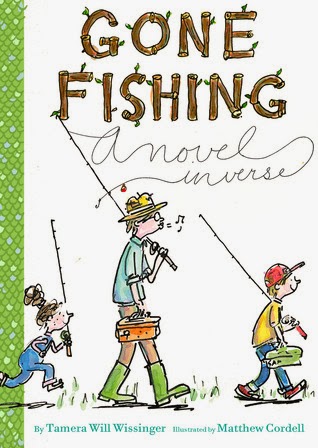
Gone Fishing: A Novel in Verse by Tamera Will Wissinger, illustrated by Matthew Cordell

Let's face it, Poetry isn't really a favorite of kids, nor is it something they get much of in school.  I am afraid I am even guilty of it myself.  I have reviewed at least 5 books on this blog and never added a poetry label, and only mentioned they were written in free verse (I will be correcting this oversight today!)  Yet, hey are all excellent novels that can be used to introduce kids to poetry.  And then there is the very amusing novel by Greg Pincus, The 14 Fibs of Gregory K, which has a boy protagonist who likes to write poetry, much like the author does.

Gone Fishing, Tamera Will Wissinger debut book, is a new work that can be added to the list of novels written in verse.  Sam, 9, is beyond excited because he and his dad are going to go fishing together, just the two of them, without Sam's little sister, Lucy.

To get ready, they dig up some night crawlers for bait, but when Sam pulls out his tackle, what a surprise - it is full of Lucy's toys. And he finds her playing pretend fishing with his precious fishing gear.

By early next morning, though, Sam is all set and up before the sun, but so is Lucy.  They get to the lake, get the boat in the water and Sam is ready for some serious fishing.  So is Lucy.  Sam likes it quiet so the fish don't get scared away, Lucy likes to lure the fish with a song and the first fish of the day is caught by….Lucy.

Sam is seething mad, Lucy is singing and fishing.  Sam. even tries Lucy's fish songs under his breath to lure a catch, but not luck.  He just sinks lower into his anger and annoyance, begrudging Lucy each fish that she catches even as his sibling rivalry rises to the top.  Sam is determined to catch a bigger fish.  The first big one gets away, but not the second.  Sam is proud, but to his surprise so is Lucy, who cheers for him:
"You caught one, Sam!"
Lucy scoots close to me.
"A big one, too!"
I nod, gulp.
I didn't even look
when she caught
her first fish.
But she
cheered for me.
Maybe I was wrong
about bringing her along.
Gone Fishing is really about coming to terms with sibling rivalry, something all brothers and sisters eventually (hopefully) go through, learning to accept the other as a person not a competitor, annoyance, things like that.  And it is charming to see how that begins to work out for Sam and Lucy.

Adding to the fun of the poetry are the colorful, whimsical illustrations done in pen, ink and watercolor by Matthew Cordell.

But wait, that's not all there is to Gone Fishing.

Each part of Sam's fishing day is told in its own poem.  Some of the poems are in Sam's voice, some in Lucy's and some in the Dad's, and sometimes a poems has all three voices in it.  Each poem is short, have much to say and are done in different poetic forms - odes, free verse, lyric, Lucy's fish song is a poem of address, to name a few.

At the end of the book, Wissinger has included a section called The Poet's Tackle Box.  Here, she explains the different poetry techniques used, all the different poetic forms she used and they difference between rhyme and rhythm.  It is an ideal book for introducing poetry in to young students, all the more so because the poems in Gone Fishing are about kids just like them and they could even make up their own similar poems.

Even if you aren't interested in poetry, you will have lots of fun reading Gone Fishing, a fun, playful novel in verse.

This book is recommended for readers age 6+
This book was borrowed from the NYPL

Monday, December 23, 2013

The Best Christmas Pageant Ever by Barbara Robinson

When I was a kid and I still went to Sunday School, I used to love Christmas pageant day.  There was something magical about performing the Christmas story late in the afternoon, in the semi-darkened sanctuary that made the holiday and all of it anticipation feel suddenly so exciting.

And when I picked up The Worst Best Christmas Pageant Ever again after all these years, that feeling returned to me - but only until I remembered the Herdman kids.  What was I thinking, I asked myself, when I promised to read this story to the kids this year?

The Herdmans are every teacher's nightmare - pranksters, cigar smokers, firebrands, just plain mean bullies and all still in elementary school.  There's Ralph, Imogene, Leroy, Claude, Ollie and Gladys - one for every grade.  It seems the Herdmans were everywhere with one exception Sunday School.

But, after Leroy began to steal our narrator's little brother Charlie's lunchbox dessert. he made the mistake of telling him that he didn't care, that they had all the refreshments they wanted every week at Sunday School.

So the next Sunday, there they were - all six Herdmans looking for refreshments and instead of scarfing up goodies, they ended up scarfing up all the best parts in the Christmas pageant.  See, our narrators mom had ended up with the responsibility of the pageant this year and didn't quite have the same business-like savvy as that of Mrs. George Anderson and her years of Christmas pageant experience.  But that worked to the Herdmans advantage.

When she realizes the Herdmans don't know why Christmas is important, well-meaning, gentle mom-turned-pageant director actually takes the time to read the Christmas story to them, managing to actually bring it home to them and unleashing a fascination about Herod (and not because they thought he was cool) that inspired them to go get library cards and read about him.

Slowly, and differently, the pageant comes together, to the anger and dismay some in the congregation who resented the Herdmans taking over and the pageant director not doing anything about it.  And yet, in the end the Herdmans, in their tough innocence, have something to teach everyone about the true meaning of Christmas and that is what makes this story such a nice book for the season.

Published in 1972, The Best Christmas Pageant Ever has held up remarkably well over the years.  Robinson has really capture the true spirit of the season in the Herdmans interpretation of the Christmas story - all the fear, the confusion, the anxiety and even the fear that Mary and Joseph must have actually felt.  And they understood the importance of what was happening, even if they thought the Wise Men brought dump gifts and replaced them with what they considered to be a more valuable, more cherished gift in the true spirit of giving - the ham the Herdmans were given as part of the charity basket they received from the church.

So take a step back from the hustle and bustle of holiday shopping and all its trappings and take a little time to read The Best Christmas Pageant Ever with your kids.  You might be very surprised at wheat they have to say about it.

This book is recommended for readers age 8+
This book was purchased for my personal library

Monday, November 4, 2013

The Year of Billy Miller by Kevin Henkes

Just before Billy Miller, 7, begins 2nd Grade, he gets a bump on his head.  This bump makes him a little anxious that perhaps he might have trouble with school, especially after he overhears his parents talking about it.  It didn't help matters that on that very first day, his dad reread the letter from his teacher that said 2nd grade would be "a wonderful, joyful, exciting challenge."  When he heard the world challenge, Billy really began to worry.  Then, to make matter worse, on the very first day he insults his teacher.

But wait, hadn't his dad told Billy on the way to school that this was "the year of Billy Miller?"  And so it is.  From his first humiliating moments on the first day of school, through to the end of the year, we journey with Billy as he grows in confidence, as he learns new and interesting things, and culminates is an wonderful poem to his mother, presented in the auditorium.

The Year of Billy Miller is a very gentle, funny, sad, and entertaining book about one kid trying to navigate himself successfully through school and life.  It is written with the characteristic Kevin Henkes simplicity but not in the least bit condescending and includes lots small,whimsical, marginalia-type drawings throughout.

But the question of who this book is for has come up again and again.  It looks and feels like a middle grade novel, but the character and story are too young to appeal to that age group.  It is definitely not a chapter book for beginning readers, which is what usually happens around 2nd Grade.  And although it reminds me and others of the Ramona books, it is really still too young for those 7-11 year old readers.  It also reminded me of Tomie dePaulo's 26 Fairmount Avenue series, but those are indeed chapter books for 7-10 year olds.

The way I see it is that The Year of Billy Miller is an episodic novel and for that reason, I think it is an ideal read-aloud book for 6 and 7 year olds, especially at bedtime, where a chapter a night can be manageably read, by or with an adult or older sibling.  And it is a perfect as a classroom read aloud, offering so many teachable moments, classroom activity possibilities and new vocabulary words to learn.  And what a wonderful book for a 1st Grade teacher to read at the end of the school year, helping to prepare his/her students as they are promoted into 2nd Grade.

I really enjoyed reading this compassionate story and I hope we get to meet Billy again, as he traverses 3rd, 4th and even 5th grade, growing and accomplishing each year, facing problems and anxieties that all kids have to deal with at that age.

This book is recommended for readers age 6+
This book was borrowed from the NYPL

Monday, September 16, 2013

What the Witch Left by Ruth Chew

One boring rainy afternoon, Katy and her friend Louise are hanging out in Katy's bedroom when Louise becomes curious about what is in the chest of drawers stored there.  The first three drawers yielded not really interesting, but the bottom, fourth drawer was locked and Katy, as explained to Louise, she was not allowed to open it.  The things in the bottom drawer belong to her mother's Aunt Martha, whom Katy has never met.  But, curiosity gets the best of the girls, and off they go off to fetch the key.

Inside they find a bunch of ordinary looking items - a mirror, a bathrobe, an old dented metal box with a fruitcake painted on it, a pair of boots and some flesh colored gloves.   But are they really ordinary?

When Katy put the gloves on, she notices that, oddly enough, she couldn't see them on her hands.  But before she had time to take them off and put them back in the draw, her piano teacher arrives.  Still wearing the gloves, Katy's piano playing goes better than usual, even her teacher is impressed.  Later, when Katy isn't wearing the gloves, her piano playing was just a bad as ever.  Likewise, without the gloves, Louise is just a girl who draws well, but when she wears the gloves, she becomes a masterful artist.

Concluding that the items in the drawer are truly magical, the best friends continue to be drawn to it, especially when they start getting perfect spelling tests while wearing the gloves.  All that sounds pretty good, but. needless to say, soon the gloves lead to all kinds of school problems for the girls, including pandemonium in the auditorium when Louse wears the bathrobe in a school play and all you can see of here is her head floating through the air.

Over Thanksgiving break, Katy and Louise decide to try out the boots.  Called Seven League Boots, the girls calculate that each step in these boots equals 21 miles.  So the girls decide to so south where it is warm for a day of swimming.  And sure enough, in no time they find themselves in Mexico, meeting a young girl named Pilar and her donkey.  Pilar and her grandmother weave place mats to sell in the market to tourists.  Wearing the magic gloves, Katy and Louise spend part of their day helping her weave her mats, and because Louise's artistic talents are enhanced by the gloves, she makes mats with an unusual design to them.

But when the girls return home to Brooklyn, they discover the gloves are missing and they must return to Mexico the next day.  They find the gloves and teach Pilar how to do the new place mat design, which have been a hit in the marketplace.

The girls have lots of adventures with the items in the bottom draw, until...well, you'll just have to read the book to find out.

I loved this slow-paced, magical story.  But, how could I not love a book that not only takes place in Brooklyn, but near Church Avenue, my old stomping ground.   I do, however, think What the Witch Left is a nice companion chapter book for kids who are just starting to get into Mary Pope Osborne's Magic Tree House series.   And, in a day and age when kids can't wait to read books like Harry Potter, it is a perfect introduction to books about magical worlds and fantasy and to spark the imaginations of young readers and prepare the way for the kind of magical world Harry lives in.

The story is well-written, and there are no real scary bits in it.  I did find that What the Witch Left held up very well over time, although I don't think children go out to play without supervision any more quite the way that they do in this book.  Given that the book was published about 40 years ago, it might be a nice book to read with a parent or grandparent who has fond memories of reading it when they were young.

One nice thing worth mentioning: the dustcover illustration has been redone for this new edition, but underneath the DJ is the original illustration from the 1973 edition of What the Witch Left, seen here


This book is recommended for readers age 7-10
This book was borrowed from the NYPL


Monday, January 7, 2013

Unspoken: A Story from the Underground Railroad by Henry Cole


"What would you do if you had the chance to help a person find freedom?" 

This is the question at the heart of Unspoken and it turns out to be a very thought-provoking question in this poignant, wordless story of a young girl during the Civil War and the runaway slave that she helps.

As she is bringing home the family cow to milk, the girl sees some Confederate soldiers passing by.  She continues to go about doing her chores, but when she is sent to the barn to fetch something, she senses she is not alone.

Indeed, there is an eye peering out of the corn crib.  Scared, she runs back to the house.  It is clear she is thinking about the person in the barn during dinner and later that night she sneaks back to the barn, bringing some food to the person hiding there.  She continues bringing more food.  One day, some bounty hunters show up looking for a runaway slave.  Her family knows nothing about the runway slave in the barn that the girl has been helping, but that night the little girl goes to warn him about the bounty hunters.  What she finds, however, isn't the runaway slave, but a gift he has made for her.

Unspoken is such a simple but powerful book.  Without using a single word, Cole captures the all the fear, hatred, and kindness in the actions of the characters that are associated with this period in American history.  The story is enhanced with Cole's detailed illustrations drawn in monochrome pencil on rough textured cream colored paper.

Perhaps what makes Unspoken so powerful is that it is rooted in old family stories that Cole listened to when he was a child, repeated by relatives who were the children of family members who lived through the Civil War.  I can easily believe that these stories would have a powerful effect on an artistic child later in life.

I also found that while the wordless story to be very effective in conveying so much emotion that words might not have been about to capture as well, I found the title to be particularly compelling.  That one word in the title expresses so much able the plight of runaway slaves.  One spoken word would mean, quite simply, a death sentence to the person running away to freedom.  That is a really chilling thought.

Unspoken is an incredible story of humanity and compassion.   There is so much to see and study on each page that can be used to spark dialogue, especially if used as a teaching tool for students learning about the Underground Railroad.

This book is recommended for readers age 4-8 by the publisher, but I think it would be better aged at 7+ given the subject matter.
This book was purchased for my personal library


Kid Lit Blog Hop

Saturday, December 22, 2012

Paula Danziger's Amber Brown is Tickled Pink by Bruce Coville and Elizabeth Levy

I have always had a soft spot for the Amber Brown series.  As a teacher, I watched one of my 4th graders go from not reading to devouring Amber's adventures, as well as other Paula Danziger novels.  I thought that Paula's sudden death in 2004 would be the end of Amber, and who knows what other charming novels she could have written had she lived.  But I was wrong, there would be at least one more Amber Brown book for kids to discover how much they like to read.  Paula's best friends Bruce Coville and Elizabeth Levy teamed up to give us Amber Brown is Tickled Pink.

But does it work?  Is Amber the same Amber she always was, dealing with her joys and sorrows as she learns some important life lessons in the same charmingly 'I, Amber Brown' way?

You bet it does and it is almost seamless.

And best of all, the whimsical illustrations by Tony Ross, who did the other Amber Brown books, are back, too and help to provide a nice sense of continuity

In Amber's latest adventure, her mother is about to get married to Max and Amber couldn't be happier.  Not only does she get to be "best child" at the wedding, but it means her best friend Justin and his family will be there all the way from Alabama, and her dad is seeing a counselor to help him move on with his life and get pass his bitterness over being divorced from Amber's mother.

But suddenly there is trouble in paradise.  Amber's mom is worried about money and wants to just go to City Hall to get married and punk on the reception.  Which means no Justin visiting and telling her friends Brandi and Kelly they are disinvited from the reception party.

To top it all off, Amber's dad is making very snarky remarks about the wedding and Max and causing this 9 year old a great deal of unhappiness, and almost ruining their perfect weekend together.

So who would have thought the a possible affordable solution for the wedding and reception would be found through her nose-picking classmate  Fredrich?  But even after Amber hatches what seems to be the perfect plan, can she pull it off?  And will she be able to get her dad in line, too?

Fans of Amber already know some of the trials and tribulations she has had to deal with over the course of the series and so many of them caused by the adults in her life.  Her best friend Justin's move to Alabama, her parents separation and divorce, her father's new job in Paris, and her mother's new boyfriend now fiancee.  And then there is school - homework, skunks, a girl who also has a two color name.

But these realistic situations told in a first person narrative are exactly the kinds of everyday issues that Amber's young readers are often also dealing with, and for some the stories may be just entertaining, but for others, they may bring moments of solace and solidarity, they way they did for my student.

And I, Alex Baugh, am happy to see Amber's return.

This book is recommended for readers age 7+
This book was obtained from the publisher.

Thursday, November 8, 2012

Too Tall Houses by Gianna Marino

Too Tall Houses is the story of how the good friendship between Rabbit and Owl is almost completely ruined when it turns into a ridiculous competition.  Rabbit and Owl have always lived in harmony: Rabbit liked to garden, Owl liked to look at his lovely view.  But when Rabbit's garden grows and grows so that it blocks Owl's view of the forest, instead of talking to Rabbit about it, Owl simply builds a higher  house.

And when Owl's new higher house blocks the sun that Rabbit's garden needs to grow, instead of talking to Owl and trying to work a compromise out, Rabbits builds his house higher.  And so the two former friends continue to out build each others houses, until, having built the tallest houses in the world, both Rabbit and Owl realize they no longer have the things they want and love: Rabbit can no longer carry water to his garden and Owl can no longer see the forest.

In fact, they are now so high up, all they have is wind blowing their house around until one day a strong enough gust comes along and not only knocks the houses down, but knocks some sense back into Rabbit and Owl.  Reconciled, the two friends decide to build one house together because they realized that "Alone they had nothing...but together they had everything they needed."

I have to be honest and say that animals acting like people aren't ususally my favorite kinds of stories, but when it comes to fables, they seem to be just the ticket for getting a message across in a very gentle, indirect, not preachy way.  And Too Tall Houses has an important message about friendship, competition and cooperation.  As their houses grow higher and higher, Rabbit and Owl grow further and further apart, physcially and emotionally.

I think Too Tall Houses is such a well done picture book.  It was written and illustrated by Gianna Marino, whose Meet Me at the Moon has always been a favorite of mine.  For illustrating Too Tall Houses, Marino has used a full bleed pencil and gouache method.  The colors are rich earthy tones and each illustration has a nice textured feel to it, giving the reader a real sense of nature.  As you read, be sure to look at the expressive eye of Rabbit and Owl on each page and how they change over the course of the story.  I also like the whimsical detailing in each illustration.  I always think illustrations are such a good way to get kids studying and talking about the story being read, making it interactive.

This book is recommended for readers age 3-6
This book was obtained from the publisher

NOVEMBER IS PICTURE BOOK MONTH

 
Imagination Designs