Showing posts with label Middle Grade/YA. Show all posts

Saturday, June 5, 2021

Fighting Words by Kimberly Brubaker Bradley

 SPOILER ALERT!!
Fighting Words 
by Kimberly Brubaker Bradley
Dial Books/Penguin BFYR, 2020, 272 pages

Trigger Warning: Sexual Abuse and Attempted Suicide

Life has not been easy for Della, 10, and her sister Suki, 17. They are both in foster care now that their mother is in prison for blowing up a hotel room cooking meth. Six years ago, they had been taken in by their mother's former boyfriend, Clifton, but he has now been arrested and is about to go on trial for child sexual abuse. Suki caught him attempting to sexually abuse Della and filmed what was going on while calling the police. Now, Della is expected to testify at Clifton's trial, but Suki insists that it must be filmed and not done in person. Their new foster mother, Francine, is an old hand at fostering kids and really seems to be on Suki and Della's side. Living with her is the closest to a normal life that they have ever experienced. There is enough food to eat and no one abuses them. They go to school regularly, although Della struggles with the work, but also makes friends with a girl named Nevaeh (heaven spelled backwards) and stands up to a boy in the class named Trevor who is always harassing the girls for wearing or not wearing a bra. 

And so it is in just such an atmosphere that Della begins to narrate their story, seemingly searching for something that she may have missed. Francine, who know exactly what has happened to the girls, keeps asking them if they want to talk to a counselor, but their case worker never follows through with that. Then, Suki attempts suicide, suffering from PTSD and unable to continue to be strong for herself and Della. As the pieces to what happened to Suki while living with Clifton begin to make sense to Della, she decides that she would rather testify in the courtroom at his trial instead of on a recording. She also finds the strength to report what Trevor has been doing to the girls in her class, right under the teacher's nose.  

Fighting Words ends well, but I think it needed a positive ending for it to be considered a middle grade novel. There is a lot of heavy stuff going on in Suki and Della's story, but Brubaker Bradley has included enough humor that it doesn't diminish the experiences of the sisters, but it sure is needed for some relief. I found Della to be a wonderful unreliable narrator (after all, she's only 10). And I was glad this didn't turned into an ugly foster care story. It's always encouraging to read about a positive foster care situation, and while Francine is a little rough around the edges, she is a real softy with her heart in the right place. 

I loved the irony of Della using the word "snow" whenever she was using "colorful language" and she did that a lot. I used to teach in the Bronx and Della's "snowy" language and defensive attitude reminded me of some of the kids I had in my classes, making her such an authentic character for me. I think Brubaker Bradley did a stellar job presenting Della and Suki's story, getting what happened across without being terrible graphic except for the one incident involving Della. But, in the end, I think this book needs trigger warnings - it is definitely not for every middle school reader. 

This book is recommended for readers age 10+

Wednesday, April 14, 2021

Beneath the Waves: Celebrating the Ocean Through Pictures, Poems, and Stories by Stephanie Warren Drimmer

 
Beneath the Waves: Celebrating the Ocean 
Through Pictures, Poems, and Stories
by Stephanie Warren Drimmer
National Geographic Kids, 2021, 192 pages

This year's Earth Day theme is "Restore the Earth" and what better place to begin than with the earth's oceans. After all, there is more ocean on earth than there is land, and unfortunately, it has become a dumping ground for a lot of man-made garbage, making it a good place to begin restoring. But before that, it would be good to get to know the oceans...and Beneath the Waves is the perfect place to begin. If you look at the Table of Contents you can see that it is a book chockablock with information accompanied by some wonderful poetry and many exquisite photographs.


The book begins with an explanation of the three ocean zones. There is the sunlit zone, the twilight zone, and the midnight zone and readers will learn that each one is a world unto itself. As you can see, the book is arranged in eleven chapters beginning at the ocean's edge and ending in the extreme ocean depths. The last chapter looks at People and Oceans.


Each chapter includes two-page spreads on each of the topics covered, and includes lots of relevant interesting factoids. For example, in On the Beach readers discover what a beach is and how those tiny grains of sand are created. There is also information on sea shells and all different kinds of beach living creatures, from crabs to turtles and beach birds (yes, there's many more than just seagulls waiting to snatch the ice cream right off your cone). 

Throughout the book, each chapter ends with a section called Sea Sleuths that looks at a topic relative to the chapter's subject matter. Why is the Sea Salty?, The Myth of Mermaids, The Myth of the Kraken, and The Search for Longitude are just some of what readers will marvel at. 


The next chapter, Between Two Worlds, looks at animals that live on both land and in the water. Here you will meet swimming lizards and creatures most of us are familiar with - seal and sea lions. Interesting factoid: do you know the difference between a seal and a seal lion? And that seals share their ancestry with dogs? There are also a wide variety of sea birds here, too. And in some parts of the world, there are crocodiles and even some fish that will leave the water and fly through the air. 

Chapter Three, Wading In, begins with a look at the different kinds of sea snails living in the ocean, and the variety of colorful boneless echinoderms or spiny creatures such as sand dollars and sea urchins. This is followed by a chapter on Reef Life, all about the different kinds of colorful coral reefs that flourish in the tropical parts of the ocean and the wide variety of marine species that dwell in these coral reefs.

Leaving the shallower waters, the next few chapter explore the deeper parts of the ocean. First up are Ocean Forests, what they are, for example, eel-grass, seaweed, and kelp. and who lives there, creatures like crabs, leafy sea dragons, octopuses, and the enemy of ocean forests, the spiny sea urchin and the enemy of the sea urchin, the otter, among others that readers will learn about. 

The next chapter introduces The Open Ocean, which covers more than half the earth and is more than two miles deep. This is the home to animals like the giant blue whale and the tiny plankton. In between, there are jelly fish, schools of different kinds of fish, sea creatures like the cuttlefish, which is really part of the mollusk family and not a fish at all. Like octopuses and squids, they have the ability to change their skin pattern, color and texture to blend into their surroundings and fool any hungry predators. And of course, the open ocean is home to sharks and dolphins.

Chapter Seven, On the Move, follows those ocean creatures that are either swimming in search of food or breeding grounds or hitching a ride on these distance swimmers. Readers learn about the journey of salmon, humpback whales, and leatherback sea turtles, as well as hitchhikers like seahorses and barnacles. There is also information on the many migrating sea birds.

In Life on the Icy Edge, readers heads to the north and south poles to learn about penguins, seals, walruses, polar bears, orcas and narwhals, and there is an informative 2 page Sea Sleuths spread called Arctic Experts, all about the Inuit, the indigenous people living there and who know the arctic better than anyone. 

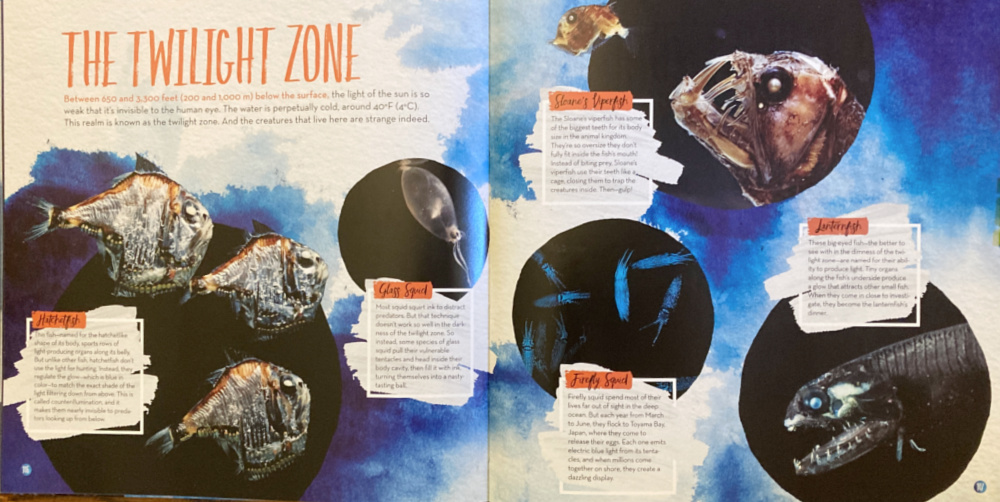
In the next chapter, Deep Down, readers enter the twilight zone, where sunlight no longer filters in and there is just blackness. Here there are some really strange sea creatures to discover, such as the hatchetfish, the Sloan's viper, and the lanternfish.


Chapter 10 brings readers into the Extreme Ocean, the least known place on earth. Here there are "mountains, geysers that spew superheated noxious water, and all kinds of living things that make these alien places their home." (pg 159) And this is where shipwrecks provide a home for all kinds of deep water species, like sear stars, crabs and fish.

Finally, Chapter 11 is about People and Oceans. This includes spreads on the history of ocean exploration, the importance of oceans, ways of protecting oceans and their occupants, and finally, how people have polluted our oceans and why I chose this book to highlight Earth Day 2021.


Beneath the Waves make the ocean sound like a pretty amazing place - beautiful, scary, powerful, busy, and necessary for sustaining life on earth. Thankfully, this book ends on a note of hope - "...success stories [that] show. when people step in to help, they can make a difference.' (pg 184)

Wondering what kids can do for Earth Day and every day after, and to help clean up and restore the ocean? You can find all kinds of activities and projects just right for youngsters at National Geographic Kids Celebrates Earth Day.

Or visit the official Earth Day website HERE

Meet the Author:                                                                                            Stephanie Warren Drimmer writes books and magazine stories for kids. She covers all topics weird and wonderful, including adorable animals, freaky brain experiments, and the hunt for new planets. She is a longtime contributor to National Geographic Kids magazine and has written many books for National Geographic kids, including Hey, Baby!, Mastermind, The Book of Heroines, Ultimate Secrets Revealed, and Ultimate Weatherpedia. Drimmer studied science journalism at New York University. You can find Stephanie on stephaniedrimmer.com, and on Twitter @Stephdrimmer 

This book is recommended for readers age 8+
This book was received from Media Masters Publicity in exchange for a review

Wednesday, March 11, 2020

Dare to Be You: Inspirational Advice for Girls on Finding Your Voice, Leading Fearlessly, and Making a Difference by Marianne Schnall


When I was growing up, at around 12-year-old I found an old book in the house that had belonged to an older cousin of mine. Since my older sister had also read the book, I figured I would, too. Basically, it was an advice book for teenagers that had been published in 1958 and, needless to say, I didn't get very far. Thinking about it today, I felt the message for girls was "keep your mouth shut, don't make waves and be a good girl for your husband."*

Sometimes it feels like things haven't progressed much from that way of thinking. And why wouldn't I think that? When my Kiddo was in school, she did a project where she kept track of the number of times teachers called on boys in relation to the number of times the same teachers called on girls. She also included the number of times both boys and girls raised their hands to either ask or answer a question. Boys beat out the girls on average 3 to 1. The subtle message to girls: your voice doesn't count.

Well, yes it does and here is a whole book packed with quotes from different successful, well-known women that will help girls remember that their voice is important. My personal favorite quote comes from Madeleine Albright, former Secretary of State under President Clinton:

"It took me quite a long time to develop a voice, and now that I have it, I am not going to be silent."
                                                                                                                                                  (pg 106)

But the book doesn't end at finding a voice, there are also inspiration quotes about the importance of having an authentic voice, as Speaker of the House Nancy Pelosi says:

"Be your authentic self. Authenticity is everything. Think of what you have to offer and how unique that is." (pg 64)

This book contains quotes from a lot of different women in a lot of different fields: politics, sports, acting, diplomats, journalists, and more and you can find short biographies at the end of the book on each one of them.

I wondered what a girl around 12 would think about this book, and gave it to one of my neighbors daughters. She read it, passed on to a friend, who passed it on to another friend. It was a well-read book by the time I got it back, with unlinings and marginalia. Their verdict: not all the quotes appealed to all the girls, but each one had a wide variety of favorites, which is basically how I felt about it, too.

March is Women's History Month and a great time to read this book. It is the kind of book young readers will probably return to again and again.

This book is recommended for readers age 9+
This book was an ARC sent to me by the publisher, Tiller Press, an imprint of Simon & Schuster

* The book I almost read was called 'Twixt Twelve and Twenty by Pat Boone

Wednesday, July 3, 2019

Nate Expectations (Better Nate Than Ever #3) by Tim Federle


So after running away from home to audition for E.T.: The Musical in NYC and landing a part in it, the sad news that the show is closing because it didn't get even a single Tony nomination has Nate Foster, now 14, saying goodbye to Broadway, his kinda sorta boyfriend Jordan, and his NYC guardian Aunt Heidi, and heading back to Jankburg, PA and a new high school.

But at least best friend Libby is there and happy to have Nate home again. And to his surprise, Nate isn't the target for bullies that he had been in middle school. Being on Broadway has given him some notoriety and, except for one homophobic name calling, the kids are pretty open and curious about his experience. Too bad the school has cancelled all "arts" classes, tearing down the auditorium to make a lacrosse field.

But that doesn't stop Nate from deciding to be creative for his English teacher, Mr. English, and planning a musical based on Charles Dickens' Great Expectations for his big English project (LOL - I read this my freshman year, too). With Libby's help, posters are made for auditions and lots of kids actually show up. The part of Miss Havisham is promised to shy Paige, the gym coach's niece in exchange for using the gym for the only performance of the Nate's musical.

Nate really throws himself into his production, while trying to keep up a long distance relationship with Jordan, who is part of the cast of a television show. At the same time, Nate meet Ben Mendoza, Mr. English's secret star student. Ben shows up at Nate's auditions, but doesn't want a part, just hangs around, filming stuff on his phone.

To make a musical requires music, so Nate and Libby decide to use some of Mr. English's favorite songs for the cast to lip-sync, song by people like Joni Mitchell, Elvis, Simon and Garfunkel. And it looks like Nate's musical version of Great Expectations is going to happen. And when Ben films the final dress rehearsal and posts it online, it gets so many hits, even Jordan in NYC watches it. Unfortunately, so do some lawyers representing the music Nate plans to use - and sure, he can continue to use those songs by those famous musicians for a mere $25,000 per song. Why? Because a ticket to the musical version of Great Expectations in the gym costs $5.00 and as any blogger knows, if you are making money, you gotta pay for what you use if it belongs to someone else.

It looks like Nate's show won't go on - or will it?

I was actually hoping Federle would write a third Nate book because between Better Nate than Ever and Five, Six, Seven, Nate! I just didn't feel as though Nate's story was over. So I was really happy to see Nate Expectations. Sure, he had a crush on Jordan and there was some kissing backstage, but Nate hadn't officially come out as gay by the time he returns home to Jankburg (well, except to Libby). But that part of Nate's journey is part of the focus in Nate Expectations and Federle does a great job of presenting it. And even though the tackles Nate's coming out, and even though he's a freshman in high school, this is still very much an upper middle grade fiction.

Nate again narrates his story, told in usual first person stream of consciousness that has all the energy, humor and snarkiness of a 14 year old, which can be a lot. I really liked the inclusion of Ben in this book because he's a much nicer kid and a lot more funk than self-centered Jordan. Nate and Ben both come from homes with some parental problems and hit it off almost immediately.  I almost wish there were a book about Ben, too, cause I would love to know his whole story.

I don't usually comment on book covers but I was really disappointed by the cover of this book compared to the first two:
Really?
I love theater and I've been going to see shows on and off broadway since I was in elementary school, so I really enjoyed reading this whole series, even when some of it was funny but a little far-fetched. And I could accept that - after all, Broadway is magical. So if your middle grade readers are looking for an entertaining trilogy this summer, you can't go wrong with the Nate books, especially if they are theater-struck the way Nate and Libby are.

This book is recommended for readers age 11+
This book was an EARC received from EdelweissPlus

Friday, August 24, 2018

Copyboy by Vince Vawter


I was very excited to see that Vince Vawter had written a sequel to his book Paperboy. Victor Vollmer was such an endearing character and I've often thought about him since reading that book.

Now, six years have passed since the then 11-year-old Vic met Mr. Spiro while temporarily taking over his friend Rat's newspaper route for a month. Back then, the very well read and very well traveled Mr. Spiro became a true friend to Vic, patiently helping him understand the world a little better and offering ways to help him manage his stutter, and the two remained friends.

Now, it's the summer of 1965, Vic is 17, working a summer job at the local newspaper as a copyboy, and getting ready to begin college. Sadly, Mr. Spiro has recently passed away, a loss Vic doesn't really want to deal with. But he has been left one last request by Mr. Spiro - to scatter his ashes at the mouth of the Mississippi River.

Against his parents wishes, Vic decides to drive alone from Memphis to New Orleans, armed with the name of the sports editor at the Times-Picayune, a road map, the cash from his last 3 paychecks, and, of course, Mr. Spiro's ashes. He leaves early one the morning, after writing a note for his parents explaining his plan.

In New Orleans, Vic is introduced to a whole new world of people and experiences. Editor Ray Patton is more than happy to help Vic, taking him home to his houseboat for the night. There, Vic also meets Adrienne, Ray's Cajun girlfriend. After helping Vic understand a little about the Mississippi and the Gulf of Mexico, he puts him in touch with people who really understand those waterways, sending him off to Venice, Louisiana - Fishing Capital of the World - and his friend Captain Henri Moreau, a lifelong river man.

In Venice, Vic meets the Moreau family as they are getting ready to celebrate Captain Moreau's birthday and everyone is pitching in for the fais do-do. Vic is welcomed with open arms and immediately put to work, but it is the very independent Philomene "Phil" Moreau, 18, who really takes charge of him, introducing him to her Cajun world of people who make their living fishing, including a somewhat dangerous ex-boyfriend. Phil loves everything about river life and wants to follow in there father's footsteps.

Reports of a tropical storm had followed Vic from Memphis to the Gulf Coast, but even when it was upgraded to a hurricane, it was expected to stay on the eastern side of Florida. So when Hurricane Betsy suddenly shifts course and heads straight for Gulf Coast, everything changes as people prepare to flee.   

I loved Paperboy and wondered if Copyboy, with its six year difference, would measure up. I am happy to say that yes, it does and does not disappoint. Copyboy is written in the same quiet, gentle style that was so appealing and so spot on for relating Victor's story in the first book. Now, Vic is older, but not really very worldly-wise. Because of his stutter, he has lived rather sheltered life, and his parents still treat him like a child. Vic's stutter isn't as much of a problem in this novel. The people he meets just accept it as part of who he is. For his part, Vic, who already loves words and language, finds their Cajun English new and different and wonderful.

Interestingly, it is Ray who suggests to Vic that perhaps Mr. Spiro had tasked him with spreading his ashes at the mouth of the Mississippi is a last parting gift, and it is an idea that Vic continues to think about. By sending Vic on a quest to find the mouth of the Mississippi River and scatter his ashes, Mr. Spiro knew that he was sending him an a new adventure, even if he couldn't envision what that adventure would hold for Vic. From eating raw oysters in a Bourbon Street bar with Ray to his first kiss, Vic experiences an independence in life he's never had before, and yet, he never loses sight of the purpose for his trip.

Copyboy is a compelling coming of age quest story that readers surely won't soon forget. Sure, Vic's journey had plenty of setbacks and some adversaries, but he ultimately figures what Mr. Spiro has been trying to help him understand - how to have a life well-lived.

A word about who this book is for. Paperboy was clearly a middle grade novel, but in Copyboy Vic is 17, and he really hasn't yet had the range of experience most 17-year-old have. He always been introverted and self-conscious about his stutter, and his parents made sure he had a somewhat sheltered life, which has left him slightly more immature than most kids his age. My feeling, therefore, is that this really isn't a strictly YA novel, but one that older middle grade readers will also enjoy reading it. And if you haven't yet read Paperboy, no problem. This is a fine stand alone novel.

You can download a new Discussion Guide for this book HERE

This book is recommended for readers age 11+
This book was an EARC received from NetGalley

Monday, November 13, 2017

Sea Girl: Feminist Folktales from Around the World, edited by Ethel Johnston Phelps, illustrated by Suki Boynton


In his introduction to Sea Girl, author Daniel José Older writes that we need a new mythology, a new mythology that catches all the myths, folktales, and other narratives of women’s empowerment that have fallen through the cracks of history or just weren’t “marketable” enough for Disney. Older should know what he’s talking about. After all, he’s given us Sierra Santiago, hero of Older’s books Shadowshaper and Shadowhouse Fall. And now, the Feminist Press has reissued its series of feminist folktales from around the world in four volumes.

Edited by the late Ethel Johnston Phelps, who held a master’s degree in Medieval literature, Sea Girl is volume III in the series and it includes 10 fairy and folktales based on stories that have been handed down for generations. 

For instance, there is a changeling tale from Ireland about a single mother whose healthy child is taken by the fairy folk and replaced with a sickly child of theirs. Determined to get her own child back, she cares for the sickly child and brings it back to health and on May Eve, she confronts the Queen of the fairy folk, who had taken her son. The single mother is resourceful and brave in this tale, and confronting the fairy Queen takes a certain kind of courage, even the Queen admits that. But now that her own son is a healthy, robust little boy, will the fairy Queen be willing to exchange babies, so each goes with its own mother, or will be decide to keep both?

I’m a medievalist at heart, so naturally I found the English tale about Sir Gawain and the Lady Ragnell very appealing. Older that even Geoffrey Chaucer’s Canterbury Tales (published in1476). In this story, Sir Gawain is given one year to answer a question posed by Sir Gromer, who is looking to avenge the loss of his lands to Arthur. The question: What is it that women most desire, above all else? The answer and end of the tale will really surprise you. 

In the Norwegian tale, “East of the Sun, West of the Moon,” a large white bear falls in love with a woodcutter’s daughter. Though the woodcutter refuses to let his daughter go live with the bear in his castle, the daughter isn’t afraid and agrees to go with him. She notices that night after night, someone comes into her room and lays down next to her. Curious, she discovers a handsome young man, who it turns out has been cursed by trolls. By day, he is a large bear, by night, a handsome man. The man and castle immediately disappear, and the lass finds herself sitting in the forest. Determined to break the enchantment, she decides to travel to the Land of the Trolls and find the young man. But first she must get to the castle that lay East of the Sun and West of the Moon with the help of the North Wind. But will she arrive in time to save him from his fate in the Land of the Trolls?

There are also tales from China (“Wild Goose Lake” - a wonderful tale about the titular Sea Girl), Finland (“The Maid of the North”), and a Punjabi tale (“he Tiger and the Jackal”), as well as an ancient Swahili fairy tale (“The Monkey’s Heart”), and one from Germany (“The Twelve Huntsmen”).  And though the tales vary greatly, they have one thing in common - here are women who, through their own wits and common sense, determine their own fate, one way or the other.

The beauty of folktales is that they root us not just in our own culture, but in the world at large, providing examples of women's courage and resourcefulness in the face of great odds. And they can be enjoyed again and again.

If Sea Girl sounds like a book you would like to read, you might want to check out the other three companion volumes of Feminist Folktales from Around the World:
Tatterhood - introduced by Gayle Forman
Kamala - introduced by Kate Schatz
The Hunter Maiden - introduced by Renée Watson

This book is recommended for readers age 9+
This book was sent to me by the publisher, Feminist Press of the City University of New York

Monday, June 19, 2017

Flying Lessons & Other Stories, edited by Ellen Oh


In this anthology, Ellen Oh presents 10 short stories, all written by authors whose work we already know and admire for their honesty and integrity, not to mention their talent, and for their belief in the We Need Diverse Books movement Oh began just a few years ago in response to the underwhelming number of books by diverse authors that are being published. 

The title of the anthology, Flying Lessons, comes from the story by Soman Chainani, author of the School for Good and Evil series, by the same name. A shy young Indian boy is traveling through Europe with his grandmother, a rather colorful women who insists on wearing a couture dress, red stiletto heels and a white fur coat to the beach after outfitting her grandson, Santosh, in a tiny striped Speedo. She has other things to do, so she deposits Santosh on a nude beach with the admonishment “make friends.” Santosh finds himself drawn to a boy about his own age, not sure why he finds him so attractive. But Santosh’s Nani may just understand him better than he understands himself. She is like a (grand)mother bird teaching her young that he is meant to soar, to be who and what he is by nature, and the European trip is her flying lesson.

And so it is with all the stories in this anthology - each story features a young main character who has stood on the margins of society until they come into their own and take off. For instance, in Matt de la Peña’s “How to Transform an Everyday, Ordinary Hoop Court into a Place of Higher Learning and You at the Podium,” a smart 8th grader knows what to expect when he decides to play basketball with the best at Muni Gym during summer vacation- to be told that he’s too young, too light, too short, too skinny, too Mexican. At the end of summer, he definitely does leave his mark on the basketball court, but what he learns off the court is the most important lesson of all.

In “The Difficult Path,” Grace Lin takes the reader to long ago China, where Mrs. Li promises to educate the female child, Lingsi, she has just bought. Though a servant to the family, Lingsi turns out to be a formidable student, unlike Mrs. Li’s lazy, uninterested son FuDing. Eventually, when no one will marry FuDing, it is decided that Lingsi will be his bride. But fate has another path for Lingsi - and all because she can read - and what a path it is.

The last story in this collection is called “Sometimes a Dream Needs a Push” by Walter Dean Myers. Chris knows his father’s dream was for him to become an athlete and follow in his footsteps onto the basketball court. And although an auto accident has left Chris in a wheelchair, it does not keep him off the court. Chris plays in a wheelchair league, but his dad seems to have trouble accepting it. When his dad must take him to a game, things change. Slowly, a dream comes true - but whose dream?

As a rule, I’m not a big fan of short stories. I like the depth and meatiness of a novel. Besides, when a collection of stories is put together, it’s a sure bet that not of them are going to be good. But, Flying Lessons sounded just too good to pass up. After all, some of my favorite authors have contributed to this anthology and, to a teacher like myself, I know how important their diverse characters and variety of themes are for  the young readers who, after all, will shape the future. And I wasn’t disappointed reading Flying Lessons - the stories have  substance, the characters are well developed and the themes are universal, and each one is unique. 

There is a short biography of each author at the end of the book, plus a short history of why and how the We Need Diverse Books (WNDB) movement began written by its founder and editor of this anthology, Ellen Oh. After reading it, you may want to refresh your reading of Walter Dean Myer’s New York Times article “Where Are the People of Color in Children’s Books?” written shortly before his death, an article which he ends with the exhortation "There is work to be done." And finally, publishers are beginning to listen to that.

The stories in Flying Lessons are aimed at middle grade readers, but could certainly be read and enjoyed by high school kids and adults.

This book is recommended for readers age 9+
This book was an EARC received from NetGalley

Wednesday, November 23, 2016

Ashes (Seeds of America Trilogy - Book 3) by Laurie Halse Anderson


Ashes continues the story of Isabel and Curzon begun in Chains and continued in Forge, picking up the threads of their story 3 years later, beginning on June 25, 1781, and ending on November 5, 1781.  And while Chains was told from Isabel's point of view, and Forge was told from Curzon's point of view, in Ashes the story is again narrated by Isabel.

Three years have gone by since Isabel and Curzon escaped from Valley Forge and their enslavement by the cruel, sadistic Mister Bellingham. Now, as runaway slaves, they have already walked nearly 1,000 miles from Pennsylvania to Virginia to South Carolina in search of Isabel's younger, epileptic sister, Ruth, and dodging British and Continental patrols, armed Loyalists and bounty hunters along the way.

But when they finally find Ruth, Isabel doesn't get the reception she had been hoping for. Instead, Ruth is cold and won't even look at her sister.  She has been living with an elderly slave couple and a young boy named Aberdeen since being sent south in 1776. Though the couple love Ruth as if she were their own daughter, they tell her to go north with her sister and to do what she says. Ruth may be obedient to her sister's requests, but she still wants nothing to do with Isabel, refusing to even look at her, much to Isabel's disappointment.

Meanwhile, Curzon's loyalty is still with the Patriots, while Isabel feels that neither the British nor the Patriots will help enslaved people like themselves achieve freedom, no matter what they promise. The two argue about this endlessly, so when Curzon, Isabel, Ruth and Aberdeen meet up with the Continental Army at Williamsburg, Va, they decide to go their separate ways. Aberdeen chooses to work as a spy for the British, Curzon rejoins the Patriot army, and the two sisters find work in a laundry run by Widow Hallahan. With a promise to be paid money, Isabel also finds work washing up and later serving in a tavern owned by Widow Hallahan's son and frequented by the Americans and French. But once the armies move on the Yorktown, Isabel wonders what will happen. It doesn't take long to find out. Isabel rightly suspects that Widow Hallahan has plans for Ruth that don't include Isabel - shades of Mrs. Lockton's treachery in Chains that originally separated the two sisters.  Isabel quickly decides that it is time to leave, and the sisters make a daring exit from Williamsburg, following the armies to Yorktown, VA and finding work as cooks.

Though Isabel finds herself in the midst of the war, this last book in the trilogy is really about her, with the chaos and confusion of the war mirroring her thoughts and feelings about her and Ruth, and what the future will hold for them, and the place Curzon may or may not have in it. Isabel and Curzon have now known each other since she was 12 and he was 15. He is the only person she has ever really trusted, but as the war carries on around them, Isabel sees less and less of him, even as she thinks more and more about him. It takes a long time for Isabel to realize that Curzon can love her at the same time that he loves his country and he is willing for fight for both of them.

Laurie Halse Anderson has explored so many aspects of the Revolutionary War in her Seeds of America Trilogy that are not a part of the usual school curriculum.  And she has brilliantly woven them into the story of these young enslaved people who only want their freedom, paralleling their stories with that of the Patriots who are fighting for their freedom and independence from Britain. She offers readers a vibrant history of a war that we traditionally think of in terms of white soldiers and leaders being fought for white colonists, forgetting or not even knowing that there were many African American soldiers who also fought, generally in place of their owners, in the hope of gaining their freedom after the war is over, soldiers like Curzon; and girls like Isabel, who were charged with helping to care of the leaders of the war with no real hope of future freedom.

Ashes ends with the surrender of the British and the end of the war.  And for readers it is the end of Isabel and Curzon's stories, but Anderson offers us a hopeful conclusion to her Seeds of America trilogy, though there are no tidy answers about the future for Isabel, Curson, Ruth and Aberdeen. They must still head north, they are still considered to be runaway slaves, and there are still bounty hunters after them.

Chains, Forge, and Ashes are individually and as a trilogy so well-crafted that it takes my breath away when I think about it. They are honest, thought provoking, gripping adventure as they narrate the sensitive personal stories about people who traditionally have not had voice at that time. By giving Isabel and Curzon a voice, Anderson has opened our eyes to really thinking differently about the history of this country.

Be sure not to miss the extensive appendix at the end of the book which offers explanations and suggestions for further reading about many of the people, places and events included in Ashes.

I cannot recommend Chains, Forge, and Ashes highly enough.

This book is recommended for readers age 10+
This book was an EARC received from Edelweiss/Above the Treeline

Monday, November 14, 2016

Forge (Seeds of America Trilogy - Book 2) by Laurie Halse Anderson


Forge continues the story of Isabel and Curzon begun in Chains, picking up the threads of it almost 10 months later, beginning on October 7, 1777 and ending on May 18, 1778. And while Chains was told from Isabel's point of view, in Forge it switches to Curzon's voice.

Isabel and Curzon have gone their separate ways.  Isabel has run away, determined to find her sister Ruth while Curzon finds himself first in the midst of the Battle of Saratoga after saving the life of a Patriot soldier name Eben Woodruff of the Sixteenth Massachusetts Regiment and nephew of the regiment's commanding officer. From Saratoga it was on to the winter encampment at Valley Forge. Curzon enlists in the army in the hope of gaining his freedom and in the process, besides Eben, he makes a few other friends and a few enemies.

Valley Forge proves to be a real challenge.  There are no barracks, so they are ordered to built huts that are always cold and leaky, many of the soldiers don't even have shoes anymore, and must stand in the cold snow in bare frostbitten feet, many are ill with disease and every one is cold and hungry all the time, desperate for food, warm clothing and shoes that never seem to arrive.  And for Curson, because he is African American, it also meaning dealing with constant racism.

Isabel and Curzon may have gone their separate ways, but he never stops thinking about her.  Nor has Curzon forgotten his former master, the cruel, sadistic James Bellingham.  In Chains, Bellingham had enlisted Curzon to take his place in the army with the promise of his freedom after the war, a promise he has no intention of honoring.  When he shows up at Valley Forge, Curzon finds himself again in his clutches, having enlisted again as a free man when he was still owned by Bellingham. And to real surprise, after arriving at the house where Bellingham is staying, he finds that Isabel has also there, as well as another slave, Gideon, who refuses to even acknowledge Curzon. To keep Isabel in her place and, Bellingham has placed an iron ring around her neck as a constant reminded of her enslavement, and only he has the key to unlock it.

Curzon begins plans to escape Bellingham again, and tries to talk Isabel into going with him, but she seems more interested in Gideon now, and eventually reveals that they have their own plans to escape.  But Curzon doesn't trust Gideon, and it turns out, with good reason. When the truth about Gideon is discovered, will Curzon and Isabel be able to mend their friendship enough to attempt escape from Bellingham?

Like Chains, Forge never lets the reader forget the irony of African Americans fighting for the freedom of the country that has enslaved them, perhaps expressed best by Curzon's friend and fellow soldier Eben Woodruff who tells him "Two slaves running away from their rightful master is not the same as America wanting to be free of England." (pg 65) And Laurie Halse Anderson explores this irony in the attitudes and beliefs of a variety of different characters, American and British, rich and poor, as they impact the lives of Curzon and Isabel.

Isabel was such a compelling narrator in Chains, and I found that to be true of Curzon in Forge. By switching narrators, Anderson presents the harsh conditions on the battlefield and as well as in a house with a white man is a harsh master over his enslaved servants. I have to be honest and say that what happens on battlefields isn't something I am generally interested in, yet I found I couldn't put this down and have a better understanding of what the Patriot soldiers experienced than I ever did when we studied the Revolutionary War in school.

Just as she did in Chains, Anderson has included quotes at the beginning of each chapter, so taken from original sources and adding to the authenticity of the novel.  She also includes the dates during which each chapter occurs.  This kind of timeline approach also helps situate the reader in terms of what was actually happening in the Revolution.

Forge is a wonderful sequel to Chains, but it is also a novel that can stand alone.  And as I did with the first novel, I cannot recommend this highly enough.

Laurie Halse Anderson has excellent teaching resources for Forge.  You can find it HERE

This book is recommended for readers age 9+
This book was purchased for my personal library

Monday, November 7, 2016

Chains (Seeds of America Trilogy - Book 1) by Laurie Halse Anderson


Much of this review was posted on my other blog, The Children's War, as part of a Revolutionary War Reading Challenge a few years ago.  

Chains is the story of a young slave girl who yearns for freedom.  It takes place during the American Revolution and he time period covered in this first book of a trilogy is May 27, 1776 to January 19, 1777.  

Living in Rhode Island, Isabel, 13, and her younger sister Ruth are quickly sold by a greedy nephew for the money they will bring after their somewhat benevolent owner, Miss Fitch, passes away.  But Miss Fitch had promised them freedom after her death and Isabel can't get that promise out of her head. And unlike most slaves at the time, Isabel knows how to read. 

Now, as the American Revolution begins, the sisters find themselves in a Loyalist household in New York City at the mercy of a cruel mistress, Mrs. Lockton.  The Locktons, who believe their bread is buttered on the side of the Loyalists and King George III, despise the Patriots who want independence from them and everything they stand for.

It isn't long before Isabel meets Curzon, a young slave working for the Patriots, and known for the red tricorn hat he is always seen wearing.  Curzon convinces Isabel to spy on Mr. Lockton, and report anything she hears that might be useful to the Patriots.  Isabel isn't very enthusiastic about doing this, but when she is given the devastating news that Mrs. Lockton has sold Ruth, she changes her mind.  It had just been discovered that Ruth suffers from seizures and the very ignorant, superstitious Mrs. Lockton believes that they are a sign that the devil is in Ruth.

Curson proves to be a good friend to Isabel, although she has very mixed feelings about him, the war between the Patriots and the Loyalists and which side would be most beneficial to her in terms of getting her freedom. 

As the war heats up, so does Isabel's determination to find her sister and, as she is told by an elderly slave known as Grandfather, to find the way to cross her own River Jordan* to freedom.

Chains is written in the first person, so we always know exactly what is going on in Isabel's mind, how she perceives everything around her and, most poignantly, how she feels about the things that happen to her.  But by spying on Mr. Lockton and his friends, we are also given a certain amount of insight into the Loyalist side of things. 

Isabel is a very strong willed girl and Mrs. Lockton knows it and is determined to break that will and so she is constantly trying to tighten the chains of slavery that bind Isabel.  Yet, it takes a while for the realization that Mrs. Lockton cannot chain her soul to really sink in to Isabel's consciousness, even though all her actions had always already proven it to be true.  Her strength in the face of Mrs. Lockton, her wavering between the Patriots and the Loyalists, her determination and her innate sense of kindness despite everything all make Isabel such an exemplary protagonist. 

In fact, Anderson has created a whole cast of characters in Chains who play their parts to perfection.  Set against the backdrop of New York City,  Anderson has written a brilliantly crafted novel in which the fictional walk through the historical and it is spot on.  Anderson has even turned New York into a character in its own right, by staying true to the history of the time (NB: I used to teach New York history to my 4th graders and it was my favorite thing to teach).

One of the things I really liked about Chains were the quotes used at the beginning of each chapter. These quotes are from actual sources of the time that help situate the reader and gives the novel a real feeling of authenticity.

I don't think I could possibly recommend this book highly enough.

Laurie Halse Anderson has excellent teaching resources for Chains, including a section on how to put on a colonial tea (with some really good recipes).  You can find it HERE

This book is recommended for readers aged 10+
This book was purchased for my personal library

*I was talking to a friend about Chains and she said she didn't get the River Jordan reference, which is a reference to God's command that after the death of Moses, Joshua would lead the Israelites out of slavery in Egypt to freedom in the promised land by crossing the River Jordan.
 
Imagination Designs