Showing posts with label Mother/Daughter. Show all posts

Wednesday, November 4, 2020

Some Days written and illustrated by María Wernicke


This has been a year of loss for so many people, but for children who have lost a parent, it is an especially devastating loss. It may be hard for them to understand fully what has happened, and often wishful thinking can easily move into their thoughts. María Wernicke has used very sparse text supported by spare illustrations to capture the emotional feelings and wishes of one young girl dealing with loss and how her mother responds to her pain. 

Some Days written and illustrated by María Wernicke,
translated by Lawrence Schimel
Amazon Crossing Kids, 2020, 48 pages 

After finishing a meal, a young girl begins telling her mother about a passageway in their backyard. As the two head out to hang up some freshly washed red sheets, the child explains that some days, it's there, other days, it isn't, but she makes it clear that this isn't some kind of fantasy passageway - it's not a well, a hollow in a tree and there is no door that leads to fantastic adventures.  

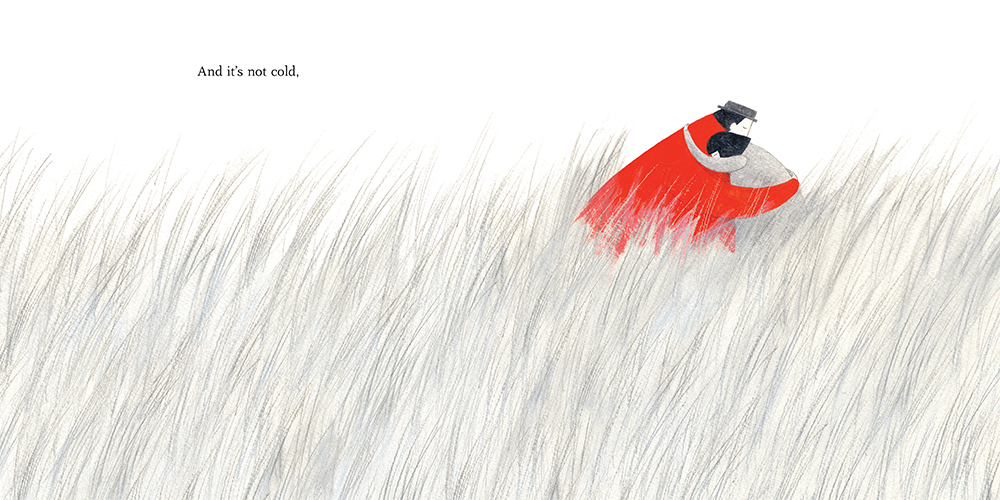
On the other side of the passageway, life is different. The child plays with an unknown man, presumably her father. There, in his presence, "I've already learned how to swim./ And it's not cold,/ and there's no danger./ And nothing, nothing at all, can can happen to you." Yearning for the safe and comforting arms of this man, the little girl wishes that passageway could be there everyday.

After listening to her child tell her about this passageway and what she finds there, her understanding mother tells her daughter that they can always go looking for it together, even if they don't always see it.


Without saying it, but relying on the illustrations, it is clear the this little girl and her mother have just lost their father and husband, indicated only by their grief and the pork pie that plays an important but subtle part of the narrative. There is an interesting use of color throughout the story. The parts of the story that revolves around the girl and her mother are done in shades of gray, reflecting the somber mood of mourning and grief, with the exception of the sheets being hung on the line which serve as the portal to the other side of the passageway. On the other side, the girl is still dressed in gray, but the unnamed man is done in a bold, bright red coat, letting the reader know that he is still very much alive in his daughter's mind, even as she grieves.

This is a gentle, solemn, very poignant story about a child dealing with loss and missing all the things that might have been had the loved one not passed away. But it is also a story that carries a great deal of hope and love and a promise of a future that also includes the memories of the past. This is the kind of book I wish I'd had when my Kiddo's dad suddenly passed away when she was young. It is the kind of book that will start needed conversations. I highly recommend it.

Meet the Author:

María Wernicke is an award-winning Argentinian author and illustrator of children’s books. She is a 2020 Astrid Lindgren Memorial Award nominee. Her illustrations have been part of multiple international exhibits, including at the Bratislava Biennial exhibition and the Bologna Children’s Book Fair, among others. Learn more about the author at www.maria wernicke.blogspot.com.

On Instagram: @wernicke_maria


Meet the Translator:

Lawrence Schimel is a bilingual author and translator, with more than one hundred books to his credit. His children’s books have won a Crystal Kite Award from the Society of Children’s Book Writers and Illustrators, and have been selected for lists of outstanding titles by the International Board on Books for Young People. His translated books include Wanda Gàg’s Millions of Cats and George Takei’s graphic novel They Called Us Enemy, among many others. He lives in Madrid, Spain.


Read the Reviews:

★“A gentle model for living while missing a loved one.” —Kirkus Reviews (starred review)


“This brief, wistful exchange between a mother and her child delivers its emotion between the lines, and Schimel’s translation handles the understatement deftly…Wernicke shows the two twirled up in another set of sheets, looking for the passageway together, in this portrait of a parent who hears and honors her child’s words.” —Publishers Weekly


This book is recommended for readers age 5+
This book was gratefully received from Barbara Fisch at Blue Slip Media

Monday, August 17, 2020

Summer and July by Paul Mosier


It's July 1st and Goth girl Julliet, 12, is on a plane with her mother traveling from Michigan to Ocean Park, California, where her mom, a doctor, will be working in an ER. Julliet's parents are divorced, and her dad is in Switzerland with his new younger girlfriend. Julliet is also a girl who is fraught with fears, all shared with her best friend Fern, whom she is forbidden to hang out with after a misunderstanding. 
On her first morning, Julliet finds a note from her mom listing possible goals for her, including exercise, fresh air and work on her fears. Later, she meets Summer, an energetic surfer girl who wants to be friends. At first reluctant, Julliet, whom Summer insists on calling "Betty," slowly begins to warm up to Summer, and Summer for her part, patiently puts up with Julliet fears, while slowly, and even more patiently helping her deal with them. 

At first, they simply walk around town, checking out stores and just hanging out. Summer, who lives year round in Ocean Park knows everyone. Like Julliet, she's mostly on her own because her parents both work. Eventually, Summer gets Julliet to go to the beach and into the water, introducing her to surfing culture. Always at her side when Julliet confronts a fear, the two begin with skateboarding at the beach, then graduate to boogie boarding, all the while continuing to pal around, visiting to Santa Monica pier, and just having fun. But once in a while, Summer isn't available and Julliet wonders why. It seems Summer has a secret and isn't ready to share it with Julliet, at least not until Julliet is ready to finally try surfing. 

I don't think I've read a good surfing book since I found my sister's old copy of Gidget in the late 70s. So surfing culture isn't exactly something I'm up on. But I am a girl who spent summers on the Jersey shore, and I do love the ocean, and enjoyed reading a book that is set in an ocean community. In fact, the setting in Summer and July is so realistic, I could practically feel the sand and smell the salty ocean breeze.

I loved reading Julliet's transformation as she became more of a Betty, as her "fears" dropped away and she seemed to feel a much less antagonistic towards her mother. Her summer with Summer gives her a confidence that she lacked before arriving in Ocean Park, even allowing her to explore her sexuality. To his credit, Mosier never lets the reader think that Julliet's fears and her Goth look are anything more than an affectation she's picked up from Fern and defense mechanism which suits her anger at her parents for divorcing and the way they dealt with the aftermath of that divorce. Right from the start, it's clear there is someone else under the heavy black eye make up and clothing.

Summer, on the other hand, is such charming, natural, and kind character without any of the shallowness you might associate with pretty blond surfer girls. Summer has an inner strength that enables her to face everyday with a smile and a positive attitude, despite what has happened in her family. And it's this inner strength that she uncovers in Julliet. I also think that by always calling her Betty, she gives Julliet the freedom she needs to find herself away from her everyday life.

Summer and July is an textured, multilayered coming of age story that turned out to be one of the most satisfying books I've read this summer.     

This book is recommended for readers age 10+
This book was an EARC gratefully received from Edelweiss+

Tuesday, June 4, 2019

Two for Tuesday: Juana & Lucas Books 1 and 2 written and illustrated by Juana Medina


Here are two mini reviews about books that my young readers really enjoyed - over and over. Not only did we find Juana to be a chatty, funny, heartwarming character, but we also learned some things about living in Bogotá, Columbia, South American and some Spanish words while reading both books. I gave them copies of a map so the kids could see just where Bogotá is and how Juana could see the Andes Mountains from her bedroom window. The kids were also able to see how far Juana and her family had to travel to get to Spaceland in Orlando, Florida. We spent a lot of time with these books and had lots of fun doing it. 

Juana & Lucas 
written and illustrated by Juana Medina
Candlewick Press, 2016, 96 pages
Young readers will love getting to know Juana in this delightful semi-autobiographical chapter book. She's a young girl living in Bogotá, Columbia with her two favorite people: her Mami and her dog Lucas. Juana also likes lots of things: drawing, superhero Astroman, brussels sprouts,and reading books (sometimes under the covers with a flashlight). She also like living near her abuelos and playing her friends, especially Juli. Juana isn't crazy about math, dance class, or her school uniform, but she does like lunch when she can play fútbol with her friends. Juana thinks her life is just about perfect, that is until English comes along - on the first already-not-going-well day of school. Thank goodness, there's Lucas to come home to after such a horrible day.

English, Juana discovers, has lots of THs, big Ws, and long Ls and she finds them all so hard to pronounce. Besides, why does she have to learn English anyway?  Her mother tells Juana that "learning English can change [her] life...in a good way." And everyone else she asks seems to agree with that - neighbors Mr. and Mrs. Sheldon, shopkeeper brothers Fernando and Hernando Herrera, even Tía Cris. But it's when her abuelo tells her she needs to learn English for the family's trip to Spaceland where Astroman lives in the United States that Juana finally finds a good reason to study English harder.

I thought the kids in my reading group were a little too young for this book, but I read it to them anyway. I thought it was just such a great kid-friendly book, that I couldn't resist. And my kids loved it! One could relate to Juana's struggle to learn English, and Juana reminded a few of them of their older sisters, but all agreed it was a great story. I thought it was also an ideal read aloud.

Told in first person narration by Juana, you can feel the energy behind her words, and she gives a very easy to follow vision of her life, that includes detailed asides that draw the readers into her world along with the main story. These are all accompanied by lively cartoon-like ink and watercolor illustrations and sprinkled with Spanish words throughout. Each time we came to a Spanish word, we practiced it until it was memorized, which proved to be a lot of fun. We also talked about how Juana's is similar to their lives and how it is different, which was also an interesting conversation. And though we learned that her father had passed away, we also saw that Juana has a loving, supportive family and lots of friends.

With her pigtails, her dislike of her uniform, her friendliness, and her abundant enthusiasm, Juana is a wonderfully appealing character, and we were pretty excited to continue her adventures with a second Juana & Lucas story.

You can download some handy Spanish/English flash cards to use along with Juana & Lucas thanks to Candlewick Press

Juana & Lucas: Big Problemas
written and illustrated by Juana Medina
Candlewick Press, 2019, 96 pages
This sequel to Juana & Lucas, begins just as Juana is realizing that her just about perfect life has become a little less perfect lately. It starts when she notices that her mother is wearing her hair differently, using more perfume, more lipstick and even singing. And lately Juana has also been spending more time with her abuelos, or with her abuelo's sister Cecilia, nicknamed Piti, or she has been staying with her cousins Cami Pipe, which is nice since Lucas can come, too. But Juana misses spending time with her Mami, whose spending times elsewhere without her.

Change is in the air and it turns out that Mami has been dating a man named Luis. Luis asks Juana lots of questions about herself when they first meet, and she learns that he loves to take pictures (so does she), he has a house in the country, called La Finca, and Luis likes to listen to jazz (so does she). And she really likes visiting La Finca. But when Mami and Luis announce they are getting married, Juana is less than happy.

And now, Juana needs to pack all her things because she, Mami, and Luis will be moving to a new house. Not only that, but her abuelita's seamstress is called in to take measurements for wedding dresses, including one for Juana and a special bow tie for Lucas. Piti is making the wedding cake, and Juana is her official taster. And she is excited about the new house, too. Pretty soon, Juana's dress is ready, the cake is made, and the wedding day has arrived. By now, Juana has accepted that her life has changed in a big way, and she starting to enjoy it, especially the idea of more cousins, uncles and aunts. After all, "it might guarantee an adventure or two."

Once again, Juana's first person narration draws readers into her life as she deals with the trauma of change and a new stepfather. I liked that Medina included an aside that is very touching as Juana thinks about the father she doesn't really remember and wonders what life would have been life with him. And Mami's reassurances that not everything will change, that she will always be her Mami who loves Juana, not matter what, and who will take care of her, laugh with her, cook her favorite foods, was also a nice touch.

The ink and watercolor illustrations are every bit as playful and energetic as in the first book, capturing all of Juana's emotions that run from very happy to very sad. And once again, there are Spanish words sprinkled throughout Juana's story. Juana's asides might inspire young readers to think about what is good in their own lives.

Both Juana & Lucas books deal with the kind of ups and downs that kids anywhere might face, but I really thought this story might be way, way over the heads of my young readers. Happily, most of them really got into it, and we again had lots of discussions, especially regarding the topics in the asides that Juana includes. I really hope they revisit both of these books when they begin reading on their own.

As a sequel, Juana & Lucas: Big Problemas stands up very nicely in terms of execution and strong storyline, and with the short introduction to Juana's near perfect life in Bogotá, it can be read as a stand alone story. 

And it is the humble opinion of my kids that Juana & Lucas and Juana & Lucas: Big Problemas are just about perfect. And we are hoping for more stories about Juana's life in Bogotá, Columbia with her best furry friend Lucas in the future.

You can download some handy Spanish/English flash cards to use along with Juana & Lucas. There is also a short Juana & Lucas: Big Problemas Activity Kit that can also be downloaded. Thanks to Candlewick Press for these.

These books are recommended for readers age 5+
These books were provided to me for review by Candlewick Press

This is the map I used:
Source: http://lanic.utexas.edu/la/region/map/

Wednesday, December 7, 2016

Gertie's Leap to Greatness written by Kate Beasley, illustrated by Jillian Tamaki


Gertie Reece Foy is a fifth-grader that lives with her dad and her Aunt Rae. Her mother, Rachel Collins, had left her family when Gertie was just a baby and is now living in a house Gertie passes everyday on her way to and from school. Now, however, Rachel Collins was selling her house, getting married and moving a way.

But before she leaves (again), Gertie has a Five Phase plan to get her mother's attention, and Phase One involves becoming the greatest fifth-grader she can possibly be. That way, Gertie could launch Phase Two of her plan - showing her mother just how awesome she is, so much so, that she just didn't even need a mother. Not being Gertie's mom will be Rachel Collins' loss.

Unfortunately, Phase One doesn't work out exactly the way Gertie had planned when she is usurped by a new student claiming Gertie's front row seat between friends Junior and Jean as her own. It doesn't take long for Mary Sue Spivey to become a major thorn in Gertie's side, especially when she announces that her father is a film director and she is friendly with Jessica Walsh, who just so happens to be very popular and has her own TV show. Added to that, no matter how hard Gertie studies, Mary Sue's grades are always better.

But movie stars, film directors and good grades aren't Gertie's only Mary-Sue-Spivey-induced-problems; Mary Sue's mother is an environmental lobbyist who is working on shutting down the very same oil rig that Gertie's father works on. And to rub salt in that wound, Mary Sue creates the Clean Earth Club, dedicated to exposing the truth about offshore oil drilling. Before she knows it, Gertie loses even her best friend Jean to Mary Sue and her quickly formed clique of fifth-graders.

It certainly looks like all of Gertie's high hopes for fifth grade and her five-phase plan to get her mother to acknowledge her just aren't going to work out. Is there any chance Gertie and her arch-rival Mary Sue can find a middle ground?

Gertie's Leap to Greatness has everything going for it to make it an ideal novel for middle grade readers.  Gertie is a spunky protagonist, who just wants to be acknowledged by her mother. In fact, I found her loneliness and feelings of abandonment poignant and palpable, despite the fact that she lives with a loving father and aunt. Gertie, like so many kids, blames herself for her mother's leaving, as though there were something inherently wrong with her that made Rachel Collins unable to love and mother her. Gertie's defensive false bravado is easy to see through, though a very realistic response to her mother's (assumed by Gertie) rejection of her.

Mary Sue Spivey is an excellent foil for Gertie. Mary Sue is a lot richer than Gertie and can afford to buy friends; she is assertive and confident, appearing to be everything Gertie isn't. Mary Sue manages to make Gertie look and feel like a real loser and even turns her classmates, with whom Gertie has been friends since kindergarten, into bullies. Of course, astute readers will see through Mary Sue's defensive false bravado just as they do Gertie's. But I kept wondering why their teacher didn't intervene sooner in some of the antics carried out during school hours.

Plotwise, I thought Gertie's Leap to Greatness had a little too much going on for a tween novel. The mother/daughter storyline would have been enough for one book, as was the Gertie/Mary Sue rivalry over grades, offshore drilling and the environmental issues.

Characterwise, I just didn't like Gertie very much. She was way too self-involved to the point of being oblivious to others, which is why I can understand her best friend Jean navigating away from her and into the clique formed by Mary Sue. Granted, Gertie has an important lesson to learn about appreciating family and friends, but she just never felt like a sympathetic protagonist to me, even after that.

On the whole, however, I would still recommend Gertie's Leap to Greatness if only for the realistic way Kate Beasley portrayed Gertie's mother issues, and the fact that sometimes a parent is just not able to parent and that is a painful reality for any child to deal with.

This book is recommended for readers age 8+
This book is an EARC received from NetGalley

 
Imagination Designs