Showing posts with label Racism. Show all posts

Friday, July 22, 2022

The Marvellers (Marvellerverse #1) by Dhonielle Clayton

 
Ella Durand comes from a prominent New Orleans family of Conjurors and although she is only 11-years-old, she is about to make history. She will be the first Conjuror to enter the Arcanum Training Institute for Marvelous and Uncanny Endeavors and Ella is beyond excited about it, even if her mother isn't. And she isn't the only one not happy about Ella attending this school. Once Ella arrives, she finds she has three roomates, two of which believe Conjurors don't belong in the school and only one of which is even remotely friendly. She is also assigned a mentor, Masterji Thakur, who will help her learn the Marvellian Way, and a guide, Jason Eugene, the youngest of an illustrious Marvelling family and the youngest of four siblings in the school. At first, Ella rejects Jason's help, determined to do everything on her own as part of her need to prove that she belongs. 

The first thing that happens is that Ella is moved from her dorm with three roomates to one she will share with unfriendly Brigit Ebsen from New York City. Unlike Ella, Brigit does not want to be in the Arcanum Training Institute and plans on running away as soon as she can. Brigit also continuously knits images onto squares, but doesn't know why, who the images are, and seems to go into a trance when she is knitting. 

It's not just students who don't want Ella at their school, some of the teachers feel the same way and she begins to get demerits for things she hasn't done. But, little by little, she and Brigit become friends, and Ella warms up to Jason enough to call him friend too. But when a prisoner, Gia Trivelino, who calls herself the Ace of Anarchy, escapes from the Cards of Deadly Fate, a prison made out of powerful conjure cards and then Masterji Thakur disappears, students and teachers are quick to point their finger at Ella. All the while, Ella keep wondering just what her Marvel is. 

Click to Enlarge
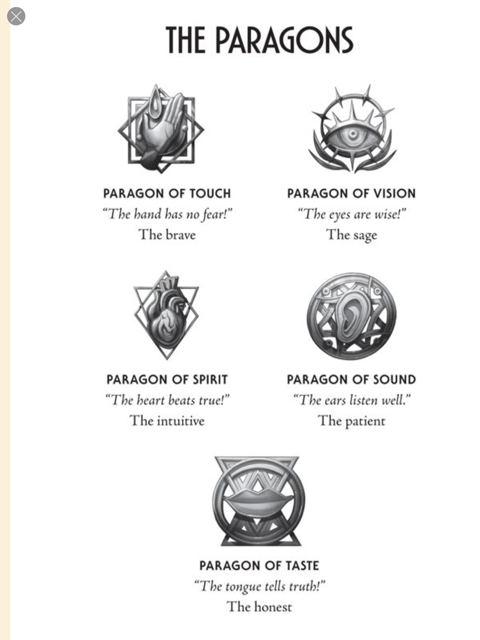
Marvels are a light within a person that is strongly linked to one of five Paragons. Paragons are similar to the five senses (vision, touch, sound, taste, smell) except smell has been replaced by spirit. At the end of the school year, there is an exam where kids find out their Paragon. Since all of the kids who are in Ella's class come from Marvelling families, they already have an idea of what their Paragon will be, with the exception of Ella and Brigit. I found myself wondering just what Ella's Paragon would be that would really work for a series. Then I thought, duh, she has at least two friends who can help with their Paragons. And then it occurred to me that wondering what will happen is part of the fun of reading The Marvellers

And there is a lot of fun stuff in this book because Clayton's worldbuilding is just so wonderfully imaginative. Sure, some of it may remind you of Harry Potter, but there is just so much originality that the comparisons fall away quickly until you are only left with one - they are both fantastic school stories. And astute readers will definitely chuckle at the names of some of the teachers in Ella's school.

But don't get me wrong, there is plenty of serious stuff going on. Ella is marginalized right off the bat when she must change rooms and live with Brigit, the other marginalized student. And with marginalization, comes bullying by students and collecting demerits because Conjurors are not welcomed by every teacher in the school.  

I have to admit when I first began reading The Marvellers, I had a hard time getting into it, but after a few pages, I was totally hooked. And I could go on and on about how great it is because there is just so much to this story, but maybe you should just read the book. It is well worth your time. Maybe I'll reread it.  

Thursday, January 20, 2022

Equal by Joyce Moyer Hostetter

Equal
is the fifth book in Joyce Moyer Hostetter's excellent Baker's Mountain Stories series. The first book I read was Blue, set in Hickory, NC, in the midst of the Polio Epidemic of 1944. Told to be the man of the house while her father is off fighting in WWII, Ann Fay Honeycutt, 13, is diagnosed with polio and the novel follows her treatment and recovery. The next book is a prequel, set in 1941 and tells the story of ninth grader Junior Bledsoe, who needs to solve the mystery of how his abusive father died while grappling with the changes and challenges this brings his life. Book 3, Comfort, returns to Ann Fay's story. She home from the polio hospital and finding it difficult to fit into her old life. WWII has ended and her father has returned from fighting in Europe and is suffering severe PTSD. The fourth book, Drive, brings the Honeycutt family in the 1950s. Ann Fay's younger twin sisters, high schoolers Ida and Ellie are beginning to grow apart, but both like the same boy. Ellie is the driven-to-achieve twin, while Ida is more laid back. Their father is still suffering with PTSD, and taking up a lot of their mother's time, along with Jackie, 6, the youngest Honeycutt. And Ann Fay and Junior Bledsoe decide to get married. Plus, it is the year that the Hickory Motor Speedway, the birthplace of NASCAR stars, opened and Junior is an automobile mechanic.    

And that short summary leads readers to Equal, set in 1959. Jackie, the youngest of the Honeycutt children and a rising eight grader, has one thing on his mind - entering his beloved cow Lucy into the 4-H dairy contest at the upcoming fair. But, he is reminded by Thomas Freeman, a Black kid he doesn't really know, about the Lutzes, who always walk away with first place. Thomas is into birdwatching and bird calling, and not much interested in the friendship Jackie is offering.

But at the river one day, while the two kids are fishing, a drunk old man goes after Thomas for being on the riverbank with a white boy, throwing his empty liquor bottle at him, hitting him in the side of the head. The incident jolts Jackie's own memory of a time when he threw an apple at the Black kids waiting for their school bus and hit Thomas in the back of his head. Jackie knows he should say something to Thomas, but is too ashamed to bring it up with him.

1959 sees a lot of unrest in the world: the cold war between the Russians and the United States, the growing Civil Rights Movement and angry white supremacists, and locally for Jackie, it's an enemy in class named Dennis Aiken. All of which prompts his teacher to put a quote from Abraham Lincoln on the blackboard: "Do I not destroy my enemies when I make them my friends?" for her class to think about.

Little by little, Jackie becomes more aware of the constant fear that the Freeman's and other Black families live with. His sister, Ellie, is working for a Black attorney in the Civil Right's movement and friends with his daughter, Maribelle Bradley. When she invites them to stop at the Honeycutt house on their way to a protest that turns into an overnight visit, it becomes surprising but enlightening visit for the Honeycutts, for which they pay a big price afterwards. 

Although Lucy didn't win the 4-H contest, Jackie is still proud of his cow. But after the Bradley's visit, someone tries to poison Lucy by feeding her a poisonous branch from a yew tree, and no one can figure who or why. But when the Freeman's cow is found dead also from a branch of a yew tree, it looks like both incidents are related. Will Jackie and Thomas be able to solve this mystery before there are any more incidents?

One of the nice things about reading the Bakers Mountain stories is that they can be read as a series, or as a stand alone novel. Each one provides enough background to know who is who and what has happened. The other nice thing is that these are really excellent historical fiction novels. Author Joyce Moyer Hostetter has managed to incorporate the most important international, national, and local events into the lives of the Honeycutts in each of the novels and shows how these events impacts the lives of even the most ordinary citizens, and she includes enough back matter about each event in every book for the reader. 

The Lincoln quote permeates the novel, and forces Jackie and his parents to rethink their view of who is a friend and who is an enemy and why. I was relieved that is isn't a white savior book. Jackie changes and grows by seeing how the Freeman and the Bradley families live their lives and their truths and not by being put in the position of having to educate the Honeycutts. Instead, Jackie and his parents learn to have empathy for their new friends after getting to know them. For example, Jackie's dad and Mr. Bradley were both soldiers in WWII and could empathize with each other over their experience and resulting PTSD. 

Equal is a well-written, well-researched novel that will no doubt at times touch the readers heartstrings. It is an emotional journey for Jackie, but in the end, he is a much better person for it and so are we for having traveled his journey with him. 

This book was an eARC gratefully received from Edelweiss+

Saturday, August 21, 2021

MMGM: Three Keys (Front Desk #2) by Kelly Yang

 
It's 1994 and life has certainly changed for Mia Tang, 11. You may recall from Front Desk, that when she was much younger, Mia and her parents had emigrated to the United States from China hoping for a better life. But, you may also recall, the degrees and work experience Mia's parents had didn't help them get jobs for which they were qualified (he is a scientist, she is an engineer). Instead, they took menial jobs, finally landing at the Calavista Motel as maintenance workers. But eventually, they buy the Calavista from the very unpleasant owner Mr. Yao, whose son is in Mia's class and who bullies her every chance he gets. But the Tang's also make good friends among the more permanent residents of the motel. Mia and Lupe Garcia, whose dad works for the Tangs, are now BFFs, and she has even made friends with Jason Yao. 

Mia is excited to begin sixth grade, hoping to improve her writing with the help of her new teacher Mrs. Welch, who clearly resents teaching in a trailer because of budget cuts, blaming it on immigrants the state has to take care of. It soon becomes clear that Mrs. Welch supports Pete Wilson for governor and Proposition 187 which would prohibit undocumented immigrants from using any state services, including health care and public schools. 

Then Lupe tells Mia that her family is undocumented, but working on getting the papers they need, and they live in fear of being deported. When Mia's first writing assignment on immigration is returned, Mrs. Welch has only given her a C, not the A or B+ she was expecting. What begin as a great new beginning for the Mia feels like it is quickly turning into more disappointment and worry.

And she's right. When Lupe's grandmother in Mexico dies, her mother decides to take a chance and return there for her funeral. When they don't hear from Mrs. Garcia for weeks, there is nothing that can be done to find out what happened without the authorities discovering they are undocumented and deporting the whole Garcia family. But when Mr. Garcia drives down to the border to find his wife, he is picked up and held by the immigration police.

On top of that, the Tang's improvements of the Calavista are finally paying off financially, but when new property manager Hank (you remember him from Book #1) writes Immigrants Welcome in big letters outside the motel, it ends up on the nightly news and investors are not happy. Now, the Tang's financial future is once again in trouble but Mia insists the sign must not be take down.

It begins to look like nothing is going to go right during Mia's sixth grade year, but this is a girl with spunk and drive, and she is not going to go down without a fight. Can she change people's minds, though, especially Mrs. Welch's, about immigrants and the unfairness of Proposition 187? Can she help bring back Mr. and Mrs. Garcia, or has she lost her best friend to politics. 

Some of the issues addressed in Three Keys are pretty heavy duty for a middle grade novel, and yet what better place to explore these issues of immigration and racism than at this moment when they are sadly still so relevant and urgent. For example, there is racial animosity directed at Hank, who is African American, but who tells Lupe "I have fear every day...But let me tell you something about fear: If you don't control it, it controls you." (pg 215) And recent immigrants like Tangs are were and are still looked down on by people like Mr. Yao, and others. 

I wouldn't say that Mia develops as much as I would say that she expands who she is, and who she is is passionate about supporting the people she cares about, and what is happening in the world as it impacts them, as well as her and her family. Her political awakening is interesting to see and I think more kids are having that kind of experience today and can really relate to her. Mia certainly embodies Hank's definition of the three keys of friendship: "You gotta listen, you gotta care, and most importantly, you gotta keep trying." (pg 245)   

I would not skip reading the Author's Note in the back matter. There is a lot of information about Proposition 187 and life in California in 1994 for immigrant adults and children and she brings it into the present so well, and includes sources. 

The next book in the Front Desk trilogy, Room to Dream (Front Desk #3), will be out on September 21, 2021 and I can't wait to see what Mia, Lupe, and Jason are up to.

This book is recommended for readers age 9+
This book was an eARC gratefully received from Edelweiss+
Be sure to check out the other Marvelous Middle Grade Monday offerings, 
now being carried on by Greg at Always in the Middle


Sunday, February 21, 2021

Unspeakable: The Tulsa Race Massacre by Carole Boston Weatherford, illustrated by Floyd Cooper

 
Unspeakable: The Tulsa Race Massacre
written by Carole Boston Weatherford,
illustrated by Floyd Cooper
Carolrhoda Books, 2021, 32 pages

This year will mark the 100th anniversary of the Tulsa Race Massacre on May 31st and June 1, 1921, when a armed white mob swarmed the town of Greenwood, Oklahoma, killing up to 300 Black Americans over two days and burning the prosperous town to the ground. The what massacre, you may ask? Exactly. When did any of us ever learn about this heart wrenching event in American history? If you're like me, the answer is never. I hadn't heard about the Tulsa Race Massacre until just a few years ago when I read Dreamland Burning, a YA novel by Jennifer Latham.

Now, however, Carole Boston Weatherford has made the events of the Tulsa Race Massacre accessible to younger readers. Written in measured, lyrical free verse, she begins her narrative as though it were a fairytale - "Once upon a time near Tulsa, Oklahoma..." painting an idyllic picture of life in the all Black prosperous town of Greenwood. She continues the use of "Once upon a time..." as she introduces the achievement of the citizens of Greenwood in building their own community. 
Click to Enlarge

Segregation laws made it impossible for Blacks to vote, and demanded that they have separate neighborhoods, their own schools, streetcars and railroad coaches. The residents of Greenwood may have been separate, but they were very prosperous. Not surprisingly, there were almost two hundred business in Greenwood, earning it the name the "Negro Wall Street of America." Greenwood had everything a town could want - a school system, a post office, a hospital, several libraries and churches, a theater named Dreamland
Click to Enlarge

But not everyone was happy about Greenwood and its flourishing citizens. Midway through Unspeakable, Weatherford drops the fairytale phase "Once upon a time... " and introduces a stark reality on a black page with white writing - "But in 1921, not everyone in Tulsa was pleased/ with these signs of Black Wealth..." A 17-year-old white elevator operator accusing a 19-year-old shoeshine man of assault was all it took to inflame an angry white mob to descend on Greenwood, killing, destroying, burning it down until nothing remained but ashes. 

Carole Boston Weatherford does an outstanding job in making difficult and/or little known subjects or events available and understandable for young readers and this picture book for older readers is no exception. Her language is clear and musical, and she never talks down to her readers, writing in such a way that respects their intelligence, no matter how tragic the circumstances. Dividing Unspeakable between what went into making Greenwood so successful for the African Americans living there and the destructive mob that destroyed their years of achievement really drives home her message - "...to realize the responsibility we all have/ to reject hatred and violence and instead choose hope."

Weatherford's words are beautifully born out in Floyd Cooper's sepia-toned paint and erasure illustrations. I once saw him do this method in person once and I was amazed by it. Perhaps because he has a personal connection to Greenwood, Cooper has really captured both the community in all its bustling activity and the hatred and anger of mob violence. And as we have witnessed recently, it's so easy to destroy the trust and faith we have in our communities when people are motived by hate and jealousy.

Back matter includes an important Author's Note and an informative Illustrator's Note. Be sure to check out the front and back endpapers to see was Greenwood really looked like before and after the mob destroyed it. 

This is a book that should be in every school library, classroom or home school library. If you are thinking about using Unspeakable with your classes, you can download an extensive Teacher's Guide courtesy of Lerner Books HERE

This book is recommended for readers age 9+
This book was an eARC gratefully received from NetGalley

Monday, November 16, 2020

Mary Seacole: Bound for the Battlefield by Susan Goldman Rubin, illustrated by Richie Pope

 
It's always a pleasure to read a book about a little known historical figure who should be more well-known. That is certainly the case of Susan Goldman Rubin's new book about Mary Grant Seacole. Mary was a Creole woman, who was born in Kingston, Jamaica in 1805 to a Jamaican mother and a Scottish father. Though her father died when she was young, his stories about war left Mary with a desire to someday travel. Her mother was a "doctress," making her own medicines using different flowers and plants, and Mary wanted to follow in her footsteps. 

After two trips to London, where she experienced racism for the first time Mary began helping at her mother's boarding house when an outbreak of yellow fever hit Jamaica, caring for the sick. During that time, she met an Englishman named Edwin Seacole and married him in 1836. Sadly, he died in 1844. Later, Mary acquired more experience caring for the sick when an outbreak of cholera hit while she was visiting her brother in Panama. 

But it was reading about the Crimean War in 1854 that convinced Mary to head to the battlefield with her mother's healing recipes. Volunteering as a nurse in London, she was turned away, so she headed to Turkey on her own. There, she tried to volunteer at Florence Nightingale's army hospital, but Nightingale rejected her because of the color of her skin. Undaunted, Mary headed straight for the battlefield, where she and her homemade medicines were more than welcomed and where Mary spent a number of years nursing wounded soldiers. 

Mary certainly risked her life more than once, but sadly returned from war in great debt. It was the praise of a war journalist that finally gave Mary the credit she deserved for all she did, and helped get her out of debt. 

Mary lived a very exciting life, and it has certainly been captured in this short, but informative picture book for older readers. Most surprising to me was her encounter with Florence Nightingale, who felt that Mary's race and class made her character automatically questionable. Clearly, Mary's character was both impeccable and strong, given what she unselfishly gave to the soldiers she nursed, a few of whom recognized her having been cared for by her in Kingston. 

Mary Seacole: Bound for the Battlefield is a compelling biography, written in accessible language, and full-page, full-colored stylized digital illustrations. There are plenty of quotes, most from Mary's own book, Wonderful Adventures of Mrs. Seacole in Many Lands published in 1857, as well as other sources noted in the back matter. 

Mary is shown to be brave, dedicated, and very tenacious. She is an historical figure that deserves to be recognized and admired by today's young readers.  

This book is recommended for readers age 8+
This book was gratefully received from the publisher, Candlewick Press 

Friday, July 24, 2020

American as Paneer Pie by Supriya Kelkar


Eleven-year-old Lekha Divekar may be a first generation Indian American, but she couldn't be prouder of her Indian heritage, culture, and her Hindu faith. And there's nothing Lekha enjoys more than a good Bollywood movie, some delicious Indian food, and playing raas at home with her best friend Noah. But these enjoyments belong only to the at-home Lekha. At-school Lekha is a different story. 

As the only Desi* in her school in Oakridge, Michigan, Lekha tries her hardest to fit in and not be noticed. But that's kind of hard when she has a dark-brown birthmark in the spot on her forehead where a bindi would normally go. This earns her the unwanted nickname Dot by a white boy named Liam, who seems to have it out for her. Each time she passes him, he asks "What reeks, Dot?" in a sneering, condescending way and insinuating that Indians smell and adding to her feelings self-consciousness. Is it the wonderful Bengali food her mother makes and that she enjoys so much, or the coconut oil she uses in her hair, or none of this and just plain racism? she wondered. His mocking only increases when Lekha makes the school swim team and Liam doesn't, making fun of her for not shaving her legs:"She needs a lawn mower." to the delight of his friends. And how does Lekha deal with these insults and other microagressions, like students and teachers always mispronouncing her name and not correcting them? "I knew exactly how loud my voice would be when facing a bully. It would be totally silent." 

When a new girl moves in across the street, Lekha couldn't be happier. At last, a Desi friend at school and someone who would soon get what it is like to have two lives, an Indian life at home and an American life at school. But Avantika Savarkar may be fob (fresh off the boat), but she is also a proud Indian and doesn't care who knows it. And she is not afraid to stand up to Liam and his racist bullying. Lekha is amazed at this brave girl who speaks accented English and brings homemade Indian food for lunch, but she still wishes to just fit in and not be noticed.

When a white candidate runs for Congress on an anti-immigrant platform with the slogan "DON'T LIKE IT? LEAVE, Lekha refuses to even think about it, unlike her friend Noah. Noah has always been annoyed that Lekha refuses to speak up when she's make fun of. Even after a racist incident is directed at her family over the Christmas holidays happens, Lekha keeps her mouth shut about it and is only angry that Noah writes about it and it is published in the school paper for everyone to read. 

When a violent hate crime impacts her family and people she loves, will it be enough to get Lekha to finally find her voice to speak out against the racism she and her family face day after day and stand up for the culture she loves so much?

I found American as Paneer Pie to be an interesting novel and Lekha a very complex, flawed character as she grows and changes over the course of sixth grade. She is the first person narrator and while she can sound a little whiny and self-pitying at times, readers (myself included) need to remember, racism and xenophobia aren't occasional incidents in her life. It's also the ongoing day-to-day barrage of microaggressions, like not bothering to learn how to pronounce her name, comments about smelly Indian food, a pushy white swim teammate named Aidy insisting they lost a match because Lekha didn't shave her legs, even though it was Aidy's poor performance that caused the loss.

While this is a story that nicely highlights Lekha's journey toward discovering the power of her own voice, Kelkar has included a richly detailed picture of her Indian family's life, including lots of interesting references to their culture, traditions, and, of course, food. One thing that did bother me was that there is no glossary for the many Indian reference that are probably not going to be familiar to many readers. 

If you are looking for a thought-provoking, accessible novel that presents difficult but timely themes in an age appropriate way, then look no further than American as Paneer Pie. A recipe for Paneer Pie is included. 

This book is recommended for readers age 9+
This book was an ARC provided by the publisher, Aladdin, an imprint of Simon & Schuster

*Wondering what the word Desi means? So was I. Very simply put, the online Oxford dictionary defines it as "a person of Indian, Bangladeshi or Pakistani birth or descent who lives aboard." Desi comes from the Sanskrit deÅ›a meaning country or home. 

Friday, May 3, 2019

Genesis Begins Again by Alicia D. Williams


Life for 13-year-old Genesis Anderson isn't easy. Especially on the day Genesis finally comes home from school with a few girls she's been wanting to be friends with and finds her family's belongings laid out in the yard and the front door locked...evicted again. Once more, her dad has drunk and gambled the rent money away. And that means that Genesis and her mother will be staying with her overly critical (maternal) grandmother for a few days, until dad finds another place to live.

And as if dealing with an unreliable father, eviction and another new school aren't hard enough, Genesis must also contend with her own feelings of self-loathing and low self-esteem. And she knows exactly what the reasons are for feeling that way - she keeps a list of all things she hates about herself, a list begun by some cruel kids in 5th grade in a school she had once attended, and to which she has since added more things. And now she's added reason #86: "Because she let them call her Charcoal, Eggplant, and Blackie" (pg. 7). Genesis has very dark skin just like her dad, and has been told so often that she's too black by people, including her father and grandmother, that she has internalize their negative attitude.

But now, dad has moved Genesis and her mother to a big house in a more upscale suburban  neighborhood and she's been enrolled in a fancier school than in the past. Things aren't quite a bad as in the other schools she attended and Genesis even begins to make some new friends, including shy Sophia, a white girl with her own school horror story. But it is her music teacher, Mrs. Hill, who believes in Genesis' musical talent and introduces her to such greats as Billie Holiday, Ella Fitzgerald, and Etta James, black women who learned to put their joy, longing, loneliness and soul into their incredibly beautiful eloquent  music. Can Genesis learn to use the negative voices that hold her back to finally begin to love herself for who she is?

Genesis Begins Again is a tough book to read. Genesis is so young and vulnerable, and people can be so cruel to her, and what makes it harder is the her story, in all its poignancy, is a story of so many girls just like her. At the heart of this novel is the issue around the colorism that Genesis faces every day at home, at school and within herself. She was supposed to take after her light-skinned mother and she is very aware of her father's disappointment that she didn't. Her grandmother, who intently dislikes Genesis' dad, introduces her the the brown bag test (a test he failed), and her belief that light-skin is a measure of superiority. Some of the conversations with her dad, grandmother, and even Sophia are heartbreaking to read. As are Genesis' attempts at trying to lighten her skin, all the more difficult to read knowing that they just won't work, but understanding her need to try. And try she does, with lemons, bleach, cream, even exfoliating her skin raw at one point.

I can't say I loved the book's ending, but I would still highly recommend it. I did wonder why Genesis's mother was not involved in the handling of the family's finances so that she didn't know the rent wasn't being paid, or why she didn't just take Genesis and leave.

On the whole, I thought Genesis Begins Again is a book that should be read by everyone regardless of their skin color. Sensitively written, it is an eyeopening window into the tough subject of colorism within the black community and racism in the white community, making it is a book that needed to be written for today's world.

This book is recommended for readers age 10+
This book was borrowed from the NYPL

Monday, July 23, 2018

Breakout by Kate Messner


It's two weeks before the end of school and the kids in Wolf Creek Middle School in upstate New York are looking forward to summer vacation. This year, however, they have a summer assignment to submit at least 5 items to be put into the Wolf Creek Community Time Capsule to be opened in fifty years. For best friends and lifetime residents of Wolf Creek Nora Tucker and Lizzie Bruno, the assignment is pretty interesting. Nora's father is the superintendent town's maximum security prison, and Lizzie's grandmother works in the prison kitchen.

But for Elidee Jones it's a very different story - she and her mother have just moved to Wolf Creek from New York City, a decision made when Elidee didn't get into the elite charter school she had applied to and since her brother is incarcerated in the prison, the move would make visiting him a lot easier. Nora and Lizzie are curious about Elidee, but find her to be unfriendly at first. Nora is also  upset because she used to be the fastest runner in gym class, and Elidee beat her timing by 30 seconds running a mile.

But no sooner does Elidee begin school in Wolf Creek then two inmates escape from the prison and everything comes to a halt. People are told to lay low at home while an intense manhunt begins. Lizzie's grandmother is in the hospital so she's staying at Nora's and the two girls can't wait to get out of the house to find out what's happening. At home, Elidee writes letters to her brother Troy and begins to explore her own creative voice through poetry, influenced by Lin-Manuel Miranda's Hamilton, a play she saw with her NYC class just before moving.

As the days go by and the inmates aren't caught, the kids return to school and slowly Nora, Lizzie and Elidee form a tentative friendship. But the manhunt, the presence of reporters in town, the stress of thinking the two escapees might be everywhere and anywhere in or around Wolf Creek begins to crack open the friendly façade of the town's residents. Soon, Elidee is noticing racially based comments, behaviors, and microaggressions at school and in town, and experiments with recording her anger in different poetic forms. But Nora is also becoming aware that her beloved Wolf Creek isn't the warm, welcoming place she always thought it was, as she notices how people, including her mother, have an unconscious racism that makes them see Elidee not as a middle school kid, but as a racial stereotype. Thanks to her older brother, however, Nora also begins to understand some of the ways that systemic racism plays out in communities and especially disproportionate number of incarcerations of African Americans, as well as other social injustices faced by people of color in this country.

And Lizzie, well, she learns what it means to have a family member incarcerated when it comes out that the escape was an inside job.

Told through variety of methods - letters, text messages, poetry, recorded conversations, new reports, even comics, and by various people beside Nora, Lizzie and Elidee - Breakout is based on a real prison escape (and being a New Yorker, one that I remember quite well). Elidee's presence and the breakout aren't the main storyline, but really the catalyst that brings out people's true feelings about race and racial profiling. Once they see this happening, it is up to Nora and Lizzie to figure who their own authentic selves are and not Elidee's job to teach them or change them. Elidee's presence in the story is to find her own authentic voice as a poet for expressing her feelings about what she experiences.

Breakout is a fast read, but we get to know the main characters so well. I loved watching Elidee's growth as a poet, Nora growth as an empathic person (who knows what she will do with that) and Lizzie's growth as a journalist. But I really enjoyed seeing Elidee's growth as a poet. I think a lot of people don't realize that copying the style of greats artists is one way to get there. And Elidee has chosen some of the best - Langston Hughes, e.e. cummings, Jacqueline Woodson, Nikki Grimes, and of course Lin Manuel-Miranda. Interestingly, we never really discover why Elidee's brother is in prison and we don't need to know.

Breakout is a timely book and one that should be on every middle grade classroom, and every middle grade library.

This book is recommended for readers age 10+
This book was an EARC received from NetGalley

Friday, April 27, 2018

Ghost Boys by Jewell Parker Rhodes


For Jerome Rogers, living in his low-income Chicago neighborhood can be dangerous, but so can going to middle school. There, Jerome is the target of three bullies, Eddie, Snap, and Mike, who enjoy doing things to him like dumping out his backpack, hitting him in the head, or pulling down his pants. Jerome has no friends, and eats his lunch in a bathroom, locker room or supply closet - hiding out alone.

That is, until Carlos arrives. Carlos, a Mexican American boy, is the new kid in school, originally from Texas and Jerome unwillingly ends up showing him the ropes to avoid the bullies. But when they are discovered in a boy's bathroom eating lunch, Carlos pulls a gun on Eddie, Snap, and Mike. Not realizing it's a toy gun, the bullies back down.

Carlos gives the toy gun to Jerome, who doesn't want it, but takes it anyway. One day, allowed to go out and play, Jerome is playing an imaginary game of good guy/bad guy in a rundown park with the toy gun when police arrive and one shoots him in the back when he tries to run away.

Later, at a preliminary hearing, the white officer claims he had no choice but to shoot, that he thought Jerome was bigger, older and had a real gun, and despite shooting him from his patrol car, he said he feared for his life.

The chapters switch between Jerome's real life (Alive), in which he recounts his life and the actual events leading up to the shooting and his death, to his afterlife (Dead), in which, as a ghost, he is privy to seeing things he never would have seen when he was alive. Jerome goes to his home and observes what life is now like for his - family, mother, father, younger sister Kim, and grandmother. He also finds himself in the bedroom of Sarah Moore, also 12, and the middle class daughter of the police officer who shot him. Jerome is frequently accompanied by the ghost of Emmett Till, a name Jerome recognizes from conversations at home, but doesn't really know the details of Emmett's death in 1955. 

Emmett is there to help Jerome understand what happened to him. Slowly, as Jerome sees other ghost boys just like Emmett and himself, he begins to understand just how deep and far-reading the roots of historical racism run in this country, so much so that a snap decision based on those roots and the often unconscious acceptance of racism can end the life of a 12 year old black boy playing in a park.

On the whole, I thought this was a well-done, very accessible book for middle grade readers (I don't think there are any others about young black kids being killed by white police officers, but if you know of one, please share the title). By connecting Emmett Till's lynching and murder by white racists in Mississippi in 1955 with Jerome's murder by a Chicago police officer Rhodes shows the reader that their deaths really are one and the same - death by racism.

And although this sounds horribly depressing, Rhodes leaves the reader with reason to hope that change is possible. Remembering, making these killings real for people and working towards change and social justice are the important points of Ghost Boys.  As Emmett tells Jerome "Bear witness...Everyone needs their story heard. Felt. We honor each other. Connect across time." But this is where I found one flaw in the the novel.

In 1955, Emmett Till's death sparks the Civil Rights Movement. Being an agent of change here is the work that Rhodes gives to Sarah Moore to do in this novel. Why? Why perpetuate the idea that only white people (here a girl) can be the helpers or agents of change and that black people (here a boy) can only be the victims, thus supporting ideas of gender and race stereotypes. Jerome's younger sister, Kim is a pretty smart girl and, if she had been only a few years older, could have been just as if not more effective than Sarah at working towards change and social justice. 

Despite this, Ghost Boys isn't perfect, but it is definitely a book that most middle graders need to read.

And if Jerome's story sounds familiar to you, perhaps it's because of the close parallel to another murder, that of Tamir Rice, also a 12 year old black boy killed by a white Cleveland, Ohio cop on November 22, 2014 and mentioned in the book.

This book is recommended for readers age 10+
This book was an EARC received from Net Galley

Thursday, April 28, 2016

A Tiny Piece of Sky by Shawn K. Stout


This was originally posted on my other blog, The Children's War, but I thought I would share it here as well.  It's an interesting story about what happens when rumors are spread about a German American who refuses to support the bully running for mayor. 

It's only June, but the summer of 1939 does not look very promising as far as Frankie Baum, 11, is concerned.  Her sister and best friend Joan, "the just-barely-older of the two," is getting to spend the summer at Aunt Dottie's farm in New Jersey, where Frankie is sure she will be having the best summer ever, while she's stuck at home in Hagerstown, MD with older sister Elizabeth, called Princess by their parents.

And ever worse, Frankie is expected to work in her father's newly purchased restaurant, a long neglected Alpine-style relict of years ago, now with only weeks to get it cleaned up and running again to become his dream of "An Eating Place of Wide Renown."  Opening day is planned for July 5th.  Sure enough, at the restaurant, Frankie is sent to the kitchen to work, a dirty, messy job, while Princess gets to work the cash register.

Frankie is vaguely aware of war talk among the townspeople, of anti-German feelings that are beginning to brew, but she has never really considered her family to be German, even though her father's parents immigrated from Germany.  But when Hermann Baum is approached by the cigar smoking president of the Chamber of Commerce, Mr. Sullen Waterford Price, and refuses to let himself be bullied into becoming at paid member of the chamber, he makes a formidable enemy, one all too aware of his German roots.

Price is also running for mayor of Hagerstown, so when Hermann also refuses to put his election poster in his front window, Price begins looking for just the dirty information he needs to start spreading rumors that Hermann Baum is quite possibly a spy and Nazi sympathizer.

To make matters even more complicated, Hermann decides to throw his own  pre-opening day Fourth of July party for friends, family and even his African American staff and their families.  Hermann has always treated his kitchen staff fairly, despite living in a state where Jim Crow is in effect.  That, coupled with the German flyer that has mysteriously fallen into the hands of Mr. Price, are all that is needed for a boycott of Hermann's party. 

Frankie has overheard quite a bit while working in the kitchen, and decides to do some investigating of her own about what is going on.  But she also finds herself doubting her father's innocence.  When no one shows up at her father's party, she goes to the town's celebration to try and find out what is going on.  When Hermann shows up looking for her, he collapses.  And the Baum family's life is changed forever.

A Tiny Piece of Sky is a wonderful coming of age story.  Frankie's character develops slowly over the course of the novel as she encounters different people and situations.  The story is told in the third person by an omniscient narrator in a rather conversational style, and who seems to be right in the thick of things, more aware of what is going on in the world than Frankie is.  To get some of Frankie and even Joan's mindset, there are also first person letters they write to each other, which tend to create more mystery about Hermann Baum's heritage than information.

The story takes place over June, July and August 1939.  There aren't many pre-World War II home front stories for young readers, making this all that much more interesting.  Stout looks at both racism and xenophobia through the lens of Frankie's summer.  Frankie hasn't really paid attention to the racism and discrimination towards the African American community in Hagerstown, until she starts working in the restaurant.  But the character of Mr. Stannum, the restaurant's new manager, opens her eyes when she witnesses the way he treats the black kitchen staff with such cruelty and contempt, even refusing to allow them to use the bathroom he uses.  

You  also don't find many books for young readers that are about the kind of treatment that German Americans experienced in the 1930s and 1940s as the possibility of war with Germany became more of a possibility.  Most people don't realize they were also discriminated against. though to a far lesser extent than Japanese Americans.  What makes this an interesting theme here is that Stout shows how easily people can change their attitudes towards of friends and even fathers when doubt begins to take hold.  For that reason,  A Tiny Piece of Sky is not just good historical fiction, but also resonates so loudly in today's world. 

The other part of what makes A Tiny Piece of Sky such an interesting, realistic novel is that much of the material comes from Shawn Stout's own family and the restaurant they owned in Hagerstown, which she writes about in her Author's Note at the end of the novel.  Be sure to read it when you read this excellent novel.

Teachers can find an extensive Teaching Guide for A Tiny Piece of Sky HERE

This book is recommended for readers age 9+
This book was borrowed from the NYPL


Used with permission: the original menu from Shawn Stout's grandparent's restaurant.
Click to enlarge and check out the prices listed.
 
Imagination Designs