Wednesday, February 26, 2014

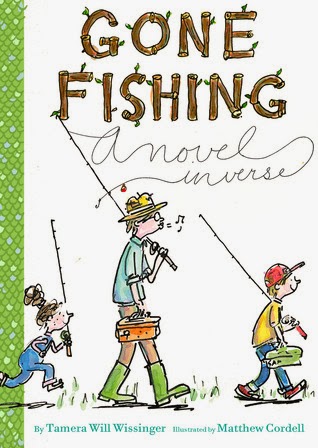
Gone Fishing: A Novel in Verse by Tamera Will Wissinger, illustrated by Matthew Cordell

Let's face it, Poetry isn't really a favorite of kids, nor is it something they get much of in school.  I am afraid I am even guilty of it myself.  I have reviewed at least 5 books on this blog and never added a poetry label, and only mentioned they were written in free verse (I will be correcting this oversight today!)  Yet, hey are all excellent novels that can be used to introduce kids to poetry.  And then there is the very amusing novel by Greg Pincus, The 14 Fibs of Gregory K, which has a boy protagonist who likes to write poetry, much like the author does.

Gone Fishing, Tamera Will Wissinger debut book, is a new work that can be added to the list of novels written in verse.  Sam, 9, is beyond excited because he and his dad are going to go fishing together, just the two of them, without Sam's little sister, Lucy.

To get ready, they dig up some night crawlers for bait, but when Sam pulls out his tackle, what a surprise - it is full of Lucy's toys. And he finds her playing pretend fishing with his precious fishing gear.

By early next morning, though, Sam is all set and up before the sun, but so is Lucy.  They get to the lake, get the boat in the water and Sam is ready for some serious fishing.  So is Lucy.  Sam likes it quiet so the fish don't get scared away, Lucy likes to lure the fish with a song and the first fish of the day is caught by….Lucy.

Sam is seething mad, Lucy is singing and fishing.  Sam. even tries Lucy's fish songs under his breath to lure a catch, but not luck.  He just sinks lower into his anger and annoyance, begrudging Lucy each fish that she catches even as his sibling rivalry rises to the top.  Sam is determined to catch a bigger fish.  The first big one gets away, but not the second.  Sam is proud, but to his surprise so is Lucy, who cheers for him:
"You caught one, Sam!"
Lucy scoots close to me.
"A big one, too!"
I nod, gulp.
I didn't even look
when she caught
her first fish.
But she
cheered for me.
Maybe I was wrong
about bringing her along.
Gone Fishing is really about coming to terms with sibling rivalry, something all brothers and sisters eventually (hopefully) go through, learning to accept the other as a person not a competitor, annoyance, things like that.  And it is charming to see how that begins to work out for Sam and Lucy.

Adding to the fun of the poetry are the colorful, whimsical illustrations done in pen, ink and watercolor by Matthew Cordell.

But wait, that's not all there is to Gone Fishing.

Each part of Sam's fishing day is told in its own poem.  Some of the poems are in Sam's voice, some in Lucy's and some in the Dad's, and sometimes a poems has all three voices in it.  Each poem is short, have much to say and are done in different poetic forms - odes, free verse, lyric, Lucy's fish song is a poem of address, to name a few.

At the end of the book, Wissinger has included a section called The Poet's Tackle Box.  Here, she explains the different poetry techniques used, all the different poetic forms she used and they difference between rhyme and rhythm.  It is an ideal book for introducing poetry in to young students, all the more so because the poems in Gone Fishing are about kids just like them and they could even make up their own similar poems.

Even if you aren't interested in poetry, you will have lots of fun reading Gone Fishing, a fun, playful novel in verse.

This book is recommended for readers age 6+
This book was borrowed from the NYPL

Saturday, February 22, 2014

The Real Boy by Anne Ursu

Although he is a little odd, Oscar, 11, was nevertheless chosen from among all the other children at the orphanage to be a hand by Master Caleb, who is the first magician on Alethia in a generation and therefore, a very powerful person.  Ever since, Oscar has always been content living with his cat friends and working in the cellar of Master Caleb's shop, mixing his herbs and making charms and potions for him to sell or venturing out to the forest to find more herbs and flowers.  Oscar loved being in the the forest, and felt at home among the 5 wizard trees that protected the Barrow.  Although he may only be a hand, and unbeknownst to anyone, Oscar knows how to read.  At night, he often sneaks into his Master's library and spends the night reading.

One day, Master Caleb decides to take a trip to the continent.  While he is gone, Wolf, his apprentice is in charge.  Wolf delights in tormenting Oscar, but one day he disobeys the Master's order and goes off to the forest where he is killed by something very large and very hungry.

Now Oscar is in charge of the shop, but he has never been comfortable around people, has difficulty speaking to them or looking the in the eye.  Callie, the healer's apprentice, befriends Oscar tries to help him in the shop with his social skills, but she is worried because some of the privileged, perfect children who live in the Shining City of Asteri are beginning to show signs of something being very wrong with them.

Not only are the perfect children beginning to their mysterious illnesses, but to his dismay, Oscar discovers that things in his beloved forest are being destroyed.  Then Oscar remembers something he has read in one of Master Caleb's books about the wizards and why they became the wizard trees.  Are the children and the incidents in the forest related?  Between the two of them, can he and Callie figure out exactly what is happening and stop it?  And hand and an apprentice?

This is a very multilayered novel.  First there is the world that Oscar and Callie live in.  There is an island called Alethia and on it is the Barrow Village, where Oscar and Callie live and which is a place of magic.  There is a forest nearby where Oscar collects his supplies and beyond that his the plaguelands.  But there is also the city of Asteri, a perfect city that has no magic, but its perfection is protected by spells surrounding it.  All of this sits on the edge of an enormous sea.  I was pleased to find the world of Alethia rather easy to imagine, since I read an ARC which didn't have the picture of the map the real book has.

The illness of the children and the forest monster that kills Wolf and begins to destroy the Barrow are connected.  The connection worked for me, but some of the action around that was a bit too much and too vague.

I did like the friendship between Oscar and Callie and the way she took him in hand and taught him some social skills.  She was such an extroverted character, a nice contrast to Oscar.  Ursu very nicely allows who Oscar is to unfold and we never really know if he is autistic, has Aspberger's, is painfully shy, is painfully introverted, or has just become subservient because of the way he is treated.  I think Oscar should be seen by each reader through their own eyes and experience.  My painfully shy middle-grade self would have loved this book, as does my not quite as painfully shy adult self.

On the whole, this was an interesting novel and one I would definitely recommend to anyone who loves fantasy.

This book is recommended for readers age 9+
This book was received as an ARC from the publisher

Tuesday, February 18, 2014

2014 Sydney Taylor Book Award Winner Neal Bascomb - an interview

Today, I am so happy to welcome Neal Bascomb to Randomly Reading.  Neal and his book The Nazi Hunters: How a Team of Spies and Survivors Captured the World's Most Notorious Nazi have been named the winner of the 2014 Sydney Taylor Book Award for Teen Readers by the Association of Jewish Libraries.  The Sydney Taylor Book Awards are given annually to those outstanding works that authentically portray the Jewish experience.

Welcome and congratulations, Neal, on being given this award for writing such a fascinating account of the events leading up to capture of Adolf Eichmann.

First, I was wondering if you would share some personal history about yourself with us?  

Well, I was born in Denver, though I didn't live there long enough to learn to ski.  I was actually raised in St. Louis, where I spent a lot of time at the ice skating rink.  I loved reading and writing from an early age, and in 10th grade, a teacher inspired me to believe that I could make a career for myself as a writer (I just love those teacher who inspire).  I went to college at Miami University in Ohio, and later, I was a journalist in Europe (London, Dublin, Paris) and later, I lived in New York as a book editor.  I finally begann writing full time in 2001.  Now, I live in Philadelphia with my wife, two daughters and a Portugese Water Dog named Moses.

After a career in journalism, what made you decide to begin writing books?

For a long time, I wrote short-form journalism, mostly for magazines.  I loved the idea of committing to longer projects that I could spend months, even years researching, and really delving into my subject.  Thus, books!

Have you always been interested in history and biographies?  What motivated you to research and write about history?

I love stories.  Period.  They don't have to be historical or present day, just a great story, with rich characters - and it doesn't hurt if there's a lot of material to work from to really paint a full picture of the events as they unfolded.

You originally published the story of Eichmann's capture as an adult work entitled Hunting
Eichmann: How a Band of Survivors and a Young Spy Agency Chased Down the World's Most Notoriaous Nazi.  What was the impulse or reason for you to undertake writing The Nazi Hunters for young adult readers?  And did you find it a difficult process?

The whole purpose of the operation to capture Eichmann was for education, specifically Ben Gurion, the leader of Israel, wanted the Nazi war criminal brought to trial so that the world would be reminded of the crimes inflicted on the Jewish population during the Holocaust.  That said, I was dim to the idea of turning my adult book on the subject in a young adult project until I received a call from a wonderful editor at Scholastic named Cheryl Klein.  She saw the opportunity - and all at once, I did as well.  And so, I sank myself headlong into the process.

Since young adult readers are beginning to have to do serious research papers, could you tell us what resources (i.e. museums, libraries, relatives) did you find most useful when researching this book?

I found all of these to be useful - everything.  I'm like a Hoover of information.  I gather as many resources across as spectrums as possible.  Sometimes, I start with the Internet, even Wikipedia.  They should never be your sole source of information, but it's a great launching pad for other sources, especially books, and then you look at their lists, and just keep going deeper and deeper into the topic.  I love primary material, original interviews or archival material that has not been seen through the lens of other historians or authors.

I know from personal experience that reading and writing about anything related to the Holocaust can be a very emotional experience.  But I was wondering how researching and writing this book about such a represhensible person affected your life?

This was a very difficult book to research and write, particularly when handling what Eichmann did over the course of the war.  Writing about his victims often left me with nightmares, but in a way, I was glad that it affected me so much, as I hope that I put that same feeling of horror and sadness into the pages related to his crimes.

Perhaps you could tell us what you find to be the most challenging aspects of your work as well as the most rewarding.

I once thought that the life of an author was glamourous (this was before I actuallly became one).  I thought that I would spend my days in cafes and work when I wanted, that I would vacation in Europe during the summer and never have a care in the world.  Well, that was a fantasy.  Writing, being an author, is work, everyday at your desk or coffee shop, whichever you prefer, bit it is work that takes committment, focus, and persistence.  That all said, I love it.  I love every part of it, both researching, hours spent in libraries or in archieves or interviewing people  And I love the writing, tough as the blank page is sometimes.

Could you tell us about any of your upcoming projects?

My next YA book from Scholastic is called SABOTAGE, and it's about Norwegian and British commandos who stopped the Nazis from getting the atomic bomb.  It's very much a "spies on skis" kind of tale, but one layered with science and history and the machinations of war.  I'm super excited about it.

Thank you, Neal, for visiting Randomly Reading and for the insight you have given us into your life, your work and your writing process.  I know I will be looking forward to reading SABOTAGE when it is published.  Once again, congratulations on winning the 2014 Sydney Taylor Book Award for Teen Readers.  I wish you all the best in the future.

Below is the schedule for the 2014 Sydney Taylor Book Award Blog Tour. Please follow the links to visit the hosting blogs on or after their tour dates, and be sure to leave them plenty of comments!
SUNDAY, FEBRUARY 16, 2014
Renee Londner, author of Stones for Grandpa
Sydney Taylor Honor Award winner in the Younger Readers Category
At The Write Stuff
Martha Aviles, illustrator of Stones for Grandpa
Sydney Taylor Honor Award winner in the Younger Readers Category
At Practically Paradise
Aline Sax, author, Caryl Strzelecki, illustrator, and Laura Watkinson, translator of The War Within These Walls
Sydney Taylor Honor Award winner in the Teen Readers Category
At The 3 R's: Reading, 'Riting, Research
MONDAY, FEBRUARY 17, 2014
Laurel Snyder, author of The Longest Night
Sydney Taylor Book Award winner in the Younger Readers Category
At Geo Librarian
Catia Chen, illustrator of The Longest Night
Sydney Taylor Book Award winner in the Younger Readers Category
At Holy Sparks
Robyn Bavati, author of Dancing in the Dark
Sydney Taylor Honor Award winner in the Teen Readers Category
At Bildungsroman
TUESDAY, FEBRUARY 18, 2014
Neal Bascomb, author of The Nazi Hunters: How a Team of Spies and Survivors Captured the World's Most Notorious Nazi
Sydney Taylor Book Award winner in the Teen Readers Category
At Randomly Reading
Carol Matas, author of Dear Canada: Pieces of the Past: The Holocaust Diary of Rose Rabinowitz
Sydney Taylor Honor Award winner in the Older Readers Category
At Pen and Prose
WEDNESDAY, FEBRUARY 19, 2014
Cosei Kawa, illustrator of Rifka Takes a Bow
Sydney Taylor Honor Award winner in the Younger Readers Category
At Jewish Books for Children
Elisabeth Leyson, contributor to The Boy on the Wooden Box: How the Impossible Became Possible...on Schindler’s List
Sydney Taylor Honor Award winner in the Older Readers Category
At The Interlace Place
THURSDAY, FEBRUARY 20, 2014
Patricia Polacco, author and illustrator of The Blessing Cup
Sydney Taylor Book Award winner in the Older Readers Category
At Ann Koffsky's Blog
Blog Tour Wrap-Up with All Authors and Illustrators
At The Whole Megillah

Sunday, February 16, 2014

The Nazi Hunters: How a Team of Spies and Survivors Captured the World's Most Notorious Nazi by Neal Bascomb


Congratulations to Neal Bascomb, first for winning the 2014 YALSA Award for Excellence in Nonfiction for Young Adults and, second for winning 2014 Sydney Taylor Book Award for Teen Readers.

I will be interviewing Neal on Tuesday as part of the 2014 Sydney Taylor Book Blog Tour, which begins today.  You can click on the link to see the complete schedule.

I first heard about The Nazi Hunters at the 2013 Book Bloggers' Conference, when Arthur A. Levine editor Cheryl Klein spoke about it at the YA Editor Insight panel and later, I received an ARC of the book.  I read it over the summer at the beach and found it fascinating.  I thought before I post my interview with Neal, I would reproduce my review that I originally posted on September 13, 2013 on my other blog, The Children's War.


The Nazi Hunters was a book that was promoted at BEA this year, so naturally I was very curious to read this account of the capture of Adolf Eichmann in 1960.   The author, Neal Bascomb, had already written a book about the group of Holocaust survivors who pulled off Eichmann's capture for adults called  Hunting Eichmann and now he has revised it for younger readers.

Eichmann was the very high ranking Nazi who had been responsible first for the emigration of Jews to Palestine and later for implementing the Final Solution beginning in 1942 to meet Hitler's goal of making Europe "Jew free."  But in April 1945, as the Allies attacked Berlin and with the deaths of 6 million Jews on his hands, it was time for Eichmann to get out of Europe.  For 16 years, no one heard anything about him.  It was as if he simply disappeared off the face of the earth.

Amazingly, despite efforts to find Eichmann and bring him to justice, he was never found until a teenage girl named Sylvia Hermann, living in Buenos Aires, South America in 1956, started dating a young man named Nick Eichmann.  Invited to dinner at the Hermann home, Nick, like his father, was also anti-Semitic and couldn't resist commenting at table that his father had been a high ranking Nazi officer and it would have been better if Germany had finished what it started as respects the Jews in Europe. 

It seems amazing that the capture of such a notorious criminal began with two young people dating for a brief time, but eventually a group of survivors of Eichmann's concentration camps came together based on this and additional information.  But it didn't happen immediately.  In fact, interest in what the Hermann's reported to Israeli intelligence died and it wasn't until a few years later that Eichmann was again identified and a group of highly trained Mossad spies and Holocaust survivors set the plan to capture him in motion.

The Nazi Hunters is a hard book to put down, but it is also a fast read, in part because it is so well researched and so excellently written.  It is as exciting and tense as any spy thriller you might read with one difference - it all really happened. 

Lest you forget that what you are reading is nonfiction, there is also an abundance of photographs of the people, the places involved and the documents used, some forged, to help the reader formulate a well rounded picture of the whole very clandestine operation from start to finish.  And because most of the names will not be familiar to readers today, and because there were so many of them, there is also an in-depth list of all the people who participated on some level or other in the plan to capture Eichmann.  Bascomb has really done such a good job of presenting the whole story factually and appropriately for young readers, without simply dumbing down his original adult work, and he includes plenty of back matter for further information and/or inquiry.  

I have read Hannah Arendt's account of Eichmann's trial in Israel, Eichmann in Jerusalem, a number of times, but have never read an account of how he got there.  Bascomb does cover the trial briefly, but his main focus is really the capture of Eichmann.  And I can say unequivocally, that from the beginning to the end, Bascomb will keep you on the edge of your seat as Eichmann's fate unfolds.  The Nazi Hunters is a book I would definitely recommend to anyone interested in the Holocaust and its perpetrators.

This book is recommended for readers age 12+
This book was an ARC from BEA

Friday, February 14, 2014

Sam and the Lucky Money by Karen Chinn, illustrated by Cornelius Van Wright and Ying-Hwa Hu

Gung Hay Fat Choi

Tomorrow, February 15th, is the last day of Chinese New Year and I thought I would end this year's celebrations with a book that I thought would be relevant for today's world.

In Sam and the Lucky Money, Sam has been give four red envelopes, one from each of his grandparents, each one containing &1.00.  Sam thinks he is quite rich with his $4.00 and is especially happy because this year, his mom said he can buy anything he wants with his fortune.

On the morning of the big New Year parade, Sam and his mom go shopping for all the things they will need to celebrate the New Year at home.  The streets are crowded and busy with people out doing the same things as Sam and mom.  Restless when his mother stops at the vegetable store, Sam started kicking at some piles of red paper nearby.  Suddenly he hears a yelp and he discovers a homeless Chinese man wearing dirty clothes and no shoes or socks despite the cold weather.

But the man is soon forgotten because the next stop is the bakery and Sam thinks about what he can buy there with his Lucky Money - a nice fresh bun,  or maybe a sweet egg tart or some coconut pastries (which happen to be my favorites).  Suddenly there is a noise outside announcing the approach of the colorful, giant Lion doing his dance.  Caught up in the excitement, Sam forgets about the bakery.

After the Lion dance, Sam and his mom go into a new toy store, but everything Sam looks at cost more than $4.00.  Angry and disappointed, Sam complained to his mom about his Lucky Money.  Mom tells him he must learn to appreciate the gifts he is given.  But, the bright sunny day has become overcast and no longer fun.  Along the way, Sam spies the homeless man once again and as his mom hands the man a quarter, Sam sees how grateful he is for the small gift she has given him and Sam suddenly knows exactly what to do with is Lucky Money.  It won't buy shoes, but it will buy socks.

Sam and the Lucky Money is is a wonderful read aloud for kids.  It is not so much about teaching young readers about the Lunar New Year, as it is about helping them to understand the importance of being thankful for what they have.  Besides gratitude, Sam also learns about compassion and generosity.  The nice part about all that is it comes in the form of a lovely story that young readers will no doubt enjoy.

The beautiful realistic illustrations in Sam and the Lucky Money were by Cornelius Van Wright and Ying-Hwa Hu in bright colorful watercolors, giving the book a feeling of celebration.

This book is recommended for readers age 5+
This book was purchased for my personal library.

The publisher, Lee & Low, offer a wonderful Teacher's Guide for Sam and the Lucky Money complete with age appropriate activities.

祝好运、健康、佳肴伴你度过一个快乐新年
Good Luck, Good Health, Good Cheer and Pass a Happy New Year

Monday, February 10, 2014

Two of my favorite Chinese New Year Picture Books - My First Chinese New Year by Karen Katz and Chinatown by William Low

Chinese New Year, also known as the Spring Festival and Lunar New Year, is celebrated for 15 days.  The dates of the New Year are figured out each year using the lunar calendar.  Each month in the lunar calendar begins on a new moon, the darkest day of the month.  Chinese New Year begins on the second new moon after the Winter Solstice and ends on the next full moon, the brightest night of the month.  It is a time for honoring ancestors and deities, and there are certain traditions that are followed every year.

What are these traditions?  You can learn all about them in My First Chinese New Year written and illustrated by Karen Katz.

In this charming picture book for very young readers, a little girl explains each tradition as she and her family get ready to celebrate the New Year.  Fist they decorate the walls with bright red cut papers.  Red is the color of luck in China.

Next, she sweeps away any bad luck for the previous year.  Tiny blossoms are bought to remind us that things grow again.  Ancestors are honored with bowls of oranges and tangerines for luck and money.

Everything is new - new clothes, new haircut, a fresh beginning.  And on New Year's Eve, the whole family gets together to enjoy traditional New Year's food.  Then, all the children receive pretty little red envelopes containing lucky money.

And finally, the big Chinese New Year parade, with music and dancing, and the guest of honor - a big, long, colorful Dragon for luck.

Katz has illustrated My First Chinese New Year in the very bright colors associated with the New Year and using patterns with a very nice Chinese folk art feel to them.

I loved this book, all the more since much of what goes on are traditions I have become more and more familiar with.  And I am sure that you will enjoy learning about Chinese New Year, too.  Though this book is designed for preschool kids, it is a perfect book for kids in kindergarten through 2nd grade because it gives so many good ideas for activities - making lucky money envelopes, red lanterns for the Lantern Festival on the last day of the New Year celebrations.  Instructions for all kinds of arts and crafts can be found on Chinese New Year Crafts for Children on Pinterest.

Chinatown written and illustrated by William Low is a book I always enjoy reading.  When my Kiddo was young, she wanted to go to Chinatown in lower Manhattan.  So, we got on the subway one Saturday morning and made out way there.  It was kind of a drizzly day, but the cheerful colors, the delicious smells, and the friendly merchants made us forget about that.  And every time I read Chinatown, I think about that day and how much fun we had.

Chinatown about a boy and his grandmother who live there and who go out for a walk together every morning and he tells the reader about all the sights he sees as they go along.  There is the Tai Chi class in the park, the cobbler, who can make old shoes look like new ones, and delivery trucks making there rounds.

The sights and smells of restaurants and the musty herbal shop, where you can get the things needed for a nice winter medicinal soup, are all part of their routine.  And on Saturdays, there are King Fu lessons.

But most special of all is Chinese New Year.  Even with crowds of people, the boy and grandmother find good places to watch as the colorful parade pass by them, until finally the favorite lion comes along, doing its traditional lion dance.  "GUNG HAY FAT CHOY" the boy and this grandmother say to each other, Happy Chinese New year!

Low's lovely detailed colorful illustrations are done in oil paints on board to capture the wonderful tradition sights one might find in any of the different Chinatowns in various American cities.  If you are lucky enough to live near a Chinatown, it is a wonderful place to visit.  And a visit for Chinese New Year is even more special.  Of course, you might want to read and enjoy Low's book before and after going with your children as I did with my Kiddo.

My First Chinese New Year is recommended for readers age 3+
Chinatown is recommended for readers age 5+
Both books were borrowed from the children's library at Bank Street School


祝好运、健康、佳肴伴你度过一个快乐新年
Good Luck, Good Health, Good Cheer and Pass a Happy New Year

Friday, February 7, 2014

Josephine: The Dazzling Life of Josephine Baker by Patricia Hruby Powell, illustrated by Christian Robinson

The life of Josephine Baker was quite notorious and not what I would have thought to be the stuff of a children's biography, but Patricia Hruby Powell has written one the suits both.   Josephine Baker was an extraordinary African American woman.  The eldest of four child, born into poverty in St. Louis, Missouri in 1906, Josephine spent much of her life caring for her siblings and helping her grandmother and  mother wash other people's laundry.  

But St. Louis was also the home of ragtime music and Josephine, who seemed to feel the music right down to her very core, longed to dance to it up on the vaudeville stages.  With the little bit of money she earned, Josephine went to see the show at the Negro theater, the Booker T. Washington.  

Her first step into vaudeville was putting on street shows, first with other kids, later with the Jone's Family, where she played the slide trombone.  Then she got to be a replacement dancer with The Dixie Steppers on a real stage at the Booker T. Washington.  And she was great.  

So Josephine left home and traveled with The Dixie Steppers to New Orleans, where she became a dresser instead of a dancer.  When she ran into the Jones Family, the Dixie Steppers told her to stay with them - she just wasn't stage material in their opinion.  

But Josephine wanted to dance and so she stowed away on a costume trunk when The Dixie Steppers traveled up north to Philadelphia.  There, they let her dance and shimmy again and at age 15, Josephine married and became Josephine Baker.  

And then she left Philadelphia and her husband and traveled to New York City and its beckoning Broadway lights.

And the rest is history.  From New York, Josephine went to Paris, where she was quite a sensation, on her own and making lots of money.  And when the war came, instead of running back to America, Josephine became a spy.  After the war, she adopted 12 children, all from different countries, all difference skin tones, they became her Rainbow Tribe.  

And ever after her lavish lifestyle used up all her money, Josephine figured out how to make more.  And she danced til the end of her life, doing exactly what she loved to do.

This is a beautiful book that just has such a musical feel to it.  Written in free verse that mimics the ragtime/jazz music that Josephine loved to dance to.  And, together with artist Christian Robinson's spirited illustrations done in acrylic paints in the vibrant colors of the time and resembling a vaudeville show, Josephine just makes you want to get up and dance, too, or at least tap your toe while you read.   

February is Black History Month and that is a perfect time for reading and learning about this strong, incredible  lady. 

Experience some of the favor of the music that made Josephine want to dance in this trailer created by Christian Robinson, with music provided by Morgan Powell (the author's husband) on his jazz trombone. 


This book is recommended for readers age 8+
This book was received from the publisher

FEBRUARY IS BLACK HISTORY MONTH


This is book 2 of my 2014 Nonfiction Picture Book Reading Challenge hosted by Kid Lit Frenzy

Tuesday, February 4, 2014

The 14 Fibs of Gregory K. by Greg Pincus

As if being the middle child isn't bad enough, sixth-grader Gregory K. has the misfortune to be born into a family of math obsessed geniuses.  Misfortune?  Greg is not a fan of math, he would rather spend his time writing poetry.  Greg's problem is that while his parents believe that he loves math (yes, it was Greg himself who helped lead they down that path of delusion), he is now on the verge of flunking math and his teacher wants to have a meeting with his parents.

But wait, there's more.

Greg and his best friend Kelly want to go to Author's Camp together.  It is a summer of writing that they have been planning to do together for years.  And now, it is especially important since Kelly and her mom will be moving 140 miles away at the end of the school year.  Yet, in the teacher/parent/student meeting, when his parents tell him to do better or it is Math is Magic Camp for Greg, he decides to keep his parents happily believing in his love for math by announcing his intention to compete in the City Math competition.  And why not? It extra credit that might boost his low math grade and, besides, the competition is months away, and surely Greg could think of something in the meantime.

Kelly is furious when she finds out what Greg has done, knowing how bad he is at math.  But Greg keeps on reassuring her that Author's Camp is going to happen, he just has to talk to his parents about it, and submit an sample of his writing with his application.  None of which he has been able to do, because he is afraid to tell them he loves poetry, and not math.

Luckily for Greg, he has a math teacher who seems to understand his problem with relating to math, and who understands that he also needs and wants a B in it.  Mr. Davis gives him a journal and explains that his math homework is to write about math.  Where he sees math, how he sees it, anything that relates to math goes in the journal for the rest of the term.

But is a B possible for a flunking student?  And that math competition?  That is for math brains like his older brother Owen, who swept the competition every year, or like his 9 year old sister Kay, who will one day do the same.  Is Greg up to all the challenges that he is facing?

This was a fun book to read, especially for a person who was a bad in math as Greg is.   Greg is a quirky character, but so is everyone in his family.  What is interesting to see in the family dynamics is how everyone gets to live their bliss except Greg, and that is only because they all share the same bliss except Greg.  His bliss is hidden away in an old, empty fuse box hole.

I thought this book was interesting, and had a nice way of handling Greg's math phobia and I loved the ending.  I have to admit that I would have liked a little more character development, but not as far as Owen is concerned.  I think he should get the award for being one of the most arrogant, obnoxious, sometimes plain old mean brother.  Kay, on the other hand, is smart and kind, I like that.  She is a character I would like to get to know better, perhaps in a novel of her own  But, of course, this is Greg's story, so…

Kelly's mom runs a pie shop and Greg loved pie.  I like the pie factor, though I haven't met many 11 year olds who are that crazy about pie, except for my own Kiddo.  I did think there would be some kind of pie/pi connection, but when I thought about it, I decided too obvious and I liked the Fibs better.  And I really liked watching Greg's fibs morph into Greg's Fibs.  Oh dear, I guess you will just have to read the book to know what I am talking about.

Greg (Pincus) did a great job of valuing poetry without devaluing math in The 14 Fibs of Gregory K, which I thought was a nice touch.  This is a fun book that will probably have great appeal to middle grade readers, many of whom will be asking a question similar to mine: Why, of why did I not have Mr. Davis for math when I was in school?

This book is 9+
This book was purchased for my personal library.

So what is a Fib?  This New York Times article nicely explains what a Fib is.

And after you read that, you will probably want to know more about Greg Pincus and his Fibs and you can in this New York Times article.


Imagination Designs