Showing posts with label Black History Month. Show all posts

Sunday, February 28, 2021

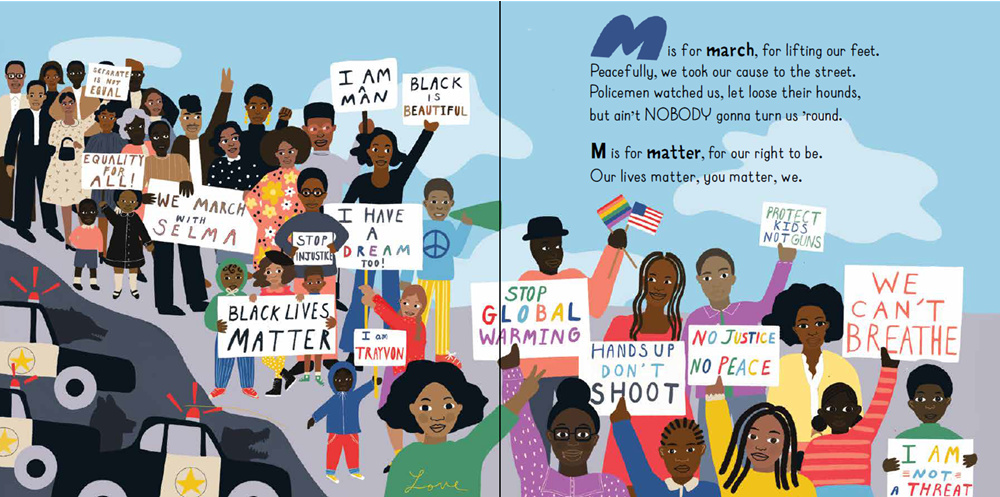
The ABCs of Black History by Rio Cortez, illustrated by Lauren Semmer


The ABCs of Black History written by Rio Cortez,
illustrated by Lauren Semmer
Workman Publishing, 2020, 64 pages

Black History Month 2021 is coming to an end and I thought I would look at a book that has become one of my favorites and one I have used often with my young readers in the last two months. It is a bold and beautiful book that introduces kids to Black culture, heritage, and history. It is set up like a typical ABC book, but each letter of the alphabet is used to frame and celebrate important dates, events, people, and community structures like the church that are so much a part of the Black experience, with most letters used more than once, but no letter needing to be left out or glossed over. Told in rhyming stanzas, it is a look back at the past and what has been accomplished, a look at the present and what is being done, and a look forward to the future and what more can and needs to be done in the fight for freedom and equality, beginning with A is for anthem.

This is also a book that is meant to empower young readers with pride in who they are (B is for Beautiful - I'm talking to you!/ Your voice, your height, your hair, your hue.); what they can do (R is for rise, to reach for the top,/ relentlessly striving, refusing to stop.); and where they come from (D is for diaspora - pulled from our homes,/ we were carried away in ships on the foam/ to Haiti, Cuba, America, Brazil.) Included in this journey are important and influential roles models, such as scientists like Katherine Johnson,  inventors, politicians like Shirley Chisholm and President Barack Obama, artists, musicians and writers among those celebrated are Toni Morrison. James Brown and, of course, James Brown, as well as places like Harlem where some were able to explore and hone their talent.


Everything included in this work is a unique part of Black history, and yet, the information never overwhelms readers with facts and dates, rather it serves as an invitation to find out more. The illustrations are bright, bold and beautiful, just like the message, digitally done in cut paper collage. There is extensive front and back matter with resources for anyone wanted to explore more, as well as list of Terms and Figures used in throughout the book. So, for example, if your reader doesn't know who Langston is, they can find more detailed information about him there. This is a book that is a wonderful celebration which not only empowers its readers, but it also serves as a call to action for them to add their voice.


I read this with my young readers several times, and while none are African American, they are nevertheless children of color who could relate to so much of what is included in this book. And I think that part of the beauty of it is that it will appeal to all children of color and open their eyes to some of the same ideas about themselves and who they are. 

The ABC's of Black History is a beautifully thought out, well crafted book that every parent, teacher and child should own, read, discuss and use all year round. 

This book is recommended for everyone who cares.
This book was gratefully received from the publisher.

Friday, February 7, 2020

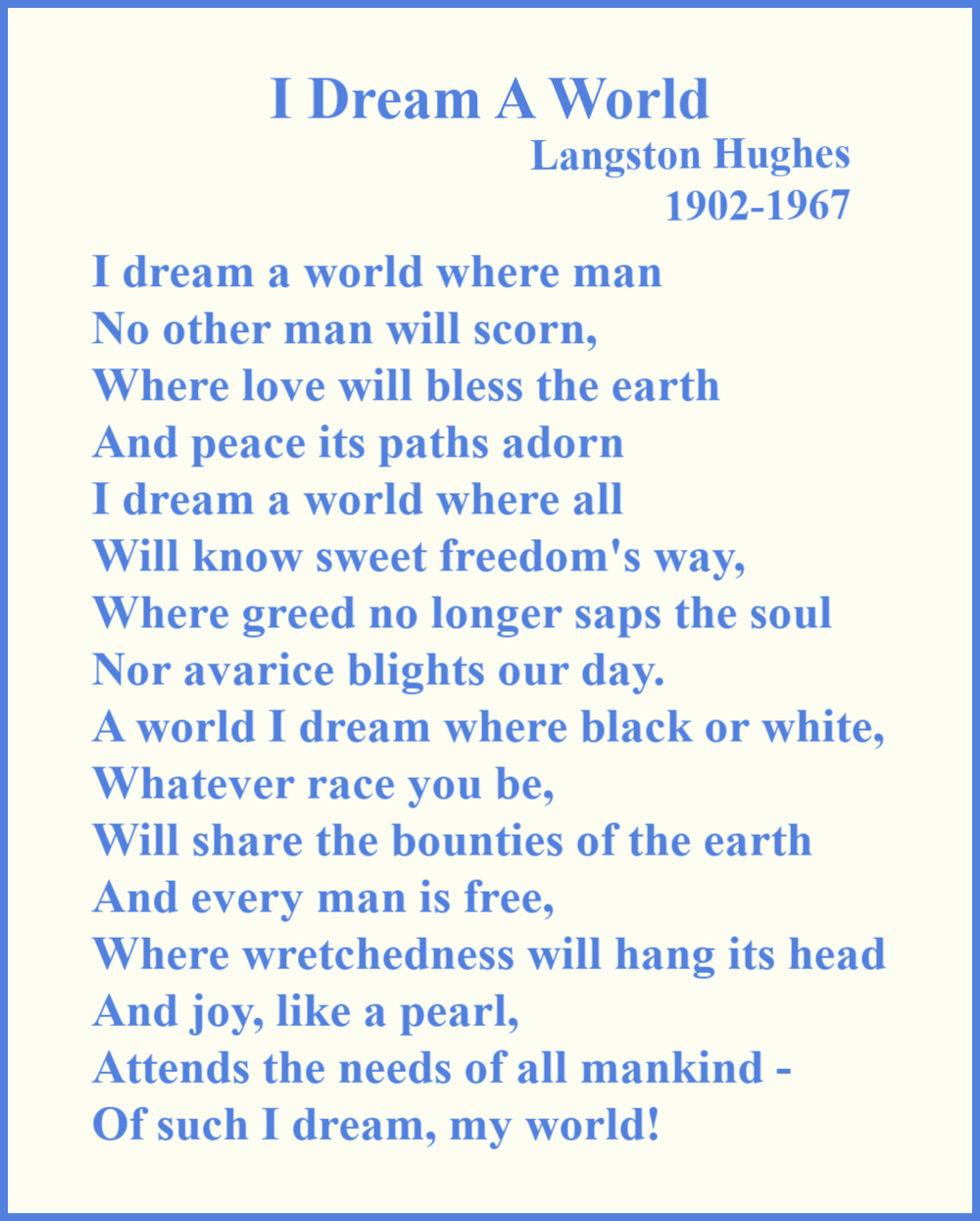
Poetry Friday: I Dream A World by Langston Hughes


This is one of my favorite Langston Hughes poems and since it is Black History Month, I thought I would share it today. It's also one of the poems I would regularly use in the classroom when I taught in the Bronx. I think it is especially poignant in light of recent events in here and abroad.


Poetry Friday is a weekly blogging event in which poets, writers, readers, and lovers of poetry share blog posts about poetry. Poetry Friday is being hosted today by Laura Purdie Salas at Small Reads for Brighter Days

Monday, February 4, 2019

Africville by Shauntay Grant, pictured by Eva Campbell


In an article for CBCBooks, Shauntay Grant says that when she began writing her tribute to Africville, she had originally intended it to be a poem, a tribute to this once thriving community of black refugees, including runaway slaves from America, located in Halifax, Nova Scotia. The poem was to be about her visit to the site where Africville had once been, and which had lasted 150 years before the government tore it down. But when she said the words she had written spoken aloud, she knew it had to be made into a children's picture book.  That book, of course, is Africville.

A young black girl implores "Take me to the end of the ocean.." and as she walks around the area where Africville once stood, she imagines what life was like for the people who had lived there and "where home smells like sweet apple pie and blueberry duff." More scenes of life greet her as she walks along and imagines kids picking berries from bushes thick with them, as her mind's eye sees other kids in a field playing football, still others rafting down a pond, and some catching cod fish from a dock.
Africville was home, where the pavement ends and family begins, where the young girl's family name is marked in stone, and people still come together and sing the old songs and share stories, and have memories of Africville. And though Africville is no longer a vibrant black community, its memory sparks dreams that turn to hope that never ends.
Told in spare, dreamlike lyrical language, Grant paints a picture of what home was for the people of Africville, complimented by the oil and pastel illustrations that carry the same sense of reality, yet are dreamily detailed to represent imagination. Africville is such a beautiful, loving homage to what was such an important part of American and Canadian black history.

What happened to Africville:
At the back of the book is a short history of Africville and its sad demise. This vibrant community may have been called home by many people, but it also lacked basic services, like paved roads, running water, sewers. Although the residents paid municipal taxes, it was decided by Halifax city officials to relocate its inhabitants and demolished Africville in the 1960s instead of making any attempt to bring those basic services to the residents - 150 years of history gone just like that.

Grant ended her tribute to Africville's history on a hopeful note - the young girl is a descendant of former residents, who have been having reunions there since 1983 of which she is a part.

Africville is an beautifully written, important work depicting one part of the rich history of black Canadians and Americans that shouldn't be forgotten. If you would like to explore the history of Africville, you can at the Africville Story Map, an interactive history,

This book is recommended for readers age 5+
This book was borrowed from the NYPL

Thursday, February 15, 2018

Blog Tour: Heroes of Black History: Biographies of Four Great Americans by the Editors of Time for Kids


Just in time for Black History Month 2018, Time for Kids has published a book spotlighting four heroes of black history from Harriet Tubman, to Jackie Robinson, Rosa Parks, and, of course, Barack Obama. Each one of these courageous Americans has contributed so much in the fight for social justice for African Americans, and in fact, for all persons of color.

 Each 40 page biography begins with a look at the person's childhood, influences of family and school that helped them become who they were/are. Each section also contains a mix of photographs and illustrations as well as maps and inserts with additional information to give a more depth to each person's achievements, and ends with a two page recap of important dated in their lives. Heroes of Black History is ideal for readers in middle school, and the large print and clear sentences makes this an especially good book for older reluctant readers.

Young readers will learn about what an important part of the Underground Railroad Harriet Tubman was, and how, in the first half of the 1800s, she led over 300 slaves to freedom, risking her own life each time. Later, during the Civil War, Harriet worked tirelessly caring for injured Union soldiers, and, at the same time, continuing to help free more than 800 slaves. Harriet is truly an inspiring and audacious hero for kids.

Jackie Robinson was not just a great athlete, but also a groundbreaking African American. First, in the US Army during WWII when he stood up for what was right, even facing a court martial for not giving up his seat on a military bus after the army was desegregated. Later, Jackie became the first African American to play on a major league team when he joined the Brooklyn Dodgers in 1947. Imagine how much courage it must have taken in the face of all the discrimination and prejudice Jackie had to deal with in his fight for social justice.

Rosa Parks probably never imagined how much her life would change the day she refused to give up her seat on a city bus in 1955 in segregated Montgomery, Alabama. Despite fear, Rosa also believed in fighting for what was right and she was tired of living a life of separate and unequal. Rosa's arrest led to the famous bus boycott in Montgomery when working people refused to ride city buses to their jobs in solidarity with Rosa. After buses were desegregated almost a year later, Rosa spent the rest of her life working for social justice for African Americans. Rosa is an inspiring example of how one person can really make a difference.

Even before he was elected our first African American president, Barack Obama has spent his adult
life serving people. First, as a community organizer in a poor section of Chicago, advocating for and with the people there to improve their lives and their community. Later, Barack became a United States Senator, with the same ideas about improving life, especially for the African American communities he represented. And that didn't change much when he was sworn in as President Obama on January 20, 2009.

President Obama is the only present day hero included in this book, and I think his story shows young readers that he is more than just a public figure, that his family is of utmost importance to him and it is from them that he garners the desire to fight for change to make the world a better place. I hope kids will realize, as I have after reading this book, that he served his time as President with grace and dignity for 9 years, showing strength, humor, and resiliency in the face of so much opposition. And I believe kids today will reap the benefits of this youthful leader who still has many great years of achievement ahead of him.

Heroes of Black History is an excellent resource for both school and home libraries. In addition to the book, the editors of Time for Kids have also produced a detailed downloadable PDF Curriculum Guide that also includes a printable Fast Facts sheet for all four of these heroes.

This book is recommended for readers age 9+
This book was provided by Blue Slip Media

Sunday, February 11, 2018

Black History Month: Some New Favorite Picture Books


February is Black History Month, and every year, there are more, but definitely not enough, wonderful books published that offer inspiring stories about people and events who have contributed to Black History. Here is a small roundup of some of the newest books (OK, there's one older book, too). For even more suggestions of books that can be read at home or in the classroom, please visit: Colours of Us.
Let the Children March by Monica Clark-Robinson,
illustrated by Frank Morrison
2018, Houghton Mifflin Harcourt, 40 pages
In 1963, in Birmingham, Alabama, Dr. Martin Luther King, Jr. called for an army of peaceful protesters to mobilize against Jim Crow Laws and to fight for African American freedom. But if adults marched, they knew there would be trouble with their jobs and they had families to take care of. King's call was answered by Birmingham's children. Despite the fears of the narrator's parents, she and her brother choose to march in their place, knowing that they might be arrested. The young marchers face not only jail, but also water hoses, police dogs, and angry white people, yet, they keep going day after day. By keeping the sister and brother nameless, they represent 'everychild' who risked their lives and marched in this Children's Crusade. The simplicity with which the text of this book is written makes clear the determination of these young marchers, who never wavered in their mission. Morrison's boldly colorful oil painted illustrations realistically reflect the courage, strength and determination of these brave young people. Be sure to read the Afterword, and Artist's Statement in the back matter. Complement this book by paring it with Cynthia Levinson's The Youngest Marcher: The Story of Audrey Faye Hendricks, a Young Civil Rights Activist
Trailblazer: The Story of Ballerina Raven Wilkinson by Leda Schubert,
illustrated by Theodore Taylor III
2018, Little Bee Publishers, 40 pages
When Raven Wilkinson was 5 years old, her saw her first ballet and was smitten with dance. When she was 9, her uncle gave her ballet lessons for her birthday. It didn't take long for her teacher, the well-respected Madame Maria Swoboda, to recognize that Raven was a student with real talent. In 1953, Raven started Columbia University, and auditioned for the Ballet Russe. In 1955, at Raven's third audition, she was finally selected to dance with the Ballet Russe de Monte Carlo. The ballet traveled quite a bit, and, being African American, Raven often met with racist attitudes in southern states that sometimes almost turned into physical danger. Nevertheless, Raven stayed with Ballet Russe for six years, leaving in 1962 for Holland and the Dutch National Ballet, where she danced for seven years. Returning to the US, Raven danced with the New York City Opera until 1985. Raven was a truly courageous trailblazer, paving the way for Misty Copeland to become the first African American principle dancer with the American Ballet Theater. Theodore Taylors line illustrations have the quality of simple comic book images but make no mistake, they convey with clarity both the happiness and seriousness of Raven Wilkinson's career and they do not shy away from the racist obstacles she faced as a young African American dancer. Be sure to read the forward by Misty Copeland, and the Afterword by Raven Wilkinson. Pair this with Firebird: Ballerina Misty Copeland Shows a Young Girl How to Dance Like the Firebird. 
The United States v. Jackie Robinson by Sudipta Bardhan-Quallen,
illustrated by R. Gregory Christie
2018, Balzer & Bray, 40 pages
Jackie Robinson had to deal with segregation every day of his life growing up in Pasadena, California, including in college despite being one of the most talented athletes in the country. Realizing he could never play professional sports because he was African American, Jackie left college, and when the US entered WWII, he enlisted in the army. The army was still segregated, but by 1944, Jackie had been promoted to second lieutenant. When the army was ordered desegregated, Jackie got on a military bus one day and sat where he wanted, but not where the bus driver wanted him to sit - in the back of the bus. Jackie refused to move. He was arrested and faced a court martial - but he stood up for what he believed was right and won. Jackie went on to become the first African American to play on a major league baseball team - the Brooklyn Dodgers. Bardhan-Quallen has written an inspiriting biography of this trailblazer who never backed down because of his race. Christie's acryla gouache illustrations reflect the quite dignity of Jackie Robinson's life. Pair this with Between the Lines: How Ernie Barnes Went from the Football Field to the Art Gallery
Between the Lines: How Ernie Banks Went from the Football Field to the Art Gallery
by Sandra Neil Wallace, illustrated by Bryan Collier
2018, Paula Wiseman Books, 48 pages
When Ernie Barnes was a young boy, he loved to draw, and after seeing the art hanging in the library where his mother worked, he knew he wanted to be an artist. But becoming an artist wasn't the easiest thing. Because he was 6'3" Ernie was recruited to play football, first for his high school, than in college, and finally in the pros. But Ernie never gave up his dream of being an artist, even after his coach tore up his sketchbook. As a football player, Ernie observed everything he saw with the eye of an artistic, not a player and much of what he saw was later realized on canvas. Luckily, after being injured, Ernie was offer a position with the New York Jets - as official team artist at full salary. I'm a girl who doesn't know very much about football, so I really appreciated the way Wallace focused on Ernie's drive to be an artist rather than a player. Wisely, Collier didn't try to imitate Ernie's style of art, creating his own dynamic watercolor and collage illustrations. There's plenty of back matter in this well researched book, including a Historical Note, an Author's Note, an Illustrator's Note. There are also suggestions for learning more, books for further reading, videos and films of interest, and Additional Resources.
Ella Fitzgerald: The Tale of a Vocal Virtuosa by Andrea Davis Pinkney with
Scat Cat Monroe
illustrated by Brian Pinkney
2002, Jump at the Sun, 32 pages
Ella Fitzgerald was the Queen of Scat, so it only makes sense that her story should be told by the very hip Scat Cat Monroe, complete with zoot suit and spats. Scat Cat traces Ella's rise to stardom, dividing her story into four record tracks, cut to cut. Track 1, Hoofin' in Harlem, covers career from its beginning at the Apollo Theater's talent contest as scared 17 year-old dancer turned singer.Track 2, Jammin' at Yale, finds Ella a singer with the Chick Webb Orchestra making beautiful music together at Yale. Track 3, Stompin' at the Savoy, Ella and the Chick Webb Orchestra play Harlem's very popular Savoy Ballroom, where Ella sang and dance her heart out and the two made beautiful music together, even defeating the Benny Goodman Orchestra in a Battle of the Bands. Track 4, Carnegie Hall Scat, finds Ella joining the king of bebop Dizzy Gillespie. It didn't take Ella long to make bebop, "jazz on the wild side," all her own. Together, Ella, by now truly the "first Lady of Song," and Dizzy brought bebop to Carnegie Hall. Scat Cat's jazzy narration is reflected in Brian Pinkney's sometimes playful, always vibrantly colored acrylic on scratchboard illustrations really capture all the energy of a jazz track. Jazz is a true African American music genre, and Black History Month is an ideal time to introduce it and its history to young readers. This pairs nicely with the Pinkney's book Duke Ellington: The Piano Prince and His Orchestra.

Sunday, February 26, 2017

Three Picture Books about The Great Migration


The Great Migration was a historical transformation in which over six million African Americans left the farmlands and cotton fields of the rural south for better jobs in the industrialized north between 1916 and 1970. It began when America entered WWI, and northern factories and plants needed to replace workers who had left to fight overseas. Migration of African Americans slowed down during the Great Depression, but increased again once the US entered WWII. The Great Migration is an important part of Black history and below are three picture books that allow young readers to understand the experience of those courageous people who chose to pick up stakes and move away from the south, in the hope of a better life.
The Great Migration: An American Story
Paintings by Jacob Lawrence
"Migration" a poem by Walter Dean Myers
HarperCollins, 1993, 48 pages, age 5+
A few years ago, the Museum of Modern Art (MOMA) has an exhibit called "One-Way Ticket: Jacob Lawrence's Migration Series and Other Visions of the Great Movement North." It was the first time that all 60 paintings by Lawrence were shown together, as they should be, in over 20 years. The small paintings, done in tempura or gesso on composition board, and originally called "The Migration of the Negro," tell a formidable story when looked at sequentially, and I have to say it was one of the most powerful exhibits I have ever seen.

All 60 of Lawrence's paintings have been reproduced in this picture book for young readers, accompanied by his text telling the story of the great migration. Lawrence, whose family had migrated north as part of the migration, worked on the paintings from 1940 to 1941 at the age of 22, painting the panels all at once, so that the color palette would be the same throughout the series (and, it is). The images are done in a folk art style, but there is nothing simple about them. Although the book loses some of the textural greatness of the paintings, they are still a moving testament to this unique African American experience. The book closes with a fitting poem called "Migration"by Walter Dean Myers.
This Is the Rope: A Story from the Great Migration
by Jacqueline Woodson, illustrated by James Ransome
Nancy Paulson Books, 2013, 32 pages, 5+ 
Narrated by an unnamed young African American girl, this book tells the story of a single length of rope given to her by her grandmother and used as a jump rope, then later used to tie the family's belongings to the car when they moved from South Carolina to New York City, where it becomes a jump rope again. The rope continues to be used by the family whenever needed, until it is too threadbare to use anymore. It is finally returned to the grandmother who found it so many years ago in South Carolina. Woodson uses an ordinary length of rope both literally and metaphorically to tie the four generations in the story to one another over time and place. Ransome's bright oil paintings, done in a palette of yellows, browns and oranges, continue the story line in his realistic illustrations that include very timely details from each generation. Be sure to take the time explore the illustrations.
The Great Migration: Journey to the North 
by Eloise Greenfield, illustrated by Jan Spivey Gilchrist
Amistad Press, 2010, 26 pages, age 5+
In a series of free-verse poems, Greenfield chronicles the great migration through the eyes of those who have decided to leave their homes in the south and to head north for a better life. The poems are written chronically, beginning with news about life up north, away from the fear and violence of the Ku Klux Klan. It is followed by a number of poems exploring the mixed feelings of those who have decided to make the move. Each person is left unnamed, identified only as, for example, man, woman, boy and girl, giving them a somewhat Everyman persona, even as they are personalized by expressing their feelings about leaving.  At the center is a lone poem called "The Trip." It details the train ride and what the riders experienced as they leave everything familiar behind them.  This is followed by a poem that speaks to the fears of the travelers about having made the right decision, as they arrive at their destination. The last poem, "My Family"is the most personal poem, a tribute to the author's family and their move north when she was only 3 months old. Gilchrist's mixed-media collage illustrations perfectly compliment the Greenfield's poems. You will notice, as you explore these details illustrations, that she has incorporated faces taken from photographs into them. And do explore each page, as there is so much to notice and talk about.

If you are looking for more information on The Great Migration, The Schomburg Center for Research in Black Culture, which is part of the New York Public Library, produced an excellent, in-depth online presentation in 2005 that you can find HERE

FEBRUARY IS BLACK HISTORY MONTH

Wednesday, February 22, 2017

Shackles from the Deep: Tracing the Path of a Sunken Slave Ship, a Bitter Past, and a Rich Legacy by Michael H. Cottman


Michael H. Cottman may be a Pulitzer Prize winning African American journalist and author, but he is also a passionate scuba diver. And it was because of his love of diving that he was brought into the history of a slave ship called the Henrietta Marie while attending a meeting of the National Association of Black Scuba Divers in Key West, Florida in 1992.

The story of the Henrietta Marie began in 1981, when shackles had been found on the floor of the Gulf of Mexico. This was followed by the discovery of a ship's cannon, and finally, a few years later, a ship's bell. The bell was an important archaeological find because it gives the name of the ship and the date of the bell - Henrietta Marie 1699.

Knowing it was a slave ship, and feeling a strong emotional connection to the Africans that had been crammed and shackled in the ship's hull, Cottman decided he wanted to trace the history of the Henrietta Marie and to understand just how the slave trade worked. His quest was a much personal as it was professional.

Cottman's journey began in London, England, where he was able to learn more details about the slave trade, including the sheer numbers  of slaves exported annually (between 12,000 and 15,000), most kidnapped by raiding parties in Africa. While in England, Cottman also traveled to the location of the foundry that produced the cannons discovered on the Henrietta Marie.

Each piece of information Cottman discovered only led him to more questions and he found himself compelled to really follow further and further in the wake of the Henrietta Marie. From England, Cottman went to Barbados in the West Indies, where slaves were sold to wealthy plantation owners, then on to Jamaica, another port where slaves were also sold.

Finally, Cottman traveled to Africa, arrived in Dakar, Senegal. Here, he visited Gorée Island. Here, the author explains, is the House of Slaves (Maison des Esclaves), where kidnapped Africans would be chained up to wait in the heat until it was time to walk through the Door of No Return and board ships like the Henrietta Marie that would take them far from their homes to be sold at auction.

Cottman quest was an emotional one for him personally, knowing that he had descended from Africans like the ones who were on the Henreitta Marie. In a sense, that makes their story also his story. Does his journey provide Cottman with any kind of closure about his own history, or is it impossible to come to terms with the kind of inhumane, brutal treatment shown to the men, women, and children by their Europeans captors?

Michael Cottman's journey to discover the history of the slave ship the Henrietta Marie is both an informative endeavor and an emotional one. Certainly, his own emotions from the gamut of deep sadness to anger. But, he also includes a lot of information most likely unknown by the reader from each person and place that he visited, such as the Door of No Return in Senegal.

I found it so interesting that each place that Cottman visited, and wherever it was possible, he felt a compulsion to dive into the waters where the ship had been moored, feeling that it was a way to connect more strongly to the Africans who had been there before him and under such terrible conditions.

And while the writing has a definite journalistic feel to it, it is not unpleasant, difficult or graphic, and is a means for Cottman to include a lot of background information without sounding pedantic.

Shackles from the Deep is Michael Cottman's is homage to those many nameless men, women, and children who were taken out of Africa against their will, and he had given them a voice readers won't soon forget.

This book is recommended for readers age 10+
This book was sent to me by the publisher, National Geographic


FEBRUARY IS BLACK HISTORY MONTH

Wednesday, February 1, 2017

Garvey's Choice by Nikki Grimes


Garvey's dad always wanted his son to be a jock, someone he could shoot baskets with and bond with over sports talk. But middle grader Garvey would much rather settle in with a good sci-fi novel, learn more about astronomy and listen to his favorite music. Garvey has a best friend, Joe, who shares his love of music, and with whom he likes to play chess and make up knock knock jokes.  Garvey's older sister Angie is the family jock - a great soccer player. Why can't his dad be happy with that and just accept Garvey for who he is?

It's a question that causes Garvey to overeat, pushing his feeling down with food and soda. Kids have always teased and bullied him because of his weight, even his sister indulges in what she calls good natured kidding about it, never thinking about how it hurts her brother.

So Garvey is understandably dreading the new school year that is about to start. And the cruel teasing begins immediately. But at least there is Joe to eat lunch with and Joe who encourages Garvey to try out for the chorus. In chorus, Garvey meets Manny, an albino boy. The two become good friend, hanging out together when Joe has a schedule change. Manny has accepted that he has albinism and just doesn't care what others think about it.

In chorus, Garvey learns to accept what he can to well (with a little help from his friends), and to his surprise he discovers his dad also has a love of music, especially the music of Luther Vandross. When Garvey is given the coveted tenor solo for the chorus's school concert, he finally finds a way to connect with his father and make him proud of who Garvey is. And the confidence Garvey gains from his talented singing begins to change how people see and treat Garvey in school, as well.

Garvey's Choice is a short, poignant novel in verse about friendship and self-acceptance and I think Garvey's journey is one that many readers will be able to relate to, whether they sooth their hurt feelings with food or other means. The middle school years are a time when kids are trying to not stand out from the crowd so it is encouraging to read a novel that deals with the kind of bullying being different can lead to.

Nikki Grimes is one of my favorite verse novelists. She gives her readers not just a wonderful story, but she also introduces them to different verse forms in her books and does them all so well. For Garvey's Choice, she used Tanka, an ancient Japanese form meaning "short poem." Grimes gives a fuller explanation of this poetic form and her modern use of it at the end of the book. Short poems also make this an excellent novel for reluctant readers.

You might want to consider pairing Garvey's Choice with Planet Middle School, another novel in verse about a young girl entering a new phase in her life. In my review of that book, I said that one of the things I loved about Planet Middle School is that "the protagonist is African American but it is not about being African American per se, it is about being a girl entering a new phase of her life and that makes the story really universal." The same holds true for Garvey's Choice.

This book is recommended for readers age 9+
This book was borrowed from the NYPL

FEBRUARY IS BLACK HISTORY MONTH

Sunday, February 28, 2016

Black History Month: More Favorite Picture Books: Nonfiction


My niece was visiting me for a while this month and before she left to go home, we sat down and went through some nonfiction picture books with which to end Black History Month.  My collaborator is 11 years old and an avid reader, and even though she doesn't read many picture books anymore, we spent a few very nice afternoons choosing our favorite picture books for this post and our earlier post. We also chose a few middle grade books, but February ended before we got to them, so you will be hearing about them throughout the year.   


The First Step: How One Girl Put Segregation on Trial
by Susan E. Goodman, illustrated by E.B. Lewis
Bloomsbury, 2016, 40 pages (Age 6+)


In 1847, Sarah Roberts, 4, was attending the school closest to her home when she was suddenly pulled out and told she could no longer attend the Otis School, one of Boston, MA's best.  The reason: Sarah was African American and the Otis was for white kids only.  Knowing how far Sarah would have to walk and how ill-equipped the nearest Black school was, her parents filed a lawsuit hoping the change things.  Although they lost, Sarah's story is well worth reading.  In 1855, Boston integrated the schools there, as did some other states, it wasn't until 1954 that desegregated schools became the law of the entire country,  This picture book for older readers included a Timeline, a What Happened to Our Heroes section, some Sources and Resources and an Author's Note.


George Washington Carver by Kitson Jazynka
National Geographic Children's Books, 2016, 32 pages (Age 5+)

In this Level 1 National Geographic book, beginning readers are introduced to the life of George Washington Carver.  Born into slavery around 1864.  After his mother was kidnapped, George was raised by his owner's, Moses and Susan Carver.  He was taught to read there, but wasn't to learn more and at 13, ran away to attend a school for black children.  Interested in agriculture and farming, George made it through college and began to teach farmers how to grow sustainable crops.  George also found hundreds of uses for peanuts through his work and research.  I included George in this roundup because I realized when I picked up this book, that I haven't heard the name George Washington Carver since elementary school.  And yet, he is such an important part of African American history.   


Voice of Freedom: Fannie Lou Hamer, Spirit of the Civil Rights Movement 
by Carole Boston Weatherford, illustrated by Ekua Holmes
Candlewick, 2015, 56 pages (Age 9+)

Told in beautifully written first-person free-verse poetry, and accompanied by equally stunning collage illustrations, the life of Fannie Lou Hamer unfolds page by page.  Born in Sunflower County, Mississippi in 1917, grew up in the Delta witnessing her parents hardships, mistreatment and poverty as sharecroppers.  Fannie was subjected to indignities and humiliations herself, living under the yoke of Jim Crows laws, failing an unfair literacy test when she tried to register to vote, threatened for encouraging other blacks to vote, and beaten almost to death after sitting at a whites-only lunch counter.  But Fannie's persistence led her into the Civil Rights Movement, where she was a force to be reckoned with at the 1964 Democratic National Convention.  As soon as you open this incredible book, you will understand why it received so many awards this year.  Don't overlook the Author's Note, the Timeline, Sources and Select Bibliography.  


Ellington Was Not a Street by Ntoozake Shange, 
illustrated by Kadir Nelson
Simon & Schuster, 2004, 40 pages (Age 5+)

Playwright/poet Ntozake Shange takes the reader inside her childhood home where her parents welcomed some giants in the world of African American arts and politics.  Set among the lines from her poem about those days, "Mood Indigo" are some who may be very familiar to readers: musicians Duke Ellington and Dizzy Gillespie,  NAACP founder W.E.B. DuBois, Civil Rights activist Paul Robeson, and others who may not be so easily recognized: jazz musician Ray Barretto, singer Sonny Til, Welterweight Champion (1958) Virgil Atkins.  Shange's poem is a tribute to and celebration of all the men and the influence they had on her life and on the lives of all African Americans.  Kadir Nelson's beautiful realistic paintings highlight and commemorate their visits to Shange's home on each page.  Shange's poem "Mood Indigo" is recounted on the last page.


My Story, My Dance: Robert Battle's Journey to Alvin Ailey
by Lesa Cline-Ransome, illustrated by James E. Ransome
Paula Wiseman Books, 2015, 48 pages (Age 5+)


Robert Battle may not be a familiar name to many young readers, but he is the artistic director of the Alvin Ailey American Dance Theatre.  But dancing wasn't always a dream for Robert, who wore braces on his legs as a child to straighten his bowlegs.  Growing up in Liberty City, FL, Robert began studying martial arts at age 12, to provide him with some defense on the streets, where he was often picked on and called names.  Dancing didn't come into his life until age 13 and he was a natural, eventually attending  Julliard School on a full scholarship.  Battle's life is such a wonderful example of how one kid followed his dream despite obstacles.  James Ransome's pastel illustrations capture the movement of the dance so beautifully, as well as the important moments in Battle's life.   


Michelle by Deborah Hopkinson,
illustrated by AG Ford
Katherine Tegen Books, 2009, 32 pages (Age 5+)


Michelle Robinson Obama is our country's first African American first lady and who has shown herself one of the most more active and accessible first ladies to date.  Michelle grew up on the South Side of Chicago with her parents and brother.  Education was important in her home, so Michelle was allowed only one hour of TV a day (her favorite show: The Brady Bunch).  After attending Princeton University and Harvard Law School, she returned to work as a lawyer in Chicago.  One day, her firm asked to advise another Harvard law student -  Barack Obama.  This is a nice, straightforward biography of Michelle Obama, who is indeed an wonderful inspirational figure for young girls.  AG Ford's expressive, realistic illustrations compliment the text, adding insight to Michelle Obama's life. I think the quote from Michelle Obama and used on the back cover sums up her life philosophy perfectly and seems to be the perfect way to bring Black History month to a close this year:

"Don't let anybody set the limits of your dreams."

FEBRUARY IS BLACK HISTORY MONTH


Nonfiction Picture Book Challenge is a weekly celebration of 
nonfiction books hosted by Alyson Beecher at Kid Lit Frenzy

Wednesday, February 24, 2016

Nonfiction Picture Book Wednesday: We've Got a Job: The 1963 Birmingham Children's March by Cynthia Levinson


Can you imagine letting your children voluntarily go to jail?  Well, that is exactly what happened in Birmingham, Alabama on May 3, 1963 when 4,000 young people skipped school in order to participate in the Children's March protesting segregation, a march that they knew would ultimately end with their being arrested.  This was a time when the Civil Rights Movement was gaining momentum - adults and children, supporters and enemies.

Right from the start, Levenson introduces the reader to four of the young people who took part in the Children's March.  They are a interesting cross-section of the participants.  There's 9 year-old Audrey Faye Hendricks, whose educated, middle class parents had been involved in the Birmingham Civil Rights Movement since the early 1950s.  Audrey was a diligent student , who carried a game with her on the march to have something to do in jail after being arrested.

Washington Booker, 14, lived in abject poverty before moving into public housing when he was 8.  Wash didn't have much use for school, skipping most days to hang out with his friends.  He had no idea that children all over Birmingham were about to demonstrate with the intention of being arrested to make their point.  Wash had already had experience with the police, yet he ultimately, though reluctantly volunteered to go to jail for the cause of Civil Rights.

James W. Stewart, 15, was a serious student, whose middle class parents lived in a home with a pool. When the pools and parks were closed to the black community in Birmingham, James and his parents welcomed the kids from the projects to spend summer days at their house.  Acutely aware of what was happening around him in Birmingham, and not possessing the fortitude to take part in passive, non-violent demonstrations while people hurled garbage at him, James decided that marching and being arrested felt like the right thing for him to do.

Arnetta Streeter, 16, was inspired to get involved in the Civil Rights Movement after hearing Dr. Martin Luther King speak.  After thinking long and hard about whether King's nonviolent approach to Civil Rights was for her, Arnetta began training to become a nonviolent protester, even signing the 10 Commandments of Nonviolence pledge, after which she could hardly wait to demonstrate.

Levinson continues with a brief history of Birmingham's segregationist politics, including the white Commissioner of Public Safety, named Eugene "Bull" Connor, a virulent anti-segregationist with an aggressive, violent police force under his command.

The book also traces the evolution of the Children's March, introducing the leaders of the Civil Rights Movement, including Dr. King, Rev. Schuttlesworth, founder of the Alabama Christian Movement for Human Rights, and a 26 year-old pop musician/preacher, James Bevel, who "became the pied piper for the young people."

But what is most compelling about this book is the day-by-day account of the Children's March beginning May 2, 1963 and ending May 11, 1963, when approximately 2,500 young people were arrested and flooded the city jail.

To her credit, Levinson takes what was a very complicated, multi-faceted historical event that involved so many people and so many important events happening simultaneously, and through clear and concise prose makes it accessible to young readers.

By focusing in only 4 of the participants, Levinson makes the story personal and very readable.  In addition, she included sidebars adding more information, copious photographs and important documents from that time.  Levinson's research is detailed and impeccable.  She uses a wide variety of sources, including newspaper accounts, letters, interviews and includes a timeline of events, an Author's Note, a Bibliography and comprehensive Notes citing her sources.

We've Got a Job: The 1963 Birmingham Children's March is an excellent nonfiction choice for anyone interested in history, and especially in the Civil Rights Movement.

You can find an excellent Teacher's Guide HERE

This book is recommended for readers age 12+
This book was an EARC received from NetGalley


Nonfiction Picture Book Challenge is a weekly celebration of 
nonfiction books hosted by Alyson Beecher at Kid Lit Frenzy

FEBRUARY IS BLACK HISTORY MONTH

Monday, February 22, 2016

Black History Month - Some Favorite Picture Books: Fiction


February always catches me up short and this year is not different.  There was the big Cybils Middle Grade Fiction decision for the winning book with my fellow second round judges, and this year Chinese New Year fell in February and, of course, it is Black History Month.

Today I thought I would share some of my niece's favorite picture books.  Because it is an election year and voting is so important, we decided to begin with two books about that.


Granddaddy's Turn: A Journey to the Ballot Box
by Michael S. Bandy and Eric Stein, illustrated by James E. Ransome
Candlewick, 2015, 32 pages (Age 6+)

Michael and his granddaddy do all kinds of things together on their farm, like chores and fishing.  One day, his grandfather puts on his church suit, and takes Michael for a long walk, without telling him where.  What a surprise when they end up at the town hall.  It's voting day and granddaddy will be the first in their family to cast a ballot and couldn't be prouder.  Standing in line for a long, long time because other [white] voters cut in ahead of them, granddaddy has to remind Michael to have patience, "Takes patience to get what you've got coming to you."  But when it is finally granddaddy's turn to vote, the deputy tells him he cannot vote because he can't read.  The look of disappointment on his grandfather's face prompts Michael to promise that someday he would vote for him, a promise he keeps.  The realistic watercolor illustrations by James E. Ransome add so much to this emotional story, that shows the prejudices and the practices that prevented African American men from exercising their right to vote.


Lillian's Right to Voe: A Celebration of the Voting Rights Act of 1965
by Jonah Winter, illustrated by Shane W. Evans
Schwartz & Wade, 2015, 40 pages (Age 5+)

Follow the long, uphill journey of 100 year-old African American Lillian as she goes to an Alabama courthouse to cast her vote In this picture book for older readers.   As she climbs upward, Lillian recalls her family's history - from her enslaved great-great-grandparents and their baby Edmund being sold on the courthouse steps, to her enslaved great grandfather Edmund picking cotton from early morning to night and his later attempt to vote after the Fifteenth Amendment guaranteed him that right, to her grandpa Issac being charged a poll tax, and her uncle Levi asked impossible questions to answer, like "how many bubbles in a bar of soap?"  Later her parents would be chased away from the polls by an angry mo, a cross burned on their property and Lillian's first failed attempt to vote.  But as she nears the courthouse, she also recalled the Civil Rights Movement and the men and women who fought for voting equality for all African Americans and the passage of the Voting Rights Act of 1965.  Set in narrative form, Lillian's life allows for a timeline of African American history right up to the point where she presses the lever to cast her vote.  There is a sad note at the back of the book about how the Voting Rights Act was dismantled by the Supreme Court in 2013.  This is an incredible book for kids to read and on that will work really well in classrooms and for homeschooling.   Shana Evans's mixed media illustrations really capture the long, hard upward climb, both historical and for Lillian personally.

When my niece and I were deciding which books to include in this post, we thought it would be nice to include books about ordinary kids, too.  As my niece reminded me, they are also part of Black History month.

Amazing Grace by Mary Hoffman, illustrated by Caroline Binch
Dial Books, 1991, 32 pages (Age 4+)

I picked this book because my mother's name is Grace, and because I love the message that Grace can be anything she sets to mind on.  Grace loves to hear and to make up stores, and then to act them out.  Naturally, when her teacher announces that they will be performing Peter Pan, Grace wants to play Peter.  But two of her classmates tell her she can't to that - after all, Grace isn't white and she isn't a boy.  Discouraged, Grace's grandmother takes her to see the ballet Romeo and Juliet, starring a young, black dancer in the role of Juliet.  Lesson learned, Grace gets the part of Peter Pan and is a great success. Amazing Grace is such an uplifting book, and Grace is such a wonderfully enthusiastic character, really so inspirational in how she lives her life.  I gave this to my niece when she needed some encouragement and she says she goes back to it whenever she feels she needs some reassurance (she's 13 years old now).  Caroline Binch has really evoked Grace's infectious spirit with her realistic watercolor illustrations (and I love that she illustrated Grace with a big smile even with her front teeth missing.  So many kids refuse to smile when they loose front teeth).


The Paperboy written and illustrated by Dev Pikey
Scholastic, 1996, 32 pages (Age 4+)

Every morning, while it is still dark and everyone else in his family is asleep, a young boy and his dog quietly get out of their warm bed, eat some breakfast, then head out to the garage to fold a bunch of newspapers, getting them ready for delivery.  Then, the paperboy, with his dog, heads out on his bicycle to deliver the paper to all his customers.  The two pals have done their paper route so often, they know it by heart.  After delivering his last paper, boy and dog head back home and, yup, you guessed it, right back to bed for a while.  Pikey's illustrations, done with acrylics and India ink, really capture the silence and clearness of early morning and you can almost feel the dew forming on the grass. This is a simple, but inspiring story about doing a good job and about the companionship and loyalty of your best canine friend.  My brother used to have a paper route, and while it was a nice way to make some extra money, but it's not an easy job.  Interestingly no mention is made of the young paperboy's race, other then in the illustrations.  


Chocolate Me! by Taye Diggs, illustrated by Shane W. Evans
Square Fish, 2015, 40 pages (Age 4+)

Self-esteem is a fragile thing when you are a child and sometimes it is a child's 'friends' who manage to chip away at it.  In this picture book, the white playmates of a unnamed African American kid are always making comments and asking him questions about his skin color, his hair, his wide nose. Each time, the refrain "Chocolate me" shows how dispirited these things make the young boy.  When he tells his mom that he wishes to be more like those playmates, read white, his mother points out how much she loved all the things that make her son who he is.  Slowly, the refrain "Chocolate me!" shows how the young boy goes from feeling dejection to feeling proud of who he is.  


Firebird: Ballerina Misty Copeland Shows a Young Girl 
How to Dance Like the Firebird
by Misty Copeland, illustrated by Christopher Myers
G.P Putnam, 2014, 40 pages (Age 5+)

Let's face it, Misty Copeland is an incredible dancer, but, as she tells a young girl who is wondering if she will ever be a good a dancer, that she was once in the same place - she came to dancing late, at age 13, and often lacked confidence in herself about her ability,  But, she tells the young girl, with hard work and dedication, she, too, will someday reach great heights with her dancing.  The language  in this picture book is so simple, yet so lyrical - my favorite lines are "each position one through five/stair steps to the sky?/ that's right."  Complimenting the lyrical prose are Christopher Myers illustrations/collages which are every bit as abstract and bold as the Firebird dance itself.  In June 2015, Misty was the first African American to be named a principle ballerina in American Ballet Theatre's 75 year history.  


FEBRUARY IS BLACK HISTORY MONTH

Saturday, February 28, 2015

Saturday Roundup #7: 2015 Black History Month

I had picked out a lot of books for Black History Month this year, but unfortunately illness got the better of me for more than two weeks (and now you know, I'm not one of those efficient bloggers who does her posts in advance).   But I still have a few books I'd like to share with you now that I think reflect this year's theme, A Century of Black Life, History and Culture.


I, Too, Am America by Langston Hughes, illustrated by Bryan Collier
Simon & Shuster BFYR, 2012, 40 pages

Artist Bryan Collier takes the reader on a ride covering past to present, South to North, segregation to integration using as his starting point the spare words of Langston Hughes's well-known 1925 poem "I, too, sing America"about the Pullma porters who worked on the railroad trains.  The illustrations are metaphorical representations of Langston's words, for example, he shows how the porters used to toss the items left behind - newspapers, magazines, records, etc- from the caboose, and sees them as "acting as a conduit of culture, a distributor of knowledge to those who couldn't afford these items on their own." (Author's Note)  This is a beautiful book that will generate lots of discussion and, I hope, a love Langston Hughes's poetry. Collier used mixed media for creating his visually stunning illustrations.  Age 5+


Swing Sisters: The Story of the International Sweethearts of Rhythm
By Karen Deans, illustrated by Joe Cepeda
Holiday House, 2015, 32 pages

In 1909, a school/orphanage was founded by Dr. Laurance Clifton Jones to educate black girls.  Part of the school's curriculum was learning to play a musical instrument.  In 1939, an all-female interracial group called the International Sweethearts of Rhythm was formed.  Embracing the new Jazz music of that time, the Sweethearts played around the country, traveling in a bus called Big Bertha, where they often sleep and ate when the African American members were barred from hotels and restaurants in the Jim Crow south.  The band was particularly popular during World War II, when traditional male bands lost members to the Armed Forces.  A nice addition to the world of jazz picture books.  The very colorful, very upbeat illustrations are done with acrylic and oil paint.  Age 7+


Ruth and the Green Book by Calvin A. Ramsey, illustrated by Floyd Cooper
Lerner Publishing, 2010, 32 pages

It's 1950 and Ruth is pretty excited when her dad brings home a nice new car and the family decides to drive from Chicago to Alabama to visit grandma.  Eager about going on a road trip, Ruth and her family keep running into signs that say "Whites Only"along the way.  Finally, a family friend they stay with for a night, tells them to go to an Esso station and ask for a copy of the Green Book.  The rest of the trip goes more smoothly as Ruth finds places to eat and places to stay that welcome African Americans listed in the Green Book.  The history of the real Green Book is included in the back matter.  This is an interesting and informative picture book for older readers about a part of African American history that most of us are not familiar with.  Cooper's realistic illustrations manage to beautifully capture the whole wide range of emotions that Ruth and her family experience on their road trip to grandma's.  Age 8+


Freedom Summer: The 1964 Struggle for Civil Rights in Mississippi 
by Susan Goldman Rubin
Holiday House, 2014, 128 pages

1964 was an important year in the Civil Rights Movement, particularly the Summer of 1964, when the eyes of the nation were focused on Mississippi and the young, mostly college student volunteers who traveled there to help educate the black citizens about their rights and help them register to vote.  Rubin chronicles the bombings of homes and churches, the creation of Freedom Schools, the jailing and beating of activists, but at the center of the book is the story of three civil rights workers from the north who disappeared and whose bodies were later found.  The book, which is written in chronological order, with copious photographs and other documents of the time, is a wonderful introduction to those difficult days for readers age 10+


28 Days: Moments in Black History That Changed the World
by Charles R. Smith, illustrated by Shane W. Evans
Roaring Brook Press, 2015, 56 pages

Written chronologically and beginning with an African American former slave whose shooting death with three other men was a spark that began the American Revolution, each person or event is included in this unique book is presented in a two page spread.  Smith uses a mix of poetry and prose and each entry is accompanied with a short informative piece about the person or event.  Some of Smith's choices will be familiar to young readers, like Oprah Winfrey, Nelson Mandala and Barack Obama, others may not be, but all contributed something in their own way that made the world a different place than it was before them.  The words are artfully matched with Evans's colorful digital collage and oil illustrations.  This picture book for older readers (age 8+) must be read and studied in order to fully appreciate every aspect of it.  

February is Black History Month

Wednesday, February 25, 2015

The Cosmobiography of Sun Ra by Chris Raschka

Since the theme of Black History Month this year is A Century of Black Life, History and Culture, I thought I would look at this picture book about a very talented African American musician who contributed to making jazz one of the most beloved musical forms around the world.  Jazz has its roots in African American communities, beginning in New Orleans, and spreading quickly to St. Louis, Chicago and New York and the reast of the world and it is considered by many to be a quintessentially black musical art form.

Herman (Sonny) Blount in Birmingham, Alabama in 1914, it quickly became evident that he was a musical genius.  He was a talented piano player by 11 and as a teen, Sonny could notate, compose and even had his own ensemble with singers.  But Sonny was too ordinary an name for someone who felt they really had come from Saturn, so Sonny became Sun Ra.

Sun Ra also noticed that blacks and whites lived separate, very different kinds of lives.  And when the US went to war, he refused to fight and kill people, spending those years in a Pennsylvania forest as a conscientious objector.

When the war ended, Sun Ra was off the Chicago, mastering jazz, do-wop and the blues.  Forming his own bank, the Arkestra, it was time to hit the jazz clubs of New York City, arriving in the 1960s.  From there, the sky was the limit, playing his particular brand of jazz around the world, wearing long colorful robes, necklaces and shiny metal crowns.

Raschka introduces the reader and draws them into the life of Sun Ra by playing a game of let's pretend - let's pretend that Herman Sonny Blount really did come from Saturn (but we know it is only pretend, right?).  He keeps up the conspiratorial tone throughout the book, thereby creating an intimate bond with his readers.  Raschka's colorful watercolor and ink illustrations, done in a palette of fittingly bold black and mostly primary colors, give the feeling of jazzy improvisation throughout the book.

Sun Ra may not be as well known as other jazz musicians like Dizzy Gillespie or Thelonious Monk, but Raschka's obvious love of jazz has now made him and his music accessible to a whole new generation of readers and hopefully, jazz lovers.

And The Cosmobiography of Sun Ra would pair up very nicely with Rascha's other jazz musician biographies - Charlie Parker Played Be-Bop, John Coltrane's Giant Steps and Mysterious Thelonious - for some very jazzy fun.

This book is recommended for readers 7+
This book was sent to me by the publisher, Candlewick Press

February is Black History Month

This is book 3 of my 2015 Nonfiction Picture Book Reading Challenge hosted by Kid Lit Frenzy
 
Imagination Designs