Showing posts with label Activism. Show all posts

Sunday, February 28, 2021

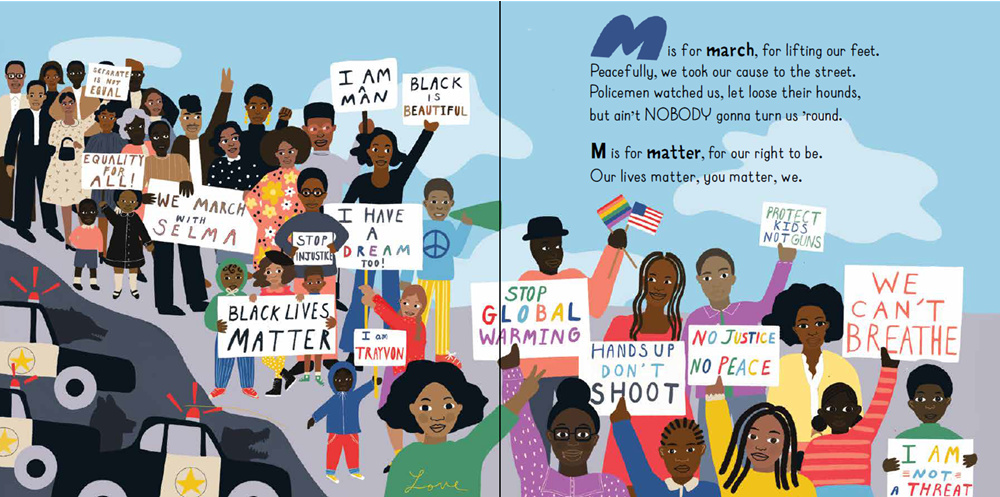
The ABCs of Black History by Rio Cortez, illustrated by Lauren Semmer


The ABCs of Black History written by Rio Cortez,
illustrated by Lauren Semmer
Workman Publishing, 2020, 64 pages

Black History Month 2021 is coming to an end and I thought I would look at a book that has become one of my favorites and one I have used often with my young readers in the last two months. It is a bold and beautiful book that introduces kids to Black culture, heritage, and history. It is set up like a typical ABC book, but each letter of the alphabet is used to frame and celebrate important dates, events, people, and community structures like the church that are so much a part of the Black experience, with most letters used more than once, but no letter needing to be left out or glossed over. Told in rhyming stanzas, it is a look back at the past and what has been accomplished, a look at the present and what is being done, and a look forward to the future and what more can and needs to be done in the fight for freedom and equality, beginning with A is for anthem.

This is also a book that is meant to empower young readers with pride in who they are (B is for Beautiful - I'm talking to you!/ Your voice, your height, your hair, your hue.); what they can do (R is for rise, to reach for the top,/ relentlessly striving, refusing to stop.); and where they come from (D is for diaspora - pulled from our homes,/ we were carried away in ships on the foam/ to Haiti, Cuba, America, Brazil.) Included in this journey are important and influential roles models, such as scientists like Katherine Johnson,  inventors, politicians like Shirley Chisholm and President Barack Obama, artists, musicians and writers among those celebrated are Toni Morrison. James Brown and, of course, James Brown, as well as places like Harlem where some were able to explore and hone their talent.


Everything included in this work is a unique part of Black history, and yet, the information never overwhelms readers with facts and dates, rather it serves as an invitation to find out more. The illustrations are bright, bold and beautiful, just like the message, digitally done in cut paper collage. There is extensive front and back matter with resources for anyone wanted to explore more, as well as list of Terms and Figures used in throughout the book. So, for example, if your reader doesn't know who Langston is, they can find more detailed information about him there. This is a book that is a wonderful celebration which not only empowers its readers, but it also serves as a call to action for them to add their voice.


I read this with my young readers several times, and while none are African American, they are nevertheless children of color who could relate to so much of what is included in this book. And I think that part of the beauty of it is that it will appeal to all children of color and open their eyes to some of the same ideas about themselves and who they are. 

The ABC's of Black History is a beautifully thought out, well crafted book that every parent, teacher and child should own, read, discuss and use all year round. 

This book is recommended for everyone who cares.
This book was gratefully received from the publisher.

Sunday, October 11, 2020

Marjory Saves the Everglades: The Story of Marjorie Stoneman Douglas by Sandra Neil Wallace, illustrated by Rebecca Gibbon

 
Marjory Saves the Everglades: The Story of Marjory Stoneman Douglas
written by Sandra Neil Wallace, illustrated by Rebecca Gibbon
Paula Wiseman Books, 2020, 56 pages

By now, most of us recognize the name Marjory Stoneman Douglas because of the tragic 2018 shooting that happened in the high school named in her honor just east of the Everglades. But few of us know why the school was named after Marjory. Now, thanks to the excellent research by Sandra Neil Wallace, we have our answer. 

In this richly illustrated picture book for older readers, Wallace begins her biography with Marjory's first trip to Florida to visit her dad where she fell in love with the sunshine. Returning home, Marjory grew up, attended Wellesley College, got married and divorced, until finally she headed back to Florida to work as a reporter for her father's newspaper, the Miami Herald. It was there that Marjory found the voice she would need later as an activist.

During WWI, Marjory enlisted in the Navy and went to Europe with the Red Cross. But when she retuned to Florida after the war, she was absolutely dismayed to see how much of the Everglades had disappeared as developers dynamited, dug and drained it to expand post-war building. 
But dismay wouldn't save the destruction of the Everglades, It would take a visit by Ernest Coe, a landscape architect, and a meandering trip with him through the glades that made Marjory realize that the Everglades needed to become "a national park to save the birds, the plants, and the other wildlife."
But how to convince the National Park Service, who felt that 'a swamp is a swamp.' Other people just wanted to drain the Everglades to expand the land and build. But, Marjory wondered, were the Everglades really just a swamp, or were they something else? Something beautiful, living and unique? By now middled aged, Marjory was determined to find the answers to her questions, and dedicated the rest of her life to saving her adopted home from hungry developers, including the U. S. Army. 

And although the area became the Everglades National Park in 1947, it didn't stop developers. But through activism and organization, Marjory and the group she formed, Friends of the Everglades, managed to get developers to reverse their destructive building, restoring this unique ecosystem back to what it once was. 

Marjory Saves the Everglades is a such an inspiring story for young readers, showing them what a difference one dedicated voice can make in the world. Marjory lived to be 108 years old, but was an early activist, a suffragette and feminist, before she became involved in saving the Everglades and Wallace has really captured her independent spirit. The book is written in accessible language, and includes quotes by Marjory from various sources including her own work River of Grass. Marjory Saves the Everglades would make a wonderful addition to any STEM classes learning about ecosystems and the environment. 

Rebecca Gibbon's folk-art style illustrations, done with acrylic inks and colored pencils, are the perfect compliment to a book about the Everglades, done in shades of brilliant greens and blues, and including lots of vibrant birds, grasses and flowers throughout.  

Wallace's back matter includes an Author's Note, a page of creatures and plants indigenous to the Everglades, a Timeline of Marjory Stoneman Douglas and the Everglades, some tips for protecting the environment, as well as additional resources for learning more about this amazing, but overlooked woman. 

You can find an in-depth Discussion Guide courtesy of Sandra Neil Wallace HERE
You can also download an Activity Kit courtesy of Sandra Neil Wallace HERE

MEET THE AUTHOR:
Sandra Neil Wallace hope that her stories inspire readers as much as they inspire her. Her book The Teachers March! How Selma's Teachers Changed History was written with her husband, Rich Wallace, and has received three starred reviews to date. Between the Lines: How Ernie Barnes Went From the Football Field to the Art Gallery received the Orbis Pictus Book Award, was an ALA notable Book and a Booklist Top 10 Biography for Youth. Formerly, Sandra was an ESPN reporter and was the first woman to host an NHL broadcast. She continues to break barriers as co-founder of DailyGoodNH.org and lives with her family in New Hampshire. You can find Sandra at

IMO, Marjory's life and work become even more important these days as we hear about developers eyeing National Parks for their natural resources. 

This book is recommended for readers age 7+
This book was gratefully received from Barbara Fisch at Blue Slip Media

Friday, September 6, 2019

Blog Tour: Strange Birds: A Field Guide to Ruffling Feathers by Celia C. Pérez


For Ofelia Castillo, summer in Sabal Palms, Florida means writing and submitting a winning story to the Qwerty Sholes Journalism Contest. Winners get to spend a week in NYC at journalism camp. All she has to do is find a great story and convince her overly-protective parents to sign the application form.

For Lane DiSanti, summer in Sabal Palms, Florida means living on her grandmother's estate while her parents get divorced, avoiding their phone calls, and not doing any of the things that her grandmother suggests, including joining The Floras, a local scout-type troop for girls under the leadership of Mrs. McAllister. But after reading her grandmother's old copy of The Floras: A Handbook for Sabal Palms Girls, Lane knows exactly how she wants to spend the summer.

For Aster Douglas, summer in Sabal Palms, Florida means helping her grandfather, Sabal Palms University's first Black professor, with research for his family history book about the earliest Bahamian Douglas settlers in Sabal Palms, and cooking new recipes and old favorites for him, while her mother is deployed in Japan.

For Catarina 'Cat' Garcia, summer in Sabal Palms, Florida means Floras meeting, working on the Floras' summer volunteer project, participating in the Floras Centennial and competing be to named Miss Floras, something Cat couldn't care less about but she knows her mother desperately wants it. But Cat would rather spend her summer birdwatching an listening to their song.

But summer suddenly changes when Ofelia, Aster, and Cat receive mysterious invitations to meet at the tree house on the DiSanti estate. After reading The Floras handbook, Lane has decided to begin her own (secret) troop with three girls she doesn't know and who don't know each other, and call it The Ostentation of Others and Outsiders. At first, the girls don't get along very well, and yet, the group does begin to jell once they have a mission. And that mission is to get the Floras to stop using its official hat, adorned with the decorative feathers from endangered birds, and worn by the girl who wins the Miss Floras competition at summer's end. Needless to say, adventures ensue.

Pérez has brought together four diverse girls, each with her own particular talent that lends to the story perfectly, given them a goal and set them free from the lonely, boring summer they thought they would be having. As the girls get to know each other, readers see how their friendship and camaraderie evolves; at first, despite their different personalities, and then, because of them, as they learn to work together to accomplish their mission.

Themes that are explored in Strange Birds are collective power, kids making a difference, animal rights, statue quo and systemic racism, and dealing with casual acceptance past wrongs and how "ruffling feathers" can bring attention and possible solutions to them.

Pérez has created such believable characters that I felt like I really knew them. The story, though well-written, does get off to a somewhat slow start, but once the girls come together that really changes and the book becomes a real page turner.

Fun back matter consists of The Ostentation of Others and Outsiders, A Handbook that consists of Cat's Tips for Beginning Birders, Lane's Crystals for Everyday Use, Aster's Chips + Chips Cookies (which sound delicious), and Ofelia's Guide to Writing What You See, and instructions for DYI Badges (after all, if you're going to have a troop, secret or otherwise, you need badges).

Strange Birds is a book that is sure to become a favorite, and I can't recommend it highly enough.

This book is recommended for readers age 9+
This book was sent to me by the publisher, Kokila, an imprint of Penguin Random House

Meet the Author:

Celia C. Pérez is the author of The First Rule of Punk, a 2018 Pura Belpré Author Honor Book, a 2018 Tomás Rivera Mexican American Children's Book Award Winner, and a 2018 Boston Globe-Horn Book Fiction and Poetry Honor Book. She lives in Chicago with her family where, in addition to writing books about lovable weirdos and outsiders, she works as a librarian. She is originally from Miami, Florida, where roosters and peacocks really do wander the streets. Visit her at celiacperez.com.

Week One
August 27 – The Novel Hermit
August 28 – Books 4 Your Kids 
August 29 – The Young Folks 
August 30 – A Bronx Latina Reads 

Week Two
September 3 – The Geeky Yogi 
September 4 – Lost in Storyland
September 5 – Book Fidelity 
September 6 – Randomly Reading


Be sure to check out the other Marvelous Middle Grade Monday offerings, now being carried on by Greg at Always in the Middle. 

Monday, January 29, 2018

Ahimsa by Supriya Kelkar


It's 1942 and while Britain and the rest of the world are engaged in WWII, in Bombay (today's Mumbai), the Quit India Movement, whose goal is to rid India of British rule and gain independence, begins with a speech by Mahatma Gandhi on August 8th. The very next day, Gandhi is arrested, but it doesn't stop many from still having faith in the Quit India Movement.

Gandhi, a practitioner of Ahimsa, or civil disobedience, had already asked that one member of every family become a freedom fighter for Indian independence. Anjali Joshi, 10, a member of the high born Brahmin caste, knows that some kids in her class have family members who are freedom fighters, but after Gandhi's speech, she is more than surprised to learn that her mother has also joined the fight. And one of the things her mother is focused on is attempting to make the lives of those considered to be untouchable better (Gandhi referred to the untouchable caste as Harjian, meaning children of God, but Anjali learns that they consider it an insult and would rather be referred to as Dalit, meaning oppressed).

At first, Anjali isn't really too happy, especially when her mother makes her burn all of her beautiful foreign-made ghagra-cholis and replaces them with plainer khadi, a handwoven homespun cotton they spin themselves. She is particularly unhappy after her mother shows kindness towards the young Dalit boy, Mohan, who cleans their outhouse, causing him to run away, and then decides that Anjali and she will clean the outhouse themselves.

Slowly and reluctantly, however, Anjali begins to support her mother's attempts at being an activist. They begin attending Freedom Movement meetings together, and after visiting the basti where the Dalits live and getting to know the people better, Anjali decides that it is unfair that the young Dalits are not able to go to school, too. They begin teaching the children in the basti, even finding help from a very surprising source. Soon, Anjali and her mother are working to make it possible for the kids to actually attend the school that Anjali goes to, getting uniforms and tiffins all ready for them.

But the weekend before their first day of school, rioting breaks out between the Hindus and Muslims and schools are closed. Later, Anjali's mother is arrested on charges of helping to instigate the riots. While in prison and still practicing Ahimsa, her mother goes on a hunger strike, and although Anjali is afraid for her, she decides to carry on their work, even as she realizes that she herself must unlearn the prejudices and superstitions that have always been so much a part of her life.

Ahimsa is a debut novel for Supriya Kelkar, and is based on the experiences of her great grandmother, who had joined Gandhi's Freedom Movement so her husband could continue working, much the same way Anjali's mother did.

I found Ahimsa to be a very interesting novel about social injustice in 1940s India that covers quite a lot of historical and political ground, some of which may not be familiar to young American readers. But, Kelkar has taken great pains to make this important period in Indian history accessible, although at times she waxes a little on the didactic side when it comes to describing the political situation.

One of the things I did like is that Kelkar has included a lot of interesting, personal details in her narrative descriptions, including what daily life was like, the kinds of clothing people wore, the food they ate, games kids played and holidays celebrated as well as accounts of living conditions of someone in the Brahmin class, the basti where the Dalits lived, and even a bit about how the members of the British Raj (rulers) lived. These are the kinds of details that really work to bring a story to life.

The other thing I liked is that Kelkar has written flawed characters who learn from their mistakes. Anjali's mother is an enthusiastic freedom fighter, so enthusiastic that she can't see better alternatives to some of her actions, and sometimes not listening to the very people she is trying to help. Even Anjali is flawed, at first not really understanding what her country is going through, but slowly becoming more enlightened, though no less feisty and headstrong, which can and does get her into trouble. Even Gandhi and some of his ideas are presented as somewhat flawed, as Anjali discovers the more involved she becomes in the Freedom Movement.

Ahimsa is a very readable novel and a nice introduction to the Freedom Movement in India. It is also a novel about trying to make a difference, about social injustice, and about resistance, and although these themes are put into the context of Indian history, they will certainly resonate with today's young readers.

Be sure to read the Author's Note for a detailed overview of this period in Indian history and the leaders involved in it. Kelkar has also included a list of books for Further Reading and a very helpful glossary.

Although it's for slightly older readers, think about pairing Ahimsa with Padma Venkatraman's Climbing the Stairs for another view of India's fight for independence.

This book is recommended for readers age 10+
This book was purchased for my personal library

I've read a number of books that are set in Indian or have Indian characters and often the kids in them play a game called Gilli Danda. If you've wondered, as I have, what the game is and how it is played, you may find a helpful article HERE 

Friday, May 19, 2017

Stand Up and Sing! Pete Seeger, Folk Music, and the Path to Justice by Susanna Reich, Illustrated by Adam Gustavson


My dad was an immigrant who loved music, and when he arrived in this country, he discovered all kinds of American music that he had never enough of heard in Wales. He often played Jazz, Gospel, and Folk Music, and one of his favorite musicians folk artists was Pete Seeger. 

In this picture book biography for older readers, Susanna Reich introduces them to the life and music of Pete Seeger, a man who was born to play the banjo and sing the songs he wrote. As a boy, Pete spent the winter at boarding school, and the summer living with his dad and brothers in his grandparents’ barn. There he played in the woods, played music and read books. After reading about how some Native American tribes believed that everything should be equally shared among its members, Pete decided that was the way he wanted to live, too.

Later, living in New York City during the Great Depression, Pete was further influenced by the workers’ rights protest songs that he heard at parties, concerts, and parades he and his dad participated in. Pete’s family may not have had much money in those days, but, thanks to Pete, they did have plenty of music - spirituals, work songs, dance tunes, games, songs, lullabies, love songs, ballads, field hollers, blues, and even chain-gang chants. 

For a while, Pete was allowed to tag along with Woody Guthrie as he toured the county singing his songs. Pete also began performing with a group called the Almanac Singers, feeling good be able to make a difference in the world. Later, performing with Woody and Paul Robeson, a African American singer, Pete realized that the life as a singer wasn’t easy and could also be dangerous, but one thing he learned from this experiences was that music could calm a angry crowd. 

Not long after joining another group of folk singers, the Weavers, they were blacklisted for not being “loyal Americans” and could no longer find any work. Eventually, however, Pete met Dr. Martin Luther King, Jr. who was so influenced by his song “We Shall Overcome,” that it became one of the most important songs of the Civil Rights Movement. And that was just the beginning of Pete’s work as a social activist, writing songs that protested the Vietnam War and and eventually, working to clean up his beloved Hudson River. 

Stand Up and Sing! is an engagingly written biography about one of America’s most gifted and influential activists who courageously used his music to inspire so many people into action. I particularly enjoyed reading Pete Seeger’s biography because he was such a big part of my childhood, yet I knew very little about his personal life, other than the word’s to his songs, all of which I still know by heart. And as Reich shows us, Pete was a man who never wavered in his principles or his dedication to music.  I'd say that those are pretty admirable traits.

Adam Gustavson’s illustrations, done using gouache, watercolor, color pencil and oil paint, are as soft and gentle as a Pete Seeger song, yet they too say so much. Complimenting the full color illustrations are spot back and white drawing that extend the narrative of this brave, talented man’s life.

Pete Seeger may seem a little on the old fashioned side to today’s music listeners, but in fact, he sang a message that is probably needed as much in today’s world as it was in his own time. Listen carefully to the words as he sings his, perhaps, most well known song:

You can find an excellent teaching guide to use with Stand Up and Sing! courtesy of Vicky Spandel at Six Trait Gurus 

This book is recommended for readers age 8+
This book was sent to me by the author, Susanna Reich

Tuesday, December 27, 2016

Book Uncle and Me by Uma Krishnaswami, illustrated by Julianna Swaney

Yasmin, 9, loves to read and her goal is to read a book a day forever. So far, she has read over 400 hundred books. Everyday after school, Yasmin visits Book Uncle, a retired teacher and widower, who runs a free lending library near her apartment. Book Uncle's motto is "Right Book for the right person for the right day," but when he gives Yasmin two books one day, she is a little taken aback. One is an old Indian story, too easy for her. But he insists, and it is a story the she finds herself pondering all weekend long, and even in class Monday, to the annoyance of her teacher, Mrs. Rao.

Later, when Yasmin returns her book, she finds a very unhappy Book Uncle. His books still in their boxes, and holding a summons, Book Uncle has been told by the mayor that he must get a permit which he cannot afford in order to continue his free lending library.

At the same time, Yasmin discovers there is to be an election soon to elect a new mayor. Yasmin's friend Anil is rooting for Karate Samuel, a popular action movie actor, to win, but his is running against the current mayor, S.L. Yogaraja, or Mayor SLY for short, who seems to be the front runner.

Not willing to lose Book Uncle, Yasmin begins a grassroots movement to save his library, enlisting the help of friends, neighbors and her schoolmates, and finally getting a campaign promise from Karate Samuel that he will support Book Uncle. And it doesn't hurt that Yasmin and her fellow activists discover the real reason the the Mayor SLY issued the summons to get rid of Book Uncle.

Is it too late to help Book Uncle and save the Free Lending Library? Or can a grassroots movement begun by a 9 year-old girl really make a difference?

Book Uncle and Me is an absolutely charming story about a book worm turned activist. Yasmin is an chatty, energetic, sometimes sassy, other times caring and considerate character, a protagonist that readers will certainly be able to relate to. I loved seeing her struggle to find the meaning to the old Indian story Book Uncle gave her to read, and how she is eventually able to relate it to her attempts to save the library. And I think her dedication to the cause will serve as inspiration for young readers who may feel they can't make a difference.

Yasmin's story is also a nice slice of life story.  Shopping with her mother, and a visit from her overbearing uncle are not really necessary to the fight to help Book Uncle, but at a nice dimension to the story. And along the way, readers are introduced to some wonderful Indian elements of Yasmin's everyday life, from her flip-floppy chappals to her neighbor who plays a a traditional Indian ghatam, a musical clay pot, to favorite Indian foods like coconut puttu, and the wonderful istri lady"who does peoples ironing for them (istri describe the flat iron she uses for ironing).

Book Uncle and Me is a book I highly recommend, with themes perfect for young readers - friendship, community, family and making a difference.

This book is recommended for readers age 7+
This book was borrowed from the NYPL

Thursday, September 1, 2016

Be Light Like a Bird by Monika Schröder


When her father dies suddenly in a plane crash, Wren Kaiser, 12, is devastated, finding herself living under a cloud of grief with no one to talk to.  Refusing to talk about it, Wren's mother reacts with anger, quickly loading up all her husband's possessions into black garbage bags as if trying to throw him out with the trash.  And when she discovers the money gone and the mortgage overdue, mother and daughter pack up the car, leaving memories and home in Marietta, GA behind them.

First stop is Chattanooga, TN.  Wren is enrolled in school, her mother get a job, and starts dating a man. When her mother refuses to talk to her about her father's death, and with no body to bury, Wren finds herself starting to bury roadkill.  A few weeks later, mother and daughter are on the road again, this time to Ohio.

The same pattern as in Chattanooga - new school, new job, new man, pack the car and leave.

Their third stop in the in the Upper Peninsula of Michigan, in a town called Pyramid and Wren is determined that it will be their last move.  At school, Wren is befriended by popular Carrie, who later prefers another new girl named Victoria.  But Wren is kept in the friendship, because she's good a math and gives Carrie the answers to their homework. So naturally, when their Social Studies teacher assigns them a project to work on with a partner, Carrie and Victoria stick together, and Wren gets stuck with Theo, a shy unpopular boy.

Meantime, Wren has found her father's binoculars and her old bird watching journal, and has also found a pond surrounded by a wetland where she can sit and observe the wide variety of birds that come there.  Unfortunately, the pond, called Pete's Pond, is slated to be destroyed and turned into a landfill, and it is Carrie's father runs the landfill project.  Wren and Theo decide to make Pete's Pond the subject of the school project.

As they get to know each other, Wren and Theo discover they are somewhat compatible - Wren bird watches, Theo takes photographs, Wren lost her dad and her mother has retreated into anger, refusing to talk about it, Theo lost his mother to cancer and his father has retreated into himself, refusing to talk about it, and neither is popular at school.  But they are well-liked and tremendously helped by the town librarian and the health store owner where Wren works part-time, and Randle, the owner of the junkyard who defies all our preconceived notions of who a junkman is.

Wren has determined that Pyramid is where she and her mother are going to remain, and she is working to add money to their savings in the hope that  it help on a down payment for a house.  But Wren is also still walking about under the cloud of grief about her father's death.

Can these two friends help each other through their grieving process as they work to save the pond for the wildlife that lives and visits there?

I've always enjoyed reading Monika Schröder's novels and Be Light like a Bird is no exception.  Her writing is solid yet lyrical, her plots unfold logically and easily, her main characters are unusual but totally accessible and believable.  So naturally, I was immediately pulled into this story narrated in the first person by Wren, whose voice sounded so authentic to me.  Perhaps because I lost my father as a teen and could relate to her feelings of being lost, of wanting to talk about her dad, and needing closure so badly that she begins to bury roadkill.  And while that sounds so very sad, the novel really is not overwhelmingly so.  It is more about coming to terms with the loss and then moving on.

I can't say I found Wren's mother to be a very realized character until the end until I thought about it.  For most of the novel, she was more like a nebulous anger  but she was supposed to be emotionally distant and absent so I wouldn't say that is writing flaw, but a really well-done characterization of her. On the other hand, Randle the junkman was only in the novel for a short time, yet Schröder has drawn him so well that I really felt the strengthening of his presence as he became more influential in Wren and Theo's life.

Be Light like a Bird is a quiet basically character driven coming of age novel that deals in themes of loss, grief, bullies, courage, hope, being true to oneself, even conservation.  In the birding journal that Wren's father gives her, he wrote "Be light like a bird, and not like a feather," a quote from Paul Valéry.  And that is just what Wren attempts to do in the novel - to be light like a bird means that you chose the direction of your life, her father explained to her, to be light like a feather means something else determines your direction.  It is a lesson both Wren and her mother needed to learn.

Be Light like a Bird would pair up nicely with Nest by Esther Ehrlich, another book about loss and hope and a young protagonist who is a bird watcher.

This book is recommended for readers age 9+
This book was sent to me by the author
 
Imagination Designs