Showing posts with label STEM. Show all posts

Thursday, September 22, 2022

Blog Tour and Giveaway: How to Speak Animal by Dr. Gabby Wild and Aubre Andrus

Welcome to the How to Speak Animal Blog Tour!

To celebrate the release of National Geographic Kids' How to Speak Animal on August 16th and World Animal Day on October 4th, this week blogs across the web will feature special excerpts from the book, sharing fascinating insight into the secret language of animals of all shapes and sizes. If you’ve ever wondered why ants touch antennae when they meet, what it means when a cichlid fish pees, or why turkeys gobble, this is the blog tour (and book!) for you!

How to Speak... BAT

When a male bat wants to impress a female, he will spread his wings, sing, and the long hairs on the top of his head stand up. The singing noise that bats make is like that of a songbird’s, with trills and up and down notes. Each male sings a unique tune. This noise is often too high for humans to hear. Bats also use singing to identify each other, scare off predators, and teach their offspring. Scientists believe bats may use vocalizations because sound can travel far. By vocalizing, a bat can stay in one place and send a message across a distance instead of using its energy to fly there. 

After studying 22 Egyptian fruit bats for 75 days, scientists discovered that the bats weren’t just squeaking— they were arguing. They were fighting about food and sleeping space. And sometimes the squeak meant “Get away!” These squeaks were directed toward a specific bat, which means the bats were having one-on-one conversations. 

Bats use chemical communication, too. With scent glands on their neck and chin, bats can mark their territory by rubbing their chin against a surface near their home. This helps bats define their status and claim a prime location at the top of a tree or cave instead of one of the lower edges. It’s their way of saying, "This is MY spot."

*******
DR. WILD'S WORDS
After humans, bats are the most vocal mammals. That’s because they “see” by “talking.” This is called echolocation. Bats’ high-pitched noises bounce off objects around them and return as an echo. Bats can tell the difference between the echo from a tree, a human, a mosquito, or another bat. Because they rely on echolocation, bats become temporarily “blind” while they eat. They can’t make a noise with a mouth full of food.

********
DID YOU KNOW?
The world's smallest mammal is a bumblee bat.  It weighs less than a penny. 


BuyGoodreads

Learn about the secret language of wild animals in this exciting and informative guide from the experts who brought you How to Speak Cat and How to Speak Dog.

We know animals can’t speak and express themselves in the same way as humans … but even the smallest and quietest animals have incredible ways of communicating with each other. With wildlife veterinarian expert Dr. Gabby Wild as a guide, How to Speak Animal helps kids understand how animals communicate through sound, body language, and behavior. It’s full of expert insights and real-life stories of humans exploring ways to “talk” to animals, from teaching great apes sign language to speaking “dolphin.” Packed with super-engaging animal photography that helps illustrate key concepts, this fascinating bookprofiles more than 60 different creatures―from birds to mammals to reptiles and more―and their amazing ways of communicating with each other.

If you’ve ever wondered why gorillas beat their chests and make hooting noises, what it means when chameleons change color, or why some elephants twist their trunks together, this is the book for you!


About the Authors

Website | Instagram | Twitter | Facebook | YouTube

DR. GABBY WILD earned her bachelor of science and doctor of veterinary medicine (DVM) degrees at Cornell University. She completed her veterinary internship training at Metropolitan Veterinary Hospital in Akron, Ohio, and received her master’s of public health (MPH) from the University of Minnesota. She is a published genetics researcher and uses her research background to screen zoonotic disease transmission among wildlife, domestic animals, and people. To help maintain a healthy planet, she monitors herd and individual health for rising epidemics. Dr. Wild balances her Western medicine practices with traditional Chinese medicine in an effort to blend both methodologies. Acclaimed for her role as “the veterinarian” on Animal Jam, the world’s largest online “playground,” with 54 million players, she creates educational videos and teaches children internationally about wildlife conservation and medicine. When not in the wild, Gabby works as a Wildlife Health Program veterinarian for the Wildlife Conservation Society at the Bronx Zoo and is a training veterinary surgeon at the Veterinary Medical Center of Long Island. She lives in New York City.

Website | Instagram | Twitter | Facebook | Pinterest

AUBRE ANDRUS is an award-winning children's book author with dozens of books published by National Geographic, Lonely Planet, American Girl, Disney, Scholastic, and more. She has also ghostwritten books for young YouTube stars. She currently lives in Los Angeles with her family. 


GIVEAWAY

  • Five (5) winners will receive a copy of How to Speak Animal
  • US/Canada only
  • Ends 10/2 at 11:59pm ET
  • Enter via the Rafflecopter below
  • Visit the other stops on the tour for more chances to win!

a Rafflecopter giveaway


Blog Tour Schedule:

September 19th Susie's Reviews and Giveaways
September 20th Pragmatic Mom
September 21st Mom Read It
September 22nd Randomly Reading
September 23rd YA Book Nerd

Wednesday, June 22, 2022

Four STEM Picture Books (that we read and loved)

 
Summer is here and before we go our separate ways for a while, I thought it would be a good time to introduce my young readers to the idea of STEM books. Here are four books that we particularly enjoyed reading and talking about. 
Honeybee Rescue: A Backyard Drama
by Loree Griffin Burns, photographs by Ellen Harasimowicz
Charlesbridge, 2022, 40 pages
Mr. Connery is an experienced beekeeper, maintaining wooden hive boxes in his backyard. So when he discovers a bee swarm in his ramshackle barn, Mr. Connery knows that his bees have outgrown their hive and it is time to stack an additional hive box on top of the older one so the bees can spread out. But first he needs to deal with the swarm in the barn. And for that he calls Mr. Nelson, a beekeeper who specializes in removing bee swarms so that people don't exterminate these important pollinators. In between the account of Mr. Connery and Mr. Nelson saving the barn swarm, Burns provided all kinds in bee information from why they swarm, the structure of a hive, how a bee vacuum works so the bees are kept safe, and how a bee rescuer gets the bees and any honeycomb they may have started safely into hive boxes. We just had a bee swarm in Manhattan the other day, so this was a great time to read this book to my young readers. The writing is simple but informative, and generative lots of discussion. The photographs, with some great bee close-ups, really add so much to the information and framing the bee rescue in a story helped my young readers, some of whom are afraid of bees. Back matter includes an interview with Mr. Nelson, and a Glossary of terms used, as well as an Author's Note about her interest in bee rescue. Burns does a brilliant job of sticking with the concept of bee rescue, so if you want to know more about the life and work of honeybees, pair this with Candace Fleming's Honeybee: The Busy Life of Apis Mellifera.
Our latest bee swarm (Photo: Peter Gerber)

Diego: The Galápagos Giant Tortoise
Book 5 in the Another Extraordinary Animal Series
written by Darcy Pattison, illustrated by Amanda Zimmerman
Mims House, 2022, 32 pages
Giant tortoises were in abundance in the late 1600s when pirates landed on Española Island, a small Galápagos Island off the coast of Ecuador. When sailors discovered that these giant tortoises could live without food and water for up to a year, they began packing them in the holds of their ships to provide food on their journeys, so that by the early 1960s, it was believed that the Española tortoises were extinct. But by 1974, scientists discover there were actually 14 giant tortoises left in the world - 12 females and 2 males. Taken to the Tortoise Breeding Center on Santa Cruz Island, scientists learned out to successfully breed healthy tortoises, and by 1970-71, 20 Esanñola tortoises hatched and five years later, 17 were returned to Española Island. With only two males, breeding was limited until they discovered Tortoise Number 21 at the San Diego Zoo. Names Diego, at 65 he was brought to the breeding center. It didn't take long for Diego to become a father - in fact, it's estimated that he fathered about 900 to 1000 of the 2, 354 tortoises populating Expañola Island in 2019. It was time to send Diego, now about 110 years old, and the original 14 tortoises home to their island. The Española tortoise was not longer on the verge of extinction. This is such an interesting look at how the threat of extinction could be reversed for the endangered species around the world. The book is chockablock with information and it is totally accessible for young readers without overwhelming them. This was important to me. I was a little hesitant about introducing the idea of extinction and conservation to my young readers who are a little younger than the suggested target age of 7+, but they loved hearing about Diego. What really helped them to understand the plight of the tortoises were the detailed illustrations of each two page spread. In the back matter, Pattison give more information about tortoises and efforts at conservation, plue a bit about telling the difference between tortoises and turtles, plus a map of the Galápagos Islands, which was very useful. I expect this is a book we will return to again and again as we begin our STEM explorations.
Diego

What a Shell Can Tell by Helen Scales, 
illustrated by Sonia Pulido
Phaidon Books, 2022, 48 pages 6-9
The first time I took my Kiddo shelling on the Jersey shore, she filled her pail with all kinds of shells and declared "we're rich!" Since I still have some of those riches, they came in handy when I introduced this book to my young readers. It is incredibly well-organized, each section beginning with a question, and the questions following a very logical order, beginning with what a shell is, what a shell's shape and pattern can tell you as well as what it's color and texture reveal. On of the most interesting facts I learned was how a shell is created by the mollusks that live in it. Additionally, Scales goes into how mollusks move and what they eat, and who else uses a shell (and it's not always to original mollusk who created it), and where the various shells can be found around the world. Each question gets a digitally created two-page colorfully illustrated spread. One of the things I did very much like is how Scales brought together past, present and future and how the things like how global warming, increases in carbon dioxide, uses of mines in the deep ocean, and heavy nets used for catching shelled mollusks for increased consumption are all taking their toll on the ocean's ecosystem. This is a great book kids who are curious about the oceans and what lives in them, and will hopefully spark some real interest in conservation and preservation. Since NYC's beaches aren't far away for most of my young readers, they are anxious to see if they can find some shells this summer. Maybe that's just the beginning interest that this book is aiming for.  
One of my Kiddo's riches

Sea Lions in the Parking Lot: Animals on the Move in a
Time of Pandemic by Lenora Todaro,
illustrated by Annika Siems
mindedition, Astra Publishing, 2021, 48 pages
I found this book to be a fascinating look at what happened in the early days of the Covid-19 pandemic, when people took to their homes and seldom went outside. With deserted streets, parks and parking lots, stores and restaurants, the animal world ventured into places they are not usually found in and "reclaimed ancient habitats as their own - temporarily, at least." Todaro takes readers on a world-wide tour beginning with Australia, where a kangaroo left its parklands and hopped into the city of Adelaide, where it was free to explore with human interference. In Nara, Japan, a herd of deer, hungry for the treats humans always fed them, took to the street and noshed on leaves and grass, even potted plants, then had a romp in the subway. In South African savanna, a pride of lions lazed one the roads usually full of vehicles and tourists. There are more stories like this, and it is kind of interesting to see how easily the animals could take back their territory is there were no human interference. In her Epilogue, however, Todaro points out that not all animals fared as well as they ones spotlighted in her book and offers suggestions for how to go forward and make the world a safer, better place for the all the different species. Back matter includes Notes on Habitats, Biomes, and Wildlife Behaviour of the animals that appear in this book, and Some Further Resources. The illustrations are just spectacular, often with a hint of humor, but like the text, always reminding the reader just how much human behavior impacts animal behavior. 
Deer in Japan riding an escalator

Sunday, May 29, 2022

Uncle John's City Garden by Bernette G. Ford, illustrated by Frank Morrison

 
Uncle John's City Garden by Bernette G. Ford,
illustrated by Frank Morrison
Holiday House, 2022, 40 pages
It used to be that if you traveled around NYC and I mean the outer boroughs as well as Manhattan, you would see lots of empty lots converted into city gardens, growing plants, flowers, and/or vegetables. You don't see them so much anymore because, well, developers have turned them into overpriced high rises. Which is one of the reasons I just love this last book by Bernette Ford, who sadly passed away in 2021. In her Author's Note, Ford explains that growing up in projects in Canarsie, Brooklyn, her Uncle John received permission from the city to convert an empty lot next to one of the buildings into a garden. And though she had often visited the garden, she never worked in it. Now, however, comes this lovely intergenerational family story about her Uncle John's garden that is based in part on her life and based in part on her imagination. Because sometimes, you can go home again, at least in fiction.
Click to Enlarge
The story is narrated by Li'l Sissy, the youngest of three siblings. Each one is allowed to pick their own packets of seeds to plant after Uncle John has finished doing the digging and raking. Li'l Sissy picks okra, Brother chooses corn and lima beans, and Sister picks tomatoes and onions. Their mother laughs and says they are growing succotash. 
Click to Enlarge
After carefully planting their seed packets, the kids are hot and sweaty, but pleased with what they have accomplished with Uncle John's help. Every day, they return to the garden to weed, pick off any bugs and water their crops. And sure enough, after a few weeks, their plants have thrived but still no vegetables, just stems and leaves. 
Click to Enlarge
But after a storm, the plants have really grown tall and sure enough, the vegetables begin to appear. Soon, it is time to start picking their crops. Each day, they fill their bags with more ripened vegetables. And at the end of summer vacation, Uncle John throws a big barbeque for all the relatives, complete with succotash made from their garden vegetables, just like Mama said. And because they have a bumper crop, each family gets to take home a big bag of their own vegetables.

This gentle story about a Black family making a big contribution that helps to transform their otherwise bleak neighborhood and ultimately bring people together makes for some wonderful summer reading (but works anytime). Part of what makes this story so special are the oil and spray paint illustrations/ They are bright, bold and energetic in the foreground, but with the unadorned and almost monochromatic projects in the background, Morrison has really captured the stark contrast. And if you read carefully and pay attention to the way Li'l Sissy describes everything, you find it is also a nice lesson about relative size and growth and it begins right on the first page with a description of size relative to each gardener- small, smallest , big, biggest:
Click to Enlarge
And it continues in this vein all the way through. The shovels the kids use are sized relative to their size, the plants are described relative to Li'l Sissy's size (see the illustration of Li'l Sissy and her Mama). And I love the way the illustrations reflect the relative sizes of everything. So there is a nice STEM component to the story and if you look at the bottom of the page with the Author's Note, you will notice that this book received support from TERC, a non-profit that develops math curricula.  

Extra Bonus: there is a delicious recipe for succotash at the end of the book (something I have eaten since I was a kid growing up in Flatbush, Brooklyn).

Thank you, Sara DiSalvo for providing me with a review copy of this book. 

Sunday, March 6, 2022

Breaking Through the Clouds: The Sometimes Turbulent Life of Meteorologist Joanne Simpson by Sandra Nickel, illustrated by Helena Perez Garcia

 
Breaking Through the Clouds:
The Sometimes Turbulent Life of Meteorologist Joanne Simpson
written by Sandra Nickel, illustrated by Helena Perez Garcia
Abrams BFYR, 2022, 48 pages
Available March 8, 2022

Who among us hasn't spent time as a child laying in the grass, looking up at the sky and gazing at the clouds floating by? I know I have and so did young Joanne Simpson. For Joanne, the cloud watching offered an a respite from her mother's cold, harsh words, criticizing her for being so stubborn. But, it was that stubbornness that carried Joanne through to achieve her dream of studying clouds. Attending college at the University of Chicago finally gave her a real escape from her mother, and just before WWII, famed meteorologist Carl-Gustaf Rossby arrived in the US and taught Joanne enough about weather to allow her to teach officers about it for the war effort. 

After the war, Joanne wanted to study more about clouds but she was laughed at by the men at the university. Clouds weren't really that important. In fact, Rossby even told her to go home, saying "No woman ever got a doctorate in meteorology. And no woman ever will." But Joanne was stubborn. She continued to study clouds, discovering some surprising properties about them. Finally, after presenting her finding to the professors at the university, Joanne had indeed earned a doctorate of meteorology, the first woman to do so. 

Returning home to Wood's Hole, Massachusetts, Joanne continued to study clouds, discovering more and more surprising things about them. Unafraid, she would fly under, over and through all kinds of clouds, including the scary cumulonimbi clouds filling with gusting winds and rain, eventually coming to understand the power of these massive clouds. 

Joanne continued to work and study clouds for the rest of her life. And eventually, even Rossby knowledged her work as valuable, and giving her access to his massive computer.  

This picture book biography for older readers is a fascinating and inspiring look at the life of Joanne Simpson. Faced with all kinds of negativity that might have prevented someone a little less stubborn from achieving their dreams, Joanne is a shining example of determination and persistence. In other words, stubbornness. 

One of the things I really liked about the way Joanne's life was presented were the many weather related metaphors that the author used. It's a wonderful way to get kids to understand not just metaphors, but also a topic about which they may have no other knowledge. For example: "By the time Joanne was ten, she had learned her mother's words could be icier that the coldest winds." 

Nickel's text is accompanied by detailed layered and textured gouache illustrations, some full page, other spot images, but all done in a complimenting brightly colored palette. 

Back matter consists of an Author's Noted, accompanied by photographs of Joanne Simpson at work, a Selected Bibliography and a Timeline of Joanne Simpson's Life.  

Meet the Author: 
Sandra Nickel says that story ideas are everywhere; you just have to reach out and grab them.  She holds an MFA in writing for children and young adults from Vermont College of Fine Arts. Her first book, Nacho’s Nachos: The Story Behind the World’s Favorite Snack, was awarded a Christopher Award and was a Golden Kite Award finalist. Sandra lives in Chexbres, Switzerland, where she blogs about children’s book writers and illustrators at whatwason.com. To learn more, visit https://sandranickel.com/


Twitter:  @senickel

Facebook: @sandranickelbooks

Instagram: @sandranickelbooks


Check out the trailer and other cool resources here!

Thank you, Barbara Fisch @BlueSlipMedia for providing a copy of this book.

Inspiring words from Joanne Simpson, perfect for Women's History Month:

Wednesday, April 14, 2021

Beneath the Waves: Celebrating the Ocean Through Pictures, Poems, and Stories by Stephanie Warren Drimmer

 
Beneath the Waves: Celebrating the Ocean 
Through Pictures, Poems, and Stories
by Stephanie Warren Drimmer
National Geographic Kids, 2021, 192 pages

This year's Earth Day theme is "Restore the Earth" and what better place to begin than with the earth's oceans. After all, there is more ocean on earth than there is land, and unfortunately, it has become a dumping ground for a lot of man-made garbage, making it a good place to begin restoring. But before that, it would be good to get to know the oceans...and Beneath the Waves is the perfect place to begin. If you look at the Table of Contents you can see that it is a book chockablock with information accompanied by some wonderful poetry and many exquisite photographs.


The book begins with an explanation of the three ocean zones. There is the sunlit zone, the twilight zone, and the midnight zone and readers will learn that each one is a world unto itself. As you can see, the book is arranged in eleven chapters beginning at the ocean's edge and ending in the extreme ocean depths. The last chapter looks at People and Oceans.


Each chapter includes two-page spreads on each of the topics covered, and includes lots of relevant interesting factoids. For example, in On the Beach readers discover what a beach is and how those tiny grains of sand are created. There is also information on sea shells and all different kinds of beach living creatures, from crabs to turtles and beach birds (yes, there's many more than just seagulls waiting to snatch the ice cream right off your cone). 

Throughout the book, each chapter ends with a section called Sea Sleuths that looks at a topic relative to the chapter's subject matter. Why is the Sea Salty?, The Myth of Mermaids, The Myth of the Kraken, and The Search for Longitude are just some of what readers will marvel at. 


The next chapter, Between Two Worlds, looks at animals that live on both land and in the water. Here you will meet swimming lizards and creatures most of us are familiar with - seal and sea lions. Interesting factoid: do you know the difference between a seal and a seal lion? And that seals share their ancestry with dogs? There are also a wide variety of sea birds here, too. And in some parts of the world, there are crocodiles and even some fish that will leave the water and fly through the air. 

Chapter Three, Wading In, begins with a look at the different kinds of sea snails living in the ocean, and the variety of colorful boneless echinoderms or spiny creatures such as sand dollars and sea urchins. This is followed by a chapter on Reef Life, all about the different kinds of colorful coral reefs that flourish in the tropical parts of the ocean and the wide variety of marine species that dwell in these coral reefs.

Leaving the shallower waters, the next few chapter explore the deeper parts of the ocean. First up are Ocean Forests, what they are, for example, eel-grass, seaweed, and kelp. and who lives there, creatures like crabs, leafy sea dragons, octopuses, and the enemy of ocean forests, the spiny sea urchin and the enemy of the sea urchin, the otter, among others that readers will learn about. 

The next chapter introduces The Open Ocean, which covers more than half the earth and is more than two miles deep. This is the home to animals like the giant blue whale and the tiny plankton. In between, there are jelly fish, schools of different kinds of fish, sea creatures like the cuttlefish, which is really part of the mollusk family and not a fish at all. Like octopuses and squids, they have the ability to change their skin pattern, color and texture to blend into their surroundings and fool any hungry predators. And of course, the open ocean is home to sharks and dolphins.

Chapter Seven, On the Move, follows those ocean creatures that are either swimming in search of food or breeding grounds or hitching a ride on these distance swimmers. Readers learn about the journey of salmon, humpback whales, and leatherback sea turtles, as well as hitchhikers like seahorses and barnacles. There is also information on the many migrating sea birds.

In Life on the Icy Edge, readers heads to the north and south poles to learn about penguins, seals, walruses, polar bears, orcas and narwhals, and there is an informative 2 page Sea Sleuths spread called Arctic Experts, all about the Inuit, the indigenous people living there and who know the arctic better than anyone. 

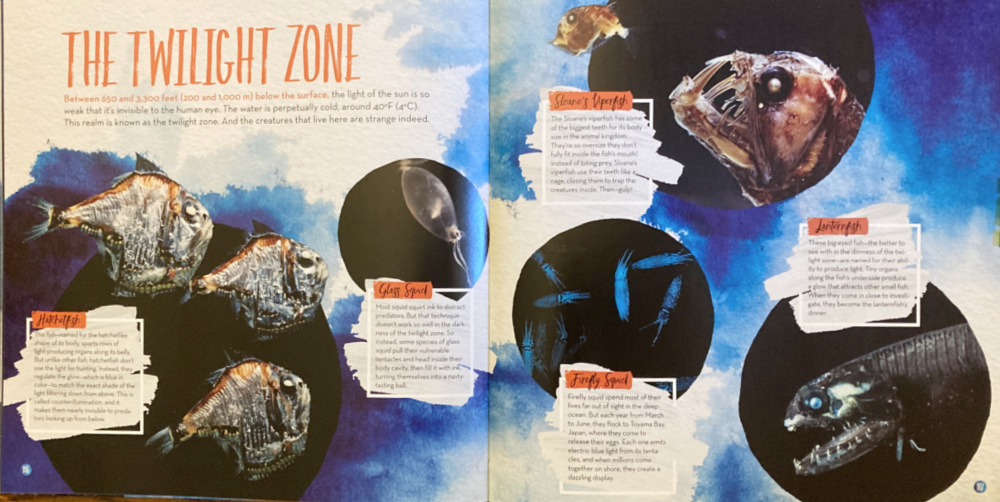
In the next chapter, Deep Down, readers enter the twilight zone, where sunlight no longer filters in and there is just blackness. Here there are some really strange sea creatures to discover, such as the hatchetfish, the Sloan's viper, and the lanternfish.


Chapter 10 brings readers into the Extreme Ocean, the least known place on earth. Here there are "mountains, geysers that spew superheated noxious water, and all kinds of living things that make these alien places their home." (pg 159) And this is where shipwrecks provide a home for all kinds of deep water species, like sear stars, crabs and fish.

Finally, Chapter 11 is about People and Oceans. This includes spreads on the history of ocean exploration, the importance of oceans, ways of protecting oceans and their occupants, and finally, how people have polluted our oceans and why I chose this book to highlight Earth Day 2021.


Beneath the Waves make the ocean sound like a pretty amazing place - beautiful, scary, powerful, busy, and necessary for sustaining life on earth. Thankfully, this book ends on a note of hope - "...success stories [that] show. when people step in to help, they can make a difference.' (pg 184)

Wondering what kids can do for Earth Day and every day after, and to help clean up and restore the ocean? You can find all kinds of activities and projects just right for youngsters at National Geographic Kids Celebrates Earth Day.

Or visit the official Earth Day website HERE

Meet the Author:                                                                                            Stephanie Warren Drimmer writes books and magazine stories for kids. She covers all topics weird and wonderful, including adorable animals, freaky brain experiments, and the hunt for new planets. She is a longtime contributor to National Geographic Kids magazine and has written many books for National Geographic kids, including Hey, Baby!, Mastermind, The Book of Heroines, Ultimate Secrets Revealed, and Ultimate Weatherpedia. Drimmer studied science journalism at New York University. You can find Stephanie on stephaniedrimmer.com, and on Twitter @Stephdrimmer 

This book is recommended for readers age 8+
This book was received from Media Masters Publicity in exchange for a review

Monday, March 1, 2021

Sadie Sprocket Builds a Rocket by Sue Fliess, illustrated by Annabel Tempest


Sadie Sprocket Buids a Rocket written by Sue Fliess, 
illustrated by Annabel Tempest
Two Lions, 2021, 40 pages

Sadie wants nothing more than to travel through the galaxy way beyond earth. So naturally, she did some research, checking out every book in the library about space and discovered that no one has ever been to Mars. Now, Sadie wants to be the first person to land on the red planet.  

But Sadie isn't just a dreamer, she's a doer. So she gathers up a crew, and together they all build a rocket ship that will be sturdy, safe and fast. As her crew builds the ship, Sadie studies the celestial map and chooses a date for blast off. 

Finally, it was time to take off and travel to Mars. Everyone comes to wish Sadie and her crew a safe journey - her family, her friends, even a group of reporters are there. After all, Sadie is a girl who was about to make history. The trip is long so Sadie and her crew try to entertain themselves to pass the time, but with no gravity, everything floats around. Finally, they land safely on their destination and immediately begin to gather samples to take back to earth. After gathering 20 bags of samples from the surface of Mars, it is time to go - a sand storm is heading their way but it arrives before they are able to blast off for earth. 

Before they can even take off, the sand storm buries the landing gear and there is so much sand they have to wait until it clears a bit to see what needs to be done. But, even after it clears up enough, the rocket ship wouldn't start. Would they be stuck on Mars forever, or will Sadie be able to save the day?

I just realized that today is the first day of Women's History Month 2021 and a book about a girl who dreams of becoming a astronaut/scientist is the perfect picture book with which to welcome the month. Sadie is a wonderful fictional role model, a girl who uses her imagination creatively, she's also a dreamer, a doer and a problem solver...and, oh, yes, a trailblazer. The whole story is written is rhyming quatrains that never lose their musicality and the digital cartoon style illustrations are detailed and colorful, and make clear for the littlest readers that Sadie's trip to Mars is an imaginary one, but that doesn't diminish the STEM message. 

But don't think this is a story just for girls. When I shared it with my young readers, both boys and girls enjoyed it equally. They all especially liked Sadie's choice of crew, and it did generate a talk about space and possibilities. Who knows? Maybe this book has inspired a future scientist or two in my little reading group.

Meet the Author:
Sue Fliess is the author of more than thirty children's books, including Mrs. Claus Takes the Reins illustrated by Mark Chambers, Shoes for Me! A Dress for Me!, and Books for Me!, all illustrated by Mike Laughead; and Let's Build illustrated by Miki Sakamoto. She lives with her family and their two dogs in northern Virginia, where they admire the moon, stars, and sometimes even planets from their backyard. Learn more about Sue at www.suefliess.com, on Twitter: @SueFliess, on Facebook: Sue Fliess Author and Pinterest: Sue Fliess

Meet the Illustrator:
Annabel Tempest is the illustrator of a number of picture books and board books. She holds a degree in fashion and textiles and has worked as a freelance illustrator on everything from maps and packaging to greeting cards and children's books. She lives in the beautiful Somerset countryside in the UK with her husband and a houseful of muddy boys and dogs. Learn more about Annabel at www.annabeltempest.com and on Instagram: annabel.tempest

This book is recommended for readers and dreamers age 4+
This book was an eARC gratefully received from Barbara Fisch at Blue Slip Media

Sunday, October 11, 2020

Marjory Saves the Everglades: The Story of Marjorie Stoneman Douglas by Sandra Neil Wallace, illustrated by Rebecca Gibbon

 
Marjory Saves the Everglades: The Story of Marjory Stoneman Douglas
written by Sandra Neil Wallace, illustrated by Rebecca Gibbon
Paula Wiseman Books, 2020, 56 pages

By now, most of us recognize the name Marjory Stoneman Douglas because of the tragic 2018 shooting that happened in the high school named in her honor just east of the Everglades. But few of us know why the school was named after Marjory. Now, thanks to the excellent research by Sandra Neil Wallace, we have our answer. 

In this richly illustrated picture book for older readers, Wallace begins her biography with Marjory's first trip to Florida to visit her dad where she fell in love with the sunshine. Returning home, Marjory grew up, attended Wellesley College, got married and divorced, until finally she headed back to Florida to work as a reporter for her father's newspaper, the Miami Herald. It was there that Marjory found the voice she would need later as an activist.

During WWI, Marjory enlisted in the Navy and went to Europe with the Red Cross. But when she retuned to Florida after the war, she was absolutely dismayed to see how much of the Everglades had disappeared as developers dynamited, dug and drained it to expand post-war building. 
But dismay wouldn't save the destruction of the Everglades, It would take a visit by Ernest Coe, a landscape architect, and a meandering trip with him through the glades that made Marjory realize that the Everglades needed to become "a national park to save the birds, the plants, and the other wildlife."
But how to convince the National Park Service, who felt that 'a swamp is a swamp.' Other people just wanted to drain the Everglades to expand the land and build. But, Marjory wondered, were the Everglades really just a swamp, or were they something else? Something beautiful, living and unique? By now middled aged, Marjory was determined to find the answers to her questions, and dedicated the rest of her life to saving her adopted home from hungry developers, including the U. S. Army. 

And although the area became the Everglades National Park in 1947, it didn't stop developers. But through activism and organization, Marjory and the group she formed, Friends of the Everglades, managed to get developers to reverse their destructive building, restoring this unique ecosystem back to what it once was. 

Marjory Saves the Everglades is a such an inspiring story for young readers, showing them what a difference one dedicated voice can make in the world. Marjory lived to be 108 years old, but was an early activist, a suffragette and feminist, before she became involved in saving the Everglades and Wallace has really captured her independent spirit. The book is written in accessible language, and includes quotes by Marjory from various sources including her own work River of Grass. Marjory Saves the Everglades would make a wonderful addition to any STEM classes learning about ecosystems and the environment. 

Rebecca Gibbon's folk-art style illustrations, done with acrylic inks and colored pencils, are the perfect compliment to a book about the Everglades, done in shades of brilliant greens and blues, and including lots of vibrant birds, grasses and flowers throughout.  

Wallace's back matter includes an Author's Note, a page of creatures and plants indigenous to the Everglades, a Timeline of Marjory Stoneman Douglas and the Everglades, some tips for protecting the environment, as well as additional resources for learning more about this amazing, but overlooked woman. 

You can find an in-depth Discussion Guide courtesy of Sandra Neil Wallace HERE
You can also download an Activity Kit courtesy of Sandra Neil Wallace HERE

MEET THE AUTHOR:
Sandra Neil Wallace hope that her stories inspire readers as much as they inspire her. Her book The Teachers March! How Selma's Teachers Changed History was written with her husband, Rich Wallace, and has received three starred reviews to date. Between the Lines: How Ernie Barnes Went From the Football Field to the Art Gallery received the Orbis Pictus Book Award, was an ALA notable Book and a Booklist Top 10 Biography for Youth. Formerly, Sandra was an ESPN reporter and was the first woman to host an NHL broadcast. She continues to break barriers as co-founder of DailyGoodNH.org and lives with her family in New Hampshire. You can find Sandra at

IMO, Marjory's life and work become even more important these days as we hear about developers eyeing National Parks for their natural resources. 

This book is recommended for readers age 7+
This book was gratefully received from Barbara Fisch at Blue Slip Media

Monday, March 9, 2020

Dream Big, Little Scientists: A Bedtime Story by Michelle Schaub, illustrated by Alice Potter


Dream Big, Little Scientists: A Bedtime Book 
by Michelle Schaub, illustrated by Alice Potter
Charlesbridge Publishing, 2020, 32 pages 

When nighttime comes, all over the neighborhood, 12 budding scientists are beginning to get very tired. It's time to go home, get ready for bed, and head off to their bedrooms for a goodnight's sleep. Each young scientist and their bedroom is seen in a two page spread, in a room decorated with representative items relating to their specific STEM interest. And their interests are as diverse as they and the ways they sleep are.

For example, there are the twins who share bunk beds and are interested in climate change; one young girl in a wheelchair, whose hero is Stephen Hawking, has an interest in physics; an Asian girl who sleeps on the mat on the floor is interested in anthropology, and has a poster of Takie Lebra on her wall (confession - I learn something new in children's books all the time. I didn't know who Takie Lebra is until I read this book). A white boy with a hearing aid has pictures of George Washington Carver and Thomas Meehan (the botanist not the movie producer by the same name) on his bedroom wall because his interest lies in botany.

This appealing bedtime story, written in a simple ABCB rhyme scheme, has a nicely embedded message that tells young readers that science is for EVERYONE, all you need is the interest and there are plenty of areas where interest can be found. The colorful illustrations are whimsical and detailed. Each two page bedroom is decorated with books, posters, and other objects reflecting what that child in interested in scientifically, as well as curtains, pjs, and quilts to match.

When I read this to my young readers, they found the rhyme very appealing. The way it is presented reminded some of the of Goodnight Moon, a book they all still love. But they also loved exploring each illustration and learning the different names the different branches of science and the names of some of the items and people found on the page.
You can read the bio of each scientists included in this book HERE
At the end of the book, there is a chart defining each area of interested presented with a definition of what scientists study in each one. And you can download an extensive Educator's Guide and Activity Kit from the author's website HERE

Dream Big, Little Scientists is an ideal bedtime story with a subtle educational message that can conveniently be explored with your young readers during the day.

This book is recommended for readers age 3+
This book was gratefully received from Barbara at BlueSlipMedia

Tuesday, January 14, 2020

Blog Tour: Fly, Fly Again by Katie Jaffe and Jennifer Lawson, illustrated by Tammie Lyon


Fly, Fly Again by Katie Jaffe and Jennifer Lawson,
illustrated by Tammie Lyon
Greenleaf Book Group Press, 2020, 32 pages

Jenny has always wanted to fly but all her attempts have so far ended in failure. Then a red-tailed hawk befriends Jenny and as he flies around, she begins to figure out how it is done. But could she invent something that would actually take-off and fly just based on what she observes? 

Meanwhile, Jenny's neighbor Jude is studying his best friend Kitty, to learn all about speed and control in order to improve his skateboarding. Jude is also interested by the tiny plane Jenny has built and although it lifted off the ground, she has no way to control where the plane went and it crashed. Could Jenny and Jude put their heads together and figure out what they needed to do to actually get off the ground and control how and where Jenny's plane would fly?

If the title Fly, Fly Again makes you think of the old adage try, try again, that is not a coincidence. Jenny learns that sometimes success comes only after failure, but to never give up on her dreams. Along the way, Jenny also learns all about the mechanics of flight, thanks to teamwork and determination, as well as a cat named Kitty and a bird named Hawk. So really, how could she miss? 

Fly, Fly Again! is also a wonderful way to introduce kids to some basic aeronautical concepts like lift, drift, pitch, roll and the importance of a rudder, and perhaps instilling an interest in engineering.    

This book is recommended for readers age 5+
This book was sent to me by the authors and I thank them for the opportunity to read and review it. 


Fun Facts about Flying 
  • The foreword for the book is from Buzz Aldrin. The 50th anniversary of the lunar landing of Apollo 11 is July 20, 2019.
  • There are over 600,000 pilots in the world. Someone/something inspired their love of flight.
  • The book teaches perseverance and teamwork and that you can be an inventor at any age; with some determination and creativity, anything is possible
Important #STEM Dates to Remember
  • December 17th - Wright Brothers Day
  • January -
    • National Mentoring Month: Buzz Aldrin wrote the foreward to Fly, Fly Again
    • Brainteaser Month:  Liftoff Learning Studios exists to encourage learning among kids
    • Creativity Month:  How do we get our kids to think outside the box?
  • January 17th – Kid Inventors’ Day
  • February 21st - Introduce a Girl to Engineering Day
  • March 4-10 - Women of Aviation Wordwide Week
  • April 30-May 6 - Children’s Book Week
  • Second Week in April - National Robotics Week 
  • June 23rd - International Women in Engineering Day 
Meet the Authors
Katie Jaffe: With a passion for children’s causes, Katie has committed herself to several charities, helping children around the world.  As Creative Director and Design Consultant of Aviation for Spectre Air Capital,  Katie has aided in the design of several high profile aircraft.  Currently, she is leading the marketing and design effort of an overseas airline.  She lives in Austin, Texas with her husband–who is a pilot– and their three children who like to fly. 
Jennifer Lawson: Lifelong educator and advocate of the Childrens’ Literacy Program.  Jennifer seeks to bring knowledge to students through creative curriculum and technology on a global level.  As Owner and President of Decision Tree Technologies, she is currently endeavoring to teach using technologically advanced solutions that excite today’s students. She lives in Austin, Texas with her family.

Saturday, July 20, 2019

Fly Me to the Moon: A Picture Book Roundup That's Out of This World!


There are lots of new books about the moon this year in honor of the 50th anniversary of the Apollo 11 moon landing. It's hard to imagine what it must have been like for Neil Armstrong, the first and only human to ever be on the surface of the moon for 19 minutes before being joined by Buzz Aldrin. Yet, as momentous an event as the Apollo 11 and the subsequent six others moon landings are, the moon remains a rich source for our imagination, speculation, and even information. Here are some of the new books that my young readers and I read and enjoyed.
Field Trip to the Moon 
written and illustrated by John Hare
Margaret Ferguson Books, 2019, 40 pages, age 4+
If you're looking for a very serious information book about the moon, this isn't it. But if you are looking for a fun story about the moon, look no further that this book. In this wordless story, a class piles into a yellow space bus for a trip to the moon, and yes, one little astronaut lags behind, then goes their own way once they arrive. Quietly drawing in a sketchpad, the child falls asleep and misses the space bus home. Waking up and realizing what has happened, they continue sketching, when suddenly they realize they are not alone. But soon child and moonarians are happily drawing together, until the space bus arrives to take the youngster home. Set against a black background of the lunar sky, this is a delightful, whimsical story. My kids loved it because it was a fun tale that basically reminded them of school, yellow space bus and all. And since it's wordless, there was lots of speculating about what was happening and what could happen. The minimally colorful illustrations are done in acrylics against a grey moonscape, black sky and white spacesuits.  Interestingly, there is no indication as to what the gender of the child is.

The Moon Book: New and Updated
written and illustrated by Gail Gibbons
Holiday House, 2019, 32 pages, age 4+
When my Kiddo was young, and it became apparent that she was probably not going to grow up and become a scientist, science fair time was a bit stressful in my house. When she was in second grade, we used this book to make an informative project about the moon. It obviously wasn't a groundbreaking project, but we both learned a lot. And this book gives a lot of information about the moon: what it is, how it may have come into existence, its orbit, its phases, the difference between a solar and lunar eclipse, how its gravitational pull affects the ocean's tides, and of course, the lunar landings. The writing is clear and simple, and the text, which runs across the bottom of the page, is complimented and enhanced with simple, full-color illustrations that take up most of the page. Back matter includes Moon Milestones, a timeline of moon-related information, and Moon Legends and Stories, most of which will be very familiar to young readers, and finally More Moon Facts, interesting tidbits, such as what a blue and harvest moon are. I am very happy to see that this book has been reissued in an updated and revised edition in time for 50th anniversary of the first moon landing. It will be a welcome addition to any home or classroom library.

Moon! Earth's Best Friend by Stacy McAnulty,
illustrated by Stevie Lewis
Henry Holt & Company, 2019, 40 pages, age 4+
This is the third book in McAnulty's Our Universe series, and I can honestly say, it is every bit as good as the first two books - Sun! One in a Billion and Earth! My First 4.54 Billion Years. This is a playful information book narrated by the moon, who tells us that because earth is never without moon they qualify as BFFs. Kidding aside, there is lots of basic moon information to be found here, I particularly liked how moon differentiated itself as earth's only natural satellite, as opposed to all the man-made plastic and metal satellites "not exactly best-friend material." Distance from earth, phases of the moon, how gravity works on the tides are all covered, as is the weight differences between the two are all covered mixing humor with information. The illustrations, done with color pencils and digital tools, depict earth and moon as two friendly female faces, and are done in the same light-hearted manner as the text. This is a really informative, entertaining moon book with some very interesting lunar facts in the back matter. I shared this with my young readers, who didn't understand everything in it, but certainly began to learn and appreciate the universe around them more.

If You Had Your Birthday Party on the Moon
by Joyce Lapin, illustrated by Simona Ceccarelli
Sterling Children's Books, 2019, 40 pages, age 6+
Birthdays are always fun and what could be better than a birthday party on the moon, after all, one day there lasts 706 hours, compared to earth's mere 24 hour day. After a 3-day ride in a rocket ship to the moon, the birthday child, with friends and dog, arrives. As everyone disembarks wearing spacesuits and party hats, because there is no breathable air on the moon, the first thing they notice is the moon black's sky, and earth shining in the distance. But now let the party begin. No need for a bouncy house thanks to the moon's weaker gravity, partygoers can just jump and slide all over the moon's surface. Playing ball is great - a ball can be hit much higher and further then on earth; the candy and other prizes will fall so slowly from a piñata, you can easily find your favorites before they hit the ground. Explore the moon's craters, make moon dust angels that will last forever, play a game of scavenger hunt for all of the things man has left behind, or collect of moon rocks, but be careful, they will weigh much more on earth than on the moon. And finally, have you cake and pizza inside the rocket before heading home. This is a fun birthday/moon story, but it is also an interesting information book. There are easy to understand explanations about everything that the partygoers see and do on the moon compared to doing and seeing those same things on earth. The earthlings are depicted as very colorful in the cartoon-like digitally created illustrations, and are in sharp contrast to all the greys and blacks of the moon's environment. Back matter includes a Glossary, Selected Bibliography, Suggestions for Further Reading, and internet links of astronauts on the moon.                   

Luna: The Science and Stories of Our Moon
by David A. Aguilar
National Geographic Kids, 2019, 64 pages, age 10+
This is a beautifully put together book that covers just about everything a young reader might want to know about the moon. Beginning with its theoretical creation and evolution, and ending with projects kids can do, including making a 3-D of lunar craters, this book is chockablock with more information about the moon. Each topic is age-appropriately informative and includes full-color illustrations or photographs that compliment the text. I particularly liked that Aguilar covered things like the different names for the moon (supermoon, harvest moon, strawberry moon), and talked about some of the different cultures whose festivals and religious holidays are determined by the moon. Another favorite chapter was on the great hoaxes and other mysteries surrounding the moon, all of which were new to me. I did like that Aguilar invites readers to explore the moon with a telescope, suggesting best viewing times and including a map of the moon to help understand where and what different places on the surface are. This is followed by an in-depth look at the moon's most prominent features. The moon continually fascinates us and this is the kind of book that curious kids will return to again and again, and each time they will find something they didn't notice before, so the in the end, young readers will gain a great deal of new information about the moon and its relationship with earth. This would be an excellent addition to home, school, and classroom libraries, or just a great book for kids interested in space.  
 
Imagination Designs