Showing posts with label Animals. Show all posts

Thursday, September 22, 2022

Blog Tour and Giveaway: How to Speak Animal by Dr. Gabby Wild and Aubre Andrus

Welcome to the How to Speak Animal Blog Tour!

To celebrate the release of National Geographic Kids' How to Speak Animal on August 16th and World Animal Day on October 4th, this week blogs across the web will feature special excerpts from the book, sharing fascinating insight into the secret language of animals of all shapes and sizes. If you’ve ever wondered why ants touch antennae when they meet, what it means when a cichlid fish pees, or why turkeys gobble, this is the blog tour (and book!) for you!

How to Speak... BAT

When a male bat wants to impress a female, he will spread his wings, sing, and the long hairs on the top of his head stand up. The singing noise that bats make is like that of a songbird’s, with trills and up and down notes. Each male sings a unique tune. This noise is often too high for humans to hear. Bats also use singing to identify each other, scare off predators, and teach their offspring. Scientists believe bats may use vocalizations because sound can travel far. By vocalizing, a bat can stay in one place and send a message across a distance instead of using its energy to fly there. 

After studying 22 Egyptian fruit bats for 75 days, scientists discovered that the bats weren’t just squeaking— they were arguing. They were fighting about food and sleeping space. And sometimes the squeak meant “Get away!” These squeaks were directed toward a specific bat, which means the bats were having one-on-one conversations. 

Bats use chemical communication, too. With scent glands on their neck and chin, bats can mark their territory by rubbing their chin against a surface near their home. This helps bats define their status and claim a prime location at the top of a tree or cave instead of one of the lower edges. It’s their way of saying, "This is MY spot."

*******
DR. WILD'S WORDS
After humans, bats are the most vocal mammals. That’s because they “see” by “talking.” This is called echolocation. Bats’ high-pitched noises bounce off objects around them and return as an echo. Bats can tell the difference between the echo from a tree, a human, a mosquito, or another bat. Because they rely on echolocation, bats become temporarily “blind” while they eat. They can’t make a noise with a mouth full of food.

********
DID YOU KNOW?
The world's smallest mammal is a bumblee bat.  It weighs less than a penny. 


BuyGoodreads

Learn about the secret language of wild animals in this exciting and informative guide from the experts who brought you How to Speak Cat and How to Speak Dog.

We know animals can’t speak and express themselves in the same way as humans … but even the smallest and quietest animals have incredible ways of communicating with each other. With wildlife veterinarian expert Dr. Gabby Wild as a guide, How to Speak Animal helps kids understand how animals communicate through sound, body language, and behavior. It’s full of expert insights and real-life stories of humans exploring ways to “talk” to animals, from teaching great apes sign language to speaking “dolphin.” Packed with super-engaging animal photography that helps illustrate key concepts, this fascinating bookprofiles more than 60 different creatures―from birds to mammals to reptiles and more―and their amazing ways of communicating with each other.

If you’ve ever wondered why gorillas beat their chests and make hooting noises, what it means when chameleons change color, or why some elephants twist their trunks together, this is the book for you!


About the Authors

Website | Instagram | Twitter | Facebook | YouTube

DR. GABBY WILD earned her bachelor of science and doctor of veterinary medicine (DVM) degrees at Cornell University. She completed her veterinary internship training at Metropolitan Veterinary Hospital in Akron, Ohio, and received her master’s of public health (MPH) from the University of Minnesota. She is a published genetics researcher and uses her research background to screen zoonotic disease transmission among wildlife, domestic animals, and people. To help maintain a healthy planet, she monitors herd and individual health for rising epidemics. Dr. Wild balances her Western medicine practices with traditional Chinese medicine in an effort to blend both methodologies. Acclaimed for her role as “the veterinarian” on Animal Jam, the world’s largest online “playground,” with 54 million players, she creates educational videos and teaches children internationally about wildlife conservation and medicine. When not in the wild, Gabby works as a Wildlife Health Program veterinarian for the Wildlife Conservation Society at the Bronx Zoo and is a training veterinary surgeon at the Veterinary Medical Center of Long Island. She lives in New York City.

Website | Instagram | Twitter | Facebook | Pinterest

AUBRE ANDRUS is an award-winning children's book author with dozens of books published by National Geographic, Lonely Planet, American Girl, Disney, Scholastic, and more. She has also ghostwritten books for young YouTube stars. She currently lives in Los Angeles with her family. 


GIVEAWAY

  • Five (5) winners will receive a copy of How to Speak Animal
  • US/Canada only
  • Ends 10/2 at 11:59pm ET
  • Enter via the Rafflecopter below
  • Visit the other stops on the tour for more chances to win!

a Rafflecopter giveaway


Blog Tour Schedule:

September 19th Susie's Reviews and Giveaways
September 20th Pragmatic Mom
September 21st Mom Read It
September 22nd Randomly Reading
September 23rd YA Book Nerd

Wednesday, June 22, 2022

Four STEM Picture Books (that we read and loved)

 
Summer is here and before we go our separate ways for a while, I thought it would be a good time to introduce my young readers to the idea of STEM books. Here are four books that we particularly enjoyed reading and talking about. 
Honeybee Rescue: A Backyard Drama
by Loree Griffin Burns, photographs by Ellen Harasimowicz
Charlesbridge, 2022, 40 pages
Mr. Connery is an experienced beekeeper, maintaining wooden hive boxes in his backyard. So when he discovers a bee swarm in his ramshackle barn, Mr. Connery knows that his bees have outgrown their hive and it is time to stack an additional hive box on top of the older one so the bees can spread out. But first he needs to deal with the swarm in the barn. And for that he calls Mr. Nelson, a beekeeper who specializes in removing bee swarms so that people don't exterminate these important pollinators. In between the account of Mr. Connery and Mr. Nelson saving the barn swarm, Burns provided all kinds in bee information from why they swarm, the structure of a hive, how a bee vacuum works so the bees are kept safe, and how a bee rescuer gets the bees and any honeycomb they may have started safely into hive boxes. We just had a bee swarm in Manhattan the other day, so this was a great time to read this book to my young readers. The writing is simple but informative, and generative lots of discussion. The photographs, with some great bee close-ups, really add so much to the information and framing the bee rescue in a story helped my young readers, some of whom are afraid of bees. Back matter includes an interview with Mr. Nelson, and a Glossary of terms used, as well as an Author's Note about her interest in bee rescue. Burns does a brilliant job of sticking with the concept of bee rescue, so if you want to know more about the life and work of honeybees, pair this with Candace Fleming's Honeybee: The Busy Life of Apis Mellifera.
Our latest bee swarm (Photo: Peter Gerber)

Diego: The Galápagos Giant Tortoise
Book 5 in the Another Extraordinary Animal Series
written by Darcy Pattison, illustrated by Amanda Zimmerman
Mims House, 2022, 32 pages
Giant tortoises were in abundance in the late 1600s when pirates landed on Española Island, a small Galápagos Island off the coast of Ecuador. When sailors discovered that these giant tortoises could live without food and water for up to a year, they began packing them in the holds of their ships to provide food on their journeys, so that by the early 1960s, it was believed that the Española tortoises were extinct. But by 1974, scientists discover there were actually 14 giant tortoises left in the world - 12 females and 2 males. Taken to the Tortoise Breeding Center on Santa Cruz Island, scientists learned out to successfully breed healthy tortoises, and by 1970-71, 20 Esanñola tortoises hatched and five years later, 17 were returned to Española Island. With only two males, breeding was limited until they discovered Tortoise Number 21 at the San Diego Zoo. Names Diego, at 65 he was brought to the breeding center. It didn't take long for Diego to become a father - in fact, it's estimated that he fathered about 900 to 1000 of the 2, 354 tortoises populating Expañola Island in 2019. It was time to send Diego, now about 110 years old, and the original 14 tortoises home to their island. The Española tortoise was not longer on the verge of extinction. This is such an interesting look at how the threat of extinction could be reversed for the endangered species around the world. The book is chockablock with information and it is totally accessible for young readers without overwhelming them. This was important to me. I was a little hesitant about introducing the idea of extinction and conservation to my young readers who are a little younger than the suggested target age of 7+, but they loved hearing about Diego. What really helped them to understand the plight of the tortoises were the detailed illustrations of each two page spread. In the back matter, Pattison give more information about tortoises and efforts at conservation, plue a bit about telling the difference between tortoises and turtles, plus a map of the Galápagos Islands, which was very useful. I expect this is a book we will return to again and again as we begin our STEM explorations.
Diego

What a Shell Can Tell by Helen Scales, 
illustrated by Sonia Pulido
Phaidon Books, 2022, 48 pages 6-9
The first time I took my Kiddo shelling on the Jersey shore, she filled her pail with all kinds of shells and declared "we're rich!" Since I still have some of those riches, they came in handy when I introduced this book to my young readers. It is incredibly well-organized, each section beginning with a question, and the questions following a very logical order, beginning with what a shell is, what a shell's shape and pattern can tell you as well as what it's color and texture reveal. On of the most interesting facts I learned was how a shell is created by the mollusks that live in it. Additionally, Scales goes into how mollusks move and what they eat, and who else uses a shell (and it's not always to original mollusk who created it), and where the various shells can be found around the world. Each question gets a digitally created two-page colorfully illustrated spread. One of the things I did very much like is how Scales brought together past, present and future and how the things like how global warming, increases in carbon dioxide, uses of mines in the deep ocean, and heavy nets used for catching shelled mollusks for increased consumption are all taking their toll on the ocean's ecosystem. This is a great book kids who are curious about the oceans and what lives in them, and will hopefully spark some real interest in conservation and preservation. Since NYC's beaches aren't far away for most of my young readers, they are anxious to see if they can find some shells this summer. Maybe that's just the beginning interest that this book is aiming for.  
One of my Kiddo's riches

Sea Lions in the Parking Lot: Animals on the Move in a
Time of Pandemic by Lenora Todaro,
illustrated by Annika Siems
mindedition, Astra Publishing, 2021, 48 pages
I found this book to be a fascinating look at what happened in the early days of the Covid-19 pandemic, when people took to their homes and seldom went outside. With deserted streets, parks and parking lots, stores and restaurants, the animal world ventured into places they are not usually found in and "reclaimed ancient habitats as their own - temporarily, at least." Todaro takes readers on a world-wide tour beginning with Australia, where a kangaroo left its parklands and hopped into the city of Adelaide, where it was free to explore with human interference. In Nara, Japan, a herd of deer, hungry for the treats humans always fed them, took to the street and noshed on leaves and grass, even potted plants, then had a romp in the subway. In South African savanna, a pride of lions lazed one the roads usually full of vehicles and tourists. There are more stories like this, and it is kind of interesting to see how easily the animals could take back their territory is there were no human interference. In her Epilogue, however, Todaro points out that not all animals fared as well as they ones spotlighted in her book and offers suggestions for how to go forward and make the world a safer, better place for the all the different species. Back matter includes Notes on Habitats, Biomes, and Wildlife Behaviour of the animals that appear in this book, and Some Further Resources. The illustrations are just spectacular, often with a hint of humor, but like the text, always reminding the reader just how much human behavior impacts animal behavior. 
Deer in Japan riding an escalator

Wednesday, January 5, 2022

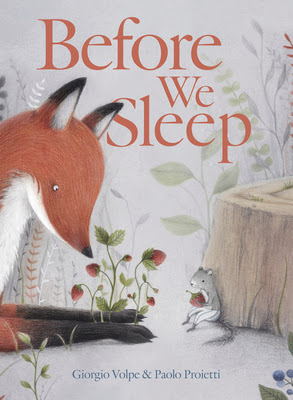
Before We Sleep by Giorgio Volpe, illustrated by Paolo Proietti

 
Before We Sleep, by Giorgio Volpe,
illustrated by Paolo Proietti, 
translated from the Italian by Angus Yuen-Killick
Red Comet Press, 2021, 28 pages

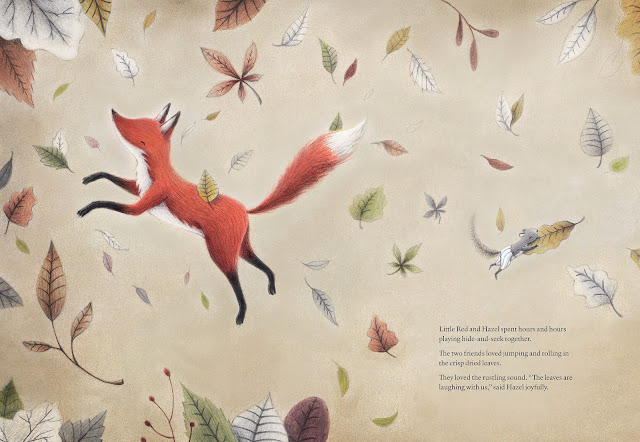
Little Red, the fox, and Hazel, the dormouse, are best friends and there is nothing they enjoy more that a good game of Hide-and-Seek. And now that fall have come, Little Red thinks it will be even more fun as he will now blend in to the beautiful rich amber, burned orange, and chestnut brown of the autumn forest.

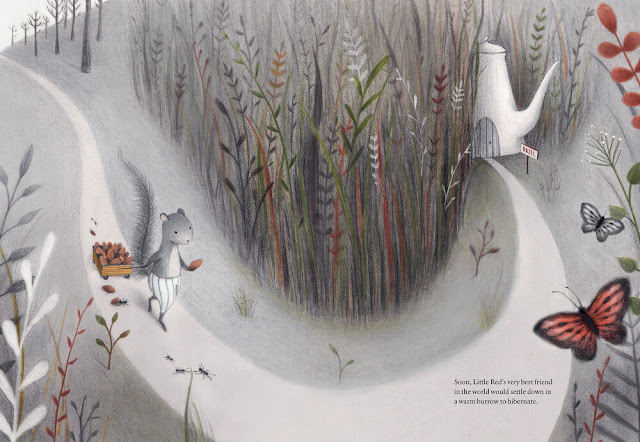
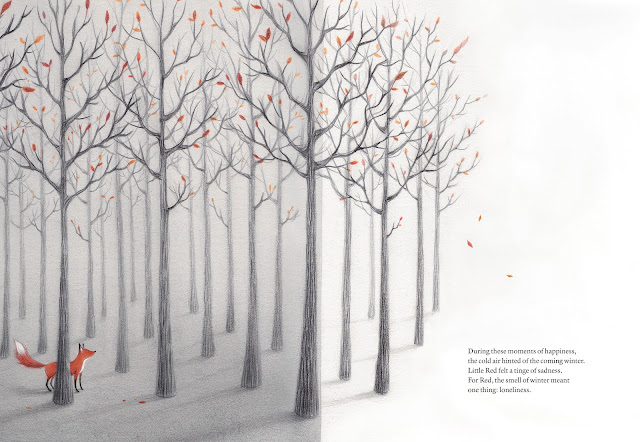
But fall also means that Hazel will soon have to hibernate snug in her burrow for the winter, and that means a long, lonely winter for Little Red. And even though Hazel tries to reassure Little Red that she will be back in spring and ready to play some more, he tries to think of ways to keep her awake for the winter. If only the sun would stay high in the sky so that winter wouldn't be so cold. or maybe Little Red could tickle Hazel to stay awake?  

Resigned to that ways of nature, Little Red suggests he tell Hazel a bedtime story before she sleeps for the winter. But before he utters a word of his story, both Hazel and Little Red are soon sound asleep, Hazel in her burrow, Little Red wrapped around it.

I loved the beautifully layered and textured illustrations that really capture the lovely colors of fall, the  crunching sounds of playing among dried leaves that have fallen from the trees, and the cold bareness of winter that follows. 

This is a sweet bedtime story about friendship but I think it is really more than that. It's also about separation anxiety, something that kids can experience in all kinds of ways. It might be the separation from parents going to school, or the separation of a friend during holidays and vacations when one friend might to away for the summer and the other is left behind. It makes this a good story for talking about how kids can hold on to the person who is temporarily absent from their lives. 

I did feel the ending was a little ambiguous, but when I read it to my young readers, it led to a discussion about why some animals hibernate and others don't, they decided that Little Red would probably do what a fox does to survive the winter, but return to Hazel's burrow to feel close to her. 

You can also download a very useful 7-page Activity and Resource PDF that can be used in conjunction with this picture book. You can find it HERE 

This book was gratefully received from Barbara Fisch at Blue Slip Media

Sunday, November 21, 2021

Robin Robin by Dan Ojari and Mikey Please, illustrated by Briony May Smith

 
Robin Robin by Dan Ojari and Mikey Please,
illustrated by Briony May Smith
Red Comet Press, 2021, 32 pages     

When a robin egg falls out of its nest, landing in a garbage dump, the newly hatched bird is found by a family of mice who decide to adopt it, naming her Robin Robin and taking her back to their burrow. The burrow is warm and cozy and Robin quickly settles in, listening to the mice talk about crumbs - all kinds of crumbs, the crumbier the better. Crumbs are always a delicious treat, but in order to enjoy them, they have to sneak into the house where the Who-mans live, which would be easy except for one thing - a great big mean cat also lives there. Nevertheless, they all decide to sneak into the house and gets some crumbs to feast on. 

There is just one problem - it's not easy for a bird to be as quiet as a mouse. Naturally, she always attracts the cat's attention and has to quickly make a run for the back door to escape. One night, around Christmas time, Robin runs right into the wings of a Magpie while escaping the cat. Robin may think she is a mouse, but Magpie recognizes her as a fellow bird and takes her home to his tree house.

After Robin explains why she was in the house, Magpie tells her about the Chrim-Cross Star that the Who-mens put on top of a spikey old tree up once a year, and how, after making a wish, the Who-mens get anything they want the next morning. Maybe if Robin and her mouse family could get the Chrim-Cross Star, they could all get their wishes in the morning, too. Robin would be a real mouse, Magpie would get all kinds of treasures for his tree house, and the mice would have all the crumbs they could want. There's just one hitch - and it isn't the cat. 

This is such a heartwarming story about identity, inclusion, and family with plenty of humor but also a serious side to it. Robin is a jolly little bird, full of determination and pluck. She never gives up trying to be "as quiet as a mouse" despite being a bird. I loved how Robin discovers her true self, which is way better than the noisy, clumsy mouse she thought she was, and ultimately more useful for her mouse family and their crumb appetite. And I think she found a real mentor in Magpie. I'm sure young readers will love the illustrations, too. They are bright, bold, and colorful, with lots of detail to explore. 

Robin Robin is a wonderful holiday story, but one kids will want to read all year round. Don't be surprised if it becomes a family classic. 
Meet the Authors

Dan Ojari and Mikey Please
 are co-founders of the BAFTA® Award-winning Parabella animation studio which is based in East London. They co-directed Robin Robin, the first production in association with Aardman and produced exclusively for Netflix. Together they authored an adaptation of the script of the Robin Robin holiday special to create the book. They both live in London. Learn more about Mikey Please at mikeyplease.co.uk and Dan Ojari at www.danojari.com.

Meet the Illustrator

Briony May Smith is a British illustrator who has published titles in the US and the UK, including Stardust, written by Jeanne Willis (Nosy Crow, 2019). She also wrote and illustrated Imelda and the Goblin King (Flying Eye Books, 2015) and Margaret’s Unicorn (Schwartz and Wade, 2020), a Fall 2020 Indie Kids’ Next List selection. She lives in Devon, England. Learn more at brionymaysmith.com


Red Comet Press

Facebook: Red Comet Press

Twitter: @redcometpress

Instagram: @redcometpressbooks


Thank you, Barbara Fisch at Blue Slip Media for providing me with a review copy of Robin Robin.


And now for some really exciting news: 
Chirpy little Robin and her adopted family of mice can be seen in a new animation holiday musical special from Netflix and Aardman Animation beginning November 24, 2021. 

Sunday, April 25, 2021

MMGM: Rescue at Lake Wild by Terry Lynn Johnson

 
I follow a bunch of animal rescue and rehabilitation sites, the goal of which is to eventually return the animals back into the wild, so I just knew this would be a book I wanted to share with young readers. And it did not disappoint.

Twelve-year-old Madison Lewis wants nothing more than to grow up and become the next Jane Goodall. Her beloved grandmother was a wildlife rehabilitator and now that her Nana is gone, Madi wants to carry on her work. But after she finds their parents dead, and even after she rescues their two beaver kits from their lodge Madi knows she's going to be in big trouble if she brings them home. Madi has been told no more rescues or she won't be able to go to the Jane Goodall Institute and meet her idol and find how she did her observations of animals in the wild.

So of course, Madi and her friends Jack and Aaron, along with Jack black Lab, Lid, rescue the kits and bring them to Madi's house. Hiding them in the shed turned clubhouse in the backyard, Madi realizes she has a lot to learn about the care and feeding of beaver kits. At least, she has Nana's notes to refer to, but even at that, it is a big job. Luckily, mom works a lot and dad is often away for a week at a time, but then there is older sister Marley, not much of an animal lover, to contend with.

Then Madi, Aaron, Jack, and, of course, Lid the tracking dog, discover that the dead beavers had built a dam that blocked the channel that flows from Lake Wild to Lake Little Hawk, and is now causing roads and bridges in their township of Willow Grove to flood. While Jack and Lid investigate to see if they can find the person who killed the two beavers, Madi works on caring for the kits. In the middle of all this, Madi finds another beaver kit. When Marley discovers the kits, she makes Madi an offer that she really can't refuse: if Marley keeps quiet about the kits, Madi won't say anything about the party Marley is planning when she is sure no parent will be home. 

Can Jack, Aaron and Lid solve the mystery of who shot the beavers? Can Madi figure out what to do with her beaver kits? And can a viable solution be found to prevent further flooding because of the beaver dams?

Rescue at Lake Wild is an entertaining, interesting and informative story for younger middle grade readers not quite ready for the Terry Lynn Johnson's wonderful but harrowing survival stories like Ice Dogs and Dog Driven. There's a lot of detail about beaver life, and especially about caring for them. Not everything Madi does goes well, but I like how she learns from her mistakes and also how the beaver kits, acting on their  natural instincts, are her best teachers. She certainly hones her observation skills watching and caring for them. 

Johnson really knows how to craft an exciting adventure story. She gives Madi and her friends a freedom of movement most kids don't have in today's world. They travel around in an ATV (all-terrain vehicle) and a small motor boat, but considering how little her parents are around, Madi does have a cell phone to check in with them. All in all, this make a nice way for young readers to have an outdoor adventure, even if it is only vicariously.

Whenever you read a Terry Lynn Johnson book, you know you are reading the words of a real animal lover, and her stories will hopefully inspire her readers to develop a strong love and respect for them, too. Do read the Author's Note for more information about this book and what inspired Johnson to write it. Besides the Author's Note, there is an important list called "The Dos of Wildlife" detailing what to do if you think a baby animal needs rescuing. Madi had the benefit of being her Nana's apprentice before she passed away, and has some experience with wildlife rescue, but as the head of the rehab facility that takes in the beavers kits tells Madi, people keeping wildlife does more harms to animals than good. 

Rescue at Lake Wild is an appealing book that should please animal and wildlife lovers looking for adventure and mystery.

This book is recommended for readers age 8+
This book was an eARC gratefully received from Barbara Fisch at Blue Slip Media

I haven't done a MMGM in a long time and it's good to be back. You can see all of this week's wonderful MMGM books thanks to Greg at Always in the Middle


Monday, April 19, 2021

Four Books for Earth Day


This week we celebrate Earth Day for the 51st time. This year's theme, Restore the Earth, feels so timely as we begin to emerge from a world-wide pandemic and take time to look around to see what needs to be done. It just feels like the earth has been treated pretty badly the last few years, losing so many protections, and now, there is some work to be done so that we can live in harmony with the earth, her creatures, her plants and her waters. But first, it's important to educate ourselves and our children and here are a few books I have been sharing with my young readers.

Zonia's Rain Forest 
written and illustrated by Juana Martinex-Neal
Candlewick Press, 2021, 40 pages

Zonia, a young Asháninka living in the Peruvian Amazon's rain forest. Every morning, the rain forest beckons Zonia and she loves to walk through it, and visit all her old and new friends living there,  accompanied by a blue morpho butterfly. As she makes her rounds, Zonia greets a wide variety of creatures that also make their home in the rain forest - sloths, birds, jaguar, dolphins, a boa constrictor and turtles are just some of Zonia's friends. But one day, Zonia discovers something she's never seen before that truly frightens her - a part of the rain forest that has just been cut down and destroyed. Running home, Zonia tells her mother about it, who wisely responds that the forest is calling out for her help and Zonia vows to answer that call. Zonia's Rain Forest, written in such simple sentences, carries a big message for readers that they too can become activists and help to preserve earth's rain forests. Thee is some important back matter included that young readers should be made aware of, including an introduction to the Asháninka People, and A Few Facts about the Amazon, a list of Threats to the Amazon and a page devoted to all of Zonia's Friends (in order of appearance), followed by a list of links to resources. This is such an important book, not just for Earth Day but for every day. 

Reptiles Everywhere by Britta Teckentrup,
illustrated by Camilla de la Bedoyere
Big Picture Press/Candlewick Press, 2021, 32 pages

Did you know that reptiles have been around for more than 312 million years, that they swim, run, slither or glide, and that their size can range from as small at a thumbnail to more than 30 feet long? This is just a small fraction of the amount of reptilian information you will find in the book - and there are all kinds and they are everywhere. Young readers will learn just what a reptile is, whose been around the longest, what they eat and where they live. From reptile basics to how they have managed to stay around so long when other species have died out is covered, as is information about reptile babies, and the travels of a leatherback turtle from hatching in the sand to adult swimming in the depths of the ocean to returning to the sand and laying her own eggs is explored. There are reptiles hiding throughout the book and readers are challenged to find them. The book ends with a two page spread on Reptiles and People, which includes Reptiles At Risk. Yes, reptiles now need human help to survive and thrive - in other words, conservation. Suggestions for citizen science and volunteering are things that kids can do. And conservation has had reptile success, bringing back some that were on the verge of extinction. This is a fun and interesting book, with wonderful color illustrations, and an ideal companion for Earth Day projects. 

Masters of Disguise: Camouflaging Creatures &
Magnificent Mimics
by Marc Martin
Candlewick Studio, 2021, 56 pages

Two of the best ways an animal can protect itself are through camouflage and mimicry. In this lushly illustrated book are twelve different animals from around the world and the unique ways they each make themselves look like part of the environment they live in. From the panther chameleon living in  Madagascar and the polar bear in the Arctic Circle, to the owl butterfly of South and Central America, the gaboon viper of Africa, and the ornate wobbegong in the waters of the Pacific Ocean, each animal is given 2 double page spreads. The first two spreads includes short text bytes of information about them, perfect for curious young readers. Each of the text bytes are accompanied with several accurate illustrations showing the animal in their environment that complement each other perfectly. Turn the page and there is a densely illustration double page spread of the animals environment and a challenge to find what is hiding there. For example, there are 10 chameleons hiding in the lush foliage of a forest along with several other creatures. I found most, but not all (and it took a while, my young readers pretty much found the all - quickly). The book is slightly oversized and the page is just heavy enough to add to the richness of the illustrations, which are done with watercolor, pencil, and digital collage and are just spectacular. At the beginning of the book, the author points out that the unique habitats of each animal, and by extension, each animal, is under threat because of climate change and human activity, and reminds us that we can do things to protect them.  

A World of Plants by Martin Jenkins,
illustrated by James Brown
Candlewick Studio, 2021, 64 pages

The most important thing about plants, Jenkins writes, is that we are utterly dependent on them and what they do. And if we are so dependent on them, we should certainly know something about them and A World of Plants is a great place to begin. Here readers will find a wealth of information on 30 different topics beginning with photosynthesis, so necessary for food production to how plants produce the oxygen we breath. Each topic is given a 2-page spread that explains the subject in clear text and is accompanied with richly detailed illustrations. There is a section on seeds, including how they spread, the lives of plants and the different environments in which different kinds of plants thrive. I found the section on Ten Plants That Feed the World particularly interesting. These are the ten plants that produce the bulk of the world's food. I had never thought about this, yet when I saw the ten, I really wasn't surprised. Another topic I found interesting was Sacred and Symbolic Plants, some of which are often associated with healing and well-being, or the date-palm with its symbolic importance in Judaism and Christianity. Both religion have their origins in the desert of the Middle East, where dates grow. Jenkins ends his book with a section on Plants in Peril. Here he looks a 16 plants around the world that have been impacted by man activities resulting in habitat loss and climate change and are in danger of disappearing. 

You can find more information on Earth Day HERE and you can find a toolkit with suggestions for what children and adults can do HERE

I received these books from Candlewick Press in exchange for honest reviews. 

Tuesday, November 10, 2020

Just Beyond the Very, Very Far North by Dan Bar-el, illustrated by Kelly Pousette

 
Just Beyond the Very, Very Far North by Dan Bar-el,
illustrated by Kelly Pousette
Simon and Schuster/Atheneum BFYR, 2020, 272 pages
We have been experiencing some really tense days lately, so it was such a pleasure to return to the very, very far north and the always charming polar bear Duane, who has just woken up from a long winter's nap. Venturing out of his cave, he finds his friends all waiting for him. There's C.C, the scholarly snowy owl, puffin Major Puff, arctic hare Twitch, Magic, the arctic fox, Handsome, the musk ox, and of course, shy caribou Boo (yes, you may recall how talented Duane is at naming his friends from the first book).
Duane and friends (pg. 5)
But a long winter's nap has left Duane hungry, and so the friends all decide to picnic down on the Fabulous Beach. But, lately there is a new presence in the very, very far north, a sarcastic weasel who loves to cause disruption and trouble. Duane first meets him in his cave where the no-name weasel informs him that, well, his life isn't happy and wonderful as he thinks it is. Sooner or later, cracks begin to form in friendships, and friends drift further and further apart. 

Always the optimist, Duane doesn't buy the weasel's point of view, until...maybe the weasel is right. For example, when Major Puff realizes it's time to migrate south, he also thinks that this year he really doesn't want to go. All kinds of dreadful things could happen while flying back and forth, and besides, the burrow he shares with Twitch is so warm and comfortable. Leave it to the weasel to convince Major Puff to head south despite his reservations by casting doubt that his friends really care about him. 

But most egregious of all is when the nameless weasel sets Magic to discover shy Boo's secret, and at the weasel's urging, he in turn inadvertently sets up Duane, Handsome, C.C., and Major Puff up to witness it. When Boo realizes that they have discovered it, she is beyond devastated. How could friends betray her like that? Some secrets are just not meant to be shared. 
Boo (pg. 181)
These two incidents and more certainly make it feel as though the weasel is right about friendships...or maybe he's at the center of all the trouble. But just when it seems that Duane's gentle, pleasant circle of friends are about to drift apart, Duane takes a thinking walk and comes up with what he hopes will be the perfect solution for repairing the cracks that have formed, before they get too deep.

Just Beyond the Very, Very Far North is every bit gentle and calming as the first that introduced readers to Duane and friends, The Very, Very Far North. There's a lot of emotional growing in these latest adventures - learning the saying you are sorry to someone often isn't enough, instead action speaks louder than words, that that turns out to be the case with Boo and her friends. And taking responsibility for your actions is an important lesson for Magic. But most of all, forgiveness is the hardest lesson. 

I really enjoyed spending more time with Duane and friends. Life at the moment is a little chaotic for everyone, and Dan Bar-el's novels are a great escape from all that. Young readers will find that besides the messages regarding friends, there is plenty of humor throughout the story, as well as lots of little details about everyone's arctic life. And readers of the first book will be happy to see the reappearance of the Sun Girl and her Pack playing an important part this this story.

Just Beyond the Very, Very Far North is an ideal book for lower middle grade readers and reluctant readers, as well as kids who love animal stories. I can't recommend it highly enough. 

There is a useful, detailed group reading guide available from the publisher, Simon and Schuster, HERE

This book is recommended for readers age 8+
This book was an eARC gratefully received from the publisher.

Friday, October 2, 2020

😷Five Picture Books About Animals and Other Creatures (and what we can learn from them)


Here are five of our favorite stories featuring anthropomorphized animals and other creatures that we have read this year. 
Don't Worry, Little Crab
written and illustrated by Chris Haughton
Candlewick Press, 2020, 48 pages
One day, Very Big Crab tells Little Crab it's time to leave their tide pool and head to the ocean. At first, Little Crab is very excited to be going somewhere, but when they reach the ocean, it's a whole different story. As the waves come nearer and get bigger, so does Little Crab's reluctance and anxiety.  As Very Big Crab gently encourages and reassures Little Crab, the two manage to slowly get closer and closer to the ocean, until enormous wave comes along and washes them down, down, down into the ocean's depths. And once there, Little Crab couldn't be happier or more excited. There are friends to be made, seaweed to eat, hide-and-seek to play. And you guessed it, when Very Big Crab says it's time to go home to their tide pool, Little Crab does not want to leave the ocean. So the very patient and understanding Very Big Crab suggests they take the long way home just to enjoy a little more ocean time. This is a really great for kids who feel anxious when faced with new experiences. 

Some Dinosaurs are Small 
written and illustrated by Charlotte Voake
Candlewick Press, 2020, 32 pages
In this very entertaining book and using spare language, Voake uses a childhood favorite for demonstrating the concept of size and proportion, and teaches readers a little about dinosaurs to boot. The story opens with a very small green dinosaur filling a pill up with fruits to eat later, while nearby lurks a very large dinosaur watching the little one. And yes, you guessed it, the big dinos gang up on the little one and take all his pickings to eat themselves. But is this the end of the story? No indeed it isn't, because size is relative and in this case, it's relative to the age of the dinosaur. And young readers will definitely laugh when they discover that little one's mom is enormous, relative to the large dinos. This is a great book for preschool and beginning readers. The text is simple and large, the unexpected ending is done with age appropriated humor and the quirky, but very appealing watercolor and ink illustrations, done is dusty shades of brown, green, and red, give the story a very prehistoric sense. I read this (repeatedly) to my young readers who loved it, a few of whom are budding dinosaur fans, and I'm pretty sure we will be reading it again and again. 

Cone Cat written by Sarah Howden,
illustrated by Carmen Mok
Owlkids Books, 2020, 32 pages
Jeremy is a cat the really enjoys his freedom. Then, one day, he wakes up after a visit to the vet with a cone covering his head and hampering his freedom of movement, and his super cat senses. Suddenly, Jeremy is plain old clumsy, bumping to things, and no longer able to hunt or even clean himself - PU! But then, Jeremy discovers that he can make the cone work for him. For instance, he can use it to tip a bowl of cereal into the cone, then into his mouth and even saving some cereal for later. Why it even works to get him some ice cream.  But then, one morning, the cone comes off. And Jeremy regains his old freedom of movement - a happy cat, but wondering would freedom ever compare to his glory days with the cone? The story ends on a bit of an ironic note. The moral of Jeremy's cone tale - when life gives you lemons, make lemonade. Or perhaps necessity is the mother of invention. OK, so maybe Jeremy isn't the best example for kids to follow, but that's just the point - Jeremy provides a conduit through which behavior conversations can be opened as well as ways to make the best of a bad situation. Kids will also like the whimsical colorful pastel illustrations, especially Jeremy's melodramatic facial expressions.  

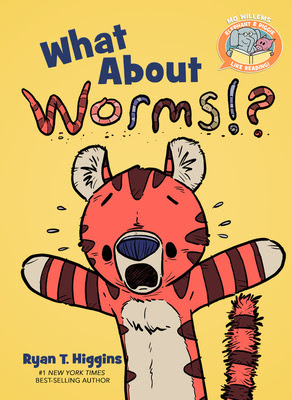
What About Worms!? (Elephant & Piggie Like Reading #7)
written and illustrated by Ryan T. Higgins
Hyperion, 2020, 64 pages
Who doesn't love Elephant and Piggie? And they like to read...and make lots of puns about it while they introduce their latest book all about worms. Tiger is very big and very brave, not afraid of anything. Well, except worms, Tiger does not like slimy, wiggly worms. The only problem is that worms could be in everything Tiger likes. Like the potted flowers that smell so good. But wait, they are in dirt and worms like dirt. Tiger quickly tosses down the flower pot, which breaks. Tiger likes tasty apples, but then he remembers that so do worms, so he tosses it on the floor with the broken flower pot. Worms, he cries, ruin everything. They could even be in the book Tiger would like to read. But it, too, gets tossed away. Worms, it turns out, are afraid of tigers, but they love all the things Tiger has left on the floor. And that book - well, it was all about tigers. After the worms read it, and learn so much about tigers, they decided they like tigers after all. Books, we learn from this work of meta fiction, can teach us so much. Elephant and Piggie may initially draw kids to this book, but it definitely stands on its own with a great message for young, new readers about not judging a book by its cover and about making snap judgements. The message may be serious, but it's delivered with lots of humor, and the bright illustrations really harmonize and compliment the story.

The Last Tiger
written and illustrated by Petr Horáček
Eerdmans BFYR, 2020, 36 pages
When hunters arrive in the jungle and the other animals run and hide, the tiger doesn't. After all, he may be the last tiger, but he haughtily thinks he is strong, fearless and powerful enough to evade capture. How wrong tiger is. Cunningly captured and taken out of the jungle, tiger is put in a cage for people to look at him. No longer free, strong and powerful, the tiger is very unhappy, so much so that he begins to lose weight - lots of weight. One night, he slips through the bars of his cage and finds his way back to the jungle. There, there tiger once again becomes strong and powerful. But now he is a changed tiger, realizing that strength and power mean nothing without the treasured possession of freedom. The vibrant illustrations and the changing expressions on the face of the tiger are just so perfect for this story. The palette is bold vibrant blues, greens, and browns in the jungle, but the colors mute when the tiger is in captivity. The story is a classic example of that old proverb: "Pride goeth before a fall." Unfortunately, it is a little to abstract for my young readers, but for older kids, it is a great book for getting them to talk about what freedom is and why it is important, as well as the up and down sides of pride.  

What are your favorite picture books about animals?

Wednesday, June 10, 2020

Snapdragon written and illustrated by Kat Leyh


When Snapdragon Bloom goes looking for her missing dog, she befriends the town witch and finds more than magic within herself. 

There's a rumor that a witch lives in a house on the outskirts of town, but when Snapdragon's dog Good Boy goes missing, she dares to look for him there. Sure enough, the dog is there, but he's been injured and is missing a front paw. When the rumored witch returns, she tells Snap that the dog was hit by a car and she patched him up. 

Snap is a fierce, fearless, precocious black middle schooler not afraid to take on bullies, often standing up for her neighbor and best friend Lu, who is also black and transgender. Living in a trailer park, Snap is the only child of a mother who must work lots of hours to support them, and who is also getting her degree at night. Good Boy belonged to an old boyfriend who was abusive but is now gone, though he does appear twice in this novel. 

When Snap finds a litter of possum joeys beside their dead mother, she brings them to the "witches" house, hoping they can be saved. The witch turns out to be an older white lady named Jacks, who is more connected to the world than first impressions would give. Jacks collects roadkill, which she buries, then after they decompose, she cleans the bones and reassembles them, selling the skeletons online. 

Creeped out, but also fascinated by Jacks' work, Snap talks her into letting her help take care of the joeys. As a friendship develops between Snap and Jacks, Snap becomes interested in learning more about the skeletons articulated. Snap is also convinced that Jacks really is a witch who uses magic to release the souls of the dead animals back to nature. And as they get to know each other even better, it turns out they have a history of family connections that go back a few generations. So maybe if Jacks can do magic, so can Snap, or at least, that's what Snapdragon hopes.

In the world of graphic novels, Snapdragon is in a class of its own, what you might call a mixed bag. There are magical elements, a mix of humor and sadness, social and social justice issues, marginalized characters, LGTBQ and gender-bending elements, domestic abuse, the roadkill creepiness factor which spikes and just as quickly falls, all wrapped up in a really unusual story.

What I really loved was the way these generally serious topics unfolded so organically throughout the novel, but without lessening any of their importance. Leyh also gives Snap a support system, family and friends who have her back, that gives her the confidence to be unique herself. I also liked the fact that with the last name Bloom family tradition is to name all the girls after flowers, a seemingly unimportant detail that ends up playing an important part in the story.

The author also did all the art work for Snapdragon. Each vivid full color cell is clear and bright, even the darker cells, and color works to add more and more layers to the story. And Leyh has also really captured her character's many moods and feelings through their facial expressions, especially Snap's.

Snapdragon is a wonderfully engaging graphic novel for middle graders who are looking for something good but different.   

This book is recommended for readers age 10+
This book was an E-ARC received from NetGalley

Wednesday, February 12, 2020

Honey: The Dog Who Saved Abe Lincoln by Shari Swanson, illustrated by Chuck Groenink


In her debut picture book, author Shari Swanson re-imagines a little known event from Abraham Lincoln's life when he was only 7-years-old and living in Knob Creek, Kentucky in this fictionalized slice-of-life biography. While waiting for the miller, Mr. John Hodgen, to grind his sacks of grain, Abe usually wandered into the nearby woods, returning to the mill when he heard the miller's three shill blasts of his whistle. There were always so many things for a boy to see or animals to rescue in the woods.

On one visit to the mill, Abe wandered into the woods and discovered a little honey-colored puppy with a broken leg. After setting the puppy's leg with sticks and bark, he took the dog home with him, begging his mother to let him keep him, telling her: "He'll do lots of good things for me." From then on, everywhere Abe went, Honey followed.

One day, after dropping off a bag of grain at the mill, Abe and Honey took to the woods. Discovering a cave, they no sooner started exploring than Abe's foot became wedged between two rocks. As day became night and Abe hadn't returned to the mill, Mr. John and Abe's mother Nancy waited and worried. Finally, Honey showed up and led Mr. Hodgen, Nancy, and some neighbors to the cave where they rescued Abe. Indeed, Honey lived up to Abe prediction, doing lots of good things for him, including saving his life.

There's nothing more appealing to a young reader than a story about a boy and his dog and their adventures. Honey: The Dog Who Saved Abe Lincoln is a particularly appealing story because it introduces them to an historical person that they may already be familiar with, but in a more accessible way and it provides a nice window for them into the kind of man the boy Abe Lincoln grew up to be.

Though this is a fictionalized account, it is based on a true story that had been recounted by Abe's best friend, Austin Gollaher. You can read more about Abe and Honey in the Author's Note in the back matter. Swanson also includes a Timeline of Abraham Lincoln and His Animal Encounters that young readers will no doubt want to explore.

Chuck Groenink's cartoon style illustrations, done in a palette of pastel earth tones and single and double page spreads, really compliment the text and show the the strong connection between Abe and Honey, as well as Abe love of all animals. Be sure to explore map of Abe's neighborhood in Knob Creek found in the end papers with your young readers to give them an idea of the kind of wilderness that surrounded the area back in 1816.

Honey: The Dog Who Saved Abe Lincoln is a book your young readers will want to return to again and again. I know mine do.

You can find an excellent Curriculum Guide to download for Honey on the author's website HERE
And there is a fun Activity Kit for young readers that can also be downloaded HERE

Meet the Author: 
Shari Swanson is a debut author who has been a middle school language arts teacher as well as an appellate lawyer. She received her MFA in writing for children and young adults from Vermont College of Fine Arts, where she wrote her thesis on musicality in picture books. She lives in Southern California with her husband and their dog, Honey. You can find about more about Shari and Honey: The Dog Who Saved Abe Lincoln by visiting her website: https://shariswanson.com/ and you can follow her on twitter at @ByShariSwanson

Meet the Illustrator: 
Chuck Groenink hails from an overgrown village among the peat bogs in the north of the Netherlands, where he spent his formative years climbing tree, drawing, reading, and cycling. He attended the Artez Institute of Visual Arts in Kampen, graduating from the department of Illustration in 2004. He moved to Portland, Oregon in 2010, and now resides in Kinderhook, New York with his wife, dog, and two cats. You can find out more about Chuck and his art by visiting his website: https://www.chuckgroenink.com/ and you can follow him on twitter at @ChuckGroenink

This book is recommended for readers age 4+
This book was gratefully received from Blue Slip Media

Wednesday, September 4, 2019

Blog Tour: The Very, Very Far North by Dan Bar-el, illustrated by Kelly Pousette


One summer day, a polar bear named Duane wanders along the shoreline of the Cold, Cold ocean looking for a good place to nap until he reaches the Very, Very Far North. There he discovers a shipwreck, and living on it is C.C., a very smart snowy white owl, who is at the moment studying Latin verbs. After chatting a bit with her, Duane finds a suitable cave, so suitable, he decides to stay, furnishing his new home with items found on board the shipwreck.

Duane loves a good nap, but being a curious polar bear, he begins to explore his new home and soon enough meets a musk ox who is always and only deeply involved in admiring his reflection. He quickly becomes Duane's second friend, especially after he names the musk ox Handsome (Duane is very good at finding just the right name for everyone). Over time, Duane makes more friends. There's Magic, a very, very energetic, impulsive Arctic fox; Major Puff, a puffin who practises military marching for when the day comes and he has to retreat; and an Arctic hare Duane names Twitch, who keeps an immaculate home but is a worrywart, always on the lookout for danger. Into this mix of animals comes Sun Girl and her pack of dogs known collectively as The Pack, and a summertime painter Duane names Squint because of the way he studies the object he is painting.

The Very, Very Far North, which is just mesmerizing, is a series of character driven vignettes involving Duane and his new friends. Their adventures are affectionately relayed by a gentle-voiced narrator using direct address, creating what feels like a very intimate story time. Added to that are Kelly Pousette's simple black and white illustrations scattered throughout and complimenting the text. And it's easy to understand why Duane has been compared to Winnie-the-Pooh. Duane is a really good natured bear with a certain cluelessness that leads to some very funny situations.

But for all Duane's cluelessness, he is a empathic bear who recognizes the differences in his friends and just accepts and respects them for who they are. For example, Duane likes a good hug, but he knows knows that C.C. does not really like being touched, preferring to share her wealth of knowledge about nature and science instead; Magic's energy can overwhelm, but Duane manages to find constructive outlets for the hare. 

The Very, Very Far North is a calming, cozy kind of book that would make an excellent read-aloud whether in school, or curled up under a blanket on a cool afternoon, or as a bedtime story, since each chapter can be read on its own. Personally, I love a good bear story and this one is just top-notch as far as I'm concerned.

This book is recommended for readers age 8+ (but works as a read-aloud for younger kids).
This book was provided to me by the publisher, Simon & Schuster

Meet the Author
Dan Bar-el is an award-winning children’s author, educator, and storyteller whose books include Audrey (cow), Not Your Typical Dragon, and The Very, Very Far North. Dan has worked with children ages three to thirteen as a school-age childcare provider, a preschool teacher, a creative drama teacher, and a creative writing teacher. He also teaches with the Creative Writing for Children Society. Dan lives in Vancouver, British Columbia, with artist and goldsmith Dominique Bréchault, and Sasha, the most adorable cat in the known universe. Visit him at DanBarel.com.


Meet the Illustrator
Kelly Pousette is an illustrator and storyteller, originally from the west coast of British Columbia. She loves to create things, especially pictures. Her work has been featured in The Huffington Post Paris, The Brown Paper Bag  blog, and Brightness Magazine. She currently resides in northern British Columbia with her husband and very large dog Clovis. The Very, Very Far North is her first book. 

Be sure to visit these other stops on The Very, Very Far North Blog Tour:

September 2 – The Story Sanctuary
September 3 – Kirsti Call
September 4 – Randomly Reading
September 5 – Alexa Loves Books
September 6 – Jean Little Library
September 7 – Tale Out Loud
September 9 – Insane About Books

 
Imagination Designs