Showing posts with label Picture Books. Show all posts

Sunday, October 16, 2022

πŸ“šFour New Favorite Halloween Picture Books πŸŽƒπŸ§™πŸΌ‍♀️πŸ‘»

 
It's almost Halloween and here are some new picture books to help your young readers get into the holiday spirit.

Happy Owl-Oween! by Laura Gehl,
illustrated by Lydia Nichols
Abrams Appleseed, 2022, 24 pages
"Pumpkins to pick./ Ghost pops to lick./ Neighbors to trick!/ Happy Owl-oween!" It's almost Halloween and the little owlets are getting ready for the big day. Told in short rhyming couplets, the owlet are busy doing all the usual Halloween traditions. There are pumpkins to carve and candy apples to make as they sip warm cups of cider, then it is time to make costumes. What will they be? One owlet makes a witch costume, one chooses to be a vampire, a third owlet is Frankenstein, and the fourth is a superhero. Then it is off for an evening of trick or treating, following by sorting and sharing their candy with each other and finally to bed, tired but happy. This is such a sweet story for young readers like mine who are really just beginning to appreciate Halloween and who don't really know the traditions of the season. Plus these cute owlets with their sweet faces will captivate kids without being scary. The rhyme never falters and the illustrations are bold and colorful. Plus there is some back matter that explains all about the roots of Halloween and how we celebrate it nowadays. My young readers really loved this book. We read it enough times they had most of the words committed to memory.  

The Crayons Trick or Treat by Drew Daywalt,
illustrated by Oliver Jeffers
Philomel Books/PRH, 2022, 28 pages
The Crayons are back and this year they are trying their hand at trick or treating on Halloween. Dressed in their color coordinated costumes - orange pumpkin, green witch, purple vampire, white ghost, black bat, grey fox and peach is just naked- there's just one problem. Though they can wait to fill their bags with candy, none of them have ever trick or treated before. What do they say after they after they knock on the door? Orange tries first saying: "Give us your candy, lady." That doesn't work, so green tries Merry Christmas with the same result as Orange - a door slam. After a few more failed attempts to get some candy, the Crayons, lead by Purple, practice saying "Trick or Treat" before knocking the next door. Will the fifth try be the charm? Young kids are often afraid of some to the traditional Halloween creatures, but this will take the scare right out of them. And it is a story that will definitely make young readers laugh even as they see the old adage "if at first you don't succeed, try try again" at work, a good lesson for youngsters. Jeffers's illustrations, done in a Halloween palette, are cartoonish and in keeping with Daywalt's other Crayon books, which fans will no doubt recognize. I read this to my young readers, many about to experience their first Halloween, and they loved it. 

Ada Twist, Scientist: Ghost Busted
written and illustrated by Gabrielle Meyer
Abrams BFYR. 2022, 32 pages  
Ada Twist has become a very popular STEM icon and the scientific method. This story is not a Halloween tale per se, but is a good ghost story. Ada and her friend Rosie are have a sleepover at their friend Iggy's house. When Ada suggests they play ping-pong, Iggy tells they that they can't. The ping-pong table is in the cellar, which is haunted, and he won't go down. The lights flicker and there's a scary ghostly voice that says "Howler's Hungry!" every once in a while. Naturally, Ada suggests they investigate using the scientific method seeking to answer the question; Is the basement haunted? It is interesting to see how they go about doing their research to form a hypothesis and test it out with experiments. I really liked the way they did everything step by step but in the end they learned that sometimes if you don't look at the whole picture, but only pieces of evidence, you can draw false conclusions. I liked this boldly illustrated book for two main reasons. First, the method that the kids use is explained very well, and a great introduction to the scientific method. Second, these diverse friends show how to work together to accomplish their goal. Group work is something introduced in elementary school and Ada, Rosie and Iggy are great roles models. And Iggy's dad was there and supportive, but left the kids alone do their thing until he was needed. Even if kids aren't into STEM, there is plenty for them to enjoy in the picture book that is also part of the Ada Twist, Scientist series on Netflix.   
A Costume for Charly by C.K. Malone,
illustrated by Alejandra Barajas
Beaming Books, 2022, 40 pages
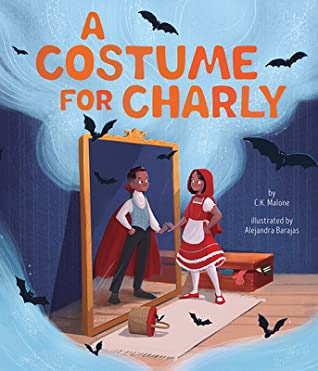
Halloween has always been problematic for Charly. They can never decide what to be that reflects who they are 100%. Digging through the box of old costumes, nothing seems to work. Going as an astronaut hides too much, a clown costume isn't even funny, and being a monster in a masked covers up who they are. Red Riding Hood is a good costume, but too girl, which Dracula is also good but too boy. Then, Charly gets a brilliant idea. They cut and snipe away at both the Red Riding Hood and Dracula costumes until they create the perfect costume that uniquely says Charly 100%. This year, Trick or Treating in a costume that is both boy and girl will be the best feeling in the world for Charly as he presents their authentic self. This is a well-written story that really says so much about gender identity and being true to oneself. And I think the reactions of the other neighborhood kids is pretty true to life - some kids thought his costume wacky, other didn't get it, but some thought it was wonderful. The brightly colored illustrations really compliment the text. Charly's quest for the perfect costume is no different than what most kids go through when it comes to choosing a Halloween costume, the only difference is that Charly presents as bigender making this a good book for starting discussions about gender identity with youngsters. Back matter includes some information about what identifying as bigender means as well as resources about the LGBTQIA+ community.


Tuesday, August 30, 2022

Back to School Picture Book Read Alouds

 
Kids and teachers all over the country are returning to school. For some, it began in mid-August, for others, it won't be until September 8th. It's always sad to say goodbye to summer, but there are lots of wonderful picture books to help make the transition back to school a good one. Here are a few that I particularly enjoyed this year. 
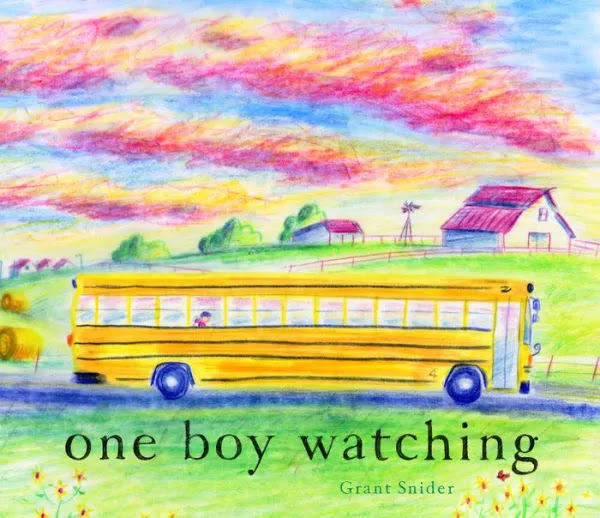
One Boy Watching
written and illustrated by Grant Snider
Chronicle Books, 2022, 60 pages
Early in the morning, a young boy watches as the Number Four school bus approaches. He's the first one on the bus and as it travels along the country roads, he catalogues all that he sees out the window, like a gnarled tree, three deer, four rusty cars, seven wild sunflowers, three pecking chickens. It is "one bus ride at sunrise under an infinite sky" and "one boy daydreaming" as more and more kids climb aboard the bus. It is a long bus ride into town and school and eventually there are "Forty-eight kids packed like crayons in a crayon box" by the time it reaches school in the city. School buses are usually portrayed and noise, chaotic, or a land of bullies, but in the reflective story, readers see another side of a long ride to school and seem to be encouraged to observe instead and to see what there is out there in both nature and the man made world. The text is simple and lyrical, with just a few words on each page, and relying on the illustrations to complete each observation. I love the colorful color pencil and marker illustrations. They have an innocent childlike feel to them, almost as if they were done by our young observer himself. Perhaps that is because so much of this story is autobiographical for the author, recounting his ride to and from school each day.  

Creepy Crayon! (Creepy Tales #3)
written by Aaron Reynolds, illustrated by Peter Brown
Simon & Schuster BFYR, 2022, 48 pages
Jasper Rabbit is back with a third creepy tale to tell. He not doing too well in school, failing all his subjects except art. It's just Tales from the Carrot Patch is too good a TV program to miss and that leaves not time for studying. Then, one day, Jasper finds a purple crayon that, oddly enough, seems very happy to see him. And it doesn't take long for Jasper to discover that when he uses the purple crayon, he gets all A's on his schoolwork, leaving him plenty of time for TV and video games. But as the purple crayon gets more and more possessive of Jasper, he begins to feel very creeped out. But it seems that no matter what he does to get free of the crayon, it always comes back, more possessive that before. As Jasper's guilty conscience begins to really bother him, he finally takes drastic measures to get rid of the purple crayon and finally do his own work in school - for better or worse. The story and pencil illustrations are just creepy and sinister enough not to scare young readers (like mine) too much but to give them that thrill that makes stories like this so much fun to read. My young readers love the previous two Jasper Rabbit books, Creepy Carrots and Creepy Pair of Underwear, so I can't wait for them to come back to share Creepy Crayon with them. I'm just guessing, but I think I won't be seeing too many purple crayons in their crayon boxes this year. 

School Is Wherever I am
written and illustrated by Ellie Peterson
Roaring Brook Press, 2022, 40 pages
When most of us think of school, we picture a blackboard, a teacher and a classroom filled with diverse students learning, creating, writing, having fun, and wondering about the world. And that is just how the young narrator in this contemplative story describes his classroom. But, then he wonders: where else is school? Are there other classrooms in which to learn new things? Can it be found at the zoo, the aquariums, museums, in Nana's kitchen, or Papa's workbench? On hikes or bike rides, around a campfire or up in the stars? Thinking about all the places where he can learn about life and the world around him, our narrator decides that school is wherever he is. And the best part is that the things that are learned at school-outside-of-school can even be shared with family and friends. There's just so much to learn and enjoy out there. Teaching kids to look beyond the classroom, to develop a healthy curiosity about things will help them become lifelong learners. This is another book I am excited about sharing with my young readers in September. I'm curious to see how they respond and talk about some of the things they have done that are in the book and what they think. I love books like this that generate thoughtful and meaningful conversations with my young readers. 

Tomatoes in My Lunchbox
written by Costantia Manoli, illustrated by Magdalena Mora
Roaring Brook Press, 2022, 32 pages
Things are difficult for a young girl whose family has just immigrated and nothing feels the same, but especially not her name. Back home, her same sounded like "soft like summer and round with love and color and light" but now, when her teacher or the other kids at school say her name, it just doesn't fit in their mouth. But one thing does feel like home even if it is weird in her new country: the whole tomato she brings to school in her lunchbox. If only she had a different name, perhaps a name like Emma, she wouldn't feel so different from the other kids. Then one day, she smiles at Chloe and they begin to talk. Soon, Chloe can say her name so that it feels right. And they have things in common, too. So when Chloe forgets her lunch, she offers to share her tomato. The friendship is sealed and before she knows it, she and Chloe part of a group of friends, who all learn how to say her name correctly. And her new country begins to sound like home. The message here is clear: don't try to someone you aren't, be yourself and everything that means. The vibrant mixed media illustrations really captures all the different emotions the main character goes through and, wisely, the author never gives her character's name or where she comes from, making this a story that can be read and appreciated by children from anywhere who are in the same situation. I'm excited to share this with my young readers soon. They all come from different places, and some have names that aren't familiar to Americans. Back matter consists of an Author's Note about her own experience as a newly arrived immigrant with an unfamiliar name.    

Lunch from Home 
written by Joshua David Stein, art by Jing Li
Rise/Penguin Young Readers Group, 2022, 40 pages
This is an unusual book in that four diverse chefs contributed their own childhood experiences to its creation. It begins on Monday at lunchtime. Most kids have sandwiches, except for Preeti, who brought soft dhokla cake topped with spices, her favorite lunch. After the kid next to her says it smells stinky, Preeti begins to bring sandwiches, too. On Tuesday, Mina brings gimbap, neat green-edged rolls of rice with carrot, radish, and ham in the center, the boy next to her make fun of her lunch, and the rest of the week, Mina brings a sandwich. On Wednesday, Niki brought a bagel with everything: lox, cream cheese, capers, and tomato. The boy next to her said cheese and fish are just weird. The next day, Niki brought a sandwich. On Thursday, Ray brought a chopped-up hot dog with scrambled eggs and cheese wrapped in a tortilla. The girl next to him said hot dogs belonged in buns, not tortillas. On Friday, Monday, and Tuesday, everyone in class ate sandwiches for lunch. But on Wednesday, Mina brought gimbap again and really enjoyed it. Before long, Preeti, Niki, and Ray were also enjoying their favorite lunches again. Who are these kids who grew up to become chefs? Preeti Misty, Mina Park, Niki Russ Federman, and Ray Garcia.

πŸ“šπŸšŒπŸ““More Back-to-School book suggestions can be found here:


Wednesday, July 27, 2022

The Pleasure of Wordless Picture Books

 
I'm going through books, getting ready for when my young readers are back from vacation. I have found that one of the most successful category of books to use with younger kids is wordless picture books. They provide kids with a way to tell a story in their own words, eliciting language and using imagination. Here are four I plan on permanently adding to our small Wordless Picture Book Library now that they have been read and enjoyed by my young readers.  

A Day for Sandcastles by JonArno Lawson,
illustrated by Qin Leng
Candlewick Press, 2022, 48 pages

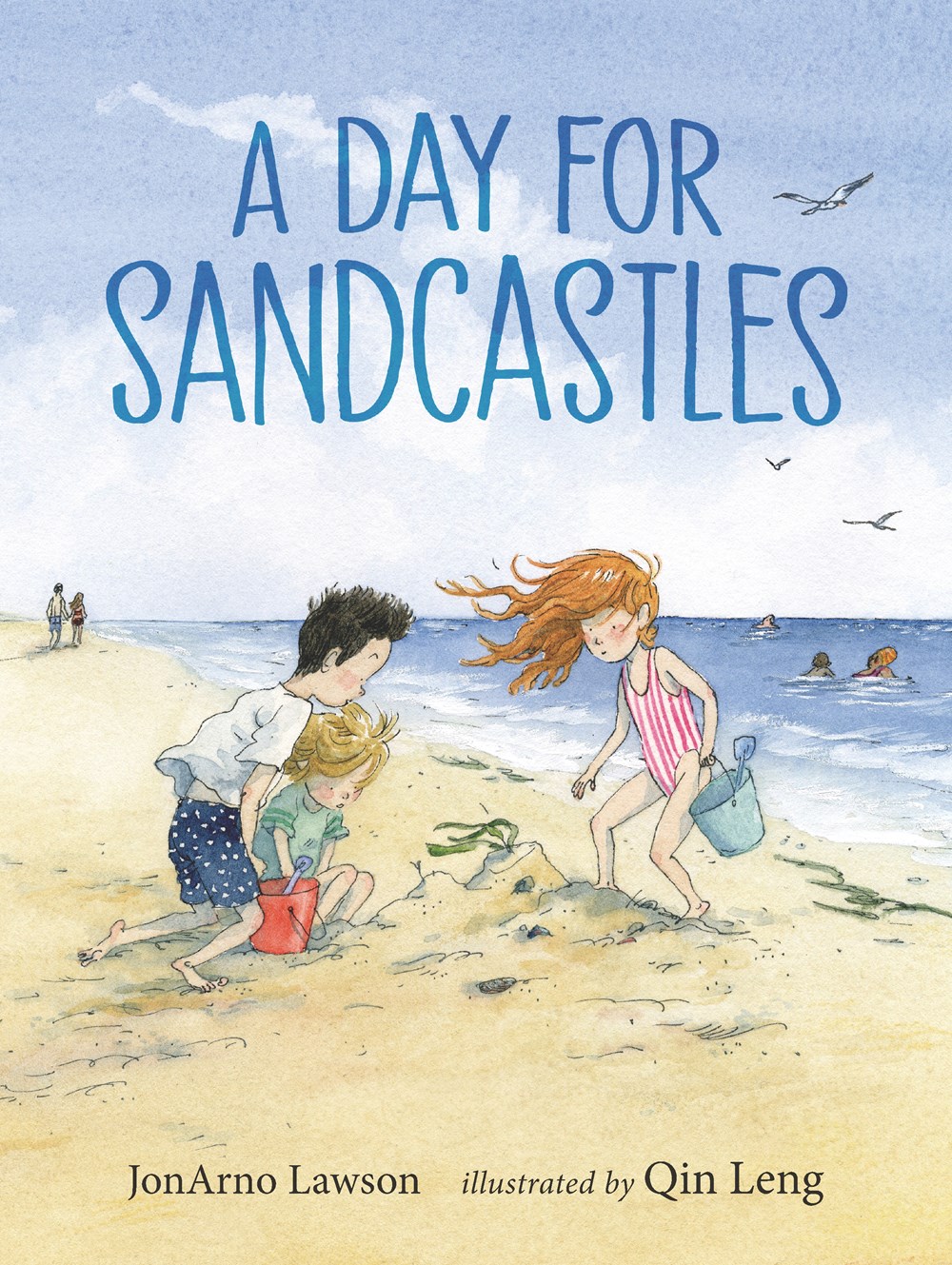
A family - mom, dad, and three siblings - arrive by bus to spend a warm summer day at the beach. Pails and shovels in hand, older brother, middle sister and a toddler are ready to build a sandcastle at the water's edge. Proud of their first small castle, it is quickly washed away when a wave comes in. And so they begin again, and again, and again. Each sand castle meetings it own beachy fate. But the siblings never give up, working together as a team. What I love about this book is not just the message of teamwork and perseverance, but the feeling of being at the beach that each illustration brings. The ink and watercolor illustrations are detailed and while the focus is on the three siblings, there is the usual beach activity all around them - people swimming, others walking along the shoreline, people reading under umbrellas, kids playing ball - all captured on one and two page spreads, some with smaller, close up montages. And who hasn't encountered pesky seagulls while eating lunch at the beach, or the wind blowing someone's hat away. This day at the beach was anything but static. I could feel the sea breeze and the feeling of it blowing sand into my hair, and smell the sun screen, and the tide coming in as the day worn on and the position of the sun changes. This is a beautiful wordless picture, (and for me, nostalgic) day at the beach and I can't wait to see what my Kiddos have to say about it.     

All Around Bustletown Nighttime
written and illustrated by Rotraut Susanne Berner
Prestel Publishing, 2022, 14 pages

Welcome back to Bustletown! Previously, we read book about Bustletown throughout the seasons, and no matter what time of the year it is, it is a pretty busy, busy place. It is, after all, a wimmelbook. Is Bustletown just as busy at night as it is in the daytime? This book follows the same format as the previous books, beginning with a home where everyone is getting ready for bed, and the kids are camping out in the backyard. But, there is still activity on the street. The bus is still running, the gas station and the train station are open, just not quite as busy as in the daytime. The market is closed, and there is a sleepover for kids at the Cultural Center. But, uh oh, someone is trying to break into the bookstore. Luckily, the police have just arrived. The department store is closed, but there a window shoppers out for an evening stroll. Cara and John are out and strolling through the pages, but where are they going at night? It seems the Park Cafe is open and there are lots of people enjoying a meal with friends, plus they can watch the fireworks lighting up the night sky. Bustletown has a different look to it at night than it has during the day, but readers will meet the same people and see the same places as in the earlier books, giving all the Bustletown books a nice continuity. The illustrations are just as charming and colorful as before, but with a dark blue nighttime sky. And each of the two page spreads are elaborately detailed and each page connects to the one before and after it, providing lots of stories that kids can make up as they read their way through Bustletown, making this a great interactive book. 

The Depth of the Lake and the Height of the Sky
written and illustrated by Kim Jihyun
Floris Books, 2021, 24 pages

In her afterword, the author says she hopes this book will help readers connect to nature much the same way she did one summer and experience the same serene feeling she felt. In this story, a young boy, his parents, and their dog leave their bustling city behind and drive to the countryside to visit his grandparents. Soon after arriving, the boy and his dog go for a walk on a winding trail in the forest behind the house. The further they walk, the more the boy notices the wonders of nature around him. Eventually, he and the dog discover a lake with a dock, and the boy dives in, exploring the wonders of underwater nature. Afterward, boy and dog lay on the dock to dry off before heading home at the end of the day. What is remarkable about this wordless picture book how the author manages to convey so much in each illustration, all of which are done using writing ink and a slow-drying blending medium in a palette of grays and whites, with only touches of blue. Each image is filled with details, whether it is the street where the family lives, or the lushness of the forest with it varied flora, the long late afternoon shadows over the countryside, or a sky filled with stars. My only problem was that the boy went swimming alone in the lake. I have drummed it into my Kiddo's head to never ever swim alone, and had to give the same warning to my young readers when we read this book. Otherwise, it is a brilliant wordless picture book that really elicited lots of talk among my kids.     

The Dog Walk
written and illustrated by Sven Nordqvist
Floris Books, 2021, 32 pages

Follow a young boy in a red cap as he takes his Grandmother's big white dog for a jam-packed adventurous walk in this wordless fanciful Wimmelbook. Pulled along by the dog, the two ride a train to places where there are tree houses piled one on top of the other, people from different time periods, people and animals of exaggerated size (both large and small), and all kinds of animated objects, among other  imaginative things. Boy and dog climb mountains, cross tropical seas, explore toy and antique shops, visit overgrown villages and castles surrounded by moats, and a town where only cats live. The sights the boy and dog see are wildly imaginative, at times fun, at other times rather dark. And just like that, they return to Grandmother's house at the end of their adventure. I was a little hesitant about reading this to my young readers, but they loved exploring the pictures and I guess they've watched enough silly things on TV that they had no problems making up stories about the boy and dog on each page after they found them in all the chaos, all of them brilliantly illustrated using watercolor, acrylic, and ink.  

What are some of your favorite wordless picture books?

Wednesday, June 22, 2022

Four STEM Picture Books (that we read and loved)

 
Summer is here and before we go our separate ways for a while, I thought it would be a good time to introduce my young readers to the idea of STEM books. Here are four books that we particularly enjoyed reading and talking about. 
Honeybee Rescue: A Backyard Drama
by Loree Griffin Burns, photographs by Ellen Harasimowicz
Charlesbridge, 2022, 40 pages
Mr. Connery is an experienced beekeeper, maintaining wooden hive boxes in his backyard. So when he discovers a bee swarm in his ramshackle barn, Mr. Connery knows that his bees have outgrown their hive and it is time to stack an additional hive box on top of the older one so the bees can spread out. But first he needs to deal with the swarm in the barn. And for that he calls Mr. Nelson, a beekeeper who specializes in removing bee swarms so that people don't exterminate these important pollinators. In between the account of Mr. Connery and Mr. Nelson saving the barn swarm, Burns provided all kinds in bee information from why they swarm, the structure of a hive, how a bee vacuum works so the bees are kept safe, and how a bee rescuer gets the bees and any honeycomb they may have started safely into hive boxes. We just had a bee swarm in Manhattan the other day, so this was a great time to read this book to my young readers. The writing is simple but informative, and generative lots of discussion. The photographs, with some great bee close-ups, really add so much to the information and framing the bee rescue in a story helped my young readers, some of whom are afraid of bees. Back matter includes an interview with Mr. Nelson, and a Glossary of terms used, as well as an Author's Note about her interest in bee rescue. Burns does a brilliant job of sticking with the concept of bee rescue, so if you want to know more about the life and work of honeybees, pair this with Candace Fleming's Honeybee: The Busy Life of Apis Mellifera.
Our latest bee swarm (Photo: Peter Gerber)

Diego: The GalΓ‘pagos Giant Tortoise
Book 5 in the Another Extraordinary Animal Series
written by Darcy Pattison, illustrated by Amanda Zimmerman
Mims House, 2022, 32 pages
Giant tortoises were in abundance in the late 1600s when pirates landed on EspaΓ±ola Island, a small GalΓ‘pagos Island off the coast of Ecuador. When sailors discovered that these giant tortoises could live without food and water for up to a year, they began packing them in the holds of their ships to provide food on their journeys, so that by the early 1960s, it was believed that the EspaΓ±ola tortoises were extinct. But by 1974, scientists discover there were actually 14 giant tortoises left in the world - 12 females and 2 males. Taken to the Tortoise Breeding Center on Santa Cruz Island, scientists learned out to successfully breed healthy tortoises, and by 1970-71, 20 EsanΓ±ola tortoises hatched and five years later, 17 were returned to EspaΓ±ola Island. With only two males, breeding was limited until they discovered Tortoise Number 21 at the San Diego Zoo. Names Diego, at 65 he was brought to the breeding center. It didn't take long for Diego to become a father - in fact, it's estimated that he fathered about 900 to 1000 of the 2, 354 tortoises populating ExpaΓ±ola Island in 2019. It was time to send Diego, now about 110 years old, and the original 14 tortoises home to their island. The EspaΓ±ola tortoise was not longer on the verge of extinction. This is such an interesting look at how the threat of extinction could be reversed for the endangered species around the world. The book is chockablock with information and it is totally accessible for young readers without overwhelming them. This was important to me. I was a little hesitant about introducing the idea of extinction and conservation to my young readers who are a little younger than the suggested target age of 7+, but they loved hearing about Diego. What really helped them to understand the plight of the tortoises were the detailed illustrations of each two page spread. In the back matter, Pattison give more information about tortoises and efforts at conservation, plue a bit about telling the difference between tortoises and turtles, plus a map of the GalΓ‘pagos Islands, which was very useful. I expect this is a book we will return to again and again as we begin our STEM explorations.
Diego

What a Shell Can Tell by Helen Scales, 
illustrated by Sonia Pulido
Phaidon Books, 2022, 48 pages 6-9
The first time I took my Kiddo shelling on the Jersey shore, she filled her pail with all kinds of shells and declared "we're rich!" Since I still have some of those riches, they came in handy when I introduced this book to my young readers. It is incredibly well-organized, each section beginning with a question, and the questions following a very logical order, beginning with what a shell is, what a shell's shape and pattern can tell you as well as what it's color and texture reveal. On of the most interesting facts I learned was how a shell is created by the mollusks that live in it. Additionally, Scales goes into how mollusks move and what they eat, and who else uses a shell (and it's not always to original mollusk who created it), and where the various shells can be found around the world. Each question gets a digitally created two-page colorfully illustrated spread. One of the things I did very much like is how Scales brought together past, present and future and how the things like how global warming, increases in carbon dioxide, uses of mines in the deep ocean, and heavy nets used for catching shelled mollusks for increased consumption are all taking their toll on the ocean's ecosystem. This is a great book kids who are curious about the oceans and what lives in them, and will hopefully spark some real interest in conservation and preservation. Since NYC's beaches aren't far away for most of my young readers, they are anxious to see if they can find some shells this summer. Maybe that's just the beginning interest that this book is aiming for.  
One of my Kiddo's riches

Sea Lions in the Parking Lot: Animals on the Move in a
Time of Pandemic by Lenora Todaro,
illustrated by Annika Siems
mindedition, Astra Publishing, 2021, 48 pages
I found this book to be a fascinating look at what happened in the early days of the Covid-19 pandemic, when people took to their homes and seldom went outside. With deserted streets, parks and parking lots, stores and restaurants, the animal world ventured into places they are not usually found in and "reclaimed ancient habitats as their own - temporarily, at least." Todaro takes readers on a world-wide tour beginning with Australia, where a kangaroo left its parklands and hopped into the city of Adelaide, where it was free to explore with human interference. In Nara, Japan, a herd of deer, hungry for the treats humans always fed them, took to the street and noshed on leaves and grass, even potted plants, then had a romp in the subway. In South African savanna, a pride of lions lazed one the roads usually full of vehicles and tourists. There are more stories like this, and it is kind of interesting to see how easily the animals could take back their territory is there were no human interference. In her Epilogue, however, Todaro points out that not all animals fared as well as they ones spotlighted in her book and offers suggestions for how to go forward and make the world a safer, better place for the all the different species. Back matter includes Notes on Habitats, Biomes, and Wildlife Behaviour of the animals that appear in this book, and Some Further Resources. The illustrations are just spectacular, often with a hint of humor, but like the text, always reminding the reader just how much human behavior impacts animal behavior. 
Deer in Japan riding an escalator

Thursday, April 14, 2022

Some New and Old Favorite Picture Books


After I got sick (not COVID), I thought I would never get back to my kiddos again, but I did spend a lot of time reading new pictures books, and revisiting old favorites so I would be ready when the day came that I would see them again. And yes, that day has come and here are the first five books we've explored that week. And I just realized I began and ended this post with books by Andrea Wang, who is a favorite of ours. 
Luli and the Language of Tea by Andrea Wang,
pictures by Hyewon Yum
Neal Porter Books/Holiday House, 2022, 40 pages
Available 5/17/2022
When five-year-old Luli enters the playroom where her English language class is held, she notices how quiet it is because everyone is playing by themselves. No one knows any English yet and all the kids speak different languages. So Luli gets an idea. The next day, she takes a thermos, a canister, a stack of cups, and a fat-bellied teapot out of her backpack and sets them on a table. Luli drops some tea leaves into the pot, pours in some hot water from the thermos, and when she loudly calls "ChΓ‘," "all around the room, heads popped up." Soon, her table is full of other kids drinking tea, that is everyone except Luli. So Luli's teacup is passed around the table and each child pours a little of their tea into it. But Luli isn't finished - next she pulls out a box and, using the only English word she knows, says "Cookie." Now, kids are no longer playing alone and the playroom is no longer quiet. This is a charming story in which a hot cup of tea really does become an ice breaker. There are ten children in Luli's English class, many from different Asian countries, but for whom the Chinese word "ChΓ‘" is similar to the word they use in their language, all of which is explained in the Note from the Author. I loved how Wang worked in the names of the different kids and the different pronunciations of tea. Yum's whimsical color pencil illustrations really capture the diversity of these English language learners, and the variety of expressions and reactions of all the kids. I grew up in a tea drinking family so I was right there for this story. 
An Educator's Guide is available to download HERE

All You Need by Howard Schwartz,
illustrated by Jasu Hu
Neal Porter Books/Holiday House, 2022, 32 pages
Using spare, lyrical text, Schwartz explores the essential things that are needed to thrive and to have a happy and fulfilling life. He begins with a planet to live on, a sun for light and warmth, clouds for rain, seeds to grow, trees to clean the air, good food, a country that welcomes you, and someone to share your life with, words to share your thoughts, a hand to write down those thoughts and finally, a beating heart. In other words, we need connectivity to our world, to nature, and to other people, as well as knowing our place in it and having an appreciation for what the world gives us. What really brings text to life are the wonderful watercolor illustrations in which debut artist Jasu Hu has used her own life experience growing up in China and then moving to the United States. This kind of personalization is one of the reasons the the illustrations carry so much emotion in them. When I read this to my young readers, it generated a long discussion about what is important in their lives that make them feel happy and somewhat content. Sometimes I surprised by how sensitive my kids are, but many have experienced tough times in their short lives and a book like this really helps them see what can also bring happiness. We haven't gotten to the words to write down stage yet, but we are certainly at the words to verbally express our feelings stage. One of my young readers did notice that there ia a bird on each page and in the note by the illustrator, she writes that the swallow in Chinese culture "is a messenger that brings happiness and a symbol of homecoming." Interestingly, I've noticed a lot of birds in the drawings my young readers have done lately (they are encouraged to draw pictures based on what we read).

The Longest Storm 
written and illustrated by Dan Yaccarino
mindedition/Astra Publishing, 2021, 40 pages
When a storm of huge proportions suddenly arrives in their town, a family - father, adolescent daughter, two younger children and a dog - find themselves forced to stay in their house for an extended amount of time. And while the storm rages outside, things begin to deteriorate inside. Soon boredom leads to fighting, then they all get sick of each other and finally dad loses it, sending the kids to their rooms. Which didn't matter anyway, since everyone wanted to be alone. But when a great rumbling is heard, one that shakes the house, and a lightning strike causes the power to go out, the family finds that the darkness may just be what they need to become a solid family again. The realistic portrayal of how things can decline under stress is so spot on in the picture book, right down to the dad getting angry at all the bickering and complaining, which is written on the body language of the kids more than in the spare text. The illustrations really carry this story, done in a palette of flat blue, yellow and black. Parallels to the COVID-19 pandemic and lockdown have been made about this book, but I think it can be seen as a metaphor for any longterm stressful event in a family's life. And while we are still dealing with COVID-19, this book offers a needed glimmer of hope. Interestingly, when we talked about this book, one of my young readers said it was like have to learn English as a second language in her house, which I thought was a very insightful observation (or maybe the frustrations are what made her think of it).  

The Ramble Shamble Children by Christina Soontornvat,
illustrated by Lauren Castillo
Nancy Paulsen Books/Penguin BFYR, 2021, 32 pages
A diverse group of five children live quite happily together in their ramble shamble house (with no adult in sight). And they all work together to care for the house and yard - Meera in the garden, Locky and Roozle chase away the blackbirds, Finn feeds the chickens and baby Jory looks after the mud. All is well until one afternoon when the children take a break from their various chores to read a book all about how to have a proper house, which looks nothing like their ramble shamble house. The next day, the children set about turning their house in to a proper house. And when they are finished, it looks very proper, but then Jory goes missing. A proper house doesn't have mud to maintain. Finding him in the nearest mud puddle, the children realize that a proper house is the house they are happiest in and for these kids, that's their ramble shamble house  and not someone else's idea of what it should be. This a great book about being true to yourself because that is what makes you happiest and not measuring yourself against what others think you should be. When I read this to my kids, they had some trouble understanding why there was no adult around, but once we got past reality and into imaginary, they loved this book, especially the colorful illustrations that just make you smile when you see those kids so happy. 

Watercress by Andrea Wang,
illustrated by Jason Chin
Neal Porter Books/Holiday House, 2021, 32 pages
My young readers and I are all the children of immigrants, and like the young narrator of this book, we have all been embarrassed by our immigrant parent(s) at one point or another growing up. So naturally, we really loved and understood this book on our first reading of it. In this story, a Chinese American family -mom, dad, a brother and sister (our narrator) - is riding in their old beaten-up Pontiac, when mom suddenly shouts "Look!" and dad quickly stops the car. Growing in a ditch by the side of the road is a crop of wild watercress. In no time at all, bags and scissors are produced and everyone is filling the bags with watercress. That night, the family sits down to a meal, including a dish of watercress, but the narrator refuses to eat it, angry and embarrassed about eating dinner from a ditch. This is, until her mother tells her about her family in China during the great famine when all there was to eat was what they could find. This story, based on the author's own memories, is really about sharing memories. Had the narrator known why the watercress was important, perhaps she would have felt empathy instead of anger. The almost dreamlike washed watercolor illustrations, in a palette of subtle yellows and green, add so much to this beautifully told story, imparting a real sense of memory and the importance of remembering and sharing. 
An Educator's Guide is available to download HERE

It's good to be back with my young readers and we have lots more picture books to read and share with you. 

Wednesday, February 9, 2022

Three New Books and Two Favorites for Young Readers

 
Hat Cat by Troy Wilson,
illustrated by Eve Coy
Candlewick Press, 2022, 32 pages
Every day, Hat Cat's human, an elderly man, would place some peanuts in the crown of his hat and go outside, where he would sit under a tree and wait for the squirrels to come to eat their treats. One day, he find a kitten hiding under his hat and takes it home. Hat, as the kitten is called, is doted on by his human, but Hat is never allowed to go outside. His human is afraid Hat would run away or scare away the squirrels. When his human suddenly disappears for days, a Black woman and her daughter arrive daily to feed Hat and give him belly rubs. When Hat manages to escape one day, the daughter realizes he is looking for his human. Finally, the elderly man returns, and it is clear he has had some kind of health issue. When he heads outside with the mother and daughter, Hat is finally allowed to join them. The realistic watercolor and colored pencil illustrations in a bright, colorful palette capture the affection between human and cat, and all their different emotions - from surprise to happy and playful to scared and finally happy again. This is a story that may help young readers understand and feel empathy for their elderly relatives and neighbors. 


Ear Worm by Jo Knowles,
illustrated by Galia Bernstein
Candlewick Press, 2022, 32 pages
It's happened to us all - suddenly a bit of song is running through your head and you don't know where it came from or why. And that is just what happens to Little Worm one summer day as he goes off to play. Suddenly there is a song in his head. When he runs into Owl, who wants to know what he's singing, he learns he has an ear worm and that Owl has one, too. But Little Worm wants to find out where his ear worm came from, so the two go off together. Pretty soon, they run into Chipmunk, Bunny, and Fox and discover they also have songs running through their heads. It doesn't take long for everyone to start having fun, dancing and singing to their individual songs and Little Worm forgets all about finding out where his ear worm came from. But what a surprise when he gets home and Papa Worm puts him to bed that night. This is such a delightful bedtime book for young kids, and even if they don't know what an ear worm is, they will by the end of the story. I loved how each of the animal friends has their own tune, that repeats throughout the book, and a few reading will have your kids singing along. The digitally created illustrations are as delightful as the text. I read this several times to my young readers, and after we finished, we made Little Worm, Owl, Chipmunk, Bunny, and Fox finger puppets and so can you. You can download the ready to print sheet from Jo Knowles' website HERE
And you can download a Teacher's Guide, which I found helpful, from Candlewick Press HERE

Star Fishing
written and illustrated by Sang-Keun Kim
Abrams BFYR, 2022, 56 pages
Available February 22, 2022
One night, a young boy dressed in bunny pajamas, complete with long ears, just can't get to sleep. Looking at the bright crescent moon out his window, he calls out to it to "play with me." That's when the magic happens - a fishing line with a star attached hauls the child up to the moon where they meet Little Bunny, who rounds  up several more little insomniacs, including crab, fox, little bear and big bear. Sitting in the hug of the crescent moon, each holding celestial fishing poles, they are pulled away from the moon to play among the stars. Pretty soon, everyone begins to yawn and feel sleepy, and after a cuddle with Little Rabbit, he sends the night's insomniacs home to bed, sound asleep. This is such a gentle, enchanting bedtime story, full of the kind of imagination and wonder that will definitely make it a nighttime story hit with young readers. Set against a blue night sky dotted with stars in the distance, the mixed-media illustrations are as soft and gentle as the text. The variety of insomniacs playing and having fun together also gives this a nice friendship theme. Don't be surprised if you begin to hear big yawns while you read this during bedtime story time. 

A House in the Woods
written and illustrated by Inga Moore
Candlewick Press, 2011, 48 pages
After two Little Pigs go for a walk in the woods, they come home to discover that their houses are being occupied. One Little Pig finds her friend Big Bear living in her den, but he is so big, the den is ruined. The other Little Pig discovers her friend Moose living in her hut, but her hut is ruined when Moose stands up. This left the four of them without a place to live. And that was a pickle. Then Moose suggests building a big house they can all live in together. So they call a team of Beaver Builders to help them, paying them with peanut-butter sandwiches. Pretty soon, the walls are up, and Big Bear is called to help. In no time at all, the house is finished, the bill is paid and the four friends move in. Chores are shared, stories are told, and soon everyone is sound asleep in their new home. I love the relationship of the four friends. My young readers thought the pigs would be mad at Moose and Bear, and this generated some good conversation about friendship. family, and cooperation and how sometimes we just have to make our own family with our friends. I love the detailed, almost impressionistic pencil, pastel and wash illustrations, done in a hazy fall palette. Sometimes we just have to make our own families.

Moose's Book Bus
written and illustrated by Inga Moore
Candlewick Press, 2021, 48 pages
In this companion to A House in the Woods, Moose is living in a house with his own family. Every night, they settle in and Moose tells them a story. One night, Moose just can't think of a new story to tell Mrs. Moose and little Moose, so he goes around the neighborhood asking to borrow a storybook, but no one owns any. So Moose heads to the library in town and that night, Bear and her cubs come over to hear Moose read Little Red Riding Hood. The next night even more woodland friends come by Moose's house to hear a story. Soon, it becomes very crowded, with hardly any room for Moose to read. This is a pickle. So, the next day, Moose goes to the junkyard, buys an old bus and fits it out with shelves for books. Then he goes to the library, borrows books for everyone to borrow and read at home. But there is another pickle. No one can read. So Moose teaches Bear, Bear teaches Badger, Badger teaches Fox, until everyone knows how to read and can borrow books from Moose's Book Bus. And even though everyone can read at home now, they miss Moose, because no one can tell a story like he can. Pretty soon, Moose's living room is back to hosting listeners: "Because reading together...is such good fun." I loved reading this to my young readers, some of whom are struggling with reading. But this book makes reading look and sound like such a joy, that even my strugglers enthusiastically got into this book. Themes of family, friends, cooperation, and now, community are explored, and the pencil, pastel and watercolor illustrations, a little less impressionistic here, and done in a springtime palette, are full of wonderful detail about life in this woodland community, for example, Mrs. Moose quietly serving hot drinks to the visitors. This is a story that will be on our favorites shelf for a long time to come, along with A House in the Woods.

Thursday, December 16, 2021

πŸŽ„More Holiday Picture BooksπŸ“š


Here are a few more picture books that help make the season a little jollier and brighter, and the wait for Santa a little easier. I read all of them with my young readers, and although they are a little young for the last book, they sure had fun with it anyway. I hope you enjoy them as much as we did.

Santa in the City written by Tiffany D. Jackson,
illustrated by Reggie Brown
Dial Books, 2021, 32 pages
Two weeks before Christmas, city girl Deja is getting really excited, but some kids don't think Santa exists. After all, they ask, how does Santa deliver gifts for kids who live in apartments and don't have a chimney? Or live up in the cold, cold North Pole. Luckily, Deja's mom has some answers for her. Christmas is magical, and magic always finds a way. Santa has a magical keychain that lets him in each and every apartment after parking on the roof. But each answer her mother has leads to another question that Deja has. Where does Santa park his sleigh and reindeer? How will Santa find them in among all the buildings? And how can Santa be a Kings Plaza Mall and the North Pole at the same time? And what about when they visit grandparents in Jamaica? How does Santa know where to find them? Still skeptical after all the answer, Deja decides to wait up for Santa himself to answer her questions, but she just couldn't keep her eyes open and Santa came and left, but not before leaving a special message just for her. This is a great book for all those city kids who may have the same questions and the answers are quiet feasible. I remember wondering the same things as Deja and so did my Kiddo when she was young. The bright, boldly colored digital illustrations capture all of Deja's emotions surrounding Christmas and Santa, perhaps because they were made with a pinch of Christmas magic.

The Christmas Owl 
written by Ellen Kalish and Gideon Sterer,
illustrated by Ramona Kaulitzki 
Little, Brown BFYR, 2021, 40 pages
Every year, there is lots of local NYC news coverage for the Rockefeller Center Christmas Tree, but the 2020 tree got some extra coverage. And no wonder - that tree came with a young saw-whet owl living among its branches and no one noticed until the tree arrived in NYC. How this little owl get from his home in Oneonta, NY to Rockefeller Center and then on to Ravensbeard Wildlife Center in Saugerties, NY is the inspiration for this imaginative picture book. Christmas is coming, but what does that mean? Is the tree little own calls home Christmas? Hiding on the branches of a large fir tree, the men cutting it down don't notice her sitting there. Soon, they are on a big truck and heading to NYC, where the tree is prepared for decorating. Where am I? wonders the little owl as she looks around at the big buildings, at the people and cars hurrying by. When a surprised worker discovers her, little owl, now called Rockefeller, is carefully put into a box and driven  out of NYC, and handed over to Ellen (the author) from the Ravensbeard Wildlife Center. There, Rocky is cared for until she is able to fly high and far. On Christmas, Rocky is released into the wild, ready to go back where she came from. This is a sweet feel-good story in which the little owl (and readers) discovers some of what Christmas is all about. The digitally created illustrations are soft and very Christmasy. Back matter consists of a note from the author and the real story of Rockefeller the owl. 

The Mice Before Christmas
written by Anne L. Watson, illustrated by Wendy Edelson
Skyhook Press, 2021, 36 pages
'Twas the night before Christmas, when all through the house/ Not a creature was stirring, not even a mouse..." Well, of course the mice were stirring, they were simply exhausted from all the holiday hustle and bustle of the day and evening before Christmas. The mice are having a party and that means lots of cooking and baking, house and tree decorating, present wrapping, and lots of stockings to hang as the excitement grows until the guests arrival. Then there are holiday greetings and wishes, carol singing, presents to open, food to eat and enjoy, after which the youngsters are sent off to bed to await Santa Mouse, while everyone else dances as a seven piece orchestra plays. The evening's festivities end with a visit from Santa Mouse before all visitors leave and the rest of the mice family fall into bed exhausted. This is a sweet alternative to the original Night Before Christmas by Clement Moore. It's told in the same rhyme scheme which never falters, and the illustrations are detailed and very traditional. I read this with my young readers right before we read the traditional Night Before Christmas and they loved how the stories kind of connected to each other, although they did wonder what the human occupants of the house were doing all day, too.

Twenty Big Trucks in the Middle of Christmas
written by Mark Lee, illustrated by Kurt Cyrus
Candlewick Press, 2021, 32 pages
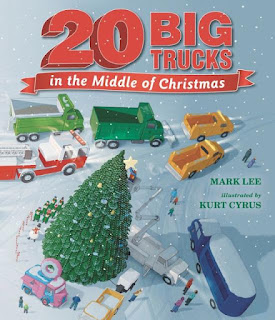
It's beginning to look a lot like Christmas as trucks of all kinds, big ones and small ones and even a pink and blue donut truck, begin arriving in the middle of this snowy town to decorate for the holidays. And the town's children watch and count the as the trucks arrive. Besides the donut truck, there's a snow plow clearing the way; a semitrailer bringing a giant sized tree; a digger to make a hole in the ground for the tree, trucks full of decorations; a crane to reaching the top of the tree; a stake struck carrying a band to play holiday music; a van bringing a choir, even a tow truck after the van breaks down; another truck brings Santa's sleigh, and a different truck brings Santa himself. There's plenty of activity, as more children and adults gather round to watch as the decorations are hung, But when the big star falls and breaks, a substitute tree topper needs to be found and the donut truck has just what is needed. This is a cute rhyming/counting book with simple, realistic illustrations that really capture the excitement and even the cold temperatures. I read this over and over to my young readers who loved learning the names of the different kinds of trucks (the kids are only 4-5 years old and English is necessarily their first language). This has already found a permanent place in our little library of favorite books.  

Where's Waldo? Santa Spotlight Search
written and illustrated by Martin Handford
Candlewick Press, 2021, 16 pages
It just wouldn't feel like Christmas without some kind of wimmelbuch, a wordless picture book of everyday scenes filled with small but many details, and the Waldo books certainly fill that bill. In Santa Spotlight Search, readers are given a spotlight searcher to help them meet the various challenges found on each of six pages. Simply slide the spotlight searcher under the red plastic shield to illuminate each of the different scenes revealed as you move it around the page. Each page has a different theme beginning with The Santa Meet, a gathering of Santas from far and wide to enjoy food and have fun. The second page is all about Christmas Shopping, including all the crowds that come with that; page three involves Festive Baking from gingerbread, cupcakes and chocolate cakes. Next is Santa's Workshop and all the toy treasures of children's dreams. Page five is a Jolly Jamboree because what's Christmas without music and a party and Santa's like a good time, too. And last but not least is Christmas Eve complete with presents, reindeer, even elves. Each page comes with several games and puzzles for those willing to accept the challenge.    

 
Imagination Designs