Showing posts with label Magical Realism. Show all posts

Wednesday, June 10, 2020

Snapdragon written and illustrated by Kat Leyh


When Snapdragon Bloom goes looking for her missing dog, she befriends the town witch and finds more than magic within herself. 

There's a rumor that a witch lives in a house on the outskirts of town, but when Snapdragon's dog Good Boy goes missing, she dares to look for him there. Sure enough, the dog is there, but he's been injured and is missing a front paw. When the rumored witch returns, she tells Snap that the dog was hit by a car and she patched him up. 

Snap is a fierce, fearless, precocious black middle schooler not afraid to take on bullies, often standing up for her neighbor and best friend Lu, who is also black and transgender. Living in a trailer park, Snap is the only child of a mother who must work lots of hours to support them, and who is also getting her degree at night. Good Boy belonged to an old boyfriend who was abusive but is now gone, though he does appear twice in this novel. 

When Snap finds a litter of possum joeys beside their dead mother, she brings them to the "witches" house, hoping they can be saved. The witch turns out to be an older white lady named Jacks, who is more connected to the world than first impressions would give. Jacks collects roadkill, which she buries, then after they decompose, she cleans the bones and reassembles them, selling the skeletons online. 

Creeped out, but also fascinated by Jacks' work, Snap talks her into letting her help take care of the joeys. As a friendship develops between Snap and Jacks, Snap becomes interested in learning more about the skeletons articulated. Snap is also convinced that Jacks really is a witch who uses magic to release the souls of the dead animals back to nature. And as they get to know each other even better, it turns out they have a history of family connections that go back a few generations. So maybe if Jacks can do magic, so can Snap, or at least, that's what Snapdragon hopes.

In the world of graphic novels, Snapdragon is in a class of its own, what you might call a mixed bag. There are magical elements, a mix of humor and sadness, social and social justice issues, marginalized characters, LGTBQ and gender-bending elements, domestic abuse, the roadkill creepiness factor which spikes and just as quickly falls, all wrapped up in a really unusual story.

What I really loved was the way these generally serious topics unfolded so organically throughout the novel, but without lessening any of their importance. Leyh also gives Snap a support system, family and friends who have her back, that gives her the confidence to be unique herself. I also liked the fact that with the last name Bloom family tradition is to name all the girls after flowers, a seemingly unimportant detail that ends up playing an important part in the story.

The author also did all the art work for Snapdragon. Each vivid full color cell is clear and bright, even the darker cells, and color works to add more and more layers to the story. And Leyh has also really captured her character's many moods and feelings through their facial expressions, especially Snap's.

Snapdragon is a wonderfully engaging graphic novel for middle graders who are looking for something good but different.   

This book is recommended for readers age 10+
This book was an E-ARC received from NetGalley

Sunday, March 1, 2020

MMGM: When You Trap a Tiger by Tae Keller


"Long, long ago, when tiger walked like man..."

It's the summer before Lily begins seventh grade, and her widowed Korean American mother suddenly decides to move her and older sister Sam from their home in California to Sunbeam, Washington, to live with their Halmoni, who is very ill. Lily claims that her one superpower is the ability to make herself invisible, or what her sister calls a QAG - quiet Asian girl, unlike Sam who is always able to fit in and get along with people. But neither girl wants to move to Sunbeam.

Sure, Lily and Sam had always enjoyed visiting their Korean grandmother and hearing her stories. They especially like the way she would have them pretend to grab a star containing a story. Their favorite story was about a tiger and two sisters who became the sun and the moon to escape the tiger. So when Lily sees a large magical tiger sitting by the side of the road into Sunbeam, she knows she can tell her Halmoni about it.

But Halmoni's reaction when she hears about the tiger, isn't what Lily expects. She tells Lily that long ago she had stolen something from the tiger and stashed it away in some jars. Now, the tiger has come looking for what belongs to her. But what could Halmoni possibly have stolen from a magical tiger? The answer is in a story that Halmoni tells Lily one night about a lonely sky princess who whispers stories to the night. The stories become stars that light the world. But as a little girl, Halmoni didn't like some of the star stories that made her sad and thought they were dangerous. So she stole them and put them into jars. Now, the tiger wants them back.

So with the help of new friend Ricky, they build a tiger trap in the basement, using boxes that Halmoni had stacked by the basement door. One of the boxes contains jars and Lily is convinced that these are the star jars that Halmoni had used to hid the tiger's stories. Sure enough, that night the tiger is in the basement waiting for Lily. When she offers her a deal - return the stories and Halmoni would feel better - Lily is at first hesitant, but later, desperate to help her sick grandmother, she accepts it. With the release and telling of each story star, Lily begins to fill in the blank spots in Halmoni's past, sorting through and separating fact from fiction.

When You Trap a Tiger is just simply a wonderful, unputdownable story. The balance of realism and magical realism is so seamlessly done, nothing jars and even the tiger, appearing and disappearing like a Cheshire cat, becomes believable in the skilled hands of author Tae Keller. Story and characters are well-drawn and equally nuanced, playing their parts perfectly. The cast of characters is small and no character, not even Ricky, is gratuitous.

Keller addresses a number of themes in this book - loss, grief, family history, identity, and LGTBQ - but at heart is the theme of storytelling. As the tiger tells Lily, stories have the power to change someone, even if don't always end happily. The release of Halmoni's stories helps Lily discover not only who her grandmother is, but who she herself is and can be, and the lesson learned is that it is up to Lily to create her own story, making this a powerful coming-of-age tale.

At one point in the book, Halmoni tells Lily "everything a little bit magic." What a wonderful time to be a reader and be able to read magical stories like this.

This book is recommended for readers age 9+
This book was purchased for my personal library
Be sure to check out the other Marvelous Middle Grade Monday offerings, now being carried on by Greg at Always in the Middle. 

Tuesday, September 5, 2017

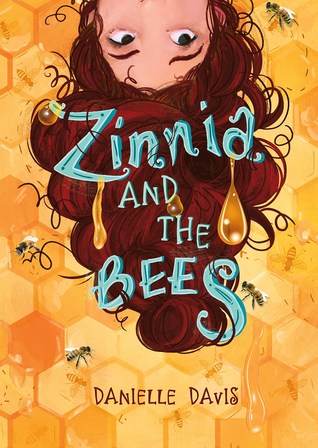
Zinnia and the Bees by Danielle Davis


The last day of seventh grade couldn’t be worse for Zinnia Flossdrop. First, she must spend the day sitting in the principal's office for yarn-bombing the school mascot. At home, she discovers that, Adam, 18, her beloved brother, a talented magician and sometimes prankster-in-crime has left home, leaving no note or explanation. Her rather cold dentist/community activist mom doesn’t seem to care, replacing Adam with a sickly little dog. Seeking comfort, Zinnia buys herself a cone of her favorite ice-cream, which melts, falls out of the cone onto a table, and gets in her hair when she puts her head down for a good cry.

Little does Zinnia know that there is an industrial rental hive of escaped honeybees looking for a new home in order to live as free bees and pollinators as nature meant them to be. Yes, the bees find a new home in Zinnia’s abundant, wildly curly locks. And nothing she does gets them to move out. So, Zinnia does the only thing she can think of - puts on a sweatshirt and covers her hair with a hood.

Which naturally arouses the curiosity of visiting, plaid-wearing Birch, nephew of her next-door neighbor. Birch is a bird-watcher, the son of naturalists, and a solid, straightforward kind of kid, who sees and faces things head-on - luckily for Zinnia. He’s the only person who actually notices that there are bees living in her hair. Little by little, the two become friends, though it is a rocky road given Zinnia’s somewhat depressing situation(s), and Birch’s overly positive attitude. Together, they begin to search solutions to getting the bees out of Zinnia’s hair and into a proper hive, while also trying to find out where Adam might be and why he left so abruptly.  

In between Zinnia’s unfolding tale of woe, are short chapters narrated by one of the bees. That way, the reader learns why they decided to run away (with parallels to Adam’s reasons), and the difficulty of surviving until they find a new hive. The plight of the bees is told with both humor and pathos, so be prepared to suspend your disbelief and at the same time, learn some interesting facts about bees. 

Over the course of the summer, having a headful of bees and no big brother to fall back on teaches Zinnia some hard truths about herself and her feelings, and about what it means to be a sister, a daughter and a friend. 

At first, I thought the yarn bombing thing was kind of silly, but as I read and got to know Zinnia better, I realized it is the perfect metaphor for her - always covering up and hiding her real feelings from everyone around her - feelings that are holding her captive, and which naturally leads to all kinds of misunderstandings. 

On the other hand, the bees are looking for freedom, tired of being held captive as pollinators on demand. Their quest for freedom also leads to all kinds of misunderstanding - particularly with regard to Bee 641, who led them to Zinnia’s hair in the first place.

This is a debut middle grade novel for Danielle Davis. Though not without flaws, it is nevertheless an entertaining and well-done novel. I particularly liked the way she managed to weave in some real information about the plight of bees in today’s world through some nice use of magical realism. And I thought her characters were very interesting, and just quirky enough to work without going over the top. 

Zinnia and the Bees is a coming of age novel that is sure to please young readers.

This book is recommended for readers age 9+
This book was an EARC received from NetGalley

Sunday, April 9, 2017

Me and Marvin Gardens by Amy Sarig King


One hundred year ago, 11 year old Obe Devlin's great grandfather drank his 170 acres of land away, leaving his wife and children with only one small house to live in. There is also a small creek running by the house, the Devlin Creek. But now the Devlins are surrounded by three housing developments on what used to be their land before it was used to by booze.

Obe has made it his business to keep the creek free of garbage that people are always tossing into it. And he has lots of time to do that, now that his former best friend Tommy has turned on him and started hanging out with the cool kids who sit in the back of the school bus, making fun of Obe and his bus friend Annie Bell, nicknamed Putrid Annie by the back seat boys. Tommy had also sucker punched Obe in a fight over hanging-out-territory and now Obe suffers from constant nosebleeds.

One day, while he is out picking up trash, Obe comes across an animal unlike any he has ever seen before - not quite dog, not quite pig, with part hoof, part toed , and skin like algae, but strangest of all, it is an animal who eats plastic. The two soon bond and Obe names the animal Marvin Gardens. Could Marvin be the answer to the problems of so much plastic flooding the environment? 

Maybe not, though the two develop a warm and cozy relationship, the first thing Obe notices is that Marvin Gardens scat (poop) has a terrible odor and is often the bright colors of the plastic he eats. Obe keeps Marvin’s existence to himself, afraid of what might happen to him if people find out, especially Tommy and his new friends.

Then, when Marvin begins pooping where yet another new housing development is being built, the developers want to get to the bottom of what it is, and Obe realizes something isn’t right about the scat. It appears to be toxic, eating through and ruining the ground around it, as well as melting sneakers, if stepped in, and deck floors, if walked on in scat covered sneakers.

When Obe finds Marvin Gardens has been wounded by a paintball, he knows it is time to get help, and he knows just the person he can safely turn to.

Me and Marvin Gardens is told entirely from Obe’s point of view. He is a sweet, genial, 11 year old, concerned more with the environment than his is with his math homework. He’s having a hard time reconciling himself to the three housing developments that surround his house, built on fields he used to play on with his then best friend Tommy. He’s loyal friend to both Annie and Marvin, cares keeping about the environment, and has never even squealed on Tommy about the nosebleeds, even after Tommy accuses him melting sneakers and decks. 

Besides the environment, King has managed to get themes of community, friendship, bullying, responsibility, and the inevitability of change in this charming coming of age novel without sounding preachy or didactic or boring. But King also doesn’t give the reader any easy answers about these things. Yes, she looks at how constant development and toxic waste are encroaching on the natural world, but she leaves it up to the reader to think about what they can do about it. 

A word about the game Monopoly. Monopoly plays a real part in Me and Marvin Gardens. Each chapter begins with an illustration of one of the (original) playings pieces - shoe, hat, dog, etc. It is a game about real estate, about buying properties and developing them with houses and hotels, about some players going bankrupt when they land on a developed property and the high rent that can't be paid while others become fat cats collecting those high rents - the more developed the property is, the higher the rent.

Obe’s father is addicted to Monopoly and loves to play monopoly a few times a week with Obe and his older sister Bernadette. Dad is a ruthlessly ambitious player, buying, building and bankrupting Obe and Bernadette each time they play. Obe, on the other hand, prefers to hoard what properties he does buy, keeping them just as they are and never building on them. What is left of Devlin property is Obe’s personal “Monopoly” property, Real life is played out on the game board and the game board plays out real life. Obe's naming a plastic eating animal Marvin Gardens, which is the least expensive Monopoly property seems only natural.

This book is recommended for readers age 9+
This book was borrowed from a friend.
Marvelous Middle Grade Monday is a weekly event hosted by Shannon Messenger at Book Ramblings, and Plenty of Shenanigans

Tuesday, July 26, 2016

The Seventh Wish by Kate Messner


Twelve-year-old Charlie (Charlotte) Brennan loves Irish step dancing, and for Christmas, her parents had given her a $300. promise towards a dress in which to compete at a Feis or Irish dancing competition.  Charlie and her friend Dasha both are hoping to move up to advance in the next Feis. Charlie decides to do some ice fishing with her friend Drew and his Nana, Mrs. McNeil, to earn some extra dress money by selling the fish she catches.

The only problem is that Charlie is actually afraid of the ice and decides not to go too far out her first day fishing.  Her first fish is a little small, but it tells Charlie she can have a wish if she releases it back into the water.  Not taking it seriously, she  wishes that Roberto Sullivan will like her, but even though it is Robert O'Sullivan who is suddenly infatuated with her, Charlie goes back for more from the wish-granting fish.  She wishes that she would not be afraid of the ice, and sure enough, her fear vanishes and Charlie is able to catch a fair amount of perch and her dress money steadily grows.

Soon, more wishes follow: friend Drew makes the basketball team, to his father's delight and his chagrin, friend Dasha passes her ESL test but discovers she is in over her head in classes where the English words just whiz by her; and Charlie's mom gets a new, better job, but it means that she can't drive Charlie and Dasha to their next Feis.  But when Charlie wishes her beloved older sister home from college so she can drive them to the Feis, no one is prepared for the phone call from the Student Health Center that Abby is quite sick and needs to be picked up.  Charlie not only misses her Feis, but she begins to realize that she needs to be careful about how she phrases her wishes.

Recovered, Abby returns to school, but not for long.  Another phone call from the Student Health Center brings the truth about Abby - she is addicted to heroin and needs help.  Charlie's life soon becomes one of hiding the truth from her friends because she must go to visit her sister in rehab every Sunday instead of working on a group science fair project.  But more importantly is Charlie's struggle to understand how her smart, funny, athletic sister could turn into a liar and a heroin addict even before her first year of college is over.  Abby just doesn't fit the picture of the drug addicts she saw in the D.A.R.E video at school, and who even signed the pledge not to do drugs.  But there is support for Charlie while her sister is in rehab in the form of Mrs. McNeil and even the 8th grade, prizewinner Irish dancer Leah, both of whom have dealt with a family member's alcohol addiction, and their relapses.

This is a very readable novel.  I was pulled in from page one and really couldn't put it down until I finished, even though I already knew what the novel is about.  I thought Kate Messner created a main character who is very nicely fully realized and relatable, in a setting that is also believable - January in upstate New York is mighty cold, just as it is in the novel. And, despite the use of magical realism, in this novel, it is a very realistic story.

I liked how Messner introduces the reader to Charlie's life, depicting it as just ordinary but so wonderfully middle class and middle grade - dancing, friends, crushes, school projects - and how she decides to work for a dress nicer than what $300. would buy because Irish dancing is that important to her.  And I thought Messner did a spot on job showing readers that when Abby's addiction becomes part of the Brennan family's life, everything suddenly centers on her and her needs, and everyone else's needs, including Charlie's, simply become secondary or are just forgotten about.  That is one of the sad truths about addiction.  And yet, Messner cleverly never lets the story turn preachy or didactic, and always manages to keep it Charlie's story from start to finish, never letting Abby's story take over, even as it takes over Charlie's life.

But, don't be put too off by the wish-granting fish in the midst of a realistic novel, that bit of magical realism that is really a means to an end with a bit of a moral about being careful about what you wish for.  But more importantly, it demonstrates, as Charlie learns, that even magic is useless in that face of life's serious issues.

Kudos to Kate Messner for taking on the difficult topic of drug addiction head on, for coming right out and using the word heroin and not skirting around it with some opaque word for it, and writing a book that is so needed right now.  Heroin addiction is really on the increase among middle class kids eighteen to twenty-five, so be sure to read her author's note about this and places where families can learn more and find treatment help.

By now, most of you know that Messner was disinvited from a school visit by a principal who felt the novel's theme showing the impact of drug addiction on families would generate questions they would "not be able to adequately answer and discuss."  You might read Messner's own thoughts about this sad occurrence HERE, rather than my second-hand recounting of it.

I should add that I also learned quite a bit about ice fishing and Irish step dancing competitions, two things I will never do, but for which I now definitely have a new appreciation.

This book is recommended for readers age 8+
This book was borrowed from the NYPL

Monday, June 27, 2016

Maybe a Fox by Kathi Appelt and Alison McGhee


Sylvie Sherman, 12, was a fast runner.  In fact, she was the fastest runner in Hobbsnon School, so fast she needed to grab hold of something to slow herself down.  So one frosty morning, after building a snow family that included a fox Sylvie took off running, but not before sister Jules, 11, grabbed hold of blue mitten, accidentally pulling it off.  Jules never sees her sister again.  Sylvie seems to just vanish.  Though she has most probably fallen into the river and drowned, no body is recovered.

Just as Sylvie disappears, a fox gives birth to three kits, two males and one female.  The female, called Senna, is born kennen.  Kennen links an animal to a spirit, to help them or to finish something left unfinished, to settled the unsettled.

Devastated by her sister's death, Jules stays home from school for weeks, unable to face the empty space on the school bus next to their best friend Sam, comforting herself by organizing and reorganizing her rock collection, and afraid she will loose the connection to the mother she never really knew except through Sylvie and her dad's memories of her.  And of course, there is the guilt that what happened to Sylvie is somehow her fault for not stopping her.

Jules and Sylvie, along with Sam, had always defied their father's Do Not rules - do not get out of earshot of the house, do not mess with wild animals, do not miss the bus, do not, under any circumstances, go near the Slip, where the rushing water would suck a body down.  But the three kids liked to toss "wish rocks," rocks upon which they wrote their burning wishes, into that part of the river.   Sam had two wishes - that his older brother Elk would come home from Afghanistan and that he would see the catamount rumored to be in the area.  Elk came home but a changed man, a veteran who has lost his best friend Zeke in combat, is probably suffering from PTSD, and who now roams the Vermont woods that surrounds their homes.  Elk seems to understand who Jules is and what she is going through.  Can he help her? And can she help him?

Jules has never had a burning wish until Sylvie's disappearance.  Sylvie's wish is always to run faster, but why is a mystery that Jules would like to solve and has become her burning wish.

When Senna hears the crying of an unknown creature, she leaves her sleeping family lair, lured by the cry to where she and Jules come face to face, wondering why the smell of the crier is so familiar to her.

Are Jules and Senna linked?  Can Senna help Jules solve the mystery of her sister's death?

Maybe a Fox is an amazing book, not just amazingly sad, but it is also a multilayered, richly textured story about love, family (human and fox), loss, mourning, and courage...and hope.  The characters are all well realized and the setting, the beautiful rural Vermont woods in early spring, is easy to visualize based on the descriptions the authors use.  At first, I did have a little trouble picturing the Slip but as I read, it became a better image in my mind.

The book is divided into three parts.  Part One focuses primarily on Jules's story; Part Two concentrates on Senna and Part Three brings them together, yet the third person point of view alternates between that of Jules and that of the fox throughout.  And there are elements of magical realism, which takes the story out of realistic fiction and helps to disperse the overwhelming grief, guilt, and loneliness that Jules carries within.    

This book really hit home for me. I lost a sister that I played with all the time when I was 6 years old, and I think that Kathi Appelt and Alison McGhee did a spot on job of capturing that pervasive sense of emptiness that you never stop feeling once someone close to you has died.  I think sibling loss is something that lots of kids must deal with nowadays and, despite all the heartbreak and the pervasive sadness of Jules's story, it ends on a note of hope and the sense of the future.

The publisher has provided a discussion guide for Maybe a Fox your use.  You can find it HERE

This book is recommended for readers age 9+
This book was borrowed from the NYPL

Monday, April 18, 2016

Hour of the Bees by Lindsay Eagar


Carol, 12, has never met her father's father and in fact, knows nothing about him except his name, Serge, and that he has been diagnosed with dementia.  And the idea of spending the summer packing up his New Mexico sheep ranch so the he can move into a facility that can care for him, is totally not how she wants to spend her vacation.

Right off the bat something feels off - for instance, the land is parched dry from a drought, and Serge still has Inés, the same dog he has had for 30 years (that's 210 in dog years).  And bees have been buzzing around Carol's head ever since they got to the ranch, but Serge tells her there are no bees, that it hasn't rained in 100 years, so drought means no flowers, no flowers means no bees.

Carol also bears an uncanny resemblance to her grandmother, Rosa, who died on the very day she was born.  At times, Serge thinks she is Rosa, otherwise he insists on calling her Carolina and admonishes her for knowing nothing about her Mexican roots, always asking "Why do you spit on your roots, chiquita?"

Carol knows that her father, Raul, and Serge had a falling out and that Raul left home at a young age, but she has no idea what happened.  There is still a lot of tension between father and son, but soon, Carol and Serge begin to bond over the stories her tells her, stories.  The stories always begin with Once upon a time, there was a tree and are about a  tree with magical life-giving power, around which Serge and Rosa's love story happened; and which kept Rosa, the only villager with wanderlust, safe as she repeatedly traveled the world wearing a simple bracelet made from its bark, and always coming back to Serge.

In-between Serge's stories, there is hard work to do so that the ranch can be sold.  Long days are rewarded by her mother's wonderful Mexican cooking, something her never does at home.  But the days also increase the tension between Carol and her 17 year-old half sister Alta, who refuses to accept step-father Raul's family as hers, and who only seems interested in her friends and her own indulgent father.

As the summer progresses, Serge's tales sound more and more like fairy tales.  Was it possible that this desolate New Mexican mesa was once a vibrant village, with villagers who could cheat death simply by living in the shade of their beautiful tree?  And could the bees really take away the village's lake drop by drop, leaving behind a parched crater, and causing the 100 year drought?  And why? Maybe, Serge's stories really are just a product of his deteriorating mind.

Or maybe not.  Rosa, he tells Carol, was always followed by a swarm of bees, and now, little by little, they are beginning to follow her, too.  But the once beautiful tree is just a trunk now with no branches or blossoms.  If the bees are coming back, can the land and the tree somehow be brought back to life?

Hour of the Bees is so not what I was expecting.  I had thought it would be about half sisters learning to accept each other in a desert setting.  Clearly, this is a story that relies on character to move it along and I thought the characterization was really spot on.  Told in the first-person by Carol, the reader will find her a very sympathetic character in this coming of age story as she learns to embrace her cultural heritage and to realistically change and grow.  I found Alta accurately annoying as the older sister (at times, reminding me a little too much of my own older sister).  She and Carol have some definite issues to be resolved.  Raul, Serge's son, really annoyed me, he is so angry at Serge, he can't even look him in the face, so he, too, has issues to deal with.  What better place to put all these unresolved issues and problems than the hot, dry desert.

Serge is my favorite character.  His dementia helps move the story along, as he alternates calling Carol "Caro-leen-a" and Rosa, though I never felt that his deteriorating mind had been exploited and reduced to a plot device.  Serge is a nice, fully-developed (ironically) character and I felt myself drawn to him just as Carol is.

When I first started reading Hour of the Bees, I was reminded of one of my favorite books, House of the Spirits by Isabel Allende.  Eagar uses magical realism just as skillfully, making you feel that it's all possible.  And magical realism is one of my favorite genres and I think this a wonderful introduction to it for young readers who are accustomed to stories about straight magic, i.e. Harry Potter (which I also love).

You can find a wonderful discussion guide, ideal for teachers and book clubs, at Candlewick Press.

This book is recommended for readers age 9+
This book was an EARC received from NetGalley

Monday, August 17, 2015

Piper Green and the Fairy Tree by Ellen Potter, illustrated by Qin Leng

If you lived on Peek-a-Boo Island just off the coast of Maine, you would have to take a lobster boat to and from school every day until it was time to go to high school.  Then you would have to leave the island and go to boarding school on the mainland.

Now it's the first day of school, and second grader Piper is missing her older brother Erik, who has just started boarding school.  To feel closer to him, Piper decides to wear his old monkey earmuffs 24/7, even in school.

New teacher Ms. Arabella may look like a princess to her students, but, unfortunately for Piper, she has some very definite idea about where her students will sit in class and what they may or may not wear in school, and that includes monkey earmuffs.  But when Piper refuses to take them off, she must stay in at recess and discovers when she get home, that a phone call to her parents has been made.

And even though they tell her no earmuffs in school, Piper is determined to keep them on and Erik close.  The next morning on her way to the lobster boat, Piper decides she done with second grade.  She decides to hide in a tree, and sitting on a branch, she watches as the lobster boat heads to school.  But when things quiet done, Piper hears an odd sound - like the tree is crying.

While Piper is sitting in the tree, hearing it cry, along come neighbor Mrs. Pennypocket, who immediately knew what to do when she heard the tree crying - and it was just the solution to help Piper give up her earmuffs.  As she saws off a small tree branch, Mrs. Pennypocket and Piper talk about how much Erik is missed and the reason for the earmuffs.  But after the branch is off the tree, Piper finds two kittens, who had gotten stuck after the mother cat had hidden them in a hole in  the tree.  Mrs. Pennypocket tells Piper the tree is a fairy tree, one she has been searching for ever since her grandmother had told her about it.  If you take a treasure from the tree, you must leave a treasure.  Yup, that's right, Piper took two little kittens and left Erik's earmuffs, but not her feelings about missing him.

Piper Green and the Fairy Tree is a new early chapter book series with a sweet, spunky, but stubborn main character that young readers won't be able to resist and a setting that offers endless unique possibilities for more Piper Green stories.

Though the idea of having a magic tree in one's front yard is a lot if fun, the real problem in this first book of the series is that Erik was away at boarding school and Piper is missing him more than the people around her realize.  Until Mrs. Pennypocket talked to her about her feelings, no one asked why she was wearing Erik''s earmuffs, not even her teacher, who just punished Piper by taking away recess.

Inked Black and white full page and spot illustrations by Qin Leng are scattered throughout the book adding a light, humorous touch to the story and serve as excellent visual cues to the action for young and beginning readers, like seeing Piper and her friend Jacob on the lobster boat instead of a school bus,  but then seeing the familiar school yard and classroom.

There just aren't enough good early chapter books for kids, but fans of such classics as Junie B. Jones, Judy Moody, Bink and Gollie, and Amber Brown are sure to add Piper Green to this list of favorites.

This book is recommed for readers age 6+
This book was an EARC received from the author through NetGalley

Tuesday, April 1, 2014

The Strange and Beautiful Sorrows of Ava Lavender by Leslye Walton

In her Prologue, Ava Lavender says that she has always known what others don't - that she is just a girl, a girl born with a pair of speckled wings.  Nevertheless, Ava embarks on a journey to discover just who she is and where she came from.

She begins with in-depth explorations of the women on her maternal side of the family - her great, great grandmother Maman, mother of Emilienne, René, Margaux and Pierette, all born in France on the first of March in 1904, 1905, 1906 and 1907 respectively and all strangely extraordinary in their own way.  Moving from France to Manhattan, all except Emilienne died deaths that are just as strangely extraordinary as they are.  Their specters, however, will accompany Emilienne throughout her life.  Feeling betrayed after she discovers that her fiancé, Satin Lush, has been cheating on her all around town, Emilienne ends up marrying Connor Lavender.  The two leave New York and travel to a small neighborhood in Seattle, Washington, where Connor opens a bakery.  Their child, Viviane, is born.

The very beautiful Viviane is born with an strong sense of smell that goes beyond the usual.  Vivianne can smell things like happiness, sadness, bitterness, broken hearts.  At age 7, she meets Jack and the two are inseparable until he goes off to college.  She waits for him to come back and he does, but only momentarily, just long enough for Viviane to get pregnant.

And so on March 1, 1944, Ava and her twin brother are born.  The two children are sequestered away in the old house on Pinnacle Lane, which just happens to also be haunted.  Home schooled by Viviane, Ava watches the world go by from her bedroom window, longing to be part of it.  Even Henry, who appears to be autistic, is allowed to wander around with his constant canine companion, Trouver.  But when Cardigan and Rowe Cooper move into the house next door, Ava gets a taste of the world beyond the home, sneaking out by climbing the cherry tree outside her window.  But, when unusually heavy rains come during the summer solstice when she is 15, Ava accepts the invitation of Nathaniel Sorrow to come in out of the rain, a decision that will change her life forever.

This is such a good book, but there is quite a bit of magical realism throughout it, making this a story that might not appeal to everyone.  But if you are someone who does like that particular genre, you will find that The Strange and Beautiful Sorrows of Ava Lavender is a beautifully written multigenerational novel about love, loss, betrayal, and redemption by debut author Leslye Walton.  The story is told from the perspective a now 70 year old Ava, whose first person prose is often so lyrical, so poetic that you won't want to put it down, even when the story gets emotionally difficult.

This family saga, however, doesn't remain entirely focused on the Ava's family.  Indeed, there are side narratives about the young girl, Fatima Inês de Dores, who lived in the house on Pinnacle Lane prior to the Lavenders, and whose ghost remains there.  There is also the story of Marigold Pie, Nathaniel Sorrow.  But in the end, it all comes together so well and so unpredictably.

The Strange and Beautiful Sorrows of Ava Lavender is one of the most unique books I have read this year and ironically, I found it to be one of the most difficult to review.  It is, however, the kind of story that will stick with you long after you have finished it.

This book is recommended for readers age 16+
This book was received from the by the publisher
 
Imagination Designs