Showing posts with label Bees. Show all posts

Friday, April 9, 2021

Bruno the Beekeeper: A Honey Primer written and illustrated by Aneta Františka Holasová


Bruno the Beekeeper: A Honey Primer
written and illustrated by Aneta Františka Holasová,
translated from the original Czech by Andrew Lass
Candlewick Press, 2021, 80 pages

There is something about bees and beekeeping that has always fascinated me. But since we have begun to hear so much about hive collapse and the dire predictions of what would happen if there were no bees to pollinate plants and flowers, my interest has grown. Bruno the Beekeeper is a book just right for kids who may be interested in bees, too.

It is the story of Bruno the bear beekeeper and his grandma, who helps him. The book begins with some basic bee facts, such as detailed drawings of bees and similar flying insects that will help kids sort through a world of lookalikes. This is followed by pages devoted to the worker bee, whose important role is hive maintenance and security, guarding the hive; the drone who keeps the hive stocked with bees by passing on sperm to the queen bee; and the queen, whose main job is to lay eggs that she then fertilizes with the sperm she received from the drone. There is also a detailed illustration for each bee showing their metamorphosis as well as a labeled anatomical closeup of each adult bee.

Also included in this section is a two page spread showing the hive a beekeeper uses and it parts, with a brief explanation of of what each part is and why it is needed, a two page spread showing the beekeeper's clothing, and a two page spread showing bee parasites and predators. 


Once these basics are understood, Bruno's beekeeping activities begin in Late Summer and Fall, which I thought was odd but once I read through this section, I understood why the author began here. This is when a good beekeeper like Bruno removes the supers and the honey frames that contain the honeycombs. These are cleaned of residue wax and put away for the winter, and all Bruno has to do until Spring is check that they bees are buzzing.


Come spring, Bruno reverses the process and supers up, putting the hives together. This is also the time when you might hear about bees swarming and a number of reasons why this happens is given.


Once summer comes, and the flowers are in bloom, honey making is in full swing and Bruno and grandma being harvesting the honey-filled combs using the honey extractor. When that is done, the honey is put into jar to be used and Bruno beings the yearly cycle all over again, beginning with taking apart the supers.


Bruno the Beekeeper is a interesting look at so many different aspects to beekeeping including all kinds of useful information about bees and their life cycle. I did find it a little disconcerting at first that Bruno is an anthropomorphized bear while grandma is an elderly woman, but the two work so well together that I quickly got past that and focused on their activities and the information at each step in the honey making process.

The writing may feel a little stiff at first, but remember, it was translated from the Czech into English, and there is a lot of technical information included which may account for that, but the translator did keep the humor of the original book. And it really isn't Bruno story as much as it is the story of bees and how we get honey. The author did the watercolor illustrations in various shades of honey browns and beiges with touches of humor throughout (check out the bee faces). 

All in all, this is a very nice STEM book, and one that you might want to consider including in your Earth Day library at home and/or in the classroom. There is much to be learned and appreciated in this picture book for older readers.

Be sure to check out the recipe for gingerbread cookies at the end of the book. They sound sooooo good!

This book is recommended for readers 7+
I received this book from Candlewick Press in exchange for an honest review.

Monday, January 25, 2021

Celebrating Nature: Two of Our Favorite 2020 Nature Books

 
I take the opinions of my young readers very seriously, and I have come to really respect what they have to say about the books that we share with each other. This past year, because they are a little older and we were stuck in pandemic conditions and that meant no field trips to the park, we have read more nonfiction than usual, focusing mainly on books about nature. Two of our favorites were about honeybees and otters.

Honeybee: The Busy Life of Apis Melllifera 
by Candace Fleming, illustrated by Eric Rohmann
Holiday House/Neal Porter Books, 2020, 40 pages

I have to admit that while I enjoy watching the bees in the garden go about their work gathering nectar, last summer I realized that I really didn't know much about the rest of a bee's life. Turns out, it is a pretty fascinating life, and presented in more than life size in Honeybee. Even before the reader gets to the title page, Apis Mellifera, Apis for short, squirms, pushes and chews her way out of a solitary cell in the hive, eats her fill from a nearby cell, and then begins her brief but busy life of the worker honeybee. For the first 18 days of her life, Apis remains in the hive doing all kinds of chores. First, there is cleaning up the hive nursery for future eggs, followed by queen tending, comb building, and food handling. On day 18 of her life, Apis has guard duty, protecting the hive against birds, bears, and other bees. Finally, on day 25, Apis is ready to fly and begins visiting flowers, sometimes miles and miles away from the home, collecting their nectar and returning to the hive with her honey. Then, Apis does a little dance that tells the other bees where she found her honey before heading out again, sometimes as often as nine times a day. As the days go by, Apis gets thinner and slower, until one day, she just drops to the ground and dies. And back at the nest, a new Apis emerges. I've read this book so many times to some of my young readers and judging by their reception of it, I would say that this is one of the most accessible picture books about bees I've ever read. It is written in straightforward, relatively simple free-verse text covering all stages and jobs of a honeybees life in much more depth than I've indicated here. I'm impressed at how much I learned about bees while reading it to my kids. The up-close-and-personal oil painted illustrations, done in shades of brown, black, and yellow, really capture even the smallest details of a honeybee and the hive. Back matter includes an illustration of the anatomy of a bee with informative labels, suggestions for helping out honeybees, and a short bibliography. This is an informative, well-done STEM book for science classes and for helping to make aware of the importance of bees in our lives, even as hive collapse is occurring. 

If You Take Away the Otter by Susannah Buhrman-Deever, 
illustrated by Matthew Trueman
Candlewick Press, 2020, 32 pages

Sea otters are often the star of picture books about sea animals, perhaps because they are have such sweet faces and seem so playful and friendly. But the sea otter actually plays a key role in maintaining a healthy ecosystem off the Pacific coast of North America. As Susannah Buhrman-Deever explains, there large forests of kelp growing there, providing a home for abalones, clams, sea stars, octopuses and other sea creatures, among them the spiny sea urchin, the enemy and potential destroyer of the kelp forest. Luckily, the otter is a hungry hunter, diving deep into the sea to eat whatever he finds in the kelp, including the sea urchin, maintaining the delicate balance needed for the kelp to thrive. But what if the sea otter disappeared? What would happen to this important ecosystem? At one time, the sea otter was hunted for its thick fur until they almost all gone. When that happened, the spiny sea urchin ate the kelp, causing the underwater forest to collapse. Once the kelp was gone, the other sea creatures no longer had a safe place for their eggs and babies. Fortunately, in 1911, laws were passed to protect the otter from hunters. As the otter population increased, slowly new kelp forests began to grow, providing homes for sea creatures and food for the otters. Buhrman-Deever brilliantly presents this example of the negative impact the loss of one keystone animal can have on the environment in which it lives. It is written on two levels - one in large type gives the basic story, while more detailed facts are presented in smaller type. The kids I shared this book with are young so we stuck to the basic type, and I think because the otters had a happy ending, it generated lots of conversation (more than had the ending be otherwise). The mixed-media illustrations are done in various bright to darker shades of aquamarine depending on the health of the kelp forest. Back matter included more information about kelp forests and otters, a select Bibliography and a list of books and websites for further investigation. This is another excellent informative STEM book for studies on ecosystems and the environment. 

Tuesday, September 5, 2017

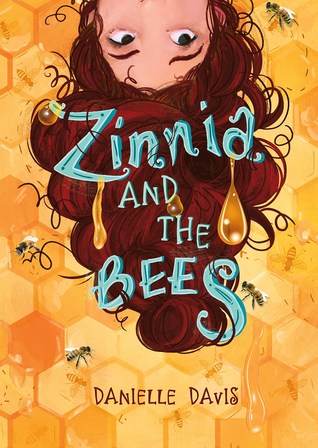
Zinnia and the Bees by Danielle Davis


The last day of seventh grade couldn’t be worse for Zinnia Flossdrop. First, she must spend the day sitting in the principal's office for yarn-bombing the school mascot. At home, she discovers that, Adam, 18, her beloved brother, a talented magician and sometimes prankster-in-crime has left home, leaving no note or explanation. Her rather cold dentist/community activist mom doesn’t seem to care, replacing Adam with a sickly little dog. Seeking comfort, Zinnia buys herself a cone of her favorite ice-cream, which melts, falls out of the cone onto a table, and gets in her hair when she puts her head down for a good cry.

Little does Zinnia know that there is an industrial rental hive of escaped honeybees looking for a new home in order to live as free bees and pollinators as nature meant them to be. Yes, the bees find a new home in Zinnia’s abundant, wildly curly locks. And nothing she does gets them to move out. So, Zinnia does the only thing she can think of - puts on a sweatshirt and covers her hair with a hood.

Which naturally arouses the curiosity of visiting, plaid-wearing Birch, nephew of her next-door neighbor. Birch is a bird-watcher, the son of naturalists, and a solid, straightforward kind of kid, who sees and faces things head-on - luckily for Zinnia. He’s the only person who actually notices that there are bees living in her hair. Little by little, the two become friends, though it is a rocky road given Zinnia’s somewhat depressing situation(s), and Birch’s overly positive attitude. Together, they begin to search solutions to getting the bees out of Zinnia’s hair and into a proper hive, while also trying to find out where Adam might be and why he left so abruptly.  

In between Zinnia’s unfolding tale of woe, are short chapters narrated by one of the bees. That way, the reader learns why they decided to run away (with parallels to Adam’s reasons), and the difficulty of surviving until they find a new hive. The plight of the bees is told with both humor and pathos, so be prepared to suspend your disbelief and at the same time, learn some interesting facts about bees. 

Over the course of the summer, having a headful of bees and no big brother to fall back on teaches Zinnia some hard truths about herself and her feelings, and about what it means to be a sister, a daughter and a friend. 

At first, I thought the yarn bombing thing was kind of silly, but as I read and got to know Zinnia better, I realized it is the perfect metaphor for her - always covering up and hiding her real feelings from everyone around her - feelings that are holding her captive, and which naturally leads to all kinds of misunderstandings. 

On the other hand, the bees are looking for freedom, tired of being held captive as pollinators on demand. Their quest for freedom also leads to all kinds of misunderstanding - particularly with regard to Bee 641, who led them to Zinnia’s hair in the first place.

This is a debut middle grade novel for Danielle Davis. Though not without flaws, it is nevertheless an entertaining and well-done novel. I particularly liked the way she managed to weave in some real information about the plight of bees in today’s world through some nice use of magical realism. And I thought her characters were very interesting, and just quirky enough to work without going over the top. 

Zinnia and the Bees is a coming of age novel that is sure to please young readers.

This book is recommended for readers age 9+
This book was an EARC received from NetGalley

Monday, November 18, 2013

Flight of the Honey Bee by Raymond Huber, illustrated by Brian Lovelock

 By now, we have all heard about how honey bees are disappearing and hives are collapsing at alarming rates and what a disaster that can be for mankind.  After all, bees are the best pollinators in the world.

So it is not surprising that a number of books for young readers have come out recently about bees.  Perhaps in the hope that if we educate young readers about the importance of bees, we, or really, they may be able to help reverse the trend and stop bee disappearance and death.

Flight of the Honey Bee is one of the new bee books to come out and it is a charming, informative look at the life of one honey bee named Scout.

Follow Scout as she flies out of the safety of the hive in search of pollen and nectar.  As Scout searches for just the right flowers to gather what she needs to bring back to the hive for the winter, we discover all kinds of interesting facts about honey bees in general.

Did you know that are hairy all over so they can sense changes in wind?  Or that a bee can travel as far as five hundred miles to find flowers?  And while we may want to avoid a bee sting, honey bees only sting when they feel threatened.

These are just some of the interesting facts that you can learn about as you fly along with Scout on her mission.  Raymond Huber has written a nonfiction book for the youngest readers that is both entertaining and informative.  And he does include ways that we can help rejuvenate bees and pollination before they die out.

Flight of the Honey Bee is delightfully yet precisely illustrated in watercolor, acrylic ink and colored pencil and gives us an up close and personal view of a honey bee's life.  Writer Raymond Huber, who is also a beekeeper, and illustrator Brian Lovelock are scientists as well, and their genuine interest and concern shine through this wonderful book.  Together these two talented New Zealanders have created a book that can be enjoyed by everyone interested in our saving our world.


I loved this book and I learned a lot about bees and how they make honey.  And the next time I stir a spoonful of honey into my tea, you can be I will remember that one jar of honey requires bees to harvest nectar from more than 2 million flowers.

This book is recommended for readers age 3+
This book was borrowed from the NYPL

Nonfiction Monday Roundup is hosted this week by NC Teacher Stuff


This is book 12 of my 2013 Nonfiction Picture Book Reading Challenge hosted by Kid Lit Frenzy
 
Imagination Designs