Showing posts with label Ocean Animals. Show all posts

Wednesday, April 14, 2021

Beneath the Waves: Celebrating the Ocean Through Pictures, Poems, and Stories by Stephanie Warren Drimmer

 
Beneath the Waves: Celebrating the Ocean 
Through Pictures, Poems, and Stories
by Stephanie Warren Drimmer
National Geographic Kids, 2021, 192 pages

This year's Earth Day theme is "Restore the Earth" and what better place to begin than with the earth's oceans. After all, there is more ocean on earth than there is land, and unfortunately, it has become a dumping ground for a lot of man-made garbage, making it a good place to begin restoring. But before that, it would be good to get to know the oceans...and Beneath the Waves is the perfect place to begin. If you look at the Table of Contents you can see that it is a book chockablock with information accompanied by some wonderful poetry and many exquisite photographs.


The book begins with an explanation of the three ocean zones. There is the sunlit zone, the twilight zone, and the midnight zone and readers will learn that each one is a world unto itself. As you can see, the book is arranged in eleven chapters beginning at the ocean's edge and ending in the extreme ocean depths. The last chapter looks at People and Oceans.


Each chapter includes two-page spreads on each of the topics covered, and includes lots of relevant interesting factoids. For example, in On the Beach readers discover what a beach is and how those tiny grains of sand are created. There is also information on sea shells and all different kinds of beach living creatures, from crabs to turtles and beach birds (yes, there's many more than just seagulls waiting to snatch the ice cream right off your cone). 

Throughout the book, each chapter ends with a section called Sea Sleuths that looks at a topic relative to the chapter's subject matter. Why is the Sea Salty?, The Myth of Mermaids, The Myth of the Kraken, and The Search for Longitude are just some of what readers will marvel at. 


The next chapter, Between Two Worlds, looks at animals that live on both land and in the water. Here you will meet swimming lizards and creatures most of us are familiar with - seal and sea lions. Interesting factoid: do you know the difference between a seal and a seal lion? And that seals share their ancestry with dogs? There are also a wide variety of sea birds here, too. And in some parts of the world, there are crocodiles and even some fish that will leave the water and fly through the air. 

Chapter Three, Wading In, begins with a look at the different kinds of sea snails living in the ocean, and the variety of colorful boneless echinoderms or spiny creatures such as sand dollars and sea urchins. This is followed by a chapter on Reef Life, all about the different kinds of colorful coral reefs that flourish in the tropical parts of the ocean and the wide variety of marine species that dwell in these coral reefs.

Leaving the shallower waters, the next few chapter explore the deeper parts of the ocean. First up are Ocean Forests, what they are, for example, eel-grass, seaweed, and kelp. and who lives there, creatures like crabs, leafy sea dragons, octopuses, and the enemy of ocean forests, the spiny sea urchin and the enemy of the sea urchin, the otter, among others that readers will learn about. 

The next chapter introduces The Open Ocean, which covers more than half the earth and is more than two miles deep. This is the home to animals like the giant blue whale and the tiny plankton. In between, there are jelly fish, schools of different kinds of fish, sea creatures like the cuttlefish, which is really part of the mollusk family and not a fish at all. Like octopuses and squids, they have the ability to change their skin pattern, color and texture to blend into their surroundings and fool any hungry predators. And of course, the open ocean is home to sharks and dolphins.

Chapter Seven, On the Move, follows those ocean creatures that are either swimming in search of food or breeding grounds or hitching a ride on these distance swimmers. Readers learn about the journey of salmon, humpback whales, and leatherback sea turtles, as well as hitchhikers like seahorses and barnacles. There is also information on the many migrating sea birds.

In Life on the Icy Edge, readers heads to the north and south poles to learn about penguins, seals, walruses, polar bears, orcas and narwhals, and there is an informative 2 page Sea Sleuths spread called Arctic Experts, all about the Inuit, the indigenous people living there and who know the arctic better than anyone. 

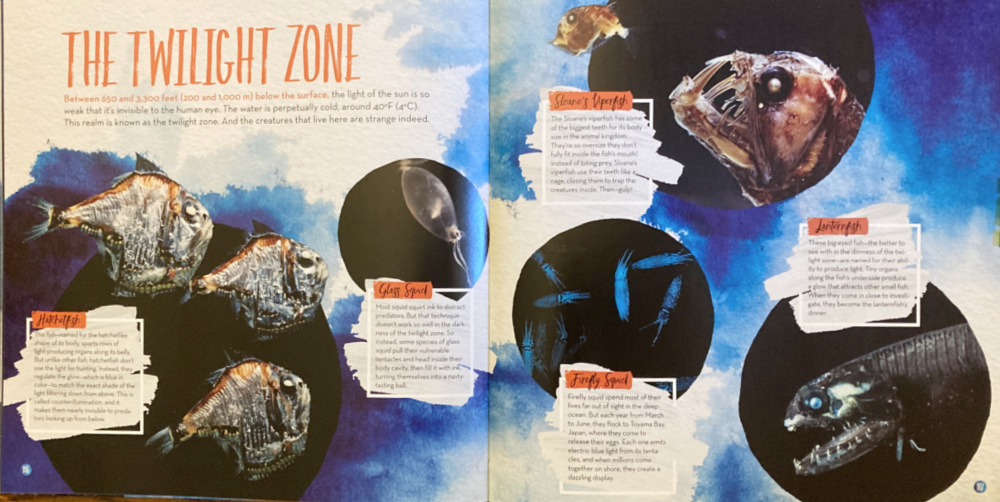
In the next chapter, Deep Down, readers enter the twilight zone, where sunlight no longer filters in and there is just blackness. Here there are some really strange sea creatures to discover, such as the hatchetfish, the Sloan's viper, and the lanternfish.

Chapter 10 brings readers into the Extreme Ocean, the least known place on earth. Here there are "mountains, geysers that spew superheated noxious water, and all kinds of living things that make these alien places their home." (pg 159) And this is where shipwrecks provide a home for all kinds of deep water species, like sear stars, crabs and fish.

Finally, Chapter 11 is about People and Oceans. This includes spreads on the history of ocean exploration, the importance of oceans, ways of protecting oceans and their occupants, and finally, how people have polluted our oceans and why I chose this book to highlight Earth Day 2021.


Beneath the Waves make the ocean sound like a pretty amazing place - beautiful, scary, powerful, busy, and necessary for sustaining life on earth. Thankfully, this book ends on a note of hope - "...success stories [that] show. when people step in to help, they can make a difference.' (pg 184)

Wondering what kids can do for Earth Day and every day after, and to help clean up and restore the ocean? You can find all kinds of activities and projects just right for youngsters at National Geographic Kids Celebrates Earth Day.

Or visit the official Earth Day website HERE

Meet the Author:                                                                                            Stephanie Warren Drimmer writes books and magazine stories for kids. She covers all topics weird and wonderful, including adorable animals, freaky brain experiments, and the hunt for new planets. She is a longtime contributor to National Geographic Kids magazine and has written many books for National Geographic kids, including Hey, Baby!, Mastermind, The Book of Heroines, Ultimate Secrets Revealed, and Ultimate Weatherpedia. Drimmer studied science journalism at New York University. You can find Stephanie on stephaniedrimmer.com, and on Twitter @Stephdrimmer 

This book is recommended for readers age 8+
This book was received from Media Masters Publicity in exchange for a review

Monday, July 22, 2019

Ocean: Secrets of the Deep by Sabrina Weiss, illustrated by Giulia De Amicis


Ocean: Secrets of the Deep by Sabrina Weiss,
illustrated by Giulia De Amicis
What on Earth Publishing, 2019, 72 pages 

What to do on a hot, hot weekend? Go to the ocean, of course. But if you can't get to the actual ocean, reading about it is the next best thing. So, as Sabrina Weiss says in her introduction to Ocean: "Take a deep breath and let's plunge beneath the waves!"

We are taught that there are five oceans in the world, each with its own distinctive characteristics as you go from place to place, but according to Weiss, they are actually connected to each other, forming one huge, global ocean, and holding 96.5% of all the water found on earth. But how much do we really know about the ocean? Not much, it seems.
Click to enlarge
Weiss begins her ocean explorations by introducing readers to the five different ocean zones - the sunlight zone, the twilight zone, the midnight zone, the abyss, and hadal zone. Zones are based on depth and the amount of sunlight that reaches them, or doesn't reach them, as the case may be. Weiss describes what is known about each zone, and the names and characteristics of the sea creatures that inhabit each zone.
Click to enlarge
From zones, Weiss looks at the ocean's different ecosystems. An ecosystem consists of the living and non-living things needed to support it, including animals, plants, organisms, and soil, plus air, water, rocks, and sunlight. Each element has its own part to play in supporting an ecosystem. Polar seas, coral reefs, deltas, salt marshes, mangroves, and kelp forests are all examined, including the different species that inhabit them.
Click to enlarge
I found the sections on Marine Life very interesting. Ocean life is teeming with activity and Weiss gives readers an excellent overview of who's who, where they live and what they eat, and includes information of unusual friendships or schools of fish, because everyone, including fish, knows there's safety in numbers when traveling. Budding marine biologists will discover how marine animals communicate with each other, how to tell the difference between male and female fish, and those sea creatures that are masters of disguise. One thing I discovered is that a symbiotic relationship exists between some species when they visit cleaning stations like coral reefs. They swim in for a cleaning, and other species will pick off and eat parasites, dead skin, algae and slime off that have accumulated on the visitor's body.. It sounds gross but everyone benefits from it, and as Weiss points out, it's like a day at the spa.

It would be irresponsible if a book like this didn't discuss how our ocean is in peril. Pollution, overfishing, climate change, warming water temperatures, dying coral reefs, and an ocean full of plastic are all putting our ocean and the marine life living there in jeopardy. Weiss not only discusses these perils, but she also give some suggestions for how we can all help protect the ocean.

One of the things that makes this book so wonderful to explore are the graphics. Every aspect of marine life is authentically illustrated and identified. The art is as lovely as it is informative, and will no doubt elicit a lot of exploration and conversation.

Another one of the interesting parts of this book is the four-page spread devoted to myths and legends about the ocean, including historic speculation about the whether Atlantis really existed and if it did, where it might have been.
Click to enlarge
This is a book that is chockablock with information, but as Weiss concludes, there is so much more to explore, so much more we don't know and maybe, just maybe a young reader out there will be the next person to discover more of the oceans's secrets.

This book is recommended for readers age 9+
This book was gratefully provided to me by Media Masters Publicity

Wednesday, October 12, 2016

Two New Picture Books from National Geographic Kids


Natumi Takes the Lead: The True Story of an Orphan Elephant Who Finds Family by Gerry Ellis with Amy Novesky
National Geographic Kids, 2016, 32 pages, age 4+
Available November 8, 2016

Natumi was only 6 weeks old when her mother was killed.  At the sound of guns, the remaining elephants in the herd that they were part of scattered, Natumi found herself all alone.  Luckily, she was found and taken to an elephant orphanage, where other lost and wounded elephants lived.  Soon the eight new elies formed a new family together.  At the orphanage, they were well cared for by their keepers, but soon they would have to be released into a new wilder place, a protected park that would become their home.  But before that could happen, they needed a leader and to everyone's surprise, it turned out to be shy Natumi.

This is a book that will help introduce young readers to the importance of elephants conservation. Although it doesn't focus on elephant poaching beyond Natumi's mother, it does make clear that the elephants population is dwindling and that it is possible for them to soon become extinct.  The beautiful photography of Gerry Ellis captures Natumi's family of elephants playful personalities as they are cared for by their keepers.  There is a map of the places where elephants can be found in Africa, sources for further reading and learning about them, as well as some basic facts.  And be sure to read the note from the photographer at the back for more interesting information about his relationship with Natumi.


Ocean Animals: Who's Who in the Deep Blue by Johnna Rizzo
National Geographic Kids, 2016, 112 pages, age 7+

Did you know that there were different layers to the ocean and that different life-forms live in each layer?  Or that the deepest part of the ocean is 7 miles down form the surface?  Well, neither did I.  Now, kids can learn all about this and more in this book about the sea creatures and plant life that call our oceans home.  They will discover facts about marine life including sharks, mammals, birds, turtles, reptiles, and other creatures and plants as well as the different oceans and habitats where they live and thrive.  There is even a chapter that includes how and why coral reefs are formed, and the importance of conserving them

This an ideal book for young readers who are already familiar with animals of the ocean through their love of Disney's Nemo and Dory. Ocean Animals will provide them with some general information at the beginning of each chapter about what species will be covered in it, followed by a more in-depth look at the differences that can be found within a species. This includes things like where they dwell, what they eat, how they sleep, how dangerous to other sea creature or humans, but there are some fun facts, too.  Readers, both young and older, will also marvel at the exquisite full color photographs throughout the book. At the back of the book is a glossary for words that may be new to young readers.  And of course, it is important to conserve our waterways nowadays, so there are also suggestions for 20 ways young readers can protect the oceans.

Both of these books are designed to introduce curious young readers not only to some of the other creatures we share the earth with, but to also help them understand the importance of conservation before it is too late.  I highly recommend both of these books.

These books were provided to me by the publisher, National Geographic Kids


Nonfiction Picture Book Challenge is a weekly celebration of 
nonfiction books hosted by Alyson Beecher at Kid Lit Frenzy 

 
Imagination Designs