Showing posts with label African Americans. Show all posts

Sunday, September 18, 2022

Swim Team by Johnnie Christmas

 
Moving from Brooklyn to Florida means a new apartment, a new school and new friends for middle schooler Bree Hanley and she's excited about the change. While moving into their new apartment, Bree meets elderly Ms. Etta, who loves to do jigsaw puzzles, and Clara, a neighbor and fellow student at Enith Brigitha Middle School. 

Bree, who loves math, is excited to begin school and sign up for the Math Puzzles elective. But when she's told the class is full and she will have to take swimming instead, Bree is completely deflated - she doesn't know how to swim. Meanwhile, she and Clara become best friends. Clara is also a great swimmer and is on the school's competitive swim team, the Enith Brigitha Manatees. After repeatedly skipping swim class, Bree is finally caught and when the reason comes out, her dad signs her up for swimming lessons. 

Some girls from her new school's rival swim team, Holyoke Prep, see Bree learning to swim in the kiddy pool, and cruelly make fun of her. Afraid and humiliated, Bree goes from skipping swim class to skipping school altogether. When her math homework falls into the pool at her apartment, Bree jumps in to get it back, and has to be rescued by Ms. Etta. It turns out that Ms. Etta had been a champion swimmer all through school, college and even professionally for a while. Naturally, she offers to teach Bree how to swim. 

Meanwhile, the coach of the Enith Brigitha Manatees learns that the pool the team swims in may be turned into a Smoothie Palace and he desperately needs to get more good swimmers on his team to save it. Bree's swimming lessons with Ms. Etta are going well, although Bree is still filled with self-doubt in the water. Ms. Etta is a calm and patient teacher, and even gives Bree a brief but important lesson about why so many Black people don't know how to swim and it has nothing to do with fear of the water, but rather from laws that limited their access to pools.

When Bree makes the team, and then signs up for swimming instead of math her second semester, her father is clearly disappointed, but accepts her decision. He's been pretty busy with his new job and training and keeps missing her meets, which is very disappointing for Bree. Bree is still filled with self-doubt whenever she's in the water, and that isn't made easier when Keisha, one of the girls from Holyoke Prep who made fun of her, transfers to Enith Brigitha after being kicked off the team there for coming in last at a meet. And Clara, whose mother wants her to go to Holyoke Prep, gets a letter saying she has been accepted there and will be transferring at the beginning of the next school year. All this makes for a very disunited team. So, maybe now that Coach has asked Ms. Etta to help with the team, she can bring some unity and help lead the team to victory and saving their pool, and maybe, just maybe, the girls can help Ms. Etta find the missing piece in her own life. 

Bree is a wonderful character. She's smart, upbeat, and supportive, then swimming and self-doubt enter her life. Christmas has really captured the kinds of thoughts that go through a person's head in the throes of self-doubt, but he has Bree swim though them more than once, because anyone who has ever doubted themselves about something knows those pesky thoughts don't go away overnight or even necessarily with accomplishment. It was hard to see this sweet girl sink but wonderful to see how she finally met the challenges put in front of her and swam to the surface. 

Ms. Etta was also a great character, bringing the past into the present with her own accomplishments and I like that Christmas portrayed her as someone who still had so much to give to the youth of today. And Bree was certainly a catalyst for turning Ms. Etta's life around as much as Ms. Etta did that for Bree. I was a little disappointed in Bree's father's behavior once she joined the swim team, but forgave him when his own deep dark secret finally came out.

Swim Team is definitely a positive, accessible book about family, community, and sportsmanship (in and out of the pool). It does have some social commentary but much of it is subtle. For example, it's Bree's more diverse school that may lose their OK pool, while the mostly white Holyoke Prep has a state of the art pool. The art is simple, but clear and the cells are easy to follow. It reminded me of Jerry Craft's graphic novel New Kid, which I loved and I would definitely pair these two books for a class read.

Tuesday, August 16, 2022

The World Belonged to Us by Jacqueline Woodson, illustrated by Leo Espinosa


The World Belonged to Us 
written by Jacqueline Woodson,
illustrated by Leo Espinosa
Nancy Paulsen Books/Penguin, 2022, 32 pages
Schools out for summer and these kids are happy, excited, and anticipating a great time all summer long, playing games with friends and running free: "Free as air. Free as sun. Free as summer." Just look at those joyous faces. Oh, I remember that feeling, do you? Woodson has captured those past summers in Brooklyn perfectly in this charming picture book fictional memoir, and I know it's spot on because, well, I grew up on the streets of Brooklyn, too. 

With school out, it's life on the streets for two whole months. On hot days, the fire hydrants are opened and everyone races to get a cooling shower, clothes and all. The streets are chalked with game boards, jump ropes are pulled out and double dutch is the name of the game. 

Hanging with friends on a stoop, telling stories, learning about life from the older kids (I became a pretty good poker player hanging out on Ismael's stoop), other times a ball and stick are pulled out and a game of stickball happens in the street (only stopping when someone yells "car"). Ice cream trucks roll down the street and moms toss money wrapped in a scarf to the lucky kids who always share with the kids who have no money (for us, it was Mister Softee, Good Humor, and Bungalow Bar). And at the end of the day, as everyone knows, it's time to go home when the streetlights came on. 

If Jacqueline Woodson got summer all right in her text, Leo Espinosa got it right in the illustrations. Kids in the 1970s were probably the last of the free range children and in his illustrations it feels almost as if they knew and had to make it all extra special. The kids seem to be extra loud, just look at those wide open mouths and you can practically hear the kids calling to each other, and extra energetic, the kids are depicted in almost constant motion. And don't you just love those clothes. The kids are all diverse, just like Brooklyn was and is. And it really did feel like the world belonged to us.

I had a friend once who grew up in the suburbs and told me she felt sorry for me growing up in Brooklyn, because I must have been so bored. Bored? Really? Just look at these kids.  

This book really brought back memories of growing up in Brooklyn for me and the games we used to play during summer vacation. It was every bit as wonderful as this book says it was. 

I loved playing skelly as a kids and this is one of my favorite pictures in the book. Kids shooting their bottle caps (ours were filled with clay not tar), and a group of kids on the sideline watching and talking. And I'm happy to see that the thirteenth square is still surrounded by poison (land in poison and you lose a turn). 
In my Flatbush neighborhood, we called this game skelly,
not skully
,

Sunday, May 29, 2022

Uncle John's City Garden by Bernette G. Ford, illustrated by Frank Morrison

 
Uncle John's City Garden by Bernette G. Ford,
illustrated by Frank Morrison
Holiday House, 2022, 40 pages
It used to be that if you traveled around NYC and I mean the outer boroughs as well as Manhattan, you would see lots of empty lots converted into city gardens, growing plants, flowers, and/or vegetables. You don't see them so much anymore because, well, developers have turned them into overpriced high rises. Which is one of the reasons I just love this last book by Bernette Ford, who sadly passed away in 2021. In her Author's Note, Ford explains that growing up in projects in Canarsie, Brooklyn, her Uncle John received permission from the city to convert an empty lot next to one of the buildings into a garden. And though she had often visited the garden, she never worked in it. Now, however, comes this lovely intergenerational family story about her Uncle John's garden that is based in part on her life and based in part on her imagination. Because sometimes, you can go home again, at least in fiction.
Click to Enlarge
The story is narrated by Li'l Sissy, the youngest of three siblings. Each one is allowed to pick their own packets of seeds to plant after Uncle John has finished doing the digging and raking. Li'l Sissy picks okra, Brother chooses corn and lima beans, and Sister picks tomatoes and onions. Their mother laughs and says they are growing succotash. 
Click to Enlarge
After carefully planting their seed packets, the kids are hot and sweaty, but pleased with what they have accomplished with Uncle John's help. Every day, they return to the garden to weed, pick off any bugs and water their crops. And sure enough, after a few weeks, their plants have thrived but still no vegetables, just stems and leaves. 
Click to Enlarge
But after a storm, the plants have really grown tall and sure enough, the vegetables begin to appear. Soon, it is time to start picking their crops. Each day, they fill their bags with more ripened vegetables. And at the end of summer vacation, Uncle John throws a big barbeque for all the relatives, complete with succotash made from their garden vegetables, just like Mama said. And because they have a bumper crop, each family gets to take home a big bag of their own vegetables.

This gentle story about a Black family making a big contribution that helps to transform their otherwise bleak neighborhood and ultimately bring people together makes for some wonderful summer reading (but works anytime). Part of what makes this story so special are the oil and spray paint illustrations/ They are bright, bold and energetic in the foreground, but with the unadorned and almost monochromatic projects in the background, Morrison has really captured the stark contrast. And if you read carefully and pay attention to the way Li'l Sissy describes everything, you find it is also a nice lesson about relative size and growth and it begins right on the first page with a description of size relative to each gardener- small, smallest , big, biggest:
Click to Enlarge
And it continues in this vein all the way through. The shovels the kids use are sized relative to their size, the plants are described relative to Li'l Sissy's size (see the illustration of Li'l Sissy and her Mama). And I love the way the illustrations reflect the relative sizes of everything. So there is a nice STEM component to the story and if you look at the bottom of the page with the Author's Note, you will notice that this book received support from TERC, a non-profit that develops math curricula.  

Extra Bonus: there is a delicious recipe for succotash at the end of the book (something I have eaten since I was a kid growing up in Flatbush, Brooklyn).

Thank you, Sara DiSalvo for providing me with a review copy of this book. 

Thursday, January 20, 2022

Equal by Joyce Moyer Hostetter

Equal
is the fifth book in Joyce Moyer Hostetter's excellent Baker's Mountain Stories series. The first book I read was Blue, set in Hickory, NC, in the midst of the Polio Epidemic of 1944. Told to be the man of the house while her father is off fighting in WWII, Ann Fay Honeycutt, 13, is diagnosed with polio and the novel follows her treatment and recovery. The next book is a prequel, set in 1941 and tells the story of ninth grader Junior Bledsoe, who needs to solve the mystery of how his abusive father died while grappling with the changes and challenges this brings his life. Book 3, Comfort, returns to Ann Fay's story. She home from the polio hospital and finding it difficult to fit into her old life. WWII has ended and her father has returned from fighting in Europe and is suffering severe PTSD. The fourth book, Drive, brings the Honeycutt family in the 1950s. Ann Fay's younger twin sisters, high schoolers Ida and Ellie are beginning to grow apart, but both like the same boy. Ellie is the driven-to-achieve twin, while Ida is more laid back. Their father is still suffering with PTSD, and taking up a lot of their mother's time, along with Jackie, 6, the youngest Honeycutt. And Ann Fay and Junior Bledsoe decide to get married. Plus, it is the year that the Hickory Motor Speedway, the birthplace of NASCAR stars, opened and Junior is an automobile mechanic.    

And that short summary leads readers to Equal, set in 1959. Jackie, the youngest of the Honeycutt children and a rising eight grader, has one thing on his mind - entering his beloved cow Lucy into the 4-H dairy contest at the upcoming fair. But, he is reminded by Thomas Freeman, a Black kid he doesn't really know, about the Lutzes, who always walk away with first place. Thomas is into birdwatching and bird calling, and not much interested in the friendship Jackie is offering.

But at the river one day, while the two kids are fishing, a drunk old man goes after Thomas for being on the riverbank with a white boy, throwing his empty liquor bottle at him, hitting him in the side of the head. The incident jolts Jackie's own memory of a time when he threw an apple at the Black kids waiting for their school bus and hit Thomas in the back of his head. Jackie knows he should say something to Thomas, but is too ashamed to bring it up with him.

1959 sees a lot of unrest in the world: the cold war between the Russians and the United States, the growing Civil Rights Movement and angry white supremacists, and locally for Jackie, it's an enemy in class named Dennis Aiken. All of which prompts his teacher to put a quote from Abraham Lincoln on the blackboard: "Do I not destroy my enemies when I make them my friends?" for her class to think about.

Little by little, Jackie becomes more aware of the constant fear that the Freeman's and other Black families live with. His sister, Ellie, is working for a Black attorney in the Civil Right's movement and friends with his daughter, Maribelle Bradley. When she invites them to stop at the Honeycutt house on their way to a protest that turns into an overnight visit, it becomes surprising but enlightening visit for the Honeycutts, for which they pay a big price afterwards. 

Although Lucy didn't win the 4-H contest, Jackie is still proud of his cow. But after the Bradley's visit, someone tries to poison Lucy by feeding her a poisonous branch from a yew tree, and no one can figure who or why. But when the Freeman's cow is found dead also from a branch of a yew tree, it looks like both incidents are related. Will Jackie and Thomas be able to solve this mystery before there are any more incidents?

One of the nice things about reading the Bakers Mountain stories is that they can be read as a series, or as a stand alone novel. Each one provides enough background to know who is who and what has happened. The other nice thing is that these are really excellent historical fiction novels. Author Joyce Moyer Hostetter has managed to incorporate the most important international, national, and local events into the lives of the Honeycutts in each of the novels and shows how these events impacts the lives of even the most ordinary citizens, and she includes enough back matter about each event in every book for the reader. 

The Lincoln quote permeates the novel, and forces Jackie and his parents to rethink their view of who is a friend and who is an enemy and why. I was relieved that is isn't a white savior book. Jackie changes and grows by seeing how the Freeman and the Bradley families live their lives and their truths and not by being put in the position of having to educate the Honeycutts. Instead, Jackie and his parents learn to have empathy for their new friends after getting to know them. For example, Jackie's dad and Mr. Bradley were both soldiers in WWII and could empathize with each other over their experience and resulting PTSD. 

Equal is a well-written, well-researched novel that will no doubt at times touch the readers heartstrings. It is an emotional journey for Jackie, but in the end, he is a much better person for it and so are we for having traveled his journey with him. 

This book was an eARC gratefully received from Edelweiss+

Monday, January 10, 2022

The Faith of Elijah Cummings: The North Star of Equal Justice by Carole Boston Weatherford, illustrated by Laura Freeman

 
The Faith of Elijah Cummings: The North Star of Equal Justice
written by Carole Boston Weatherford,
illustrated by Laura Freeman
Random House Studio, 2022, 40 pages

Carole Boston Weatherford's picture book biography about Elijah Cummings begins with the front endpapers - a bold American flag that just as boldly represents everything he believed in and fought for.  Elijah's parents were originally sharecroppers on land that their enslaved ancestors had worked on in South Carolina. In the 1940s, they decided that they and their children would have a better chance at life if they moved north to Maryland. It was seven children and two adults living in very cramped quarters, but Robert and Ruth Cummings has faith in their decision. 

Elijah, who had difficulties in school, found solace and help in the public library, where librarians would stay after work to tutor him. But in the summer of 1962, when he was 11, Elijah participated in a protest with other African American kids to integrate a Baltimore city pool. The demonstration was organized by Juanita Jackson Mitchel, a civil rights lawyer. Learning that he had rights he would have to fight for led Elijah to consider becoming a lawyer, too.

Life wasn't easy, and there were those who tried to discourage Elijah from following his dream of becoming a lawyer, including his high school counselor, but his mother's faith gave him hope" "Have faith," she said. "God has a plan for you." And she wasn't the only one who had faith in Elijah. In 1973, after graduating from Howard University with honors, Elijah went to law school.

Ten years later, in 1983, Elijah was elected to the Maryland House of Delegates where he fought for the safely of inner-city children. In 1996, Elijah was elected to the United States House of Representatives, where he became a voice for all people of color, a civil rights champion who knew that Americans of color would have to fight the good fight if they were to be treated fairly and equally, but always believing that "In God's time, we shall overcome."

While you won't find many of the particulars that are often included in biographies, readers will find the important influences in Elijah Cummings life that led him to become an important voice in congress and a strong advocate of civil rights. Boston Weatherford uses the same direct, straightforward language her children's books are so well known for and on each two page spread she has included a direct quote by Elijah relating to the text. Coordinating and complimenting the text are Laura Freeman's digital illustrations using a bold color palette and at times a photo realistic style.      

While this biography by Carole Boston Weatherford focuses on the life of Elijah Cummings, sadly, and not really emphasized in this book, he passed away on October 17, 2019. Front matter includes a except from the eulogy given by Nancy Pelosi, Speaker of the U.S. House of Representatives at the funeral of Elijah Cummings on October 25, 2019, and which you can read in its entirety HERE.

Back matter includes an excerpt of the October 17, 2019 Statement from the Congressional Black Caucus, a Timeline, a Bibliography and the Quote Sources used. This book ends with the same bold American flag, an image made all the more powerful by the profile of Elijah Cummings superimposed on it. 

This book was gratefully received from Barbara Fisch at Blue Slip Media.

Sunday, December 5, 2021

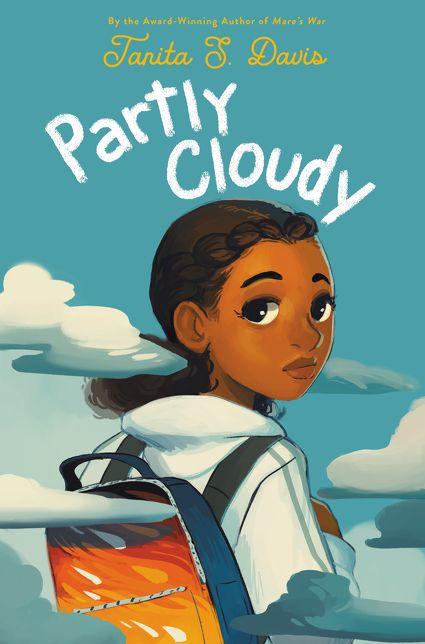
Partly Cloudy by Tanita S. Davis

 
Sixth grade was a pretty stormy year for Madalyn Thomas - her dog Lucy died, her best friend moved away, she found out she was lactose intolerant and, as it things couldn't be worse, her dad was laid off from his job. That meant moving and changing schools and Robinson Howard Middle School was a pretty grim place in which to learn, especially after the shooting that happened there. Now, her mom tells her that "Skies are clearing.... Your dad and I have a plan," which can only mean more changes in Madalyn's life.

Her dad will be working across the country in Cambridge, Massachusetts, and her mom, as social worker, works long hours, so the plan is for Madalyn to live with her great uncle Papa Lobo four days a week and come home on the weekend. While this may not be the ideal situation Madalyn would like, the one advantage is that Kingsbridge Junior High is a more promising school that her old school and there's a great library in town.  

It doesn't take long for Madalyn and Papa Lobo to develop a comfortable routine, and except for Jean Duval, Papa Lobo's godson who helps him around the house, things would be pretty good. But Jean, who goes to the same school but in a higher grade, seems to only tolerate Madalyn. She also meets neighbor Mrs. Baylor, a older white woman with a cat and a beautiful garden, but also an on-going-long-running feud with Papa Lobo.

When school begins, Madalyn realizes she isn't just the new kid, she's also the only Black kid in her seventh grade class. First day, first class Madalyn meet Natalie, who seems like a fun, potential friend. It's Natalie who warns her about Carlin and Sydney, the class snobs/mean girls. Sure enough, it doesn't take long for the first microagression when Carlin says to Madalyn "...You're Addy, like that American Girl doll, right?"

Natalie and Madalyn get along well in school, but when Natalie sees Madalyn with Jean, it becomes clear that something is wrong. It turns out that Natalie had an unfortunate bullying experience with a Black boy, and now says her older sister Annica, with whom she lives, demands she not have anything to do by Black boys in general. Madalyn is faced with a dilemma - to continue being friends with Natalie or not - but one thing she is sure of is that she will have to have a tough conversation with Natalie about race. Madalyn spends a lot of time agonizing over when and how to have this difficult conversation. 

When wild fires break out around their California area, Madalyn is worried about her mom, trying to drive from home to be with her but not answering her phone. Then, Natalie calls, home alone and frightened because she can't get her sister on the phone. Papa Lobo insists they pick up Natalie and bring her to his house, leaving a note for Annica with the address, even though Madalyn is still mad at her. A little later, Mrs. Baylor collapses in her garden. She has difficulty breathing and Papa Lobo insists they bring her to his house. 

Partly Cloudy is an interesting novel with a lesson for all readers. It is essentially a slice-of-life story but by putting Madalyn in a basically white school, Davis really highlights the kind of covert and overt prejudice and the regular microaggressions that a person of color experiences on a regular basis. but that a white person seems totally oblivious to. For Natalie, it means seeing people as indivisibles and not stereotypes. For Madalyn, it's the opposite - learning the importance of standing up for herself and not letting other people define who she are based on their expectations or stereotypical ideas. 

Partly Cloudy explores themes of family, friendship, and race through the experience of a seventh grade Black girl living in the bay area in California. It is very much a story of today and one that many readers will relate to. I can't recommend it highly enough.

This book is recommended for readers age 9+
This book was gratefully received from Madison Ostrander formerly at Spark Point Studio
Be sure to check out the other Marvelous Middle Grade Monday offerings, 
now being carried on by Greg at Always in the Middle

Saturday, August 21, 2021

MMGM: Three Keys (Front Desk #2) by Kelly Yang

 
It's 1994 and life has certainly changed for Mia Tang, 11. You may recall from Front Desk, that when she was much younger, Mia and her parents had emigrated to the United States from China hoping for a better life. But, you may also recall, the degrees and work experience Mia's parents had didn't help them get jobs for which they were qualified (he is a scientist, she is an engineer). Instead, they took menial jobs, finally landing at the Calavista Motel as maintenance workers. But eventually, they buy the Calavista from the very unpleasant owner Mr. Yao, whose son is in Mia's class and who bullies her every chance he gets. But the Tang's also make good friends among the more permanent residents of the motel. Mia and Lupe Garcia, whose dad works for the Tangs, are now BFFs, and she has even made friends with Jason Yao. 

Mia is excited to begin sixth grade, hoping to improve her writing with the help of her new teacher Mrs. Welch, who clearly resents teaching in a trailer because of budget cuts, blaming it on immigrants the state has to take care of. It soon becomes clear that Mrs. Welch supports Pete Wilson for governor and Proposition 187 which would prohibit undocumented immigrants from using any state services, including health care and public schools. 

Then Lupe tells Mia that her family is undocumented, but working on getting the papers they need, and they live in fear of being deported. When Mia's first writing assignment on immigration is returned, Mrs. Welch has only given her a C, not the A or B+ she was expecting. What begin as a great new beginning for the Mia feels like it is quickly turning into more disappointment and worry.

And she's right. When Lupe's grandmother in Mexico dies, her mother decides to take a chance and return there for her funeral. When they don't hear from Mrs. Garcia for weeks, there is nothing that can be done to find out what happened without the authorities discovering they are undocumented and deporting the whole Garcia family. But when Mr. Garcia drives down to the border to find his wife, he is picked up and held by the immigration police.

On top of that, the Tang's improvements of the Calavista are finally paying off financially, but when new property manager Hank (you remember him from Book #1) writes Immigrants Welcome in big letters outside the motel, it ends up on the nightly news and investors are not happy. Now, the Tang's financial future is once again in trouble but Mia insists the sign must not be take down.

It begins to look like nothing is going to go right during Mia's sixth grade year, but this is a girl with spunk and drive, and she is not going to go down without a fight. Can she change people's minds, though, especially Mrs. Welch's, about immigrants and the unfairness of Proposition 187? Can she help bring back Mr. and Mrs. Garcia, or has she lost her best friend to politics. 

Some of the issues addressed in Three Keys are pretty heavy duty for a middle grade novel, and yet what better place to explore these issues of immigration and racism than at this moment when they are sadly still so relevant and urgent. For example, there is racial animosity directed at Hank, who is African American, but who tells Lupe "I have fear every day...But let me tell you something about fear: If you don't control it, it controls you." (pg 215) And recent immigrants like Tangs are were and are still looked down on by people like Mr. Yao, and others. 

I wouldn't say that Mia develops as much as I would say that she expands who she is, and who she is is passionate about supporting the people she cares about, and what is happening in the world as it impacts them, as well as her and her family. Her political awakening is interesting to see and I think more kids are having that kind of experience today and can really relate to her. Mia certainly embodies Hank's definition of the three keys of friendship: "You gotta listen, you gotta care, and most importantly, you gotta keep trying." (pg 245)   

I would not skip reading the Author's Note in the back matter. There is a lot of information about Proposition 187 and life in California in 1994 for immigrant adults and children and she brings it into the present so well, and includes sources. 

The next book in the Front Desk trilogy, Room to Dream (Front Desk #3), will be out on September 21, 2021 and I can't wait to see what Mia, Lupe, and Jason are up to.

This book is recommended for readers age 9+
This book was an eARC gratefully received from Edelweiss+
Be sure to check out the other Marvelous Middle Grade Monday offerings, 
now being carried on by Greg at Always in the Middle


Tuesday, May 25, 2021

A Day for Rememberin': Inspired by the True Events of the First Memorial Day written by Leah Henderson, illustrated by Floyd Cooper

 
A Day for Rememberin'
Inspired by the True Events of the First Memorial Day
written by Leah Henderson, illustrated by Floyd Cooper
Harry N. Abrams, 2021, 40 pages
Most of us don't really know much about Memorial Day except that it's a time when we honor those who lost their lives in combat defending United States and the democratic principles upon which it was founded. And maybe some of us know that it was originally called Decoration Day, a day when families would go to the cemetery with flags and flowers to place on the graves of their fallen loved ones. But how many of us know about the origin of Memorial Day?

Well, now Leah Henderson has explored this question and has written a picture book for older readers that tells the story of one such origin and has chosen Eli, the ten-year-old son of formerly enslaved parents, as the narrator. It's 1865 and the Civil has ended with the Confederate surrender. And for nine days, Eli has wondered where his Papa goes to so early every day. Eli imagines him doing all kinds of things, but he isn't allowed to follow Papa because he is going to school, and as his mother reminds him, "...you have the hard earned right to learn...Masters locked away learning 'cause knowledge is its own freedom." 
Finally, though, on day ten, Papa wakes Eli up early and they join a procession of other formerly enslaved men and boys and head to the Charleston, South Carolina racetrack, once used for the entertainment white plantation owners. During the Civil War, the racetrack had become a prison where Confederates put captured Union soldiers, who were starved and treated so badly that even the enslaved women would try to sneak the men whatever morsels they could spare. 

Eli discovers that the men have been working to create a cemetery for the 257 dead Union soldiers who had been held in the racetrack. And it's here that Eli has a paintbrush put in his hands to help whitewash a fence with the other children. 

The next day, Eli is up early again, and heads out with his parents to join the procession other Black families heading to the racetrack, now a cemetery. Eli proudly carries the American flag, and the women carry flowers with which to decorate the newly dug graves. 
While this may be a work of historical fiction, the cemetery, called the Martyrs of the Race Track that was created in Charleston, South Carolina by formerly enslaved men, women, and children, is considered by some scholars to be the first observance of Decoration Day, later renamed Memorial Day. In her Author's Note, Henderson writes that she was inspired to write to story after seeing a photograph of about "200 Black children getting ready for what looked like a parade." Curiosity sparked, research led Henderson to the cemetery in Charleston, South Carolina, where she learned that the Decoration Day parade to the former racetrack included over 10,000 newly freed enslaved people were led by about 3,000 Black children. Henderson chose the fictional Eli and his parents to tell their story.

A Day for Rememberin' is such a poignant story about how one community honored the men who they believed fought for them, but also, as Eli reminds readers, about the fear that enslaved people lived with every day, wondering if their loved one would come home at the end of the day, or be sold to someone without their knowing. 

And who better to illustrate this moving, affective story than Floyd Cooper. Using his signature method of oil erasure in earth tones of yellows and browns seems somehow so perfect for this story. The hazy effect of this method doesn't diminish the details and the closeups of people faces really captures their different emotions. 

Besides the Author's Note, back matter includes a short essay on The Roots of Decoration Day, a Timeline of Decoration Day/Memorial Day, a list of other cities claiming to be the birthplace of Memorial Day, Endnotes, and a Select Bibliography. 

David W. Blight a scholar who believes that the birthplace of Decoration Day is Charleston, South Carolina. You can read two of his interesting articles about this HERE and HERE.

Full disclosure: I read a digital watermarked ARC received from the publisher.

This book is recommended for readers age 7+

Wednesday, March 31, 2021

Legacy: Women Poets of the Harlem Renaissance by Nikki Grimes

 
Legacy: Women Poets of the Harlem Renaissance
by Nikki Grimes
Bloomsbury, 2021, 144 pages

A number of things came together in creating this volume of poems. First, there were a number of relatively unknown women poets writing during the Harlem Renaissance, that period beginning in 1918 through the min-1930s when African American arts flourished. Second, there is the relatively new poetic form devised by poet Terrance Hayne called the Golden Shovel. Third, there is the incomparable poet Nikki Grimes. Put together, the result is Legacy, a collection of poems by African American women poets who are celebrated in new contemporary poems by Nikki Grimes utilizing the Golden Shovel form,  connecting today's readers with these Black feminist writers across time and space.

Legacy begins with a poem by Nikki Grimes in the voice of a young girl, whose teacher is telling her that she needs to find her "girl power," that it is "Time you learn/ a little history./ The women in our race/ have always gone/ from strength to strength." She then hands her three books on the Harlem Renaissance. The young girl's journey begins by reading Part I of Legacy called "Heritage," followed by Part II "Mother Earth" and Part III "Taking Notice." The books then ends with a poem called "Journey's End," giving her thoughts about what she has read and that has changed her. 

There are 19 poems by women of the Harlem Renaissance, such as Anne Spencer, Mae V. Cowdery, and Blanche Taylor Dickinson, among others. Their poetry reflects the historical times in which they as Black women lived and wrote. Each one of the 19 poems is paired with a poem by Nikki Grimes reflecting today's world and Black women's response to it. Added to these poems are 19 original illustrations beautifully paired with each poem set. These are by such esteemed artists as Ekua Holmes, Ebony Glenn, Vashti Harrison and others and are done in bold full color using various medians. Below is one of my favorite poems sets with an illustration by Keisha Morris.

Click to Enlarge

Front matter includes a Preface, information about The Harlem Renaissance, and the Poetry Form used. Back matter includes a short biography of each poet, a short biography of each artist,  a list of Sources, print and digital, and an Index. 
 
It only seemed appropriate to end Women's History Month 2021 with this collection of feminist oriented poetry. I hope you are as moved by these poets, past and present, as I am. 

This book is recommended for readers age 10+
This book was an eARC gratefully received from NetGalley

Sunday, February 21, 2021

Unspeakable: The Tulsa Race Massacre by Carole Boston Weatherford, illustrated by Floyd Cooper

 
Unspeakable: The Tulsa Race Massacre
written by Carole Boston Weatherford,
illustrated by Floyd Cooper
Carolrhoda Books, 2021, 32 pages

This year will mark the 100th anniversary of the Tulsa Race Massacre on May 31st and June 1, 1921, when a armed white mob swarmed the town of Greenwood, Oklahoma, killing up to 300 Black Americans over two days and burning the prosperous town to the ground. The what massacre, you may ask? Exactly. When did any of us ever learn about this heart wrenching event in American history? If you're like me, the answer is never. I hadn't heard about the Tulsa Race Massacre until just a few years ago when I read Dreamland Burning, a YA novel by Jennifer Latham.

Now, however, Carole Boston Weatherford has made the events of the Tulsa Race Massacre accessible to younger readers. Written in measured, lyrical free verse, she begins her narrative as though it were a fairytale - "Once upon a time near Tulsa, Oklahoma..." painting an idyllic picture of life in the all Black prosperous town of Greenwood. She continues the use of "Once upon a time..." as she introduces the achievement of the citizens of Greenwood in building their own community. 
Click to Enlarge

Segregation laws made it impossible for Blacks to vote, and demanded that they have separate neighborhoods, their own schools, streetcars and railroad coaches. The residents of Greenwood may have been separate, but they were very prosperous. Not surprisingly, there were almost two hundred business in Greenwood, earning it the name the "Negro Wall Street of America." Greenwood had everything a town could want - a school system, a post office, a hospital, several libraries and churches, a theater named Dreamland. 
Click to Enlarge

But not everyone was happy about Greenwood and its flourishing citizens. Midway through Unspeakable, Weatherford drops the fairytale phase "Once upon a time... " and introduces a stark reality on a black page with white writing - "But in 1921, not everyone in Tulsa was pleased/ with these signs of Black Wealth..." A 17-year-old white elevator operator accusing a 19-year-old shoeshine man of assault was all it took to inflame an angry white mob to descend on Greenwood, killing, destroying, burning it down until nothing remained but ashes. 

Carole Boston Weatherford does an outstanding job in making difficult and/or little known subjects or events available and understandable for young readers and this picture book for older readers is no exception. Her language is clear and musical, and she never talks down to her readers, writing in such a way that respects their intelligence, no matter how tragic the circumstances. Dividing Unspeakable between what went into making Greenwood so successful for the African Americans living there and the destructive mob that destroyed their years of achievement really drives home her message - "...to realize the responsibility we all have/ to reject hatred and violence and instead choose hope."

Weatherford's words are beautifully born out in Floyd Cooper's sepia-toned paint and erasure illustrations. I once saw him do this method in person once and I was amazed by it. Perhaps because he has a personal connection to Greenwood, Cooper has really captured both the community in all its bustling activity and the hatred and anger of mob violence. And as we have witnessed recently, it's so easy to destroy the trust and faith we have in our communities when people are motived by hate and jealousy.

Back matter includes an important Author's Note and an informative Illustrator's Note. Be sure to check out the front and back endpapers to see was Greenwood really looked like before and after the mob destroyed it. 

This is a book that should be in every school library, classroom or home school library. If you are thinking about using Unspeakable with your classes, you can download an extensive Teacher's Guide courtesy of Lerner Books HERE. 

This book is recommended for readers age 9+
This book was an eARC gratefully received from NetGalley

Friday, February 12, 2021

The Teachers March!: How Selma's Teachers Changed History by Sandra Neil Wallace and Rich Wallace, illustrated by Charly Palmer

 
The Teacher's March!: How Selma's Teachers Changed History
by Sandra Neil Wallace and Rich Wallace,
illustrated by Charly Palmer
Calkins Creek, 2020, 44 pages

Imagine teaching your African American students that freedom and equal rights are guaranteed in the United States Constitution, but not for them. That was one of the dilemma's faced by science teacher  Reverend R. B. Reese in 1965 Selma, Alabama. Selma was a segregated city and the white people there intended to keep it that way, and one of the ways they did it was by denying black citizens the right to vote.

But when Reverend Reese led marchers to the Selma courthouse to register to vote, they were stopped by Sheriff Clark and his white policemen wielding billy clubs and they didn't hesitate to use them. Realizing he needed a "triumphant idea" that would make the voices of the black citizens of Selma heard, Reverend Reese came up with the idea he needed - what if the teachers marched? After all, they were leaders, but would teachers march? Since judge had declared marching and talking about civil rights against the law in 1964, Selma's teachers might not be so willing to put themselves on the line.

How to convince the teachers to march anyway? After all, they could be arrested, go to jail, loose their jobs. Reverend Reese invited Dr. Martin Luther King Jr to come and speak to them.

After listening to Dr. King's inspiring talk, one hundred and four teachers signed up to march. Packing a sandwich and a toothbrush in case they were arrested, and led by Reverend Reese, the teachers marched to the courthouse and were twice repelled by Sheriff Clark and cops, but the teachers went back despite their bumps and bruises. 
This time, the school superintendent came out, realized what it would mean to arrest so many teachers and next thing he knew, the police had put away their billy clubs and handcuffs: "Reverend Reese and his triumphant idea had gained a glorious victory". 

Reverend Reese's marchers may not have been able to register to vote that day, but in 1965 the Voting Rights Act was passed and there were no one on the courthouse steps to stop black people of Selma from registering to vote and yes, in the next election, they voted Sheriff Clark out of office.

One of the interesting things about this nonfiction picture book for older readers is that the story, though basically focused on Reverend Reese, also shows the impact the teachers march had on one teacher, Too Sweet Parrish, and her 15-year-old daughter, Joyce, and to a lesser extent on Coach Lawrence Huggins. And the authors were fortunate enough to be able to interview Reverend Reese shortly before he passed away, as well as Joyce Parrish O'Neal and Coach Huggins to get first hand accounts of that day.

Though the Teachers March was a smaller, lesser known protest, the teachers showed so much courage and determination that they inspired others to march, too. And it shows how people can make a difference. 

The book is well-written and well-researched. I find that the Wallace's always seems to make a complicated event more accessible to young readers, and more personal so kids really get a sense of what it was like to be present during the events they write about. 

Charly Palmer's emotional illustrations are painted in bright, bold acrylic colors with thick brushstrokes, adding texture and depth to the text. 

Be sure to read the Authors' Note in the back matter for more information about the Teachers March and the participants. You will also find a Timeline relating to the Voting Rights Movement, and a Selected Bibliography for further investigation. 

You can download a very extensive and useful Educator's Guide HERE, courtesy of the publisher   

This book is recommended for readers age 7+
This book was an EARC gratefully received from Edelweiss+

Friday, February 5, 2021

BOX: Henry Brown Mails Himself to Freedom by Carole Boston Weatherford, illustrated by Michele Wood

 
BOX: Henry Brown Mails Himself to Freedom
written by Carole Boston Weatherford,
illustrated by Michele Wood
Candlewick Press, 2020, 56 pages

In BOX: Henry Brown Mails Himself to Freedom, a picture book biography for older readers, Carole Boston Weatherford offers a heartbreaking personal look at the life of on enslaved man who decided that he had nothing to lose by attempting to mail himself to freedom after everyone he loved - his wife and children - were sold:

"What have I to fear?
My master broke every promise to me.
I lost my beloved wife and our dear children.
All, sold South. Neither my time nor my body is mine.
The breath of life is all I have to lose.
And bondage is suffocating me."

Henry was born to an enslaved mother in 1815 in Virginia and put to work as a young child, along with his seven sisters and brothers. By the time he was 33-years-old, he had been moved from the farm to a tobacco factory in Richmond. There, he met his wife Nancy and soon there were children. But Nancy and the children were sold over and over. Finally, Henry manages to struck a deal to try to get her back - if he would chip in $50. of the $650 asking price for Nancy, he was promised that she would not be sold again. But when Henry couldn't meet demands for more money, his family is taken to be sold.

With nothing left to lose, Henry paid a carpenter to build a box to mail himself to freedom with the help of trusted friends. And difficult and physically painful as the trip north was, he succeeded in arriving at the Philadelphia headquarters of the Anti-Slavery Society and freedom.

Using Henry Brown's 1851 Narrative of the Life of Henry Brown written by Himself as her guide, Boston Weatherford begins Henry's story with a concrete poem called "Geometry" in the shape of the number six, and asking the question: how many sides to a box? The answer, of course, is six sides and from then on, the number six dominates each page.

Each of the 48 poems are written in sixains, six line stanzas, here done in spare free verse poems with each poem replicating the six-sides of a box and with the boxes arranged on the pages like packing crates carelessly stacked one on top of the other and giving the reader a claustrophobic feeling of confinement and lack of freedom, whether referring to Henry's enslavement or to the confines of his box to freedom.

Boston has tight control over her poems and yet, there is a musicality that never gets lost - even in the few 1 line, 6 stanza poems she includes. Each of the poems creates it's own image: clear, affective, detailed, and each connects to the poem that comes before and after it to ultimately paint a complete picture of Henry's life as well as the events of the time, in which he lives, such as the Nat Turner revolt and his subsequent murder. And most importantly, the poems do not shy away from the inhuman brutality of enslavement.

Complimenting and continuing the theme of the six sides of a box are Michele Wood's boldly dynamic mixed media illustrations in a palette of blues, reds, pinks, greens and browns. Illustrations are often set against a background of six-sided quilt patterns. 

Back matter includes a Time Line of Henry's life as well as important national events, a Bibliography, A Note from the Illustrator and A Note on Numbers  and Language used. 

You can download a useful Teacher's Guide courtesy of the publisher, Candlewick Press

This book is recommended for readers age 10+
This book was gratefully received from NetGalley

Remember:

Sunday, October 4, 2020

Class Act (sequel to New Kid) by Jerry Craft


Class Act
is, quite simply, everything you could want in a sequel. Jordan Banks returns for his second year at the exclusive RAD (Riverdale Academy Day School) along with his friends Drew Ellis and Liam Landers. Though Jordan and Drew are two of the few African Americans at RAD, they are grappling with different issues. Jordan still would rather go to art school, but his mother insists he get an education at RAD, while his dad is a little more understanding. Jordan is also worried about his physical self. All the other boys are tall and more manly smelling, but Jordan is still much shorter, less developed and has no body odor, not even after a gym workout.  

Drew, on the other hand, returns to school taller and stronger. He also has a new hairstyle, one that some of the non-Black students can't keep themselves from touching no matter how often he asks them to stop. Drew is also having issues about being a Black scholarship student in a predominately white school. Drew, who lives with his hard working grandmother in Co-Op City, must two buses from one part of the Bronx to get to RAD in a wealthy section of the Bronx, while other students arrive by car or limo. What he sees begins to come to a head when his clueless principal tells Drew that RAD is making an effort to promote diversity, equality and inclusion and has adopted an urban sister school and would like Drew to show them around when the students visit. Their visit highlights for Drew the contrast between resources at RAD and their school, which lacks so much including a decent library and cafeteria.  

After he and Jordan visit very wealthy Liam over Thanksgiving break, Drew finds that he is having a hard time with his feelings of the unfairness of things and maintaining his friendship with Liam. As long as their friendship is on campus or at Liam's home, Drew feels uncomfortable. Can he find a way to navigate their friendship so that they are able to see, respect, and support each other mutually?

I loved New Kid so I was really anxious to read Class Act. But it is a great sequel and yet, it can stand alone. I liked the focus on Drew because it allowed Jerry Craft to center the story on him and what his life is like. Jordan is a smart, light-skinned, middle class African American who lives with loving parents; Liam is a smart, very rich, privileged, blond haired white kid who lives in a mansion with an absentee father and a socialite mother; by contrast, Drew is a smart, athletic, dark-skinned working class African American living with his loving grandmother. 

Beside these socioeconomic differences, these three kids also enable Craft to address issues of how differently people are treated based on their skin color. Jordan captures the way teachers and students treat him differently than how they treat Drew in one of his black and white two-page comic commentaries that are scattered through the story.

I was happy to see that Craft address the issue of unwanted hair touching after Drew grows his out. Jordan also illustrates this in his comic commentary. This is something that apparently white people do, but I don't quite understand why, I just know it's wrong. And yes, there are other cringe-worthy microaggressions throughout, especially thanks to Drew's nemesis Andy, who for a period has green skin and is teased about it. Would such an experience change a person? It should.

And while so much of this novel may sound heavy and serious, there is plenty of humor throughout. To begin with, at the beginning of every chapter is a parody of covers from other loved graphic novels, beginning with the Wimpy Kid, and including New Kid.  

I can't recommend this novel and its predecessor highly enough. The format is perfect, the message in spot on and resonates so well in today's world. Don't miss it and if you haven't read New Kid yet, what are you waiting for?

This book is recommended for readers age 9+
This book was an eARC received from Edelweiss+
Be sure to check out the other Marvelous Middle Grade Monday offerings, 
now being carried on by Greg at Always in the Middle.

Monday, August 24, 2020

Dark Was The Night: Blind Willie Johnson's Journey to the Stars by Gary Golio, illustrated by E.B. Lewis


Dark Was the Night: Blind Willie Johnson's Journey to the Stars 
by Gary Golio,
illustrated by E. B. Lewis
Nancy Paulsen Books, 2020, 32 pages

One of the things I love most about being a reviewer is that I get to read all kinds of picture books and share them with my young readers. And one of my favorite picture book genres is biography. I have been introduced to so many people I  probably never would have known about otherwise thanks to picture book biographies.  

Take for example this new biography about Willie Johnson, an African American musician. Willie was born in 1897 in a small Texas town. As a young boy, he lost his mother and at age seven, he lost his sight. 

Despite being blind, Willie made music - at first, with a cigar box guitar his father made for him, then in church and later busking on the streets, traveling about Texas with a guitar and a tin cup, hoping for enough money to buy food and get a rented room.

And Willie knew how to sing the blues, sliding his pocket knife up and down the steel strings of his guitar, and giving it a voice of its own.

Discovered on the street by a man from a record company, Willie was given a chance to make a record his music and went on to enjoy a music career. But the one recording that Willie became best known for was a heartbreaking yet hopeful emotional gospel blues song called "Dark Was the Night, Cold Was the Ground." 

Small wonder that in 1977, when NASA was choosing what to include on the Golden Record they were sending into space that reflected the diversity of who we are as a people on Earth, a recording of Willie Johnson performing "Dark Was the Night" was chosen with its simple message of hope and a reminder that we are not alone.

Dark Was the Night is not exactly a picture book biography filled with facts, dates and places, and yet, after I finished it, I felt like I knew the real Willie Johnson, the persistent musician who could use music as if it were his own voice to express himself and his truth. And one of the ways the author did this was by contrasting the sources of lightness and darkness that impacted Willie throughout his life. 

And Golio's writing is a perfect compliment to his subject- full of emotion and musicality. He begins Willie's story in deep, dark space and brings it full circle, where his music "shined a light in the darkness and finally touched the stars." 

Adding to Golio's lyrical text are E.B. Lewis's subtle watercolor illustrations done in a palette of predominately dark blues and bright yellows. This is one of my favorite illustrations because I feel it really captures the sense of light and darkness that was so much a part of Willie's life, but not allowing either one to dominate it.

Be sure to read the back matter to learn more about Willie Johnson and the Golden Record that carried his beautiful music into the far reaches of the Universe.

And if you would like to hear Willie playing "Dark Was the Night,", you can find it on YouTube HERE. I have been listening to it repeatedly and I guarantee it is well worth your time.

This book is recommended for readers age 6+
This book was gratefully received from the author, Gary Golio
 
Imagination Designs