Showing posts with label History. Show all posts

Wednesday, April 27, 2022

King Sejong Invents an Alphabet by Carol Kim, illustrated by Cindy Kang


King Sejong Invents an Alphabet by Carol Kim,
illustrated by Cindy Kang
Albert Whitman & Company, 2021, 32 pages
This is the story of a king who loved books and reading so much he wanted to share that love with all the people in his kingdom. But how could he do that when Korean had no alphabet?  Born in Gyeongbakgung Palace in 1397, as a boy, Yi Do loved to read. And he was lucky, because only those who were a members of the royal court could learn how to read, because that required knowing how to read and write Hanja, the complex Chinese characters that were used in Korea because there was no Korean alphabet. Unfortunately, that meant that most people in Korea could not read since learning Hanja required time and money.
Even after his father hide his books, young Yi Do was overjoyed to find one book that had been missed. He loved books and learning so much that he read the missed book over and over. Years later, his father realized how valuable his son's love of learning was, believing it  would make him a good leader and chose him to be the next king at age 21, changing his name to Sejong. After an unfortunate incident between a father and son,  Sejong had a book printed and given out all over the country in an effort to teach the people to honor their parents. But no one could read the book because no one knew how to read Hanja. 
Dismayed, Sejong realized that what Korean needed was its own alphabet instead of the complex Hanja characters. But how does one invent an alphabet that would match the spoken Korean language and be easy to learn? And how to do it secretly since the yangban or ruling class didn't want to give any power to the people or sangmin class.
Sejong spent many years working in secret on a Korean alphabet and finally in 1443, he released an alphabet of twenty-eight letters, which was later called Hangeul or "the great script." And yes, the yangban did protest the use of the alphabet, but now that they could read, imagine how much the lives of the Korean people were improved. All thanks to one young boy's love of books, reading, and learning and wanting to share that.

King Sejong Invents an Alphabet is a deceptively simple yet very informative biography of both King Sejong and the Hangeul alphabet. Coupled with Carol Kim's engaging text works in harmony with Cindy Kang's colorfully detailed illustrations that reflect Korean life in the 15th century. 

Back matter includes more information about the Hangeul alphabet and why it is an ingenious design, its fate after King Sejong died and the long journey to its acceptance, as well as Selected Sources and Source Notes.

This is an excellent book to include in diverse libraries, whether public, school or home libraries. 

Thank you, Edelweiss+ for providing me with a digital ARC of this book.

Sunday, February 28, 2021

The ABCs of Black History by Rio Cortez, illustrated by Lauren Semmer


The ABCs of Black History written by Rio Cortez,
illustrated by Lauren Semmer
Workman Publishing, 2020, 64 pages

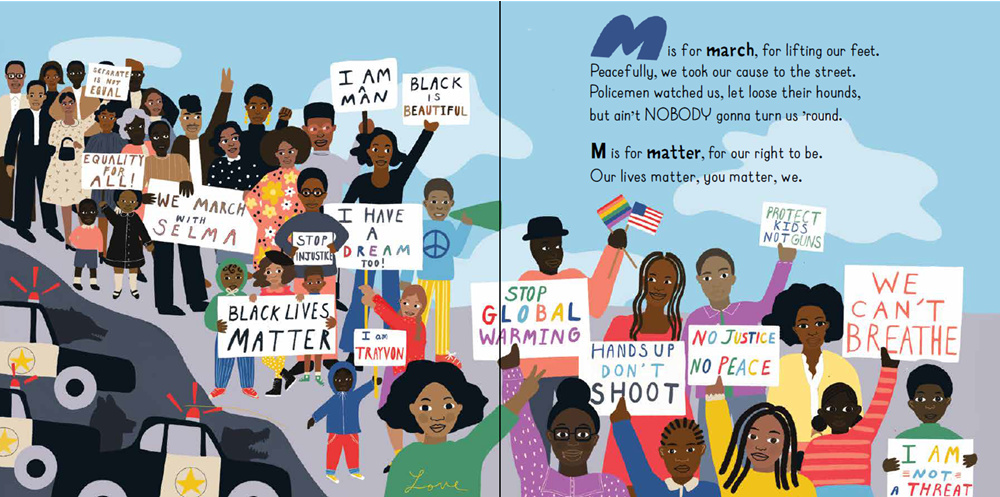
Black History Month 2021 is coming to an end and I thought I would look at a book that has become one of my favorites and one I have used often with my young readers in the last two months. It is a bold and beautiful book that introduces kids to Black culture, heritage, and history. It is set up like a typical ABC book, but each letter of the alphabet is used to frame and celebrate important dates, events, people, and community structures like the church that are so much a part of the Black experience, with most letters used more than once, but no letter needing to be left out or glossed over. Told in rhyming stanzas, it is a look back at the past and what has been accomplished, a look at the present and what is being done, and a look forward to the future and what more can and needs to be done in the fight for freedom and equality, beginning with A is for anthem.

This is also a book that is meant to empower young readers with pride in who they are (B is for Beautiful - I'm talking to you!/ Your voice, your height, your hair, your hue.); what they can do (R is for rise, to reach for the top,/ relentlessly striving, refusing to stop.); and where they come from (D is for diaspora - pulled from our homes,/ we were carried away in ships on the foam/ to Haiti, Cuba, America, Brazil.) Included in this journey are important and influential roles models, such as scientists like Katherine Johnson,  inventors, politicians like Shirley Chisholm and President Barack Obama, artists, musicians and writers among those celebrated are Toni Morrison. James Brown and, of course, James Brown, as well as places like Harlem where some were able to explore and hone their talent.


Everything included in this work is a unique part of Black history, and yet, the information never overwhelms readers with facts and dates, rather it serves as an invitation to find out more. The illustrations are bright, bold and beautiful, just like the message, digitally done in cut paper collage. There is extensive front and back matter with resources for anyone wanted to explore more, as well as list of Terms and Figures used in throughout the book. So, for example, if your reader doesn't know who Langston is, they can find more detailed information about him there. This is a book that is a wonderful celebration which not only empowers its readers, but it also serves as a call to action for them to add their voice.


I read this with my young readers several times, and while none are African American, they are nevertheless children of color who could relate to so much of what is included in this book. And I think that part of the beauty of it is that it will appeal to all children of color and open their eyes to some of the same ideas about themselves and who they are. 

The ABC's of Black History is a beautifully thought out, well crafted book that every parent, teacher and child should own, read, discuss and use all year round. 

This book is recommended for everyone who cares.
This book was gratefully received from the publisher.

Sunday, February 21, 2021

Unspeakable: The Tulsa Race Massacre by Carole Boston Weatherford, illustrated by Floyd Cooper

 
Unspeakable: The Tulsa Race Massacre
written by Carole Boston Weatherford,
illustrated by Floyd Cooper
Carolrhoda Books, 2021, 32 pages

This year will mark the 100th anniversary of the Tulsa Race Massacre on May 31st and June 1, 1921, when a armed white mob swarmed the town of Greenwood, Oklahoma, killing up to 300 Black Americans over two days and burning the prosperous town to the ground. The what massacre, you may ask? Exactly. When did any of us ever learn about this heart wrenching event in American history? If you're like me, the answer is never. I hadn't heard about the Tulsa Race Massacre until just a few years ago when I read Dreamland Burning, a YA novel by Jennifer Latham.

Now, however, Carole Boston Weatherford has made the events of the Tulsa Race Massacre accessible to younger readers. Written in measured, lyrical free verse, she begins her narrative as though it were a fairytale - "Once upon a time near Tulsa, Oklahoma..." painting an idyllic picture of life in the all Black prosperous town of Greenwood. She continues the use of "Once upon a time..." as she introduces the achievement of the citizens of Greenwood in building their own community. 
Click to Enlarge

Segregation laws made it impossible for Blacks to vote, and demanded that they have separate neighborhoods, their own schools, streetcars and railroad coaches. The residents of Greenwood may have been separate, but they were very prosperous. Not surprisingly, there were almost two hundred business in Greenwood, earning it the name the "Negro Wall Street of America." Greenwood had everything a town could want - a school system, a post office, a hospital, several libraries and churches, a theater named Dreamland
Click to Enlarge

But not everyone was happy about Greenwood and its flourishing citizens. Midway through Unspeakable, Weatherford drops the fairytale phase "Once upon a time... " and introduces a stark reality on a black page with white writing - "But in 1921, not everyone in Tulsa was pleased/ with these signs of Black Wealth..." A 17-year-old white elevator operator accusing a 19-year-old shoeshine man of assault was all it took to inflame an angry white mob to descend on Greenwood, killing, destroying, burning it down until nothing remained but ashes. 

Carole Boston Weatherford does an outstanding job in making difficult and/or little known subjects or events available and understandable for young readers and this picture book for older readers is no exception. Her language is clear and musical, and she never talks down to her readers, writing in such a way that respects their intelligence, no matter how tragic the circumstances. Dividing Unspeakable between what went into making Greenwood so successful for the African Americans living there and the destructive mob that destroyed their years of achievement really drives home her message - "...to realize the responsibility we all have/ to reject hatred and violence and instead choose hope."

Weatherford's words are beautifully born out in Floyd Cooper's sepia-toned paint and erasure illustrations. I once saw him do this method in person once and I was amazed by it. Perhaps because he has a personal connection to Greenwood, Cooper has really captured both the community in all its bustling activity and the hatred and anger of mob violence. And as we have witnessed recently, it's so easy to destroy the trust and faith we have in our communities when people are motived by hate and jealousy.

Back matter includes an important Author's Note and an informative Illustrator's Note. Be sure to check out the front and back endpapers to see was Greenwood really looked like before and after the mob destroyed it. 

This is a book that should be in every school library, classroom or home school library. If you are thinking about using Unspeakable with your classes, you can download an extensive Teacher's Guide courtesy of Lerner Books HERE

This book is recommended for readers age 9+
This book was an eARC gratefully received from NetGalley

Friday, February 12, 2021

The Teachers March!: How Selma's Teachers Changed History by Sandra Neil Wallace and Rich Wallace, illustrated by Charly Palmer

 
The Teacher's March!: How Selma's Teachers Changed History
by Sandra Neil Wallace and Rich Wallace,
illustrated by Charly Palmer
Calkins Creek, 2020, 44 pages

Imagine teaching your African American students that freedom and equal rights are guaranteed in the United States Constitution, but not for them. That was one of the dilemma's faced by science teacher  Reverend R. B. Reese in 1965 Selma, Alabama. Selma was a segregated city and the white people there intended to keep it that way, and one of the ways they did it was by denying black citizens the right to vote.

But when Reverend Reese led marchers to the Selma courthouse to register to vote, they were stopped by Sheriff Clark and his white policemen wielding billy clubs and they didn't hesitate to use them. Realizing he needed a "triumphant idea" that would make the voices of the black citizens of Selma heard, Reverend Reese came up with the idea he needed - what if the teachers marched? After all, they were leaders, but would teachers march? Since judge had declared marching and talking about civil rights against the law in 1964, Selma's teachers might not be so willing to put themselves on the line.

How to convince the teachers to march anyway? After all, they could be arrested, go to jail, loose their jobs. Reverend Reese invited Dr. Martin Luther King Jr to come and speak to them.

After listening to Dr. King's inspiring talk, one hundred and four teachers signed up to march. Packing a sandwich and a toothbrush in case they were arrested, and led by Reverend Reese, the teachers marched to the courthouse and were twice repelled by Sheriff Clark and cops, but the teachers went back despite their bumps and bruises. 
This time, the school superintendent came out, realized what it would mean to arrest so many teachers and next thing he knew, the police had put away their billy clubs and handcuffs: "Reverend Reese and his triumphant idea had gained a glorious victory". 

Reverend Reese's marchers may not have been able to register to vote that day, but in 1965 the Voting Rights Act was passed and there were no one on the courthouse steps to stop black people of Selma from registering to vote and yes, in the next election, they voted Sheriff Clark out of office.

One of the interesting things about this nonfiction picture book for older readers is that the story, though basically focused on Reverend Reese, also shows the impact the teachers march had on one teacher, Too Sweet Parrish, and her 15-year-old daughter, Joyce, and to a lesser extent on Coach Lawrence Huggins. And the authors were fortunate enough to be able to interview Reverend Reese shortly before he passed away, as well as Joyce Parrish O'Neal and Coach Huggins to get first hand accounts of that day.

Though the Teachers March was a smaller, lesser known protest, the teachers showed so much courage and determination that they inspired others to march, too. And it shows how people can make a difference. 

The book is well-written and well-researched. I find that the Wallace's always seems to make a complicated event more accessible to young readers, and more personal so kids really get a sense of what it was like to be present during the events they write about. 

Charly Palmer's emotional illustrations are painted in bright, bold acrylic colors with thick brushstrokes, adding texture and depth to the text. 

Be sure to read the Authors' Note in the back matter for more information about the Teachers March and the participants. You will also find a Timeline relating to the Voting Rights Movement, and a Selected Bibliography for further investigation. 

You can download a very extensive and useful Educator's Guide HERE, courtesy of the publisher   

This book is recommended for readers age 7+
This book was an EARC gratefully received from Edelweiss+
 
Imagination Designs