Showing posts with label Bullying. Show all posts

Friday, July 22, 2022

The Marvellers (Marvellerverse #1) by Dhonielle Clayton

 
Ella Durand comes from a prominent New Orleans family of Conjurors and although she is only 11-years-old, she is about to make history. She will be the first Conjuror to enter the Arcanum Training Institute for Marvelous and Uncanny Endeavors and Ella is beyond excited about it, even if her mother isn't. And she isn't the only one not happy about Ella attending this school. Once Ella arrives, she finds she has three roomates, two of which believe Conjurors don't belong in the school and only one of which is even remotely friendly. She is also assigned a mentor, Masterji Thakur, who will help her learn the Marvellian Way, and a guide, Jason Eugene, the youngest of an illustrious Marvelling family and the youngest of four siblings in the school. At first, Ella rejects Jason's help, determined to do everything on her own as part of her need to prove that she belongs. 

The first thing that happens is that Ella is moved from her dorm with three roomates to one she will share with unfriendly Brigit Ebsen from New York City. Unlike Ella, Brigit does not want to be in the Arcanum Training Institute and plans on running away as soon as she can. Brigit also continuously knits images onto squares, but doesn't know why, who the images are, and seems to go into a trance when she is knitting. 

It's not just students who don't want Ella at their school, some of the teachers feel the same way and she begins to get demerits for things she hasn't done. But, little by little, she and Brigit become friends, and Ella warms up to Jason enough to call him friend too. But when a prisoner, Gia Trivelino, who calls herself the Ace of Anarchy, escapes from the Cards of Deadly Fate, a prison made out of powerful conjure cards and then Masterji Thakur disappears, students and teachers are quick to point their finger at Ella. All the while, Ella keep wondering just what her Marvel is. 

Click to Enlarge
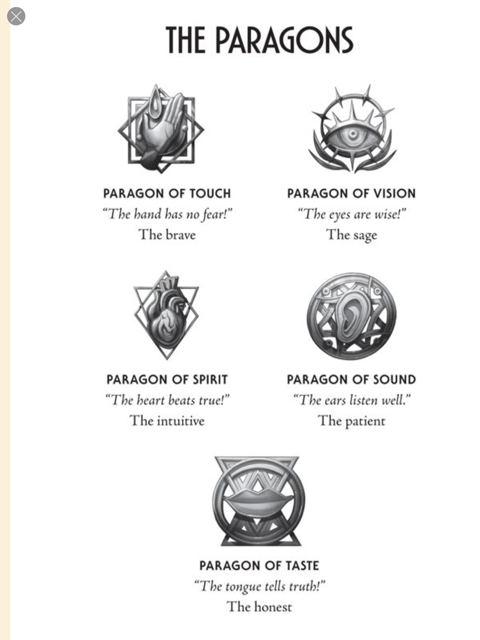
Marvels are a light within a person that is strongly linked to one of five Paragons. Paragons are similar to the five senses (vision, touch, sound, taste, smell) except smell has been replaced by spirit. At the end of the school year, there is an exam where kids find out their Paragon. Since all of the kids who are in Ella's class come from Marvelling families, they already have an idea of what their Paragon will be, with the exception of Ella and Brigit. I found myself wondering just what Ella's Paragon would be that would really work for a series. Then I thought, duh, she has at least two friends who can help with their Paragons. And then it occurred to me that wondering what will happen is part of the fun of reading The Marvellers

And there is a lot of fun stuff in this book because Clayton's worldbuilding is just so wonderfully imaginative. Sure, some of it may remind you of Harry Potter, but there is just so much originality that the comparisons fall away quickly until you are only left with one - they are both fantastic school stories. And astute readers will definitely chuckle at the names of some of the teachers in Ella's school.

But don't get me wrong, there is plenty of serious stuff going on. Ella is marginalized right off the bat when she must change rooms and live with Brigit, the other marginalized student. And with marginalization, comes bullying by students and collecting demerits because Conjurors are not welcomed by every teacher in the school.  

I have to admit when I first began reading The Marvellers, I had a hard time getting into it, but after a few pages, I was totally hooked. And I could go on and on about how great it is because there is just so much to this story, but maybe you should just read the book. It is well worth your time. Maybe I'll reread it.  

Sunday, June 26, 2022

The Night Bus Hero by Onjali Q. Raúf

 
Hector, 10-years-old and a middle child, has always been a bully and a prankster. And subsequently spending a lot of time in the principal's office. From the beginning, it's clear that Hector thinks very little of most people, and often does what he does just to annoy them. For example, as the book opens, Hector is about to drop a second rubber snake into the school's lunch soup, and even as the principal warns him not to, Hector defiantly does it anyway, knowing he will be in trouble. He always to derive satisfaction knowing he's ruin something for someone with his pranks. But, for him, it's ok, after all, his friends Will and Katie always think his antics are funny.

On their way home, Will and Katie tease Hector about being slow and getting caught. Angered by the teasing, Hector decides to show them how wrong they are. Seeing a homeless man asleep on a bench next to his trolley full of what appears to be trash, Hector decides to steal the hat the old man always wears. But when he wakes up and catches at them, they run off with the hat. 

Angry at the world, Hector decides to run off with the homeless man's trolley after school the next day. But the trolley quickly gains momentum and when Hector loses control, the trolley lands in the lake and sinks. Unfortunately, Mei-Li, the smartest girl in Hector's class, witnesses the whole thing, as does a woman walking her dog. Even though his friends think the cruel stunt is great, Hector can't celebrate - his plan went wrong, and that had never happened before. 

Meanwhile, at home, Hector learns his father is working on a new film about homeless people. And also that someone has been stealing statues and framing the homeless by leaving special marks that only they would understand. 

Skateboarding around Piccadilly Circus with a friend on afternoon, Hector decides to stay longer by himself, when his sees the homeless man, whose trolley he'd sunk and whose name he has learned is Thomas, suddenly appear and break into a run. Naturally, when another statue goes missing, Hector is convinced it's Thomas doing it, and decides to find him and turn him over to the police. And to do that, he needs to enlist the help of Mei-Li, but will she help someone who she clearly does not like? And together can Mei-Li and Thomas help Hector overcome his need to be bad?

There's a lot going on in this novel as Raúf tackles themes of bullying, homelessness, behavior, family dynamics, and a mystery. But Raúf is such a adept writer that none of these themes overwhelms the others, and never blurr Hector's selfish, cruel behavior. In fact, they all contribute to his redemption in such a believable way that it all happens almost unconsciously, for the reader and for Hector. And all the while, events inform reader and Hector of what it is like to live rough, to live where you aren't wanted, to feel the consequences of another person's cruel prank. 

Hector is a most unlikable protagonist, but then readers see his family's dynamics and the things he does are almost understandable in his need to get some attention his way. And while you may feel some empathy, it only lasts momentarily, as he commences his bad acts again. But, Hector is a boy who is and does deserve redemption. A clever artist who needs his talents redirected. 

I find that I am becoming quite a fan of Raúf. Her writing is refreshingly breezy and pulls the reader in immediately and compels them to stay to the end, to see what will become of her protagonists. Back matter consists of information about bullying and where to find information and resources about dealing with issues of bullying, and well as information about homelessness and where to find information. She has also included The Homeless Code, which may be different in Britain that in the US, symbols used by thieves, and an Author's Note. 

On a personal note, my grandmother went to Berea College in Kentucky and studied home economics. She made really great biscuits, and during the depression, despite having to feed six kids on a minister's salary, my grandmother got up every morning and made dozens and dozens of biscuits and lots of coffee to give to the homeless men who always stopped at their house. The house, my mother said, was marked showing that "a good woman lives here." 

Be sure to check out the other Marvelous Middle Grade Monday offerings, 
now being carried on by Greg at Always in the Middle

Monday, April 4, 2022

Worser by Jennifer Ziegler

 
Life has not been easy for 12-year-old William Orser. A loner whose elderly father passed away when he was very young, nicknamed Worser (W. Orser) on the first day of second grade, and bullied by the other kids, Worser is now living with a mother who has had a severe stroke, and his Aunt Iris, who is taking care of them. Ironically, Worser's mother was a professor of rhetoric who can no longer speak, but who had imparted a love of words in her son when he was a child, a love that has continued. 

Worser has been working on a project he calls his Masterwork, a loose-leaf binder filled with lists of important observations about words, a project that enables him to work in the library at the end of the school day to avoid going home and dealing with his mother and aunt. But now, because of budget cuts, Worser finds that the library is closed after school but not before he meets Turk, who has his own unique (and cringe worthy to Worser) twist on words.  

No library forces Worser to find another place to work on his Masterwork and eventually he finds and strikes a deal with Mr. Murray, the owner of a secondhand bookstore called Re-Visions. When Worser finds out that his crush, Donya Khoury, has lost the school sponsor for her Literary Club and can not longer meet in school, Worser comes up with a plan to help her out using his space at the bookstore and ultimately becoming a member of the club. But when Mr. Murray's rent is increased, it looks like he will have to close Re-Visions. And again, Worser has a plan to save the store. But will it actually work?

I have to admit that for much of this novel, I really didn't like Worser very much. It was clear he had nothing good to say about most people, including his aunt, who was trying her best to care for him and his mom. Interestingly, she is the opposite of Worser, being very emotional where he seems to completely lack emotion. She is also rather eccentric, albeit in a very different way than Worser and apparently his mother was before her stroke. It's very clear that Worser has not come to terms with the drastic changes he sees in his mother now that she is unable to speak or do anything for herself, and, rather that dealing with this, he loses himself in working on his Masterwork and later getting involved with the Literary Club to get Donya's attention.

As I went along on Worser's coming-of-age story, he began to grow on me more and more, and I began to feel very empathic as I realized how traumatized he was by the things that have happened to him over time and his attempts to avoid facing the truths about his feelings. Channeling his emotions into words is exactly how he lost his ability to communicate with the world and it would take a catastrophic event for him to find his way back. And it is quite a journey. 

Thank you Edelweiss+ for providing me with an ARC of this book.

Sunday, July 4, 2021

MMGM: Secondhand Dogs by Carolyn Crimi

 
Secondhand Dogs by Carolyn Crimi.
illustrated by Melissa Manwill
Balzer & Bray/HarperCollins, 2021, 256 pages

Meet Gus, a wise old terrier, Tank, a bulldog, three-legged Roo, and Moon Pie, a young pug. They are a collection of rescues that live with Miss Lottie. Each doggo has its own personality and its own designated dog bed, except Moon Pie who sleeps with Miss Lottie in her big, soft bed. Moon Pie had had a nice life eating popcorn and watching TV with Gertie, who unfortunately passed away. When she came to live with Miss Lottie a month ago, Gus, the leader of this pack of gentle dogs, thought it best to not yet to tell Moon Pie what happened to Gertie, and so Moonie thinks he will be returning to her when she comes back from vacation. Also living with Miss Lottie is Ghost, a cat who basically lives under a bed, and with whom Gus made a tenuous agreement to live and let live. To help out with her canine family, Miss Lottie hired Quinn, a young boy who had recently lost his dad and his dog, and who is now being bullied by his older brother's friends. Quinn loves nothing more than to escape to Miss Lottie's to care for the dogs he loves as much as she does. 

Into this happy mix comes Decker, a shepherd/doberman mix. Gus is rightfully worried about this new addition, who just doesn't feel like he will fit into the pack. The very first night, Decker manages to get Moon Pie's spot on Miss Lottie's bed, but then begins to intimate the little guy. The next day, during their yard time, Tank, who is Moonie's self-appointed protector, has a showdown with Decker. Everyone is surprised when Decker bites his own paw and needs to go to the vet's. Tank is blamed for the bite and put into his kennel. Little by little, Decker erodes Gus as the leader of the pack, but it soon becomes clear that his goal is to get rid of all the other dogs. 

When Decker learns that Gertie has passed away, he convinces Moon Pie that she is home and looking for him. Not only that, but Decker convinces Moonie to run away through a hole in the back fence. Angry that the other dogs had lied to him about Gertie and intimidated by Decker, Moonie escapes into the back alley when no one is paying attention. When Miss Lottie finally notices Moon Pie is gone, she calls Quinn to help look for him, but later Gus, Tank, and Roo decide to take matters into their own hands, escaping the same way Moonie did. None of them know where they are going, and must on Roo's excellent sense of smell to lead them. One scent they all pick up carries danger in it, but what can it be? Quinn is also worried, knowing his mother had lately spotted a coyote in the neighborhood. And Miss Lottie is beside her self with grief realizing all her beloved dogs are missing - except Decker, who is now calm and content to be an only dog. Decker has some hard lessons ahead of him about family, loyalty and love, but first, will all of Miss Lottie's doggos return home safe and sound? Or...?

Secondhand Dogs is an exciting novel for kids who like animal stories in general, and dog stories in particular and it is especially interesting because it is narrated mainly from the point of view of five dogs, one cat and two humans in alternating chapters. And along the way, there are chapters giving the back story of each character - canine and human, including Decker, whose traumatic past will definitely garner some sympathy for him. What's really nice about this dog's tale is that each canine has such a distinct personality. Gus is gentle and peace-loving, Roo is excitable and impulsive, Tank may be big and slow, but he's also a protector, and Moon Pie is just a popcorn-loving sweetie. It also wasn't lost on me that Quinn's story is an interesting parallel to Moon Pie's. 

Secondhand Dogs is a satisfying story with some tension but few surprises. This is the kind of middle grade book that is just perfect book for some good summer reading. 

Meet the Author:
Carolyn Crimi received her MFA in Writing for Children from Vermont College in 2000. She has published over 15 books, including Dear Tabby, Don't Need Friends, Boris and Bella, Henry and the Buccaneer Bunnies, Where's My Mummy? and I Am the Boss of this Chair. Her book There Must be Lobsters won The Golden Kite Award in 2018 for Best Picture Book Text, and her middle grade debut, Weird Little Robots, was named a BEA Book Buzz pick. Carolyn has received over thirty state awards and award nominations and was give The Prairie State Award in 2012 for her body of work. 
You can visit Carolyn at carolyncrimi.com 
Facebook: Carolyn Crimi
Twitter: @crims10

Thank you to Barbara Fisch at Blue Slip Media for providing me with an ARC to read and review. 

Be sure to check out the other Marvelous Middle Grade Monday offerings, 
now being carried on by Greg at Always in the Middle.

Friday, July 24, 2020

American as Paneer Pie by Supriya Kelkar


Eleven-year-old Lekha Divekar may be a first generation Indian American, but she couldn't be prouder of her Indian heritage, culture, and her Hindu faith. And there's nothing Lekha enjoys more than a good Bollywood movie, some delicious Indian food, and playing raas at home with her best friend Noah. But these enjoyments belong only to the at-home Lekha. At-school Lekha is a different story. 

As the only Desi* in her school in Oakridge, Michigan, Lekha tries her hardest to fit in and not be noticed. But that's kind of hard when she has a dark-brown birthmark in the spot on her forehead where a bindi would normally go. This earns her the unwanted nickname Dot by a white boy named Liam, who seems to have it out for her. Each time she passes him, he asks "What reeks, Dot?" in a sneering, condescending way and insinuating that Indians smell and adding to her feelings self-consciousness. Is it the wonderful Bengali food her mother makes and that she enjoys so much, or the coconut oil she uses in her hair, or none of this and just plain racism? she wondered. His mocking only increases when Lekha makes the school swim team and Liam doesn't, making fun of her for not shaving her legs:"She needs a lawn mower." to the delight of his friends. And how does Lekha deal with these insults and other microagressions, like students and teachers always mispronouncing her name and not correcting them? "I knew exactly how loud my voice would be when facing a bully. It would be totally silent." 

When a new girl moves in across the street, Lekha couldn't be happier. At last, a Desi friend at school and someone who would soon get what it is like to have two lives, an Indian life at home and an American life at school. But Avantika Savarkar may be fob (fresh off the boat), but she is also a proud Indian and doesn't care who knows it. And she is not afraid to stand up to Liam and his racist bullying. Lekha is amazed at this brave girl who speaks accented English and brings homemade Indian food for lunch, but she still wishes to just fit in and not be noticed.

When a white candidate runs for Congress on an anti-immigrant platform with the slogan "DON'T LIKE IT? LEAVE, Lekha refuses to even think about it, unlike her friend Noah. Noah has always been annoyed that Lekha refuses to speak up when she's make fun of. Even after a racist incident is directed at her family over the Christmas holidays happens, Lekha keeps her mouth shut about it and is only angry that Noah writes about it and it is published in the school paper for everyone to read. 

When a violent hate crime impacts her family and people she loves, will it be enough to get Lekha to finally find her voice to speak out against the racism she and her family face day after day and stand up for the culture she loves so much?

I found American as Paneer Pie to be an interesting novel and Lekha a very complex, flawed character as she grows and changes over the course of sixth grade. She is the first person narrator and while she can sound a little whiny and self-pitying at times, readers (myself included) need to remember, racism and xenophobia aren't occasional incidents in her life. It's also the ongoing day-to-day barrage of microaggressions, like not bothering to learn how to pronounce her name, comments about smelly Indian food, a pushy white swim teammate named Aidy insisting they lost a match because Lekha didn't shave her legs, even though it was Aidy's poor performance that caused the loss.

While this is a story that nicely highlights Lekha's journey toward discovering the power of her own voice, Kelkar has included a richly detailed picture of her Indian family's life, including lots of interesting references to their culture, traditions, and, of course, food. One thing that did bother me was that there is no glossary for the many Indian reference that are probably not going to be familiar to many readers. 

If you are looking for a thought-provoking, accessible novel that presents difficult but timely themes in an age appropriate way, then look no further than American as Paneer Pie. A recipe for Paneer Pie is included. 

This book is recommended for readers age 9+
This book was an ARC provided by the publisher, Aladdin, an imprint of Simon & Schuster

*Wondering what the word Desi means? So was I. Very simply put, the online Oxford dictionary defines it as "a person of Indian, Bangladeshi or Pakistani birth or descent who lives aboard." Desi comes from the Sanskrit deśa meaning country or home. 

Sunday, February 23, 2020

MMGM: We Could Be Heroes by Margaret Finnegan


It isn't easy to set a book on fire, but if you are the owner of a piece of camping equipment called a Survival 4000 Fire Striker with Compass and Whistle, you just might be able to accomplish your mission. At least, that's what Hank Hudson, a sensitive fourth grader, thought when he tried to burn the 495 page book about the Nazis hunting down a young boy that his teacher was reading to the class, a book that he found particularly sad and upsetting.

Hank, who is autistic, generally likes spending his time alone, thinking about and collecting rocks for his vast collection, from which he selects three each day to keep in his pocket and help him through the day. Returning to school after a three day suspension for trying to burn the book, Hank is approached by Maisie Huang, a girl in his class who was totally impressed by Hank's act of rebelliousness. Maisie has decided that he has 'the meatballs' to help her accomplish her own bold-as-brass mission. And she has just the thing needed to get Hank interested - both her parents are geologists and there are lots of rocks at her house.

Maisie's mission is simple - after freeing her neighbor's pit bill Booler, Hank will take him and give him a good home. Booler has epilepsy and his owner, Mr. Jorgensen, keeps him outside and tied to a tree while his two other dogs have free run of the house and yard. Maisie thinks this is cruel and, since Mr. Jorgensen won't let her have the dog, she's devised a plan to free Booler, so he can be Hank's dog, instead.

Little by little, Hank and Maisie become friends, much to the delight of Hank's parents. Maisie is, after all, his first friend and they spend lots of time together acting out The Jungle Book, Hank's favorite movie, while hanging around with Booler in his yard, and sometimes looking for rocks together in the schoolyard. But Maisie can be a strong, determined, even manipulative personality, who is relentless in her need to save Booler. Hank, on the other hand, is quiet and generally content with his rocks. But he does feel Maisie's manipulation and after their first attempt at saving Booler fails, along with Hank's first attempt at lying, he has a complete meltdown and is asked to consider whether she is really a good friend. Yes,  Hank decides, she is. But that doesn't mean the two friends have given up on Booler, not by any stretch of the imagination.

We Could Be Heroes is told in the third person from Hank's point of view, which is an interesting perspective. Interesting because the story isn't about autism so much as it is about how Hank sees, experiences, and navigates the world as a person on the spectrum. I came away with a better understanding of autism, and particularly, autistic meltdowns and I think Finnegan made it very accessible for young readers to understand, as well. For example, Finnegan gave Hank the perfect geological description for the way his meltdowns might feel like to him: A'a is a Hawaiian word that describes the way the surface and bottom layers of lava cool at different rates after a volcanic eruption. With a meltdown, Hank experiences his body as out of sync. On the surface, he feels punctured and bruised by the way sounds, textures, colors, smells poke at him, while inside, he feels dense, heavy and immovable. Later, she describes how Hank's mother helps him regain a sense of evenness after a meltdown.

I have to admit I really didn't like Maisie at first for the same reason Hank is somewhat leery of her. But as Hank and Maisie's friendship begins to really solidify, I began to see her differently, so that by the time Maisie's truth finally comes out, I felt real empathy for her.

One thing I really liked in this book is that Hank's family is intact, that his parents marriage didn't end because of his autism, and that both parents are involved, understanding and, most importantly, patient.

We Could Be Heroes is at times very serious story, that deals with themes like autism, epilepsy, bullying, empathy, and friendships (both age appropriate and intergenerational), but it not one without humor and some very delicious sounding cookies. This is Margaret Finnegan's debut middle grade novel and it is a well-crafted open and honest look at what it means to be different without being less and living one's authentic truth. And definitely not to be missed.

You can find an extensive and very useful Discussion Guide for We Could Be Heroes HERE

Meet the Author:
Margaret Finnegan's work has appeared in FamilyFun, the Los Angeles Times, Salon, and other publications. She lives in South Pasadena, California, where she enjoys spending time with her family, walking her dog, and baking really good chocolate cakes. You can connect with her at MargaretFinnegan.com and 
on Twitter @FinneganBegin and
Instagram  @finneganbegin

This book is recommended for readers age 8+
This book was gratefully received from Barb at Blue Slip Media

Be sure to check out the other Marvelous Middle Grade Monday offerings, now being carried on by Greg at Always in the Middle. 

Friday, October 4, 2019

🎃Blog Tour: The Itty-Bitty Witch by Trisha Speed Shaskan, illustrated by Xindi Yan


The Itty-Bitty Witch by Trisha Speed Shaskan, 
illustrated by Xindi Yan
Two Lions Press, 2019, 32 pages 

Betty is so excited to begin first-grade at witch school. Small for her age, Betty's broom is small as well. But the other kids laugh at her kinder-broom and start calling her Itty Bitty instead of Betty.

And no matter how many times she corrects them, they continue to all her Itty Bitty, which always makes her feel small inside. It doesn't help that she isn't as fast or as skillful as the other witches whenever they practice flying on their brooms. And the other witches aren't very nice about it.
But when the teacher announces the Halloween Dash, a competition among the students, Betty is convinced that if she wins the race, the other kids will stop calling her that awful name. Betty maps out the race course, makes up a rhymes to remember it and practices, practices, practices. Will her strategy work or will Betty be hindered by a "kinder-broom" and her size?

The Itty-Bitty Witch is less a Halloween tale and more a story about how hurtful the name-calling of peers can be. The text and illustrations really capture Betty's sinking self-esteem the more she is called Itty Bitty as she struggles to keep up with the other kids. However, readers see how quick thinking and cleverness save the day for Betty. The colorful, digital cartoon-like illustrations compliment a text with lots of onomatopoeia and I like the fact that the first-grade witch class is quite diverse. A fun book for kids that is sure to become a favorite.

Watch the Trailer:

Meet the Author:
When Trisha Speed Shaskan was a child, Halloween meant bobbing for apples, daring to touch brains (which may have been noodles), and—best of all—wearing costumes. She still loves dressing up for Halloween. Trisha is the author of more than forty children’s books, including Punk Skunks and the Q & Ray series, both illustrated by her husband, Stephen Shaskan. Trisha lives in Minneapolis, Minnesota, with Stephen; their cat, Eartha; and their dog, Beatrix. Learn more at www.trishaspeedshaskan.com.
Find her on Twitter and Facebook

Meet the Illustrator:
Xindi Yan grew up in a small city called Wuhu in China, and like Betty, she was always the smallest in her class. Standing a little shy of five feet, she still can’t reach the high shelves in grocery stores and sometimes finds that shoes made for kids fit her best. But her size didn’t stop her from chasing her big dreams of being a published artist in New York City. Xindi is the illustrator of Sylvia Rose and the Cherry Tree by Sandy Shapiro Hurt and the Craftily Ever After series by Martha Maker. She lives in Brooklyn with her husband and hopes to have a puppy one day. Learn more at www.xindiyanart.com
Twitter: @xindiyan
Instagram: @xindiyanart

This book is recommended for readers age 4+
This book was provided by Blue Slip Media

Friday, September 29, 2017

Real Friends by Shannon Hale, illustrated by LeUyen Pham


In this graphic memoir, author Shannon Hale revisits her elementary school years and her experiences with friendship, cliques, siblings, and bullies. 

Sandwiched in the middle between two older and two younger siblings, Shannon just wants to stay home with her mother. But, once Kindergarten begins, Shannon meets Adrienne and her life changes with a best friend. The two girls have lots of fun playing and having all kinds of imaginary adventures together, but Shannon’s possessiveness begins to bother Adrienne by second grade. And then Adrienne moves away and Shannon reluctantly makes another friend. 

In third grade, Adrienne suddenly moves back, and she and Shannon continued to be friends, but now, other girls wanted to be friends with Adrienne. A group, referred to as The Group, forms around a girl named Jen, and Adrienne is immediately accepted into their clique, while Shannon is treated like an outside or only reluctantly and occasionally allowed to be part of The Group. Luckily, Jen already had a best friend, Jenny, so she isn’t interested in Adrienne. But Jenny quickly realizes that Shannon as just the kind of girl she can bully. Jealous that Jen and Shannon spend some time together during summer vacation, Jenny ramps up the bullying.

To add to Shannon’s distress, her older sister Wendy, who’s having her own friend problems, takes her anger and frustration out on her younger sister, verbally and physically. Shannon’s unpredictable up and down year becomes so stressful, she begins showing OCD symptoms and having frequent stomach aches.

Shannon’s life doesn’t change much in fourth grade, but when fifth grade starts, everything changes. And what Shannon learns about friendships and real friends is both eye-opening and thought provoking. 

Shannon Hale is to be admired for addressing her elementary school years with such painful openness and honesty. Despite everything she experiences, she does not present herself as a victim, rather we see that she was a bit of a crybaby whenever her feelings were hurt, and, as her sister Wendy says, obnoxious at times. And a little on the selfish side as far as her friendship with Adrienne is concerned. 

But readers also see that sometimes, elementary school age kids can be really mean - as in Jenny’s behavior, yet Hale makes it clear that Jenny also is dealing with her own tough issues. On the other hand, there is the boy who spits in Shannon’s face for no reason. 

Shannon was a daydreamer, and so was I and my Kiddo. I appreciated the way she brought out how she missed things that no one else missed - for example, how did she not know everyone had put in for the same fifth grade class except her. That is exactly the kind of thing I remember happening to me and to my Kiddo. It’s the kind of thing that makes a kid feel even more like an outsider. But, Shannon’s daydreams, as they are presented in the graphics, also really show what a wonderfully vivid imagination she had and the very beginnings of her writing career. 

The thing I especially liked about this book is that Hale makes it clear that she wasn’t only kid in her school who was on this roller coaster ride of family and social relationships. And her reason for writing such an open, honest look at those painful years: so that readers, young and old, who have had similar feelings and experiences, will know they weren’t the only one.

A word about the graphics: LeUyen Pham has really captured the essence of the early 1980s, when this story takes place. The colors, hairstyles, clothes are all so realistic (and I know, I remember). The colors are bold, and her images reflect the variety of emotions in recognizable facial expressions and body language throughout the book.   

Despite its 1980s setting, Real Friends is a book that resonates in today's world and for that reason, I would recommend to young readers, as well as their parents and teachers. 

This book is recommended for readers age 8+
This book was borrowed from the NYPL

Sunday, April 30, 2017

Hello, Universe by Erin Entrada Kelly


Virgil Salinas, an 11 year old Filipino-American boy, is shy, painfully shy, more than a bit fearful, and to make matter worse, his family calls him Turtle because of his shyness, a nickname Virgil despises. Added to that are twin younger brothers who, Virgil believes, “were crafted out of a factory that made perfect, athletic, perpetually happy children, and he was made from all the leftover parts.” But Virgil does have his grandmother Lola, and he is her favorite. Lola is always telling Virgil stories from her home in the Philippines, most with a simple life lesson, which he always enjoys hearing. And then there’s Gulliver, his hamster, a good friend who is always willing to listen to Virgil and never judge.

Virgil also has a crush on Valencia Somerset, although he has never spoken to her, despite spending time together in the Thursday resource room with Mr. King. To help him overcome his shyness around Valencia, Virgil has sought the services of self-proclaimed psychic Kaori Tanaka, 12. And so, on the first day of summer vacation, Virgil sends a text to Kaori asking for an afternoon appointment to talk to her about Valencia again. Before heading off to his appointment with Kaori, Virgil carefully puts Gulliver into his backpack to take with him.

Valencia Somerset has not idea that Virgil likes her, in fact, she doesn't really know him at all. Valencia is also hearing impaired and consequently, she has two overprotective parents, so she isn’t allowed to go out and about like the other kids. But she is allowed to explore the nearby woods and take notes in her zoological diary. Valencia is also plagued by a recurring nightmare where she finds herself the only person on earth after a solar eclipse. Disturbed by the dream, Valencia also decides to seek advice from Kaori after seeing her ‘business card’ on the supermarket bulletin board. 

Kaori Tanaka knows that she should have been born in the high misty mountains of a samurai village even though she is really third-generation Japanese American. How else could she explain the gift of second sight if not from someplace magical. With her younger ardent jump roping sister Gen as her assistant, Kaori takes her life as a psychic very seriously, even if Virgil has been her only client so far.

That is until the first Saturday of summer vacation, when Kaori finds she that she actually has two appointments, Virgil at 12 noon, Valencia at 1:00 PM. 

As Virgil sets out with Gulliver, crossing through the woods to Kaori’s house, he unfortunately meets Chet Bullens, class bully with Virgil always in his sights. Sure enough, Chet takes Virgil’s backpack and tosses it down an old, dried up well, Gulliver and all. In his attempt to rescue his hamster, Virgil gets down the well, but can’t get up.

When Virgil fails to show up for his appointment, Kaori begins to wonder what happened. When Valencia shows up for hers, Kaori is still worried about Virgil. Not anxious to go home, Valencia offers to help Kaori and Gen look for him after her appointment. As the three set off, their search becomes a journey of self-discovery and new friendships, as well as ingenious and courageous actions.

In this character driven novel, Kelly gives young readers four very different viewpoints to consider, that of Virgil, Kaori, Valencia, and Chet, alternating them with each other. Told in the third person, Kelly creates an intimacy between reader and each character's inner thoughts and feelings as they navigate that one fateful Saturday, and life in general. Each is lonely and isolated in their own way, and in need of real friends. 

Each character is individual and original, and each will surely appeal to young readers. Kelly really knows how to flesh out the essence of each one of her characters and bestows on them a true sense of individuality. I think that is important when writing from a multi-character perspective, as Kelly does in Hello, Universe. But I had already noticed in her two earlier books, Blackbird Fly! and The Land of Forgotten Girls, that character is something she is particularly good at creating.

Chet, on the other hand, is a classic bully which makes him feel very stereotypical. But to have depicted him otherwise would make him a more sympathetic character and that would diminish him as a foil for Virgil and Valencia. I can live with this stereotypical bully because Kelly has written such wonderfully diverse characters in Virgil, Valencia, Kaori, and even Gen.

Hello, Universe is a neighborhood novel filled with folk tales that become object lessons (thanks to grandma Lola, and luckily for Virgil), courage, hope, humor, and some really great kids (not Chet) that is sure to please young readers.

This book is recommended for readers age 9+
This book was an EARC received from Edelweiss/Above the Treeline

Marvelous Middle Grade Monday is a weekly event hosted by Shannon Messenger at Book Ramblings, and Plenty of Shenanigans

Wednesday, February 1, 2017

Garvey's Choice by Nikki Grimes


Garvey's dad always wanted his son to be a jock, someone he could shoot baskets with and bond with over sports talk. But middle grader Garvey would much rather settle in with a good sci-fi novel, learn more about astronomy and listen to his favorite music. Garvey has a best friend, Joe, who shares his love of music, and with whom he likes to play chess and make up knock knock jokes.  Garvey's older sister Angie is the family jock - a great soccer player. Why can't his dad be happy with that and just accept Garvey for who he is?

It's a question that causes Garvey to overeat, pushing his feeling down with food and soda. Kids have always teased and bullied him because of his weight, even his sister indulges in what she calls good natured kidding about it, never thinking about how it hurts her brother.

So Garvey is understandably dreading the new school year that is about to start. And the cruel teasing begins immediately. But at least there is Joe to eat lunch with and Joe who encourages Garvey to try out for the chorus. In chorus, Garvey meets Manny, an albino boy. The two become good friend, hanging out together when Joe has a schedule change. Manny has accepted that he has albinism and just doesn't care what others think about it.

In chorus, Garvey learns to accept what he can to well (with a little help from his friends), and to his surprise he discovers his dad also has a love of music, especially the music of Luther Vandross. When Garvey is given the coveted tenor solo for the chorus's school concert, he finally finds a way to connect with his father and make him proud of who Garvey is. And the confidence Garvey gains from his talented singing begins to change how people see and treat Garvey in school, as well.

Garvey's Choice is a short, poignant novel in verse about friendship and self-acceptance and I think Garvey's journey is one that many readers will be able to relate to, whether they sooth their hurt feelings with food or other means. The middle school years are a time when kids are trying to not stand out from the crowd so it is encouraging to read a novel that deals with the kind of bullying being different can lead to.

Nikki Grimes is one of my favorite verse novelists. She gives her readers not just a wonderful story, but she also introduces them to different verse forms in her books and does them all so well. For Garvey's Choice, she used Tanka, an ancient Japanese form meaning "short poem." Grimes gives a fuller explanation of this poetic form and her modern use of it at the end of the book. Short poems also make this an excellent novel for reluctant readers.

You might want to consider pairing Garvey's Choice with Planet Middle School, another novel in verse about a young girl entering a new phase in her life. In my review of that book, I said that one of the things I loved about Planet Middle School is that "the protagonist is African American but it is not about being African American per se, it is about being a girl entering a new phase of her life and that makes the story really universal." The same holds true for Garvey's Choice.

This book is recommended for readers age 9+
This book was borrowed from the NYPL

FEBRUARY IS BLACK HISTORY MONTH

Wednesday, March 2, 2016

#Cybils 2015 Finalist Review: Blackbird Fly by Erin Entrada Kelly


Analyn Yengko, or Apple as she was nicknamed by her deceased father, migrated with her mother from the Philippines to Louisiana when she was four years old.  Now in middle school, Anna still feels some shame about her penny-pinching mother, who works hard, but also makes mistakes speaking English, still cooks Filipino food, and doesn't want Apple to forget her heritage.

But while Apple feels estranged from her mother, she really wants to connect with her dad through their mutual love of the Beatles.  If only Apple's mother could understand that and buy her that inexpensive guitar she so desperately wants to have.  But no guitar playing is allowed in her house, only studying and working hard in school.  Desperate, Apple steals $100. from the school's music, feels guilty and gets caught putting it back.  Part of her punishment is that she is no longer allowed into the band room.

Meanwhile, Apple and her two best friends Gretchen and Alyssa have also discovered boys, but boys haven't discovered Apple.  In fact, Jake thinks she's Chinese and eats dogs, a comment the will follow Apple around school once it out there.  But even worse, Apple also finds out that she is number three on their Dog Log, a list complied by the boys of the school's most unattractive girls, and she is devastated.   But when she hears that popular boy Braeden wants to dance with her at the Halloween dance, Apple hopes thing have changed.  She goes to the dance with Evan Temple, a new boy from California, but it becomes clear that Braeden was a set up and Evan leaves when he finds out he was supposed to be ditched.  Suddenly, Apple is really alone.  In the Girls' bathroom, she runs into Heleena, an overweight girl who has always been a target for the  popular kids.

By Monday, Gretchen and Alyssa can't detach from Apple quickly enough.  Ostracized by her classmates, Apple goes to the library for lunch instead of her usual place under the tree with her friends.  After checking out a book about playing guitar, Apple heads over to the band room to leave an apology for the teacher when Alyssa finds her there and accuses Apple of stealing again.  Next, Apple apologizes to Evan.  And suddenly, things begin to change for her.  Sure, the boys still taunt her about being on the Dog Log, but with the help of her new friends Evan and Heleena, Apple discovers who she really is and what most important to her.

Blackbird Fly is so different from what I expected given the cover illustration.  Middle school is the pits anyway, but Erin Entrada Kelly gives the reader an excellent, realistic picture of what a real hell it can be when you are facing the racist and xenophobic attitudes of your classmates, people you have to be near day after day.   I have to admit these were difficult parts of the novel to read, but don't gloss over them.

Apple really grows in the coming of age novel and that is a truly positive aspect of the book.  Kelly really has created well-drawn characters in Apple, her mother, Evan and Heleena.  Interestingly, Gretchen, Alyssa and the boys they like have a kind of opaque quality that renders them as shallow as they really are.

All in all, I found Blackbird Fly to be an interesting look at bullying because of difference, at how easily misinformation about cultures spreads and I think it is especially timely given all the recent talk immigrants and about closing our borders (FYI, I am a child of an immigrant).

My only problem with the novel was why didn't the creators of the Dog Log and their girl supporters get in trouble for what they were doing?  They shouldn't have gotten away with it because it will just keep happening to other girls.

On a lighter note, I found the 2FS4N (2nd favorite song for now) at the beginning of each chapter a nice way to give readers a hint of what to expect in that particular chapter.   I also love the Beatles and yes, I did listen to my Beatles playlist after I finished the novel.

This book is recommended for readers age 9+
This book was borrowed from the NYPL

Monday, March 3, 2014

Immortal Max by Lutricia Clifton

Sam, 12, really wants a pedigree puppy, but he is told that he must wait until Max, an older, overly affectionate, mangy-looking, smelly rescue dog dies before he can get a new dog.  His mother thinks that a puppy might be too much for old Max to deal with.

Trouble is, Max is a miracle dog.  Brought home one day from her job by older sister Beth, Max was on his leg and expected to die within days.  But with Sam's care, Max recovered and ever since has become known as immortal Max.

But Sam finally gets his mom to change her mind about a new puppy, so now he must figure out how to pay for it when he discovers the high cost of a pedigree dog.  With the help of two classmates, Sam gets a job walking three dogs in an exclusive gated community, but unfortunately, Justin, a boy in his class, lives there, too - Justin, who has money to burn AND a pedigree German Shepard.  And there is nothing that Justin enjoys more than bullying Sam, especially when he can do it in his father's golf cart.

But when a tragic accident happens, Sam loses his job even though it wasn't his fault.  Is his dream of a new pedigree puppy gone?

Lutricia Clifton likes to write stories about character's coming of age and coming to terms with the rotten deal life has dealt them - or so they think that is what they have gotten.  Remember Freaky Fast Frankie Joe?  Immortal Max is also an interesting story about learning to appreciate what you have and realizing that things in life are always tentative - here today, gone tomorrow.

I think Clifton created a nice contrast between rich, upper class, mean-spirited Justin and his wild untrained German Shepard Bruno, and Sam, whose family is always trying to make ends meet since his father was killed in an auto accident, and Max, his well trained, fiercely loyal and loving dog.

I did find myself getting annoyed with Sam's selfishness in the beginning.  And even though he at first resents the $75.00 his mother spends on his little sister Rosie's entry into a princess contest, it turns out to be a very rewarding experience for Sam.  And he does care that Beth is driving on bald tires after paying her college tuition and fees.

I am sure we will all recognize Sam's level of desperate desire, in his case, for a pedigree puppy, wanting it so badly he is blind to everything but that.  Yet, haven't' we or our kids all wanted something just that badly at some point in our/their lives?

I did like that Sam's school friends are a somewhat diverse group that included an Indian boy and an Asian girl, giving it a nice realistic touch.

And while I do think that the ending may feel a little predictable, it is Sam's journey to that ending that we are really interested in…because, of course, we could see what he couldn't.

FYI: There is a 5 autographed copy giveaway on Goodreads for Immortal Max running from March 1st to March 30th.

Immortal Max will be available on April 1, 2014.

This book is recommended for readers age 9+
This book was an ARC from the publisher

Tuesday, September 3, 2013

The Saturday Boy by David Fleming

Eleven year old Derek Lamb's father has been flying Apache helicopters in Afghanistan for most of Derek's life and just when it looked like he was finished, he was called back into service there.  Now, Derek is having a hard time in school, at home, and with his former best friend, Budgie.

To comfort himself, Derek reads and rereads the letters his dad has sent him over the course of Derek's young life - all 91 of them kept in his dad's old plastic Knight Rider lunch box.  Derek has read the letters so often he know which letters to read when he wants them to say exactly what he needs them to say.

Derek also has a fondness for comic books, and superheroes, like Zeroman and Dinoman, something he used to share with Budgie.  Now, though, Budgie has become pretty mean to Derek, making his life miserable every chance he can at school.

Derek's own lack of focus makes him an easy target for a bully like Budgie - which is how he earned the nickname Saturday boy.  Budgie and his mom found Derek waiting at the school bus stop in the pouring rain on Saturday morning.  And by Monday morning, everyone knew about it.

Budgie continues to be antagonist to Derek in school.  When the boys are back at school, after spending a fun (at least for Derek) day playing at Budgie house, Budgie humiliates Derek in front of the other kids, even letting him know that Derek is his archenemy.  Later, when Derek seeks revenge, it backfires.  Hurt and angry, Derek takes to magic markers and the boys' room wall to express his feelings about Derek, which earns him a trip to the principle's office, and a call home to his already stressed out, somewhat distracted mom.

Just when Derek's 11 year old life seems like to couldn't get any more difficult for him, he learns that his dad's helicopter has been shot down and his dad didn't survive.  Suddenly, everything changes for Derek.

I picked this book up to read rather reluctantly last Sunday.  I wasn't in much of a reading mood, but I had to read it for something.  It didn't take long to become riveted to Derek's story and I finished the book a few hours later.  What a surprise!  I loved it.

Engagingly told in the first person by Derek, it is exactly the kind of coming of age story I am most attracted to.  When I first started reading, I thought maybe Derek was a little slow, he seemed to miss social sures and other things, but his lack of attention, I think, is perfectly normal for kids who have a parent deployed in a war zone.  And in that respect, David Fleming is spot on with his depiction of Derek and his anxiety, his anger and his distractedness and, for that matter, of his mother, a nurse who loses herself in her job.

The Saturday Boy is funny, sad, realistic and compelling.  It's not about bullying per se, though Fleming skillfully gives the reader a nice look into the mind of a bully, making what he does understandable, but without condoning it.  Budgie is, after all, what Derek's father calls "a target rich environment," overweight, with a terrible nickname covering a really embarrassing first name.  Vulnerable to bullying himself, he recognizes Derek's vulnerability and attacks before being attacks.

The Saturday Boy is Fleming's debut and definitely one that you surely don't want to miss.

This book is recommended for readers age 10+
This book was borrowed from the NYPL


Friday, June 28, 2013

Twerp by Mark Goldblatt

I kind of dawdled around about reading this book, always putting it on the bottom of the pile, but then one day I realized I just needed to bite the bullet.  And I am really glad I did.

After being suspended from school for a week, sixth grader Julian Twerski returns to school in January 1969.  His English teacher, Mr. Selkirk, has assigned the class a term paper on Shakespeare's Julius Caesar, not something Julian wants to do.  So Mr. Selkirk strikes a deal with him - instead of doing the Julius Caesar paper, Julian is to write about the incident that he and his friends were involved in against a handicapped boy nicknamed Danley Dimmel and that caused his suspension.

Thus begins a six months period of recounting his day to day life.  Julian writes about the five friends he  hangs out with him in an empty lot the call Ponzini, after a boy who lives there and a different incident that involved them all.  And he writes about his best friend Lonnie, who seems to have so much influence over Julian that he can get him to do anything he wants him to do, from throwing a rock at a pigeon to writing a love letter to a girl he has a crush on - a letter that backfires for both Lonnie and Julian and, of course, the most serious incident that Julian continues to put off writing about.

Twerp is a compelling coming of age story set in Queens, New York in 1969 and Goldblatt has really captured the essence of what it was like in NYC and in 6th grade at that time.  Julian is an engaging narrator, thoughtful, sensitive, but a follower.  And unfortunately, the person he follows, Lonnie, is a rather mean-spirited kid - remember the pigeon.  Lonnie even makes fun of the way his own mother speaks.  She is a concentration camp survivor whose tongue what cut by the Nazis and who endured many surgeries to have it somewhat repaired.  But his charisma blinds Julian until..

As he writes his journal entries (9 composition books by the end of the year), the reader can clearly see how things between Lonnie and Julian can go from peer pressure (the pigeon entry is one example) to full scale bullying  - the incident with Danley Dimmel.

I particularly liked the novel because of its setting - 6th grade in 1969 Queens wasn't so different than 6th grade in 1969 Brooklyn.  And though the use of journal entries may be seen as formulaic to some, I felt it was an excellent method for the kind of soul-searching Julian needed to do.

I also like the positive image of the teacher in Twerp even though we never meet him directly, only when Julian addresses him in his journal, which he does often.  Recognizing that there was something about Julian that made him think he would benefit more from his journal assignment than doing the Julius Caesar paper (guilt? knowing right from wrong? a need to confess?), Mr. Selkirk did the right thing.

All in all, Twerp is an excellent novel and one that addresses the always important issue of bullying.

This novel is recommended for readers age 9+
This book was received as an E-ARC from Netgalley.com


Imagination Designs