Showing posts with label Indian Americans. Show all posts

Sunday, September 4, 2022

How to Find What You're Not Looking For by Veera Hiranandani

 
It's June 1967, and 11-year-old Ariel "Ari" Goldberg has just learned that her sister Leah, 18, is in love. The only problem is that the Goldbergs are Jewish and want nothing more than for Leah to find a nice Jewish boy to marry. Instead, the boy Leah is in love with is Raj Jagwani, a Hindu from Bombay (now Mumbai), India, but an American citizen and a graduate student at NYU. And so Ari and Leah spend the summer meeting Raj on the sly.

But when school begins in September, everything  changes. Leah has been forbidden to see Raj, and at school, Ari is sure she will face another year of struggling to write clearly until she is put into a class for kids who need more help. In the past, Leah had always helped her with her schoolwork, but now she's unhappy and too preoccupied with Raj. After Leah and Raj elope and just disappear, Ari is left to cope with school on her own. Then she discovers that her parent's bakery, Gertie's, is in financial trouble and may have to be sold. At school, Ari has always been tormented by an anti-Semitic bully, but luckily has always had her best friend Jane until they have a falling out. 

Ari has also been waiting for her new teacher, Miss Field, to finally recommend she be put into the slow class, but at a conference with Ari and her mother, she tells them she suspects that Ari has dysgraphia, a learning disability in which a person can't write coherently. Mrs. Goldberg is convinced Ari's inability to write is just laziness and requires more practice. But Miss Fields encourages Ari to write poetry, something she finds is an easy way to express how she feels, on the classroom's electric typewriter. 

When Ari's class is assigned a special current events project to present, Ari decides to do the Loving vs. Virginia case, something she learned about from Leah and a way to keep her connection to her beloved sister. Yet, unable to understand why she hasn't heard from Leah, Ari and Jane, who loves Nancy Drew mystery novels, decide to solve the mystery of where Leah has disappeared to. 

This is indeed a novel about searching for something. If it seems that there is a lot going on in Ari's life in this novel, and that Hiranandani throws a lot of things at her - the Loving case, the Vietnam War, racism, anti-Semitism, and learning disabilities - it is also a thoughtful exploration of Ariel's search to find her own voice and place in her world, and it is also wonderful to watch how Ari grows and changes as events unfold. Written in the second person singular, it was a little odd at first to be reading historical fiction in the present tense, but it also brought the story closer, doing away with historical distancing. After all, some of the events and attitudes in this novel are still with us today.

I think the fact that Hiranandani is biracial, with a Jewish American mother and an Indian father, made this novel feel more relevant and important because she was speaking from experience. She handles Ari's story with sensitivity, humor, and honestly. One of the things I really found interesting were the chapter headings, which all began with How to... It was like a little preview of what was coming without giving anything away. 

How to Find What You're Not Looking For is a wonderful heartfelt, character driven novel and if you think the ending is too pat, well, sometimes that's just what is needed.

Friday, August 26, 2022

Anni Dreams of Biryani by Namita Moolani Mehra, illustrated by Chaaya Prabhat

 
Anni Dreams of Biryani written by Namita Moolani Mehra,
illustrated by Chaaya Prabhat
Two Lions/Amazon, 2022, 40 pages

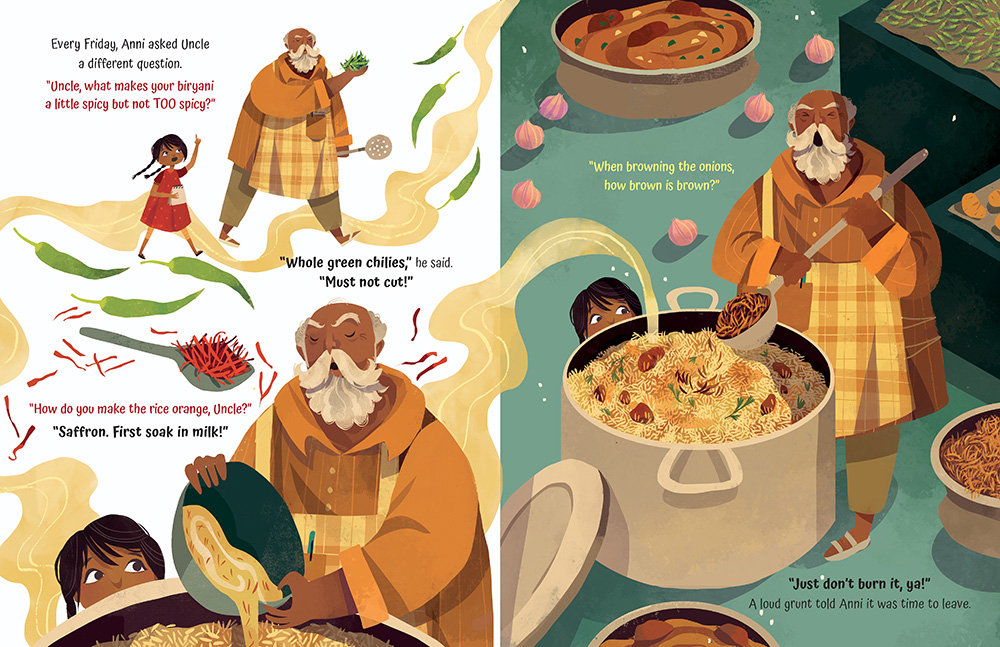
Anni lives in Little India with her mother and grandmother and every Friday, it is their once a week special treat to have biryani for dinner at the Biryani Cafe. This is the best biryani in Little India, made by an elderly chef named Mr. Arif whom everyone calls Uncle with an even older secret to his recipe. And it is Anni's absolute favorite thing to eat. If only she could make biryani that good, but she would need to find out the secret ingredient that sets it apart.
Sure, Anni can already cook all kinds of delicious curries, koftas, roti, and raita, but not biryani that taste like Uncle's. Then, one day, Anni gets an idea. Every week, Anni asks Uncle about one ingredient in his biryani and writes down his answer, until...


one Friday, instead of answering Anni's question, Uncle tells her to stop talking and try making her own biryani. And that is just what Anni does, but even though her biryani is good, it just isn't as good as Uncle's. But when Uncle looked at the recipe Anni had written down from all his answers, he stomps off in a huff, back into the cafe. And that is the end of Friday night biryani for Anni and her family. Or is it? A few weeks later, Anni comes up with a new plan, only to discover the cafe has closed and Uncle is gone. Could this really be the end of the best biryani ever? Will Anni never learn the secret ingredient in Uncle's biryani?

Anni Dreams of Biryani is such a fun book about a young girl who loves to cook, which is apparently not as uncommon as you might think. Anni is sweet, spunky, and really persistent. Her plan, after all, would require weeks of questions and answers, and she even manages  to pick up some useful cooking tips from Uncle, besides the list of ingredients. 

I loved the story of how Anni persevered trying to figure out the perfect biryani recipe, but I found the ending a bit abrupt and I didn't think it was clear why Uncle closed the cafe and left. It isn't as if Anni were competition for him - she is still just a school girl. 

The colorful digitally created illustrations depict a lively Little India neighborhood, with people busily going about their business. And the food images really capture the aroma of the different spices and other ingredients in the Biryani Cafe. They made me hungry for Indian food just looking at them. 

Back matter includes information about Biryani and how to make it special. There is a link to a quicker, easier version of Chicken Biryani that kids and their parents can try at http://indian-spicebox.com/biryani

Now, I'm dreaming of biryani, too.

Meet the Author:
Namita Moolani Mehra is a children’s book author, cookbook author, and a food and parenting writer. She wrote the children’s cookbooks The Magic Spicebox and Superfoods for Superheroes. Anni Dreams of Biryani is her first picture book. Namita also runs a social-impact business called Indian Spicebox that helps fund hot meals for underprivileged children in India. Namita was born in a remote village in Nigeria, grew up in the UK and India, studied in Chicago, and worked in New York for over a decade. She currently lives in Singapore with her husband and two children. Learn more at www.namitamehra.com, and follow her on Twitter @namstwit.

Instagram: @indianspicebox


Meet the Illustrator:

Chaaya Prabhat is an illustrator based in Chennai, India. She holds an MA in graphic design from Savannah College of Art and Design. She has illustrated several picture books, including Bracelets for Bina’s Brothers, written by Rajani LaRocca. In addition to her books, Chaaya has created illustrations for numerous clients, such as Google, Facebook, Snapchat, the Obama Foundation, the Times of India, and more. Learn more at www.chaayaprabhat.com, and follow her on Instagram @chaaya23.


Friday, July 24, 2020

American as Paneer Pie by Supriya Kelkar


Eleven-year-old Lekha Divekar may be a first generation Indian American, but she couldn't be prouder of her Indian heritage, culture, and her Hindu faith. And there's nothing Lekha enjoys more than a good Bollywood movie, some delicious Indian food, and playing raas at home with her best friend Noah. But these enjoyments belong only to the at-home Lekha. At-school Lekha is a different story. 

As the only Desi* in her school in Oakridge, Michigan, Lekha tries her hardest to fit in and not be noticed. But that's kind of hard when she has a dark-brown birthmark in the spot on her forehead where a bindi would normally go. This earns her the unwanted nickname Dot by a white boy named Liam, who seems to have it out for her. Each time she passes him, he asks "What reeks, Dot?" in a sneering, condescending way and insinuating that Indians smell and adding to her feelings self-consciousness. Is it the wonderful Bengali food her mother makes and that she enjoys so much, or the coconut oil she uses in her hair, or none of this and just plain racism? she wondered. His mocking only increases when Lekha makes the school swim team and Liam doesn't, making fun of her for not shaving her legs:"She needs a lawn mower." to the delight of his friends. And how does Lekha deal with these insults and other microagressions, like students and teachers always mispronouncing her name and not correcting them? "I knew exactly how loud my voice would be when facing a bully. It would be totally silent." 

When a new girl moves in across the street, Lekha couldn't be happier. At last, a Desi friend at school and someone who would soon get what it is like to have two lives, an Indian life at home and an American life at school. But Avantika Savarkar may be fob (fresh off the boat), but she is also a proud Indian and doesn't care who knows it. And she is not afraid to stand up to Liam and his racist bullying. Lekha is amazed at this brave girl who speaks accented English and brings homemade Indian food for lunch, but she still wishes to just fit in and not be noticed.

When a white candidate runs for Congress on an anti-immigrant platform with the slogan "DON'T LIKE IT? LEAVE, Lekha refuses to even think about it, unlike her friend Noah. Noah has always been annoyed that Lekha refuses to speak up when she's make fun of. Even after a racist incident is directed at her family over the Christmas holidays happens, Lekha keeps her mouth shut about it and is only angry that Noah writes about it and it is published in the school paper for everyone to read. 

When a violent hate crime impacts her family and people she loves, will it be enough to get Lekha to finally find her voice to speak out against the racism she and her family face day after day and stand up for the culture she loves so much?

I found American as Paneer Pie to be an interesting novel and Lekha a very complex, flawed character as she grows and changes over the course of sixth grade. She is the first person narrator and while she can sound a little whiny and self-pitying at times, readers (myself included) need to remember, racism and xenophobia aren't occasional incidents in her life. It's also the ongoing day-to-day barrage of microaggressions, like not bothering to learn how to pronounce her name, comments about smelly Indian food, a pushy white swim teammate named Aidy insisting they lost a match because Lekha didn't shave her legs, even though it was Aidy's poor performance that caused the loss.

While this is a story that nicely highlights Lekha's journey toward discovering the power of her own voice, Kelkar has included a richly detailed picture of her Indian family's life, including lots of interesting references to their culture, traditions, and, of course, food. One thing that did bother me was that there is no glossary for the many Indian reference that are probably not going to be familiar to many readers. 

If you are looking for a thought-provoking, accessible novel that presents difficult but timely themes in an age appropriate way, then look no further than American as Paneer Pie. A recipe for Paneer Pie is included. 

This book is recommended for readers age 9+
This book was an ARC provided by the publisher, Aladdin, an imprint of Simon & Schuster

*Wondering what the word Desi means? So was I. Very simply put, the online Oxford dictionary defines it as "a person of Indian, Bangladeshi or Pakistani birth or descent who lives aboard." Desi comes from the Sanskrit deśa meaning country or home. 

Monday, October 16, 2017

You Bring the Distant Near by Mitali Perkins

You Bring the Distant Near is a family story told in three parts, each covering a different time in the lives of five women.

Part One begins with a move. After living in Ghana and then London for a number of years, Rajeev Das gets a job in New York and moves his family, wife Ranee, daughters Tara and Sonia, into an apartment in Flushing, Queens. Though her daughters adjust to life in Flushing, Ranee is distrustful of the black kids who live in the neighborhood and wants to move. After a year in Queens, they move into a house in Ridgeford, New Jersey. 

Renee tries to hold on the some customary Bengali traditions, but her daughters quickly assimilate to life as Americans. Tara, the eldest daughter, wants to study theater, while Sonia’s interests lie more towards feminism and politics, aware of their parents desire for them to keep at least some of their Bengali cultural. 

Part Two begins after the tragic death of Rajeev. The Das family suddenly finds themselves at odds with each other, yet each painfully missing Rajeev. In high school, Sonia wins an all expenses paid trip to Paris, happy to get away from home. Fellow African American student Lou Johnson, handsome and friendly, has also won a spot on the trip, and although the two have always been at odds with each other in New Jersey, they quickly become friends in Paris. After college, Sonia and Lou marry, causing Ranee to completely stop speaking to Sonia.

Meanwhile, Tara pursues an acting career, while also being pursued by Amit Sen, a successful Bengali man. After refusing several marriage proposals because Amit had been picked for her by her parents, Tara finally says yes on a trip to India to spread her fathers ashes in the Ganges, and a visit to his childhood home. Tara continues with her acting career, becoming a famous actress/singer in India.

Part Three belongs to the daughters of Sonia and Tara. Chantel, or Shanti, has been raised in New York, living in Harlem with her parents, Lou and Sonia, and attending an exclusive private school on full scholarship. Anna, or Anu, has been living in Mumbai, and going school there. Now, though, she is in New York and in the same school as Shanti. Anu is not happy about the move. She is proud to be Bangali to the core, and considers Mumbai her real home. She has also inherited her grandmother's talent for sewing, even making and wearing her own salwar kameezes. 

You Bring the Distant Near is a compelling intergenerational story that is actually told more in a series of vignettes that sometimes skips over years, and yet, nothing is lost. Perkins has created five women, all seemingly so very different from each other and yet held together by their Bengali heritage, whether they embrace it or not. And it is a mark of Perkins talent as a writer that shows us the changes in each of these women over time and the events, both personal and public, that impact their lives. It is a slow, gentle novel, that more than once brought tears to my eyes.

The five female characters that Perkins has created are very well developed, truly finely tuned, but my personal favorite was Ranee. In Ranee, I saw my own father’s struggle to assimilate into American life while retaining his cultural identity. Ranee, like my dad, eventually finds the balance that works for her. And in that respect, Perkins has really captured the complexities of what being an immigrants means, as she explores the high cost and ways in which the Das family loses their cultural connections to their past and the ways in which they find redemption.

This book is recommended for readers age 12+
This book was an EARC received at NetGalley

FYI: The title of this book comes from a poem which is printed at the beginning of the book. It was written by Rabindranath Tagore (1861-1941), an Indian poet who also figures into the story of the Das family frequently. Tagore won the Nobel Prize for Literature in 1913, the first Asian to do so. You can find more of his beautiful poetry at the Poetry Foundation HERE

Monday, February 27, 2017

2016 Cybils MG Finalist: Save Me a Seat by Sarah Weeks and Gita Varadarajan


Ravi Suryanarayanan has recently moved from Bangalore, India to Hamilton, New Jersey because of his father's job. Now, Ravi is about to begin fifth grade at Albert Einstein Elementary School, confident that his English is good since it is his first language, and that he will have not trouble keeping up with the work. After all, he was at the top of his class in India.

Ravi finds himself in Mrs. Beam's class, where he notices a boy, Dillon Samreen, who appears to be Indian American, and who, he quickly discovers, is the most popular boy in the class. Ravi is sure they will soon be best friends.

But things don't start off as well as Ravi hoped. First, Mrs. Beam, like most Americans, mispronounces Ravi's name.  The other kids in the class laugh at his formal manners, make fun of his buttoned up, ironed shirts, and no one can understand him when he speaks in class because of his accent. His teacher decides to send him to the resource room to get help, a decision Ravi finds insulting and humiliating.

Things aren't much better the second day. When Ravi goes to the board to solve a multiplication problem, he uses colored markers and the Vedic method, only to be told not to do that again. Humiliated yet again, Ravi is wondering when the next insult will happen, when a foot shoots out and trips him. As Ravi falls, Dillon manages to point the blame a Joe.

Ravi sits in front of Joe Sylvester and behind Dillon in Mrs. Beams class. Joe's two best friends have recently moved away and he finds himself alone and at the mercy of Dillon, who turns out to be the sneaky class bully who always has Joe in his sights. Joe also has APD, or Auditory Processing Disorder, which makes focusing in class difficult for him, so he spends a lot of time with Mrs. Frost, the resource room teacher. To make him even more of a target, Joe's mom has taken a much needed job as a lunchroom monitor, something Dillon immediately adds to his list of taunts. But Joe also knows Dillon's secret - that he is a petty thief, stealing things from his classmates whenever possible.

The first few days of the first week of school go pretty much along these lines - Ravi continuously misreading cues from the people in school, particularly Dillon, whom he continues to think wants to be his best friend, and Joe dodging Dillon and his insults, especially in the cafeteria.

But when Mrs. Beam gives her class an assignment in which they must bring in an object that reflects who they are, along with an unsigned one sentence explanation of why that object was chosen, due on Friday, will it be the thing that finally opens up Ravi's eyes to the truth about both Dillon and Joe?

Save Me a Seat is told over the first week on school, alternating between Ravi and Joe's point of view. Interestingly, they never really interact directly with each other that first week of school, even though they have a common bullier in Dillon. yet, they manage to get to know each other better than most friends do.

The story is a little predictable, especially given the title, but the fun is in getting to the end of the first week and seeing how things unfold. I think that knowing the outcome allows the reader for focus more on what is happening and what each boy is saying about his life in and out of school.

Neither Ravi not Joe struck me as stereotypical, though Dillon does. After all, a bully is a bully, this one just happens to be Indian American, and dresses in a manner that sounded very hip-hop to me (low pants, underwear hanging out). Ravi and Joe both made assumptions about each other, and in Ravi's case about Dillon, based on past experiences, and I think sometimes kids need to be reminded not to prejudge.

One of the things I really liked about Save Me a Seat is that both boys come from intact, loving homes. Talk about assumptions - I expected Joe's family to be just the opposite of who they turned out the be. And Joe isn't a typical loner, either, he really doesn't want to be one. He wants friends and fun and all the other things kids enjoy.

At the end of the book, there are two glossaries - Ravi Glossary and Joe's Glossary for words that may be unfamiliar to readers. There is also a recipe apple crisp and one for Naan Khatai's. I happen to love the taste and smell of Indian food, so I had a great deal of interest in Ravi's lunch tiffin everyday.

Save Me a Seat is one of my favorite books of 2016 and I highly recommend it.

This book is recommended for readers age 9+
This book was provided to me by the publisher, Scholastic Press

Tuesday, May 31, 2016

The Not-So-Star-Spangled Life of Sunita Sen by Mitali Perkins


Sunita Sen, 13, is a typical California teenager who likes to play tennis, eat pizza, do well in school and really likes Michael Morrison, with whom she has just spent the summer.  She also has a best friend since first grade, Liz Grayson, and a riva for Michael's affections - the very flirty LeAnn Schaeffer.  Oh, yes and Sunita is an Indian American who has really not given a lot of thought to her Indian heritage.  That is, until her grandparents, Dadu and Didu - arrived from Kolkata for a year long visit with Sunita and her family.

Suddenly, her professor mother goes from wearing tailored suits and silk shirts to wearing sarees, a red dot on her forehead and red powder stripe in her hair to indicate she is married.  She even quits her university job for a year to stay home and cook Indian food for her family. And when she tells Sunita no boys in the house, not even to play ping pong in the basement, she apparently drives Michael right into the arms of LeAnn.  Sunita has cut herself off from Michael anyway, not wanting to tell him about her grandparents and thinking he wouldn't like her Indian family.

As her grandparents settle into the Sen household, Dadu decides to plant an elaborate garden of flowers and vegetables in the backyard, while Didu becomes hooked on American soap operas, in particular, one called Endless Hope, even deciding to participate in the Endless Hope Plot Solution Contest (this is a very funny side-storyline).

But as time goes on, and Sunita misses Michael, and resents his apparent attraction to LeAnn, and as she watches her mother's attempt to be the perfect Indian daughter for her parents, she becomes angrier and angrier and begins to withdraw from everyone.

Can Sunita learn how to happily be both Indian and American?

The Not-So-Star-Spangled Life of Sunita Sen is what I like to think of as a journey or process novel. The single event, her grandparent's visit, that brings on the conflict of cultures that Sunita feels is the start of her journey towards understanding who she is.

And Sunita is an interesting character.  At first, she is somewhat bratty, pouting, getting angry, and even lashing out at home and school, totally stunning her parents when she finally, angrily, tells her mother what she thinks of everything.  But the beauty of coming of age novels, is that there is generally definite positive growth for the main character, and Sunita certainly does grows.

Sunita seems to epitomize the dilemma of adolescents who are standing between cultures and feeling like they must choose one over the other.  Feeling confused, lost and alone, she turns to her grandfather for company, gradually realizing how very wise he is about human nature, so that, ironically, it takes this visit from her Indian grandparents to teach Sunita how to embrace both cultures.

Original 1993 Cover
I really liked The Not-So-Star-Spangled Life of Sunita Sen.  It takes a serious topic and handles it with a nice measure of respect, seriousness and humor. And along the way, the reader learns a good bit about Indian culture and customs.  And I loved the way Perkins has treated the intergenerational theme.  I thought they were realistically drawn, avoiding the kind of grandparent stereotypes so common in a three-generation household.

It was originally published under the title The Sunita Experiment in 1993 and I believe it is Mitali Perkins's debut novel. I thought that Perkins did a phenomenal job capturing Sunita's personality and her conflicted feelings about her heritage.  I read this on the heels of Born ConfusedBombay Blues and a few other more current books about Indians or Indian Americans, and I felt that even though this came out 23 years ago, it doesn't feel at all dated except that no one has a cell phone.

Actually the only thing I didn't like was Sunita's daydreaming scenes related to her favorite movie Casablanca.  Even though I got the significance of them in terms of her awakening awareness of how other cultures are presented in movies (and books), I still felt it interfered with the narrative flow, but not to the point that I wouldn't still highly recommend this book to readers.

You can find some thought-provoking discussion questions for The Not-So-Star-Spangled Life of Sunita Sen HERE

This book is recommended for readers age 11+
This book was purchased for my personal library

MAY IS ASIAN PACIFIC AMERICAN HERITAGE MONTH
 
Imagination Designs