Showing posts with label Homelessness. Show all posts

Sunday, June 26, 2022

The Night Bus Hero by Onjali Q. Raúf

 
Hector, 10-years-old and a middle child, has always been a bully and a prankster. And subsequently spending a lot of time in the principal's office. From the beginning, it's clear that Hector thinks very little of most people, and often does what he does just to annoy them. For example, as the book opens, Hector is about to drop a second rubber snake into the school's lunch soup, and even as the principal warns him not to, Hector defiantly does it anyway, knowing he will be in trouble. He always to derive satisfaction knowing he's ruin something for someone with his pranks. But, for him, it's ok, after all, his friends Will and Katie always think his antics are funny.

On their way home, Will and Katie tease Hector about being slow and getting caught. Angered by the teasing, Hector decides to show them how wrong they are. Seeing a homeless man asleep on a bench next to his trolley full of what appears to be trash, Hector decides to steal the hat the old man always wears. But when he wakes up and catches at them, they run off with the hat. 

Angry at the world, Hector decides to run off with the homeless man's trolley after school the next day. But the trolley quickly gains momentum and when Hector loses control, the trolley lands in the lake and sinks. Unfortunately, Mei-Li, the smartest girl in Hector's class, witnesses the whole thing, as does a woman walking her dog. Even though his friends think the cruel stunt is great, Hector can't celebrate - his plan went wrong, and that had never happened before. 

Meanwhile, at home, Hector learns his father is working on a new film about homeless people. And also that someone has been stealing statues and framing the homeless by leaving special marks that only they would understand. 

Skateboarding around Piccadilly Circus with a friend on afternoon, Hector decides to stay longer by himself, when his sees the homeless man, whose trolley he'd sunk and whose name he has learned is Thomas, suddenly appear and break into a run. Naturally, when another statue goes missing, Hector is convinced it's Thomas doing it, and decides to find him and turn him over to the police. And to do that, he needs to enlist the help of Mei-Li, but will she help someone who she clearly does not like? And together can Mei-Li and Thomas help Hector overcome his need to be bad?

There's a lot going on in this novel as Raúf tackles themes of bullying, homelessness, behavior, family dynamics, and a mystery. But Raúf is such a adept writer that none of these themes overwhelms the others, and never blurr Hector's selfish, cruel behavior. In fact, they all contribute to his redemption in such a believable way that it all happens almost unconsciously, for the reader and for Hector. And all the while, events inform reader and Hector of what it is like to live rough, to live where you aren't wanted, to feel the consequences of another person's cruel prank. 

Hector is a most unlikable protagonist, but then readers see his family's dynamics and the things he does are almost understandable in his need to get some attention his way. And while you may feel some empathy, it only lasts momentarily, as he commences his bad acts again. But, Hector is a boy who is and does deserve redemption. A clever artist who needs his talents redirected. 

I find that I am becoming quite a fan of Raúf. Her writing is refreshingly breezy and pulls the reader in immediately and compels them to stay to the end, to see what will become of her protagonists. Back matter consists of information about bullying and where to find information and resources about dealing with issues of bullying, and well as information about homelessness and where to find information. She has also included The Homeless Code, which may be different in Britain that in the US, symbols used by thieves, and an Author's Note. 

On a personal note, my grandmother went to Berea College in Kentucky and studied home economics. She made really great biscuits, and during the depression, despite having to feed six kids on a minister's salary, my grandmother got up every morning and made dozens and dozens of biscuits and lots of coffee to give to the homeless men who always stopped at their house. The house, my mother said, was marked showing that "a good woman lives here." 

Be sure to check out the other Marvelous Middle Grade Monday offerings, 
now being carried on by Greg at Always in the Middle

Sunday, September 19, 2021

#MMGM: Born Behind Bars by Padma Venkatraman


When she was pregnant with him, Kabir Khan's mother was accused of a crime she did not commit and put into a Chennai jail where he was born. He has lived there since that day, in a cell with several other women besides his mother. Small for his age, no one paid much attention to Kabir until the new warden decides that at age 9, he is old enough to be released. Before he goes, his teacher at the prison school tries her best to prepare him for the outside world, as do his cellmates. 

On the day of his release, Kabir is picked up by a man who says he is his uncle. But it doesn't take long for him to realize that the man is not a relative and that he plans to sell Kabir. Using his wits, Kabir manages to escape and in the process he meets Rani, a Kurava (Roma) girl a few years older than him and living on the streets with her pet parrot. 

Rani take Kabir under her wing, teaching him how to survive on the streets, educating him on India's caste system that makes low caste people like them invisible to others. Together, they manage to earn money for food - Rani tells fortunes and Kabir sings. Kabir knows all about his father and how much his dad loved his mother, but his father never told his parents about his wife before he left for Dubai because she is Hindu and Kabir's father's family are Muslim. Now, Kabir is determined to go to Bengaluru to find his grandparents. 

A stroke of good luck and Kabir's strong sense of honesty enables him to get enough money to buy train tickets to Bengaluru for him and Rani. Sadly, they face caste discrimination buying the tickets and riding the train, but also kindness of strangers helping them. In Bengaluru, they find the mosque that the Khan family worships at and follow a man to his business thinking he might be a relative of Kabir's. But when fighting over water breaks out, Rani manages to help the man save his business. In return, he posts their pictures on social media and luck is once again on Kabir's side. His grandparents see the post and manage to find him and Rani. Soon, Kabir finally has new, clean clothes, enough to eat, a room of his own and he even makes another friend who teaches him how to play cricket. Rani, who hates being confined indoors, is introduced to a woman who runs a school that allows her to live in a tent of her own with her parrot,  and get an education. The woman also knows lawyers who may be able to get Kabir's mother released so that they can be reunited. 

Born Behind Bars is told in chapters that consist of short paragraphs and that are narrated entirely from Kabir's open, honest, observant perspective. Though his eyes, readers learn what jail is like for the women and children who are incarcerated there, and also what life on the streets is like for so many children in India. Kabir's story is a nice mix of good and bad things happening to both him and Rani as Venkatraman explores themes of poverty, tolerance and intolerance of religious and caste differences, justice and injustice, loss and revelation. I also think it may be surprising for young American readers to realize that children can find themselves alone in the world on the streets of India and that it isn't just a thing of the past. 

But is Kabir's luck too good to be true? I wondered that as I read the book and perhaps the story focused on the upshot of his good luck rather than the alternatives. Think what could have been if his fraudulent uncle has managed to sell this plucky, hopeful boy into what would have amounted to slavery.

I have always enjoyed reading Padma Venkatraman's novels set in India and this is no exception. The writing is beautiful, the story is poignant, and Kabir is a character you won't soon forget. He is honest, with an engaging sense of humor regarding his circumstances (I loved his private nicknames for the women with whom he shared his jail cell) and the challenges he faces on a daily basis. It is, in short, an enlightening, compelling novel.

This book is recommended for readers age 9+
This book was an eARC gratefully received from NetGalley.com


Be sure to check out the other Marvelous Middle Grade Monday offerings, 
now being carried on by Greg at Always in the Middle

Wednesday, November 21, 2018

Four Books to Share This Thanksgiving about Gratitude and Kindness


When my Kiddo was growing up and I was still a classroom teacher, I always tried to stress the importance of gratitude and kindness not just at Thanksgiving, but throughout the year. I grew up in a house where my dad would always remind us of how grateful he was that he could come to this country and live a better life than what he would have had otherwise. As a young immigrant, people were not always kind to him and so he tried not to follow their example, and made it a point to help others. This year, I have found a few wonderful books that really express the idea of thankfulness and the way it was passed on to me, and the way I tried to pass it on to my Kiddo and my young students in the Bronx, many of whom were also the children of immigrants.

Thank You, Omu! written and illustrated by Oge Mora
Little, Brown BFYR, 2018, 40 pages
Omu (AH-moo, Igbo for queen, or sometimes grandma, see Author's Note for more information) has made a thick red stew for her evening meal. Omu's stew is so good that the smell wafts over the neighborhood. Just as she sits down to read a book before supper, there is a knock on her door, a little boy asking what smells so delicious. Omu gives him a bowl full of stew and he goes on his way. All through the afternoon,  neighborhood people knock on Omu's door asking what smells so good, and each is given a bowl of her thick red stew. But by evening, there's nothing left for Omu to eat. There is another knock on the door, and everyone she had shared her stew with has returned, each one bringing a dish to share with Omu and each other, and so they ate, danced, and celebrated, as a way of saying Thank You, Omu. This has become one of my very favorite books and one I love to share with kids. There is so much to talk about in this simple story of kindness, generosity, and thankfulness. The neighborhood is wonderfully diverse, and shared food is the means of gathering them together. Mora's collage illustrations are done with a variety mediums, including clippings from old books, and her color palette is soft earthy tones of blues, yellows, greens, and browns resulting in images that are a warm as this charming story of Omu.
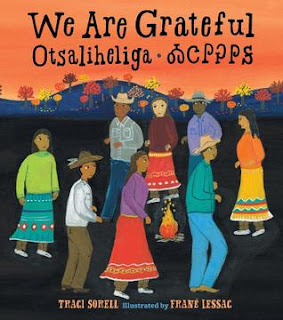
We Are Grateful: Otsaliheliga • ᏍᏟᎵᎮᎵᎦ *
written by Traci Sorell, illustrated by Frané Lessac
Charlesbridge Publishing, 2018, 32 pages
This is a lovely duel language, English and Cherokee, book about the different ways the Cherokee people express gratitude "throughout the year and across the seasons" as a reminder of both their  blessings and their struggles. Following one family throughout the year, readers learn that each season is greeted by saying otsaliheliga (we are grateful), followed by descriptions of the celebrations and rituals which are observed as the seasons change. Sorell, who is a member of the Cherokee Nation, has smoothly woven into the story the different traditional and modern customs and cultural activities, including special foods, crafts, songs, and dancing that are very much a part of the Cherokee year, as well as some of the more salient events in their history. In fact, the year closes with summer, a time for the first harvest and for recalling their ancestors' sacrifices and to celebrate their history at Cherokee National Holiday. The book ends with a two page spread in a collage of illustrations from the past year, and a reminder that "Every day, every season Otsaliheliga. We are grateful." Sorell keeps the text simple throughout, and yet she manages to convey a lot of information about the Cherokee idea of gratitude, supported by equally simple, yet informative colorful gouache folk art style illustrations. Each Cherokee word used is written in both the English alphabet and Cherokee syllabary, followed by its pronunciation and definition. Back matter includes Definitions, an Author's Note, and information about the Cherokee language. This is a wonderful book for sharing with young readers, as it opens up lots of opportunity for discussion and learning.

The Thanksgiving Door 
written and illustrated by Debby Atwell
Houghton Mifflin Harcourt, 2003, 32 pages
Ann and Ed are an elderly couple living alone. When Ann accidentally burns their Thanksgiving dinner, she thinks the day is ruined, but then Ed suggests that they try the new restaurant down the street, the New World Café. Luckily, the door is open and there is even a table set and decorated for the holiday. But the owners, an Eastern European immigrant family in the kitchen getting ready to celebrate their first Thanksgiving, are in a tizzy, the restaurant is closed for the day and now they have two unwanted customers. When the grandmother hears the family's complaints, she reminds them that it's Thanksgiving, a day to share. The family gracefully welcomes Ann and Ed, and, because of a simple act of kindness, new friends are made and everyone has a wonderful day eating, socializing and ever dancing. This has been one of my favorite stories and my kids in school also loved it when I read it. It really opened up some lively discussions of how different people make Thanksgiving their own, particularly when it comes to what food is served. But, no matter how different Thanksgiving table may have been, one thing always remained constant across the board- family, togetherness, sharing, and thankfulness. Interestingly, Atwell's colorful folkloric illustrations are the only indication of where the immigrant family comes from and what their religion might be.      

Last but not least is a book I read earlier this year that popped into my mind when I was thinking about this post because of the impact it had on me when I first read it. 

The Old Man by Sarah V. Dubois, illustrated by Claude K. Dubois
Gecko Press, 2018, 72 pages
It's morning and everyone is waking up, including a little girl who goes to school and the homeless man who has spent a cold wet night in a bus shelter. Now, though, as people arrive at the bus shelter,  he has to move on. As he walks the streets, the old man feels so hungry and stops to rummage through a trash basket, looking for something to eat and sharing what he finds with a familiar stray cat he calls Dumpling. After being chased from a park where he stops to rest, and still really hungry, the old man goes to the local shelter. After waiting on a long line, he's asked his name, but he can't remember and just leaves. Outside, he gets on an empty bus and rides until it fills up and he's forced to get off. The old man goes into another park, and decides he can rest under his blanket for a while without anyone noticing him, until the little girl the reader has met at the beginning of the book asks him if he wants her sandwich and tells him he looks like a teddy bear. The old man thinks it's the best sandwich in the world. He decides to go back to the shelter, and when they ask his name, he tells them it's Teddy. At first glance, you must be wondering why I chose the story of a homeless man for a Thanksgiving post, but when I read this to my kids, the discussion centered around the little girl's act of kindness and what a difference that made for the old man. Some of my kids felt it was the sandwich that did it, but a few thought it was giving him a name was the real act of kindness because the little girl actually saw him as a person, and with the name, other would see him the same way, beginning with the shelter. It was a lively discussion and one that lead me to consider this simple, but poignant story for a Thanksgiving post. After all, is there really much of a difference between the immigrant family sharing their Thanksgiving meal with Ed and Ann and the little girl sharing her lunch with a hungry homeless man? 
   
Three of these books are not be about Thanksgiving per se, yet all four carrying the kind of idea that I like to think of as the essence of the day. And I think all of them will be classics that we will return to during the holiday season, and throughout the year. I hope you read and enjoy them as much as my kids and I did. 

"Thanksgiving is a time of togetherness and gratitude"
Nigel Hamilton

Monday, October 5, 2015

Crenshaw by Katherine Applegate

It started again.  This time Crenshaw was riding a surfboard and wearing a t-shirt that says CATS RULE, DOGS DROOL…But, soon-to-be-in-fifth-grader Jackson is the kind of guy who no longer needs or wants an imaginary cat friend.  OK, it was alright that Crenshaw was there when Jackson needed him back in second grade to help cope with his family's money problems when they were forced to live in their minivan for several months.  But things are different now - Jackson is an aspiring scientist who likes facts, just the facts, please,  So why has Crenshaw returned?

Jackson thought things were OK.  His family has a nice enough apartment in Swanlake Village, a place that isn't fancy but it is comforting in its everydayness.  He even has a best friend, Marisol, he can count on and with whom he has a dog-walking service to make a little extra money, and they are really looking forward to being in the same 5th grade class when school begins again.

But little by little worry is creeping in.  Jackson's dad has had to quit working because of his multiple sclerosis  and his mom is working three part time jobs.  Jackson and his sister Robin, 5, are always hungry and one night, there are overheard whispers of moving if the rent couldn't be paid.  But maybe enough money would be made at the forthcoming yard sale, in which everything is to be sold except a bag of favorite thing each kid is allowed to keep.

Later that night, Jackson finds Crenshaw in the bathroom taking a bubble bath.  Hustling him into his room, Robin hears Jackson and Crenshaw talking and it seems that Aretha, the family's Labrador mutt, actually senses the presence of a cat.

Jackson has a lot on his mind with Crenshaw's return, but now that he is older, all he wants is for his parents to tell him the truth about how things stand, the truth about what is going on and their financial situation.  But first, Jackson has a lesson to learn about truthfulness as well, and Crenshaw is just the right imaginary cat friend to give him the sage advice Jackson needs to hear so badly:  "tell the truth to the person who matters most of all."

Now all Jackson has to do is figure out who that person is.

Katherine Applegate addressed an important problem in her book The One and Only Ivan regarding animal abuse through the life and memories of a captive gorilla living in shopping mall for the amusement and entertainment of shoppers.  In Crenshaw, she addresses the problem of hungry and homeless families head on, and to help readers understand how this happens and that it can happen to anyone, she has brought Jackson's old imaginary friend back to act as a catalyst towards that understanding.  OK, Crenshaw is a plot device, but it works here because Jackson can't be trusted to be entirely truthful - not yet, anyway.

The novel is narrated in the first-person by Jackson, who seems to be a relatively honest, understanding and sensible boy.  He's a very good big brother to little sister Robin, reading her her two favorite books, A Hole is to Dig and The House on East 88th Street, whenever she is feeling insecure and is seeking comfort.  Really, the whole family seem like ordinary, good people who really care about each other.  So how did they end up homeless once, with a second time on the near horizon?  Why don't they get help from family, or food from a food pantry?  "There's everything wrong with asking for help." my dad snapped.  " It means we've failed."

Really? With two hungry kids?

And what Jackson needs to do about this is what's at the heart of this coming-of-age story.

A very useful Teacher's Guide has been made available by the publisher Macmillian

This book is recommended for readers age 9+
This book was an EARC received from NetGalley

Join the Crenshaw Food Drive during the month of October - find out how you can help HERE

Family homelessness is a serious problem in this country, affecting 1.6 million children just like Jackson and Robin.  You can find out more about this at the National Center for Family Homelessness, as well as suggestions if you or someone you know are in need of assistance.

 
Imagination Designs