Showing posts with label Thanksgiving. Show all posts

Wednesday, November 27, 2019

Around the Table That Grandad Built by Melanie Heuiser Hill, illustrated by Jaime Kim


Around the Table That Grandad Built by Melanie Heuiser Hill,
illustrated by Jaime Kim
Candlewick Press, 2019, 32 pages
I was wondering what to read to my kids to get a conversation going about Thanksgiving. And then, this lovely picture book arrived that celebrates and gives thanks for family, friendships, and the bounty we share with each other on Thanksgiving Day or any day, for that matter.

Beginning with the line "This is the table that Grandad built," a young red-headed girl narrates how the table is set with different but very meaningful items to celebrate a meal together with family and friends. Onto the lovely large table built by her grandfather are placed sunflowers picked by cousins, napkins sewn by Mom, plates, glasses that were wedding gifts, and silverware from her Dad's grandma. Then, there is a bounty of vegetables from the garden, along with toasty tamales, spicy samosas and the rice pudding that is enjoyed every year, a loaf of bread that Gran baked, butter made by the kids, Dad's special huckleberry jam, and a variety of pies for dessert. It is a glorious mix of old and new edible traditions.


And while food is an important part of any gathering, it is the people sitting around the table that really make for the best meals and memories. Around the Table That Grandad Built includes a diverse group of people sharing a meal together in complete harmony, and both text and illustrations evoke the kind of warm feelings and sense of belonging that a holiday like Thanksgiving can represent. My young readers are a diverse group, too, and when we read this book, we began to talking about the different people and foods that are part of their (and my) Thanksgiving. We made a list of the foods served in their families and, just as it is in this book, their tables offered a wide variety of dishes traditional in their families. One of the things my young readers noticed is while turkey is a part of their Thanksgiving, there is not a turkey on the table in this book. They decided, after some prompting, that this makes it a good book to talk about gratitude all year long. 


Around the Table That Grandad Built follows the same pattern of cumulative rhyme as "This is the House That Jack Built." Well, only up to a point and then the repeating last line, "Set on the table that Grandad built" is dropped. And yet, the rhythm of the poem, complete with the caesura in the middle, never falters.

We have read Around the Table That Grandad Built a number of times now, and my kids never get tired of it. This is a wonderful, heartwarming story that highlights the importance of being thankful for the people and beauty that surrounds our lives.

This book is recommended for readers age 3+
This book was gratefully received from the publisher, Candlewick Press

Wednesday, November 21, 2018

Four Books to Share This Thanksgiving about Gratitude and Kindness


When my Kiddo was growing up and I was still a classroom teacher, I always tried to stress the importance of gratitude and kindness not just at Thanksgiving, but throughout the year. I grew up in a house where my dad would always remind us of how grateful he was that he could come to this country and live a better life than what he would have had otherwise. As a young immigrant, people were not always kind to him and so he tried not to follow their example, and made it a point to help others. This year, I have found a few wonderful books that really express the idea of thankfulness and the way it was passed on to me, and the way I tried to pass it on to my Kiddo and my young students in the Bronx, many of whom were also the children of immigrants.

Thank You, Omu! written and illustrated by Oge Mora
Little, Brown BFYR, 2018, 40 pages
Omu (AH-moo, Igbo for queen, or sometimes grandma, see Author's Note for more information) has made a thick red stew for her evening meal. Omu's stew is so good that the smell wafts over the neighborhood. Just as she sits down to read a book before supper, there is a knock on her door, a little boy asking what smells so delicious. Omu gives him a bowl full of stew and he goes on his way. All through the afternoon,  neighborhood people knock on Omu's door asking what smells so good, and each is given a bowl of her thick red stew. But by evening, there's nothing left for Omu to eat. There is another knock on the door, and everyone she had shared her stew with has returned, each one bringing a dish to share with Omu and each other, and so they ate, danced, and celebrated, as a way of saying Thank You, Omu. This has become one of my very favorite books and one I love to share with kids. There is so much to talk about in this simple story of kindness, generosity, and thankfulness. The neighborhood is wonderfully diverse, and shared food is the means of gathering them together. Mora's collage illustrations are done with a variety mediums, including clippings from old books, and her color palette is soft earthy tones of blues, yellows, greens, and browns resulting in images that are a warm as this charming story of Omu.
We Are Grateful: Otsaliheliga • ᏍᏟᎵᎮᎵᎦ *
written by Traci Sorell, illustrated by Frané Lessac
Charlesbridge Publishing, 2018, 32 pages
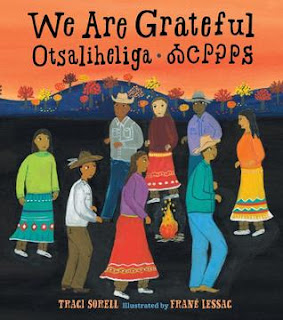
This is a lovely duel language, English and Cherokee, book about the different ways the Cherokee people express gratitude "throughout the year and across the seasons" as a reminder of both their  blessings and their struggles. Following one family throughout the year, readers learn that each season is greeted by saying otsaliheliga (we are grateful), followed by descriptions of the celebrations and rituals which are observed as the seasons change. Sorell, who is a member of the Cherokee Nation, has smoothly woven into the story the different traditional and modern customs and cultural activities, including special foods, crafts, songs, and dancing that are very much a part of the Cherokee year, as well as some of the more salient events in their history. In fact, the year closes with summer, a time for the first harvest and for recalling their ancestors' sacrifices and to celebrate their history at Cherokee National Holiday. The book ends with a two page spread in a collage of illustrations from the past year, and a reminder that "Every day, every season Otsaliheliga. We are grateful." Sorell keeps the text simple throughout, and yet she manages to convey a lot of information about the Cherokee idea of gratitude, supported by equally simple, yet informative colorful gouache folk art style illustrations. Each Cherokee word used is written in both the English alphabet and Cherokee syllabary, followed by its pronunciation and definition. Back matter includes Definitions, an Author's Note, and information about the Cherokee language. This is a wonderful book for sharing with young readers, as it opens up lots of opportunity for discussion and learning.

The Thanksgiving Door 
written and illustrated by Debby Atwell
Houghton Mifflin Harcourt, 2003, 32 pages
Ann and Ed are an elderly couple living alone. When Ann accidentally burns their Thanksgiving dinner, she thinks the day is ruined, but then Ed suggests that they try the new restaurant down the street, the New World Café. Luckily, the door is open and there is even a table set and decorated for the holiday. But the owners, an Eastern European immigrant family in the kitchen getting ready to celebrate their first Thanksgiving, are in a tizzy, the restaurant is closed for the day and now they have two unwanted customers. When the grandmother hears the family's complaints, she reminds them that it's Thanksgiving, a day to share. The family gracefully welcomes Ann and Ed, and, because of a simple act of kindness, new friends are made and everyone has a wonderful day eating, socializing and ever dancing. This has been one of my favorite stories and my kids in school also loved it when I read it. It really opened up some lively discussions of how different people make Thanksgiving their own, particularly when it comes to what food is served. But, no matter how different Thanksgiving table may have been, one thing always remained constant across the board- family, togetherness, sharing, and thankfulness. Interestingly, Atwell's colorful folkloric illustrations are the only indication of where the immigrant family comes from and what their religion might be.      

Last but not least is a book I read earlier this year that popped into my mind when I was thinking about this post because of the impact it had on me when I first read it. 

The Old Man by Sarah V. Dubois, illustrated by Claude K. Dubois
Gecko Press, 2018, 72 pages
It's morning and everyone is waking up, including a little girl who goes to school and the homeless man who has spent a cold wet night in a bus shelter. Now, though, as people arrive at the bus shelter,  he has to move on. As he walks the streets, the old man feels so hungry and stops to rummage through a trash basket, looking for something to eat and sharing what he finds with a familiar stray cat he calls Dumpling. After being chased from a park where he stops to rest, and still really hungry, the old man goes to the local shelter. After waiting on a long line, he's asked his name, but he can't remember and just leaves. Outside, he gets on an empty bus and rides until it fills up and he's forced to get off. The old man goes into another park, and decides he can rest under his blanket for a while without anyone noticing him, until the little girl the reader has met at the beginning of the book asks him if he wants her sandwich and tells him he looks like a teddy bear. The old man thinks it's the best sandwich in the world. He decides to go back to the shelter, and when they ask his name, he tells them it's Teddy. At first glance, you must be wondering why I chose the story of a homeless man for a Thanksgiving post, but when I read this to my kids, the discussion centered around the little girl's act of kindness and what a difference that made for the old man. Some of my kids felt it was the sandwich that did it, but a few thought it was giving him a name was the real act of kindness because the little girl actually saw him as a person, and with the name, other would see him the same way, beginning with the shelter. It was a lively discussion and one that lead me to consider this simple, but poignant story for a Thanksgiving post. After all, is there really much of a difference between the immigrant family sharing their Thanksgiving meal with Ed and Ann and the little girl sharing her lunch with a hungry homeless man? 
   
Three of these books are not be about Thanksgiving per se, yet all four carrying the kind of idea that I like to think of as the essence of the day. And I think all of them will be classics that we will return to during the holiday season, and throughout the year. I hope you read and enjoy them as much as my kids and I did. 

"Thanksgiving is a time of togetherness and gratitude"
Nigel Hamilton

Thursday, November 23, 2017

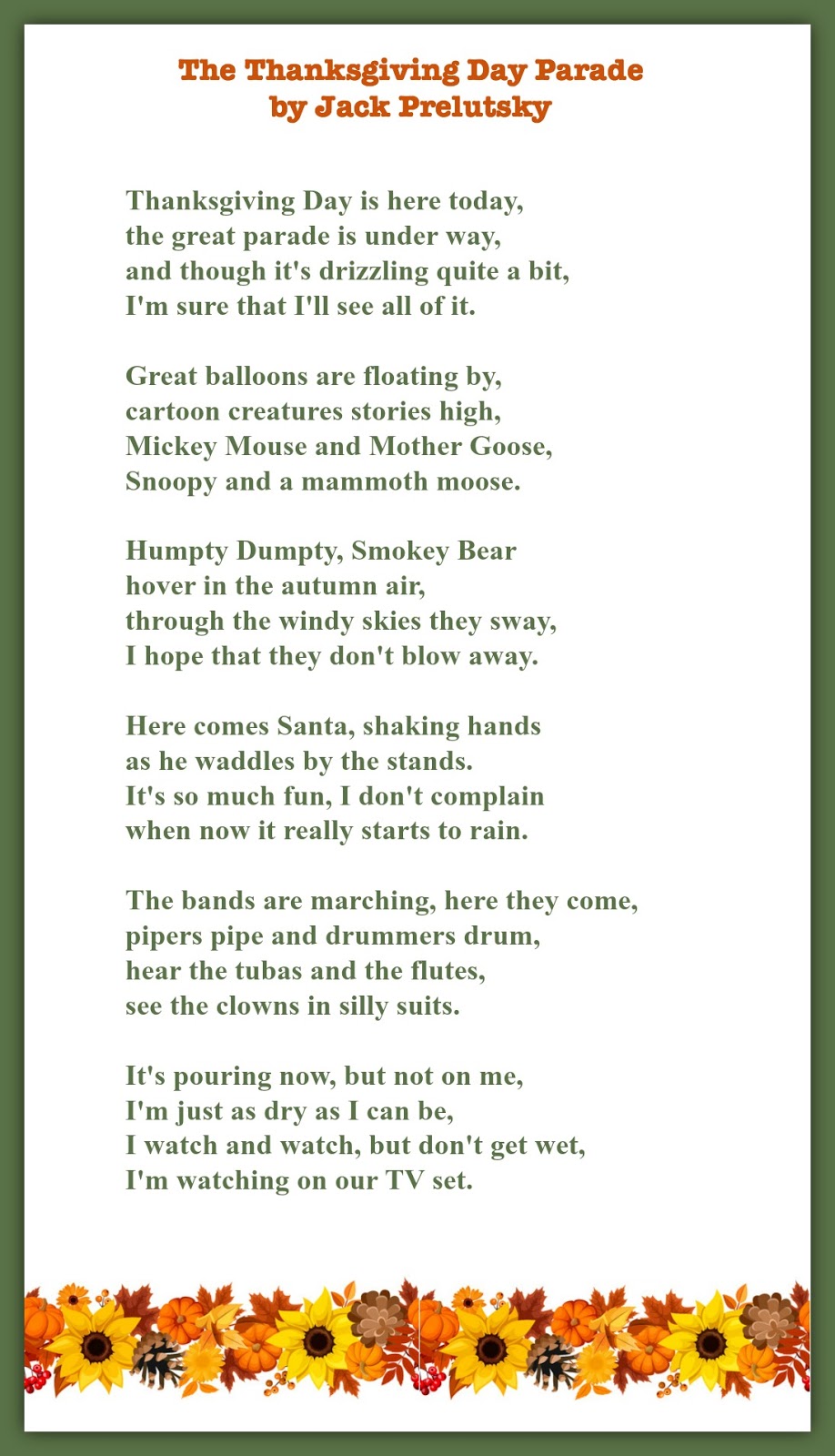
The Thanksgiving Day Parade, a poem by Jack Prelutsky


WISHING YOU A VERY HAPPY THANKSGIVING!

I was asked if I would watch Lilly, my neighbor's 6 year-old, for a little while the other day, and I brought over It's Thanksgiving! to read. We had a lot of fun going over all the poems but the hands down favorite was the poem about the Thanksgiving Day Parade, probably because of the TV hype.

The poem did generate some interesting conversation, especially about the balloons. Lilly and her mom were planning on going over to the Museum of Natural History where the balloons are inflated the day before Thanksgiving and it is almost as big a deal here in NYC as the parade is.

Some of the balloons mentioned weren't familiar to Lilly, but she didn't seem to mind and loved the poem anyway, so I thought I would share it with everyone today:

Luckily, no rain has been forecast the the parade this year. Wishing everyone a wonderful day of good food, good company, and good fun.

Thursday, November 27, 2014

The Thanksgiving Dinner Platter by Randa Handler

It's 1941 and Thanksgiving has just been declared a national holiday.  Takari, an 8 year old Japanese American girl, is very excited about it because for the first time all her relatives are coming for Thanksgiving dinner.  Takari just wants to help her mom get ready, but when she accidentally breaks Grandma Toshi's big white platter used in Japan to celebrate a similar day of thanksgiving, she gets told to go visit her friend Little Sparrow instead.

When she tells Little Sparrow about the platter, he suggests she bring the pieces over to see if his dad can mend it.  Meanwhile, Little Sparrow is making cornbread using a tree stump and thick stick as a mortar and pestle to grind the cornmeal, just like the Wampanoag did for the first Thanksgiving with the  Pilgrims.

Little Sparrow is bringing his cornbread to the patients at VA hospital with his neighbor General Williams and his friend Samoset, who is actually a Wampanoag Indian from Massachusetts.  The Thanksgiving dinner at the VA hospital is a success and as everyone tells why they are grateful that day, Takari begins to understand that the real meaning of Thanksgiving is indeed gratitude, sharing, and helping.

The Thanksgiving Dinner Platter is an interesting multilayered, multicultural picture book for older readers (age 6+).  It includes lots of information about different traditions among people.  Takari learns about how in Japan set aside a day for giving thanks for one's blessings and eat traditional food, just as she does in America on Thanksgiving Day.  Little Sparrow tells Takari about some American Indian traditions and the history behind them.


But, the story also demonstrates how people can help each other, even in little ways.  Little Sparrow's dad fixes Grandma Toshi's valued platter; he helps Little Sparrow with his cornbread by turning the stove on and taking the cornbread out of the hot oven; Takari helps Little Sparrow clean up the kitchen and both children help General William's serve Thanksgiving dinner at the VA.

Both of these are great messages for kids to read about.  This would make a great read aloud at home, at school and for home schooling because there are some many teachable moments in the story.  But it is a nice pleasure read as well and kids will most likely get the point on their own.

The Thanksgiving Dinner Platter would be an ideal book to share with your kids on Thanksgiving Day.  And Little Sparrow's cornbread recipe is included in the story.

This book is recommended for readers age 6+
This book was provided by NetGalley

I wish everyone a happy and bountiful Thanksgiving.  


Saturday, November 22, 2014

Saturday Roundup #4: Thanksgiving Edition

Thanksgiving is a great time to pause and read some books about this favorite holiday with the kids.  There are so many good books out there, but here are some I liked.


Giving Thanks: A Native American Good Morning Message 
by Chief Jake Swamp, illustrated by Erwin Printup
Lee & Low Books, 2003, 40 pages

This is not a traditional Thanksgiving Day book, but a book about giving thanks every day.   It is a children's version of the Mohawk Thanksgiving Address of the Six Nations or Iroquois, giving thanks to the natural world for providing all the things needed to live.  It is written by Chief Jake Swamp of the Mohawk Nation.  The illustrations, done by Erwin Printup, are in a folk art style and rendered in acrylic paints, in colors that are a basic and simple as the beautiful Thanksgiving Address.  This is one of my favorite books, reminding us of the importance of the natural world, a world we should all give thanks for and work to preserve.

You can hear Chief Jake Swamp reading the text of Giving Thanks courtesy of New Hampshire PBS.  As he reads, in both Mohawk and English, and accompanied by a slide how of the books illustrations. 


The Mayflower by Mark Greenwood, illustrated by Frané Lessac
Holiday House, 2014, 32 pages


In 1620, 102 people boarded the Mayflower, a small wooden ship, and crossed the Atlantic Ocean seeking a new life.  In straightforward language, the reasons why these people, called Pilgrims, decided to risk such an uncertain trip, the hardships of the first year, the help received from Natives Americans including Squanto,  a member of the Wampanoag tribe, that insured their survival, and the shared first Thanksgiving after a successful harvest.  Lessac's illustrations, painted using gouache, are done in simple, but brightly colored folk art type, so reminiscent  of Early American art and really bring the factual text to life.


Giving Thanks by Jonathan London, paintings by Gregory Manchess
Candlewick Press, 2014, 32 pages

This lovely book feels very much like the book Giving Thanks by Chief Jake Swamp and no wonder, Jonathan London is also an advocate of the natural world and how people are connected to it.  In his book, also called Giving Thanks, a young boy and his father hike through the fields and forests near their home and "Like his Indian friends- singers and storytellers- Dad believes that the things of nature are a gift.  And that in return, we should give something back.  We must give thanks." As dad gives thanks to the different things of the forest, his son admits to feeling a little embarrassed about it, until he tries it himself.  Accompanying this short, heartfelt book are oil painted illustrations in a soft earthy, autumnal palette.


Giving Thanks: Poems, Prayers and Praise Songs of Thanksgiving
edited by Katherine Paterson, illustrated by Pamela Dalton
Chronicle Books, 2013, 56 pages

Gathered together, like the world's most diverse Thanksgiving table, are some wide and varied words of thanks.  Some you will recognize, some may be new to you.  These 50 songs of praise are especially  timely as the holiday season begins, and all carry of basic message of joyful thanks.  The book is delicately illustrated using cut paper-or Scherenschnitte designs, many of which are that illuminate with watercolor.  Be sure to look closely at each illustration to fully appreciate the textured intricacy of each design.


Over the River and Through the Wood: The New England Boy's Song about Thanksgiving Day
by L. Maria Child, illustrated by Matt Tavares
Candlewick Press, 2013, 32 pages

I remember learning this poem as a song about going to grandmother's instead of grandfather's house for Thanksgiving when I was in grade school. This poem first appeared in 1844 and has been a Thanksgiving Day favorite ever since. This lovely book returns to the original words and includes all stanzas, many of which will be new to readers.  The poem captures all the excitement and anticipation of a family going by sleigh to the the grandparent's house to celebrate the holiday - not so very different from today's world.   Matt Tavares has used a mix of watercolors, gouache and pencil to successfully render the frosty cold snowy day of an early New England Thanksgiving.  A nice family touch is including the family dog running beside the sleigh, just as excited as everyone else.   

Curious abut an illustrators creative process?  Matt Tavares has posted the short video showing that process for one of his illustrations for Over the River and Through the Woods:


This poem was written by Lydia. Maria Child (1802-1880), who was a teacher, an abolitionist, a journalist, and a champion of women's rights, and who was a very prolific writer.  


Gobble, Gobble, Tucker! by Leslie McGuirk
Candlewick Press, 2014, 32 pages

Here is a fun Thanksgiving board book that is sure to appeal to the very young.  Tucker can tell by the smell of things that it is Thanksgiving.  That means good food, maybe a few tastings if something drops accidentally while cooking, helping to clean and decorate and waiting for the relatives, and his cousins Tiger and Murphy.  Tucker's is a typical Thanksgiving Day, just told for a dog's point of view.  There is no excitement, no canine calamities, just family, food and fun on a special day and a nice introduction to the typical Thanksgiving celebration.   The author used whimsical gouache illustrations to help tell her story. 


The Great Thanksgiving Escape by Mark Fearing
Candlewick Press, 2014, 32 pages

OK, so not every one's Thanksgiving is quiet and joyful and thankful and peaceful.  Sometimes, kids can get overwhelmed by all the relatives that show up at grandma's house and spread themselves out everywhere. So, when cousin Rhonda suggests to little Gavin that they escape the crowds and make their own fun, he decides this is a good idea.  But, it seems that every room in the house is full of people. There are the aunts in one room just waiting to scoop them up, pinching and squeezing your cheeks, there are the other kids playing wildly in the kids' room, and teenage kids watching TV zombie-like in the basement.  Even the kitchen, with all that good food it a relative trap.  Will Gavin and Rhonda actually be able to make their own fun in the mass of relatives?  The Great Thanksgiving Escape is a humorous look at  is a very different look at this holiday, but one that may be closer to true than we like to think.  The cartoon-like illustrations were done by Fearing in digitally manipulated color pencil and are all done at the eye level of a kid, so only the bottom half of the adults are visible.   


by Melissa Sweet
Houghton Mifflin, 2011, 40 pages

I reviewed this back in 2012 and it remains one of my favorite Thanksgiving books.  I thought it worth a second look.  Sweet chronicles the history of master puppeteer Tony Sarg and the evolution of the first gigantic balloons used in the Macy's Thanksgiving Day parade.  Like the parade itself, Sweet's child friendly illustrations, done in a mixed media of watercolor and collage, will have kids turning pages in a procession of anticipatory fun and they will not be disappointed.


by Barbara Park
Random House, 2012, 144 pages

Three days before Thanksgiving, Junie B's school is have a contest to see which class has to best list of things they are thankful for and the winning class gets a pumpkin pie.  None of this makes Junie happy - she hate pumpkin pie, her pilgrim costume itches, and maybe exploding biscuits isn't quite what the school had in mind for thankful things.  This is a fun and funny look chapter book, and in the end, well, let's just say, it's a pretty thankful ending.


1621: A New Look at Thanksgiving by Catherine O'Neill Grace,
Margaret M. Bruchac
National Geographic Society, 2014, 48 pages

In an attempt to set things right and dispel some of the myths that surround the first Thanksgiving, Catherine O'Neill Grace and Margaret M. Bruchac, together with the Plimoth Foundation, have produced this informative book showing that Thanksgiving is, indeed, is a shared history, shared by 52 white colonists and 90 Wanpanoag men for three days after the first harvest.  But, too often in books for kids, only the pilgrim's point of view is given and the Native Americans are relegated to a minor role in serious books or a comical role in more lighthearted stories.  Most don't really give full credit to how much the Pilgrims survival was due to the help of the Wampanoag and their leader Massasoit.  This picture book for older readers (age 7+) includes copious photographs, a bibliography, and a timeline.  


An extensive PDF lesson plan for this book is available from the Montana Office of Public Instruction HERE

Wednesday, November 27, 2013

Junie B., First Grader: Turkeys We Have Loved and Eaten (and Other Thankful Stuff) by Barbara Park

I had planned this post long before the sad news that Barbara Park had passed away.  I decided to go ahead with it in homage to her and the character she created.  Junie B Jones has helped so many kids learn to love reading, including a few in my family.
Thank you, Barbara.

It is Thanksgiving week and Mr. Scary's first graders in Room One have some activities planned to help celebrate the holiday.

On the Monday before Thanksgiving, the kids begin a list of things that they are thankful for to enter into the school's Thankful contest.  The class with the best list will win a homemade pumpkin pie.  Trouble is, no one in Room One likes pumpkin pie, it makes them vomit.  But a Thankful List is begun and includes such things as cranberry jelly in a can (Junie's choice) and exploding biscuits (you know, the kind that you bash on the counter to open).  

On the Tuesday before Thanksgiving, everyone has a Thankful Bag to fill with something they are thankful for.    But they can't show each other what's in their bag until it is their turn at Show and Tell.  Imagine a whole day of Show and Tell.  This is great until rich Lucille opens her Thankful Bag and waves all the money in it around the classroom and everyone goes diving for ones, fives, tens and twenties.  A trip to the principal's office delays things a bit.  Junie brought in her favorite stuffed elephant and her nemisis May brought in the same exact stuffed animal.  Words are exhanged, another delay and both girls end up having their elephants taken away by Mr. Scary.  But, despite all, by the end of the day, the class has a list of twenty things on their Thankful List, though Mr. Scary seems somewhat dismayed by what the students listed.

On the Wednesday before Thanksgiving, the class is to come in dressed as pilgrims or Native Americans.  Junie isn't happy being a pilgrim, and she is especially unhappy when May comes in dressed as the Native American Princess she wanted to be.  First thing in the morning, the winner of the Thankful List contest is named and, much to everyone's surprise, particularly Mr. Scary, it turns out to be Room One because they had the most honest list ever.  Later in the day, invited parents and other relatives arrive to enjoy a feast with the kids of food they brought with them.  And it turns out that some pumpkin pie is better than others!

Turkeys We Have Loved and Eaten is a laugh out loud story with lots of lessons to be learned.  The basic theme here is thankfulness and in the end that is was really comes across.  I thought the fact that the teacher didn't try to change the kids' list choices to make it more PC was a nice touch, and I think the list reflects reality more than we might like to think.  But that is OK, kids really do like such things as rainbow sprinkles, cookies, but not the coconut kind, and the big box of 64 crayons (I was pretty thankful the first time I got a box of 64 crayons).

Parents and teachers don't generally like the Junie B. Jones books, but kids do.  My Kiddo and her cousins always read them and, despite some incorrect grammar and sometimes rowdy behavior, it didn't seem to rub off.

And when you are a 4th grade teacher in a failing school, and a few of the kids in your class have discovered Junie B., and the Amber Brown series and want to read their stories, you are pretty thankful that they want to read anything at all.

This book is recommended for readers age 6+
This book was purchased for my personal library


Wednesday, November 21, 2012

Balloons Over Broadway by Melissa Sweet


Today is inflation day in New York City and it has nothing to do with the economy, but everything to do with blowing up the giant balloons for the Macy’s Thanksgiving Day parade. 

Every Thanksgiving, we see these giant balloons make their way down Broadway.  Old ones get retired, new ones are added to the group, but lots of balloons are always there.  Yet, have you ever wondered how it all started?  If you have, then Balloons Over Broadway is the book for you.

In it, artist/author Melissa Sweet tells the story of Tony Sarg, the genius who first figured out how to make these balloons work.  As a boy,Tony had always been interested in figuring out how to make things move.  By the time he was a young man, he had developed a technique for making marionettes move more fluidly.  His reputation grew and when he moved to New York, he was asked by Macy’s to create a movable window display.  Using storybook characters, Tony created a parade across the display windows that dazzled the crowds and made them hungry for more.

It didn’t take long to go from window display to parade and although Tony Sarg’s first parade creations didn’t fly, it wasn’t long too many years before they were floating high in the air down Broadway.  The rest, as they say, is history.

Melissa Sweet tells Tony’s story in simple, straightforward language, ideal for young readers.  She has illustrated the story with a mixed media of watercolors and her own collages which are “a mix of paper from old books to make papier-mâché puppets, found objects and fabrics all painted or altered to illustrate what it may have felt like to be in Sarg’s world.”  Also used were pages of his own illustrations for The Tony Sarg Marionette Book.  Also in evidence is the legacy he left which is “that ‘play’ may be the most important element in making art” which may be why this feels like such a fun book for kids.

This is one of my favorite illustrations in Balloons Over Broadway and, yes, the is Felix the Cat there.  And below is a photo of the 1927 Macy's Thanksgiving Day parade with the real Felix the Cat balloon.


Balloons Over Broadway is the perfect Thanksgiving Day book and should be a favorite for years to come.

This book is recommended for readers of all ages
This book was purchased for my personal library 


NOVEMBER IS PICTURE BOOK MONTH
 
Imagination Designs