This has been a year of loss for so many people, but for children who have lost a parent, it is an especially devastating loss. It may be hard for them to understand fully what has happened, and often wishful thinking can easily move into their thoughts. María Wernicke has used very sparse text supported by spare illustrations to capture the emotional feelings and wishes of one young girl dealing with loss and how her mother responds to her pain.
Some Days written and illustrated by María Wernicke,
translated by Lawrence Schimel
Amazon Crossing Kids, 2020, 48 pages
After finishing a meal, a young girl begins telling her mother about a passageway in their backyard. As the two head out to hang up some freshly washed red sheets, the child explains that some days, it's there, other days, it isn't, but she makes it clear that this isn't some kind of fantasy passageway - it's not a well, a hollow in a tree and there is no door that leads to fantastic adventures.
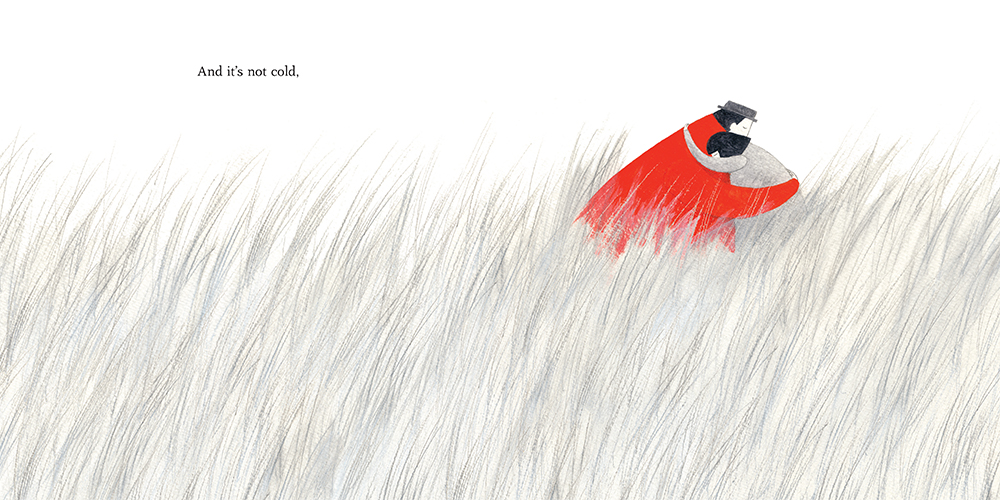
On the other side of the passageway, life is different. The child plays with an unknown man, presumably her father. There, in his presence, "I've already learned how to swim./ And it's not cold,/ and there's no danger./ And nothing, nothing at all, can can happen to you." Yearning for the safe and comforting arms of this man, the little girl wishes that passageway could be there everyday.
After listening to her child tell her about this passageway and what she finds there, her understanding mother tells her daughter that they can always go looking for it together, even if they don't always see it.
Without saying it, but relying on the illustrations, it is clear the this little girl and her mother have just lost their father and husband, indicated only by their grief and the pork pie that plays an important but subtle part of the narrative. There is an interesting use of color throughout the story. The parts of the story that revolves around the girl and her mother are done in shades of gray, reflecting the somber mood of mourning and grief, with the exception of the sheets being hung on the line which serve as the portal to the other side of the passageway. On the other side, the girl is still dressed in gray, but the unnamed man is done in a bold, bright red coat, letting the reader know that he is still very much alive in his daughter's mind, even as she grieves.
This is a gentle, solemn, very poignant story about a child dealing with loss and missing all the things that might have been had the loved one not passed away. But it is also a story that carries a great deal of hope and love and a promise of a future that also includes the memories of the past. This is the kind of book I wish I'd had when my Kiddo's dad suddenly passed away when she was young. It is the kind of book that will start needed conversations. I highly recommend it.
Meet the Author:
María Wernicke is an award-winning Argentinian author and illustrator of children’s books. She is a 2020 Astrid Lindgren Memorial Award nominee. Her illustrations have been part of multiple international exhibits, including at the Bratislava Biennial exhibition and the Bologna Children’s Book Fair, among others. Learn more about the author at www.maria wernicke.blogspot.com.
Lawrence Schimel is a bilingual author and translator, with more than one hundred books to his credit. His children’s books have won a Crystal Kite Award from the Society of Children’s Book Writers and Illustrators, and have been selected for lists of outstanding titles by the International Board on Books for Young People. His translated books include Wanda Gàg’s Millions of Cats and George Takei’s graphic novel They Called Us Enemy, among many others. He lives in Madrid, Spain.
Read the Reviews:
★“A gentle model for living while missing a loved one.” —Kirkus Reviews (starred review)
“This brief, wistful exchange between a mother and her child delivers its emotion between the lines, and Schimel’s translation handles the understatement deftly…Wernicke shows the two twirled up in another set of sheets, looking for the passageway together, in this portrait of a parent who hears and honors her child’s words.” —Publishers Weekly
This book is recommended for readers age 5+
This book was gratefully received from Barbara Fisch at Blue Slip Media
When I was young, my best friend and I found a secret place inside the dense bushes that grew outside the Prospect Park police station. It was a glorious open space where we would spend summer afternoons eating a picnic lunch we'd packed in a shoebox, reading books, drawing, or just talking. It was a place that got us away from parents and siblings and any problems at home.
Naturally, as soon as I began reading My Jasper June, I found my empathy level increasing for the protagonist, Leah Davidson, 13, from the start. Summer vacation has just begun in Ormewood Park, Atlanta, a place seeped in community traditions, all of which the Davidson family used to happily participate in. But now, a long empty summer looms for Leah. It's only been a year since younger brother Sam died as a result of a drowning accident, and since then, her parents, consumed by overwhelming grief, has been shadows of their former happy, vivacious selves. This summer, her mother forgot to make arrangements for Leah to go to camp, and though her dad suggests she take a class, nothing comes of it. Which is fine by Leah.
After spending the first days of vacation hanging around the house, Leah decides to go for a walk, following a path leading to Red's Farm, a place where she and her family used have picnics. It's there, lying on a rock in the nearby creek, that Leah first sees Jasper. The two girls chat a bit, exchange names, and Leah heads home.
Feeling a strange connection to her, Leah returns to the creek every day, hoping to see Jasper again, and finally she does, running into her while washing her clothes in the creek and wearing a nightgown. Leah invites Jasper home to use their washing machine, and a real friendship begins to form. But when Jasper finally takes Leah to her home, it is nothing like she had expected. Jasper lives alone, in a tiny abandoned house with no electricity or running water, hidden behind vines, shrubs, pines and a veil of morning glories. Jasper's hideaway from the world feels magical to Leah, a adventure right out of the books she loves, but Jasper is quick to let her know there is nothing fantastical about her situation, her homelessness is the stuff of the real world and a painful home situation.
The two girls find support and solace with each other, but Leah has promised Jasper not to reveal her secrets to anyone. A terrible storm that hits while she is visiting Jasper becomes a game change, however, when Leah's dad shows up in the middle of the night. Jasper and her circumstances become the catalyst for all the pain, the secrets, the guilt, and the grief to finally be brought out into the open, resulting in a much needed dialogue in the Davidson household. Jasper's homelessness pulls Leah's parents out of the grief-induced lethargy. Which is great, but what about Jasper? What will happen to her?
I have to admit, as I read, I thought this book would go in one of two directions, either it would be a coming out novel or maybe a story with roots in speculative fiction of the haunting variety. And it does have a feeling of fantasy about it, but without crossing that line. Reality always intrudes, as when Jasper reminds Leah that her life "...isn't a game. We aren't playing Narnia or Hogwarts. This is my real life." It doesn't go in either one of those directions, rather, it is reality fiction plain and simple and it deals with some pretty serious realities - death, grief, guilt, abuse, and homelessness. But it handles these in ways that are thoughtful and Snyder tempers these harsh realities with friendship, healing and hope.
Both Jasper and June are such well-defined, sympathetic, believable characters. Coming from very different backgrounds, each finds themselves in circumstances made difficult by the adults who should have been there for them, but weren't. Their friendship becomes a real godsend, providing them with a secret place to work through their feelings on their own.
Snyder draws wonderful characters, but she is also a master at setting. She has a way of taking her readers into her story and, though careful, vibrant description, makes them feel as if they were an invisible part of the story, watching the action unfold while sensory details wash over them. I know I could smell those morning glories outside Jasper's hideaway. I had the same sensation when I read Orphan Island.
My Jasper June is a satisfying story, and one that is sure to become a middle grade classic.
This book is recommended for readers age 10+
This book was an EARC received from Edelweiss+
Be sure to check out the other Marvelous Middle Grade Monday offerings, now being carried on by Greg at Always in the Middle.
It’s Christmas Eve, and Wallace “Lolly” Rachpaul,12, is walking along 125th Street in Harlem, trying to get home as quickly as he can. Lolly has a new pair of sneakers from his mostly absent dad and he’s not about to let the two older boys following him snatch them off his feet. But when Lolly quickly turns the corner of 125th Street and 8th Avenue, the two boys abruptly stop, because Lolly lives in a world of imaginary protected borders, each border guarded by its own crew, and crews know better than to cross those lines.
Lolly, who is West Indian, lives in the St. Nicholas House, a public housing project on West 127th Street, with his mom and his mom’s girlfriend Yvonne, a security guard in a large toy store. His older brother, Jermaine had gotten involved with a drug dealing crew and was shot and killed outside a Bronx nightclub just a few months back and, while Lolly is still trying to come to terms with his loss, he is also trying to resist the pressure to join a crew.
One thing that Lolly does like is Legos, and he has painstaking put together all kinds of kits, following the instructions to the letter. But late Christmas Eve, he takes them all apart, suddenly wanting to built something else, something of his own. Later,when Yvonne comes home on Christmas morning, she has two garbage bags full of Legos for Lolly, and just in time. Pretty soon, Lolly has built a castle so big his mom is complaining about how much space it is taking up, so he is allowed to build in an empty storeroom in the after school program he goes to, run by Mr. Ali, an understanding, but underfunded social worker.
Soon, Lolly is joined by Big Alice, a special needs student suffering her own family loss, and who never speaks to anyone, but stays by herself reading. In the Lego room, she helps herself to Lolly’s Legos (Yvonne brings him more and more bags full) and begins building her own buildings, which resemble their neighborhood perfectly. At first, Lolly resents Big Alice, but soon the two are taking trips into midtown Manhattan, exploring the different buildings found in a architecture book Lolly was given for Christmas. Eventually, the two begin to build Harmonee, an enormous alien world, together.
All the while, Lolly, and his Dominican best friend, Vega are being harassed by the same two boys who followed Lolly on Christmas Eve. Part of a crew that wants Lolly and Vega to join them, they soon resort to violence as a means of persuasion. And it almost works…but then things in Lolly’s life take another totally unexpected turn.
The Stars Beneath Our Feet is a debut novel for David Barclay Moore. It is an all-to-realistic coming of age contemporary novel, and Lolly is a wonderfully flawed character full of contradictions (like choosing Legos over video games). As Lolly tries to reassemble his life through the metaphor of Lego building blocks, life on the city streets is also becoming more and more complicated. Luckily, Moore has surrounded him with people who are caring and supportive - his gay mom, Yvonne, who is trying to help him through the grieving process by giving him Legos, the only thing she can do, Mr. Ali, who has recognized that Lolly needs to work through the trauma of losing his brother so violently, even his dad comes through, though not as much as Lolly would like. And their story threads together with those of Lolly, Big Alice, and Vega make this such a full-bodied novel.
Harlem is also as much a character in this novel as anyone, providing a living backdrop for Lolly’s important slice-of-life story. But, the danger those street hold for young men of color like Lolly isn’t something most people know or even think about and Moore has captured it with brutal honesty, compassion, and even humor. From the moment I started reading The Stars Beneath Our Feet, I could’t put it down. It may not be a book for everyone, but it is certainly a worthwhile read and, I think, a real eye-opener for many. Moore’s final message in this novel - it is not just family, but also community that can help change things for kids.
This book is recommended for readers age 10+ This book was an ARC received from the publisher, Alfred A. Knopf
Ethan Truitt, 12, and his best friend Kacey Reid used to have all kinds of adventures together, until one night Ethan dares Kacey to do something and, though it ends in a tragic accident, Ethan can't help but blame himself for causing it. Now, his parents are moving from Boston to Palm Knot, a coastal town in Georgia, using the excuse that they need to take care of his elderly grandfather, but in reality, Ethan knows it is an attempt to help him come to terms with his overwhelming grief and his all-consuming guilt.
At first, living with his grumpy grandpa Ike in a somewhat dumpy, dilapidated house, and with an angry older brother who resents him because of the move, really isn’t helpful. At school, Suzanne, who seems to have a little crush on Ethan, wants him to hang around with her and her friends, the “cool kids,” but Ethan isn’t very inclined to do that. Instead, he starts hanging around with the intrepid Coralee Jessup, a smart, talkative black girl who claims to be violin prodigy, and who is not much liked by the “cool kids.”
Coralee also introduces Ethan to the unofficial library in the back of the hardware store, both run by Mack, a woman who has been collecting books for decades and who always has some salt water taffy for her patrons. And maybe grandpa Ike isn’t so bad after all, especially when he decides to teach Ethan how to drive his pickup truck.
As Ethan adjusts to life in Palm Knot, the circumstances of Kacey’s accident are slowly revealed in flashbacks. The reader knows that Kacey is still alive because Ethan has run away a few times to try and see her. She is in a nursing home, in a coma and on life support. When Ethan is told that her parents have decided to take her off life support, Ethan’s pain is intense and palpable. His pain is compounded by the fact that when he finds out that Coralee has betrayed his confidence about what happened to Kacey to Suzanne, Suzanne also makes it a point to tell him the truth about Coralee’s life with the result that Ethan begins to believe that everything Coralee has told him about herself is a lie.
Everything comes to a dramatic climax and denouement when a hurricane hits Palm Knot and Coralee goes missing. Ethan couldn’t help Kacey when she was hurt, but can he redeem himself and help save the new friend he turned his back on?
The Ethan I Was Before couldn’t be a more appropriate title for Ethan’s story. No one remains unchanged after going through a trauma that literally shatters the innocence of childhood, and the intense feelings that follow.
This coming of age novel is written in the first person from Ethan’s point of view, so that the reader journeys with him through all his turmoil and agony as he finally attempts to come to terms with Kacey’s accident and his part in it, and begins to discover who he is now. Besides his narration, there are, throughout the book, lists that Ethan makes at the suggestion of his therapist in Boston just before he moved, thinking it might help him make sense of his world and who he is now, ”The Ethan you were before may be gone, but now you have the chance to get to know the new Ethan.”
This is a debut novel for Ali Standish, and while I thought there was just a little too much going on at the end of the story, I also felt that she really understood what Ethan was going through and conveys it to her readers quite well and with a great deal of empathy. Ethan’s story is very moving and will have readers riveted, I know I was. And while it is an emotionally charged novel about guilt, grief, the possibility of healing, it is ultimately a novel about the importance of family,friendship, honesty, and most importantly, hope. This book is recommended for readers age 9+ This book was an EARC received from Edelweiss+
Sussy (short for Susquehanna) Reed and Guy Hose have been inseparable best friends since that day in Kindergarten when he showed her how to make a never-ending Mr. Potato Head. The two friends have done everything together ever since - with one exception. They have never been allowed to have a pet.
Now in fourth grade, Sussy and Guy manage to talk Mr. Reed into letting them get Guy's choice of a leopard gecko. They find the perfect one at Total Pets, a gecko that seems to have been as immediately attracted to Guy as he was to her. And he thinks she should be called Matylda "of the Ancient Face and Starfish Toes."
Although Matylda lives in a tank on top of Sussy's dresser, she seems to like Guy so much more than Sussy, much to Sussy's dismay. The friends even give Matylda a warrior history, in which she is victorious in battle and her master grants her one wish - to be loved, a wish that is granted when Sussy and Guy find her in Total Pets.
Then one morning, Guy decides Matylda needs some vitamin D3. The two friends hop on their bikes and start riding, when a dog runs out and goes after Sussy on her bike. Guy gets off his bike to yell at the dog just as a car is coming down the street. Next thing Sussy knows is that her best friend is dead.
After the funeral, Sussy suddenly finds herself alone for the first time since Kindergarten. She begins to obsessively focus on Matylda, trying to figure out how to love Matylda the way Guy had, believing that if she does everything right, she could hold on to Guy.
When summer comes, Sussy isolates in her bedroom, every day dressing in the same red capri pants and sunflower shirt she wore the day of the accident, reliving it over and over and over. The only time she leaves the house is to go to Total Pets to buy something for Matylda, something that she hopes will convince Matylda that she loves her just like Guy had, and that will make Matylda love Sussy just as she had loved Guy, enabling Sussy to continue to hold on to him.
At Total Pets, she finds herself stealing food and toys for Matylda, egged on by the stealing girl's voice in her head. As each thing fails to do what she wants, Sussy returns to the store more frequently, until she realizes the store clerk, who had always been so friendly and helpful, is on to her and Sussy's world, as carefully constructed as the never-ending Potato Heads, comes flying apart. But it was a world constructed by Guy, and now, Sussy must find a way to construct her own world without him.
Sussy and Matylda are the central characters here, and both are believable. Sussy's first person narrative feels natural and realistic as she tries to navigate her new life without Guy while still not letting go of him. Her story is interspersed with memories of the two friends, giving the reader a real sense of what their friendship was like. As Sussy recalls more and more about Guy, the reader begins to realize that this was an uneven though dear relationship, with Sussy frequently letting Guy take the lead and acquiescing to his ideas - like insisting that they must get the vitamin D3 for Matylda.
The other characters, including Sussy's parents, Guy's mother, Mike from Total Pets are satellite characters, secondary to Sussy's struggle, much of which is experienced in her thoughts. These other characters don't need to be fleshed out, but they are needed to be there for support and love, which they all do well.
McGhee has written Sussy's grieving process with a mixture of anger, confusion, guilt, and magic thinking. Sussy begins to find herself so very tired from have to go on without Guy, suddenly not really knowing how to do things by herself. The world has lost all its color, and Sussy experiences everything around her as grey. It doesn't take long for her to endow Matylda with thoughts and feelings that a gecko is just not capable of having. The fact that Matylda would rest on the back of Guy's neck probably has more to do with hiding and warmth than with the love Sussy thinks the gecko has for him. Matylda, Bright & Tender masterfully explores the very sad, very poignant grieving process of a child, and while Sussy's pain is palpable, McGhee has infused her story enough humor so that it doesn't overwhelm the reader. Sussy's story does end on a note of hope and new friends who will help her move on and discover who she is without Guy. Matylda, Bright & Tender is a well-done, heartwarming, tender story, and one not to be missed.
This book is recommended for readers age 9+
This book was sent to me by the publisher, Candlewick Press
Set in a small English town, Conor O'Malley, 13, is a boy with a recurring nightmare. Each night, he dreams of trying to save his mother, he loses his grip and she slips away from him. The dream is a reflection of his waking life - his mother is ill with terminal cancer, and she is slipping away from Conor day by day. But Conor refuses to believe that she won't get better, no matter what is said to him or what he sees happening to his mum.
And it doesn't help that at school, ever since his mother's illness began, former friends avoid Conor, teachers overlook him and the school bully isolates him, leaving Conor to feel alienated, invisible and abandoned by everyone.
One night, as Conor wakes from his nightmare, at precisely 12:07, he hears someone calling his name outside. Getting up, Conor sees the giant Yew tree that has been overlooking the graves in the churchyard for hundreds of years, outside his window. Once outside, the monster-sized tree is surprised that Conor isn't afraid of him, but assures him that he will be. But how could this monster possibly scare a boy who knows worse monsters already?
The next day, convinced it was all a dream, Conor is surprised to find leaves and twigs on his bedroom floor. But that night, at exactly 12:07, the monster is once again outside Conor's window. Insisting that it was Conor calling him that made him go walking again, the monster also tells Conor that he will tell him three parables, and when he is finished, Conor will tell a fourth story, his own story, and that it must be the truth or he will eat Conor alive.
The very next day, Conor's cold, disagreeable, overbearing grandmother arrives at the house to take care of his mum. That night the monster returns, and tells Conor the first parable about a prince, the prince's love and the queen, his stepmother. Not liking the way the parable end, Conor discounts it. The next day, when he is bullied again, Conor turns on the girl who tries to help him, and lets her take the fall for trying to help him.
As his mother's cancer gets worse, and it becomes clear that the new round of chemotherapy isn't helping, she is hospitalized and Conor's grandmother insists he come live with her, since Conor's parents are divorced and his father is living in the United States with his new family.
Not happy at his grandmother's, Conor arrives home from school angry and destroys his grandmother's clock, a family heirloom, and everything else in the room. That night at 12:07, the monster appears in his grandmother's backyard and tells Conor his second parable about an apothecary who refuses to help save a parson's daughters who are ill. Not liking the ending, Conor again discounts the parable. When his grandmother sees the ruined room, instead of punishing him, she stops speaking to Conor, rendering him invisible.
The next night the monster returns at 12:07 and tells Conor his third parable, about a man who was invisible because people refused to see him. At school the next day, Conor confronts to boy who has been bullying him and beats him up.
In fact, each time the monster tells a parable, Conor disagrees with the ending, and yet, he acts them out the next day. And it is only after he has caused pain and destruction, that he realizes what he has done. And true to his promise, the monster returns for the fourth story, Conor's truth. And, as difficult as his truth is for Conor to speak, it will no doubt surprise you.
Patrick Ness has done something really different in A Monster Calls; in the parables, he has the monster tell them in such a way, that the characters aren't either good or bad, but a combination of both, just as what Conor is struggling with in his nightmare is a combination of grief and guilt.
A Monster Calls is one of the most honest books I have ever read. It is difficult to recognize Conor's pain, but it soon becomes obvious that no one, not even his mother, wants Conor to know how bad things are. What is really sad, is that the well-intentioned people around Conor are the ones who created the nightmare but not addressing his mother's illness honestly. Only his assertive grandmother is willing to address what will happen to him when his mother is gone (not a spoiler, it's clear from the start mom is dying). And it is the job of the monster to help Conor find and admit his truth, so that the business of healing can begin, allowing the story to end on a hopeful note.
A word about the exquisitely rendered illustrations by Jim Kay. They are as dark as any nightmare, yet if you look at the closely and carefully they reveal more that you might realize. If ever there were illustrations that perfectly supported the text and themes of a story, this is definitely it. Though they were digitally rendered, the final illustrations were sketched over and over again before they were done.
My favorite
A Monster Calls is a powerful story about guilt, love, loss, and grief as only Patrick Ness could write.
This book is recommended for readers age 13+
This book was sent to me by the publisher, Candlewick Press
The yew tree/monster plays a big roll in A Monster Calls. A yew tree can live as long as 1,000 years and really are often found in church graveyards. If you would like to know something more about them, including their mythological connections, you can find information on the website of the Ancient Yew Organization
Now that the movie is out, I was tempted to include the trailer for it, but instead I decided to include the original book trailer, after all, that's what I reviewed here:
When her father dies suddenly in a plane crash, Wren Kaiser, 12, is devastated, finding herself living under a cloud of grief with no one to talk to. Refusing to talk about it, Wren's mother reacts with anger, quickly loading up all her husband's possessions into black garbage bags as if trying to throw him out with the trash. And when she discovers the money gone and the mortgage overdue, mother and daughter pack up the car, leaving memories and home in Marietta, GA behind them.
First stop is Chattanooga, TN. Wren is enrolled in school, her mother get a job, and starts dating a man. When her mother refuses to talk to her about her father's death, and with no body to bury, Wren finds herself starting to bury roadkill. A few weeks later, mother and daughter are on the road again, this time to Ohio.
The same pattern as in Chattanooga - new school, new job, new man, pack the car and leave.
Their third stop in the in the Upper Peninsula of Michigan, in a town called Pyramid and Wren is determined that it will be their last move. At school, Wren is befriended by popular Carrie, who later prefers another new girl named Victoria. But Wren is kept in the friendship, because she's good a math and gives Carrie the answers to their homework. So naturally, when their Social Studies teacher assigns them a project to work on with a partner, Carrie and Victoria stick together, and Wren gets stuck with Theo, a shy unpopular boy.
Meantime, Wren has found her father's binoculars and her old bird watching journal, and has also found a pond surrounded by a wetland where she can sit and observe the wide variety of birds that come there. Unfortunately, the pond, called Pete's Pond, is slated to be destroyed and turned into a landfill, and it is Carrie's father runs the landfill project. Wren and Theo decide to make Pete's Pond the subject of the school project.
As they get to know each other, Wren and Theo discover they are somewhat compatible - Wren bird watches, Theo takes photographs, Wren lost her dad and her mother has retreated into anger, refusing to talk about it, Theo lost his mother to cancer and his father has retreated into himself, refusing to talk about it, and neither is popular at school. But they are well-liked and tremendously helped by the town librarian and the health store owner where Wren works part-time, and Randle, the owner of the junkyard who defies all our preconceived notions of who a junkman is.
Wren has determined that Pyramid is where she and her mother are going to remain, and she is working to add money to their savings in the hope that it help on a down payment for a house. But Wren is also still walking about under the cloud of grief about her father's death.
Can these two friends help each other through their grieving process as they work to save the pond for the wildlife that lives and visits there?
I've always enjoyed reading Monika Schröder's novels and Be Light like a Bird is no exception. Her writing is solid yet lyrical, her plots unfold logically and easily, her main characters are unusual but totally accessible and believable. So naturally, I was immediately pulled into this story narrated in the first person by Wren, whose voice sounded so authentic to me. Perhaps because I lost my father as a teen and could relate to her feelings of being lost, of wanting to talk about her dad, and needing closure so badly that she begins to bury roadkill. And while that sounds so very sad, the novel really is not overwhelmingly so. It is more about coming to terms with the loss and then moving on.
I can't say I found Wren's mother to be a very realized character until the end until I thought about it. For most of the novel, she was more like a nebulous anger but she was supposed to be emotionally distant and absent so I wouldn't say that is writing flaw, but a really well-done characterization of her. On the other hand, Randle the junkman was only in the novel for a short time, yet Schröder has drawn him so well that I really felt the strengthening of his presence as he became more influential in Wren and Theo's life.
Be Light like a Bird is a quiet basically character driven coming of age novel that deals in themes of loss, grief, bullies, courage, hope, being true to oneself, even conservation. In the birding journal that Wren's father gives her, he wrote "Be light like a bird, and not like a feather," a quote from Paul Valéry. And that is just what Wren attempts to do in the novel - to be light like a bird means that you chose the direction of your life, her father explained to her, to be light like a feather means something else determines your direction. It is a lesson both Wren and her mother needed to learn.
Be Light like a Bird would pair up nicely with Nest by Esther Ehrlich, another book about loss and hope and a young protagonist who is a bird watcher.
This book is recommended for readers age 9+
This book was sent to me by the author
Things haven't been very good in the Price home since Charlie, 12, and younger sister Imogen's mother passed away. There are piles of laundry to be done, dad keeps working later and later, and no one knows how to cook anything worth eating, especially not their mother's special spaghetti.
For Imogen's birthday, Charlie tries to make the good smelling, great tasting remembered spaghetti, but it turns out to be inedible, upsetting Imogen who storms off to her room. The next morning, looking uncharacteristically disheveled, Imogen tells Charlie she spent the night with their Mom.
Sure enough, Charlie discovers a hatch under Imogen's bed that leads to a parallel world, exactly like the one they live in, except here Mom is alive, the laundry is done, the food smells and tastes good, and she has all the time in the world to spend with her children. But soon, Charlie notices that Imogen's eyes have a vacant glassy look, exactly like his friend Frank had shortly after his beloved grandmother died and Frank disappeared. And Imogen is beginning to fade out of family photographs.
But none of this makes any sense to star Mathlete Charlie, who consoles himself with the fact the no matter what else happens, 2 + 2 will always equal 4. Still, he also finds the pull of spending time with this living Mom sometimes too strong to overcome, despite his misgivings about her. And to make matters confusing, every time Charlie and Imogen do something with Mom, it's the first time - first spaghetti meal, first scavenger hunt, first scrabble game. Noticing that he is also fading from family photos, Charlie begins to suspect his real world memories are fading or getting lost, which is confirmed when his friend Elliott reminds him about having eaten his mother's delicious spaghetti. But why is he forgetting such pleasant memories.
Finally, when Imogen gives up everything in the real world in favor of staying with Mom, Charlie knows it's time to enlist the Elliott's help to get her back. But can they succeed or will the power of Mom be too strong?
The Remarkable Journey of Charlie Price is a sinister page-turner in the same vein as Neil Gaimen's Coraline. It is written from the third person and told by a narrator with a point of view limited to Charlie. Most of the story takes place in the two places children are supposed to feel safest in - home and school. But home is not safe because of a distant father and no mother, so the temptation to spend time with the Mom in the parallel world is great, especially for the more vulnerable Imogen. School seems to be a place where people are feeling sorry for the Price kids, but don't really look too closely to notice their unusual behavior.
When a parent dies, kids no longer have that feeling of safety that comes with attentive parents. There's no one there to support and to admire their achievements, which we see with how easily Imogen gives up her Wizard of Oz school play, even though she's Dorothy, and how Charlie jeopardizes his place on Mathletes because of spending time with a Mom that makes they feel loved.
I thought the characters of Charlie and Imogen were well developed and fully realized. Maschari takes them through the whole range of emotions that a young person would feel after the loss of a beloved parent. And oddly enough, the memory-stealing Mom, even though she is no more than a phantom, was also fully realized.
But beyond the creepy mother and other fantastic elements to this novel are some pretty serious themes of loss, grief, friendship, and the power of sibling relationships. The ease with which one can get mired in grief and the difficulty of moving on after a loss are both vividly depicted, as it the support siblings can give to each other at times like that. And the limits of school and even a school-supported grief groups are sadly also realistically portrayed. Still, this is a novel that ends on a hopeful note as the Price siblings learn the ways in which their mother will always be with them.
This book is recommended for readers age 9+
This book was borrowed from the NYPL
Suzy Swanson and Franny Jackson first met in a swimming class at age five. Franny was a girl who could already swim across the pool underwater; Suzy was the girl who wanted to swim like Franny and be her friend. And they were, doing everything together, happy in their own world, apart from the popular girls. Until sixth grade…
Suddenly, Franny is hanging out with the popular girls and Suzy is left alone, still not wanting to be part of that clique. Franny had made Suzy promise to send a strong message if she ever became like those other girls and at the end of the school year, Suzy leaves Franny an unusual message that totally backfires and the girls part at the end of summer no longer friends. That summer, while on vacation with her family, Franny drowns.
Unable to accept that Franny, the good swimmer, drowned, unable to accept her mother's explanation that "sometimes things just happen," Suzy wants a justifiable reason why Franny died swimming. And she finds one that she believes is viable in the jellyfish exhibit while on a class trip to the local aquarium.
Assigned to do a research paper by her life science teacher, Mrs. Turton, Suzy begins to research jellyfish; at the same time she decides to no longer talk, effectively alienating herself from her divorced parents, her older brother and his partner, the psychologist she is taken to, the science teacher she actually likes and any new friend possibilities. All she wants to do is prove her theory that Franny died after being fatally stung by the rare Irukandji jellyfish, found mostly in Australia, though some jellyfish researchers believe a small migration may have occurred as far away as the eastern seaboard of the United States.
It sounds like a pretty far-fetched explanation, but Suzy is determined to prove it, even if that entails lying, stealing from the people who love her, and the possibility of clandestine travel to Australia.
Since Suzy is required to do a lengthy research paper for science, The Thing About Jellyfish is framed by the seven steps of the scientific method - Purpose, Hypothesis, Background, Variables, Procedure, Results, Conclusion - according to Mrs. Turton. At the beginning of each section, the reader is given Mrs. Turton's explanation of what each step involves, and the chapters that follow each step more or less follow it. Sounds complicated and sometimes I felt a little overloaded with jellyfish information, but actually, it works in the story.
At the same time, the chapters within each section switch back and forth from present and how Suzy deals with her loss and her grief, to past (written in italics), so readers can see the evolution and dissolution of Suzy and Franny's friendship. Sounds complicated, yet the switching is done seamlessly, occurring at just the right moment.
It seems that more and more young people must deal with the death of a friend in today's world and each responds to it in their own way. What's important in books like The Thing About Jellyfish is seeing that a protagonist like Suzy may have a hard time with a death, but in the end there is the possibility of some kind of closure that enables them to go on. And I know that sometimes kids will make up all kinds of stories about the person who has died, for whatever reason. I was a kid when my dad suddenly passed away, and I remember that for a long time, I would tell people that he was sailing around the world on a fishing trip and wouldn't be back for a long, long time. So Suzy's jellyfish sting hypothesis wasn't a far stretch for me to understand.
That being said, I did have some trouble with Suzy's lying and stealing, even though one could easily justify it given her state of mind and her obsessive need to explain Franny's death and her own actions on the fateful day their friendship truly ended.
I finished reading The Thing About Jellyfish the day the National Book Award finalists came out and at first, I was surprised to see it there, but that only made me think for about this debut novel and realize just what an important message there is to Suzy's story. We each grief in our own way and that is as important for kids to know as it is for adults.
This book is recommended for readers age 9+
This book was an EARC received from NetGalley