Showing posts with label Loss. Show all posts

Sunday, March 20, 2022

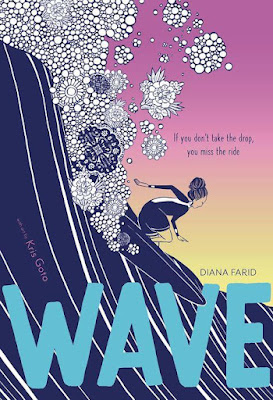
Wave by Diana Farid


Wave by Diana Farid,
illustrated by Kris Goto
Cameron Kids, 2022, 320 Pages
Available March 29, 2022
Wave is a novel-in-verse narrated in the first person by Ava, a thirteen-year-old Persian American living in southern California who is mildly OCD. Set in the 1980s, Ava is looking forward to graduating from eight grade and a summer of hanging out at the beach surfing with Phoenix and best friend Naz before school begins again. Ava's parents are divorced, her dad lives in Paris with his new family, and her Iranian born mom is an OB/GYN doctor at the local hospital. Her mom is hoping Ava will follow her into medicine, and signs her up to be a volunteer on Saturdays for the summer, something she isn't too happy about. 

At the hospital, Ava meets patient, Mr. Cameron, in room 509 and discovers that they share a love of poetry by the Persian poet Rumi. 

At school, Ava, who loves music, sings in the choir and her teacher announces that they have been invited to sing at the Fourth of July Freedom Festival, with Ava having a solo part. It means rehearsals even after school ends.  

At the beach, Ava is confronted by a racist volleyball player more than once who instantly dislikes her for her dark olive skin. This is a difficult experience for her since the beach is the one place Ava has always felt she like she fit in since her skin tone could pass for tan. And it's at the beach that she begins to notice small changes in Phoenix. He had been diagnosed with Hodgkins Lymphoma as a child, but has been in remission. Now his cancer has returned and his prognosis isn't very good. 

Then, Ava slips and falls at the hospital, breaking her leg. Since her summer of surfing is now curtailed, her mother signs her up for a medicine for teens class every Monday and Wednesday, a class that begins June 29th, which Ava resents since she has made it clear to her mother that she has no interest in medicine and needs to prepare for her solo at the Freedom Festival. 

There's a lot happening in this novel and yet none of it feels unrealistic or overwhelming. Instead, it is a poignant coming-of-age story about identity, friendship, love, loss and grief. But it is also about how music and poetry can help us process life's more difficult challenges, as summed up in the song that Ava wrote about her life.
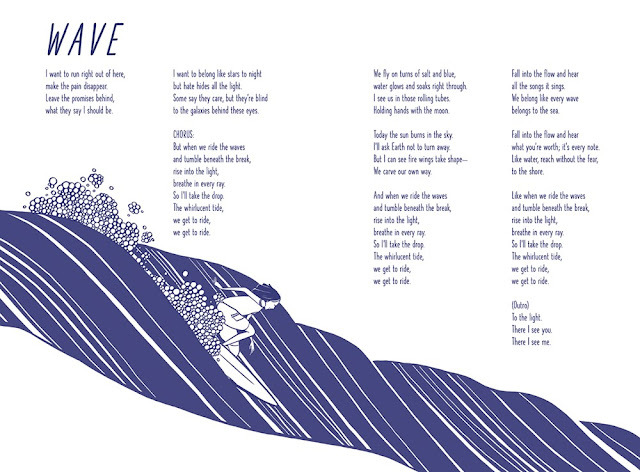
Farid has included lots of different aspects of Iranian culture throughout the novel and it is interesting that she set her novel in a time when anti-Iranian feelings were running high in this country. The poetry gives the reader not just a sense of waves building as they come in and crash at the shoreline, then draw back out to sea again, but they are so symbolic of the highs and lows of Ava's life that fateful year (the timeline goes from March to November).

Sprinkled throughout the novel are lovely spot illustrations relating to Ava's life. I chuckled when I saw the one with Ava's new walkman. I know exactly how she felt when she received it, I still have mine and yes, it still works. And to go with that walkman, Farid has included a playlist of Phoenix's songs for Ava, and Ava's songs for Phoenix - all very 80s.

Wave is a poignant novel and though some may see it as historical fiction, it will no doubt resonate for today's readers. 

Thank you to Barbara Fisch at Blue Slip Media for providing me with an ARC of Wave.

Meet the Author:

Diana Farid is the author of When You Breathe, named a 2021 Notable Poetry Book by the National Council of Teachers of English; it was also awarded the California Reading Association’s 2021 EUREKA! Gold Award for nonfiction children’s book. She is a poet and a physician at Stanford University. Wave is her first middle grade novel. For more information, visit dianafarid.com.


Twitter and Instagram: @_artelixir

Be sure to check out the other Marvelous Middle Grade Monday offerings, 
now being carried on by Greg at Always in the Middle

Tuesday, June 23, 2020

The Border by Steve Schafer


As usual, Pato, 16, his mother and father always seem to arrive late for get togethers, and cousin Carmen's quinceañera is no different. On their way into the house to join the happy, noisy celebration, Pato notices a suspicious car parked nearby, noticeable because it is completely painted black, even the bumpers. He briefly debates with himself about saying something, after all, there are two men in the car carefully watching the house, but in the end, he decides it is probably nothing. Soon after arriving, Carmen's older brother, Arbo, Pato's cousin and best friend, head out to their favorite spot in the desert behind the house with Marcos, 17, a ace soccer player, and his sister Gladys, 15. But the celebratory noise is suddenly interrupted - not by fireworks, but by the sound of gunshots - lots of them.

Back at Arbo's house, they discover that everyone has been shot dead execution style. To make matters worse, Marcos kills one of the shooters, whose brother recognizes him and threatens to kill all four of them. Realizing they have to get away, even before they can process what has just happened, Pato remembers an older man that he and Arbo had helped once as part of a school project. Pato, Arbo, Marcos, and Gladys head out to Señor Ortiz's house on the outskirts of town.

Señor Ortiz agrees to let them stay for a while and even goes into town to see if he can hear any news about the shooting. Returning, he tells them that the shooting was done as a warning by members of a drug cartel called La Frontera who control every aspect of life in their Mexican town. The school photos of all four teens have been posted everywhere, offering a very big reward for them. The teens decide that the only thing they can do is try to cross the desert and slip over the border into the United States. But this is a trip that proves easier said than done.

The Border, though timely, is a difficult book to read. It isn't enough that these teens have just lost their families to gun violence, but they are also trying to survive on a hot, unrelenting desert which is a struggle for anyone, but even worse if you are completely unprepared the way Pato, Arbo, Marcos, and Gladys are.

The story is told completely from Pato's point of view, and I think this is a story that would have lent  itself better to multiple viewpoints. I would have like to know what is going on for the other three teens. But despite that, each person's personality comes across distinctly, and there is even some humor to be found, as well as an attraction between Pato and Gladys, giving the unbelievable horror of their stories more of a human face. 

With everything that has been going on in this country regarding the border and immigrants from Mexico, and Central America, this is a very relevant story. While this country builds walls to keep desperate people out, or puts them into cages, and deprives them of any shred of human dignity, it is easy to see why people are willing to risk everything to escape local violence and abuse. 

The Border is a book for older, mature teens, even though Pato, Arbo, and Gladys are only 15-years-old. It is a very realistic novel and there is, as I've said, violence and some mild sex, as well as profanity. But it is really an eye-opening experience for those who do decide to read it.

This book is recommended for readers age 14+
This book was an EARC received from NetGalley 

Monday, November 28, 2016

Rain Is Not My Indian Name by Cynthia Leitich Smith


Cassidy Rain Berghoff and her best friend Galen Owen have promised each other to always celebrate their birthdays, both having been born on noteworthy days - Rain on New Year's Day and Galen on July 4th. Now that their friendship seems to be moving into the relationship realm, Rain had already decided that for her 14th birthday, it was time to kiss Galen, really kiss him, French kiss him. But it was a kiss destined never to happen. Galen was hit by a car and killed on New Year's Eve.

Rain is unable to bring herself to attend Galen's funeral, and in fact, holes up in the house for the next six months. By June, though, she is somewhat ready to emerge from hiding.  Her older brother has let her know that he would like her to participate in their Aunt Georgia's Indian Camp, a camp for Native American teens to explore their culture while living in a very white community. Rain isn't really interested in it, but finds a way to be there without participating. When she was young, her grandfather taught her all about photography. Rain has become a very talented photographer and is hired to take photos of Indian Camp for a news article in the local newspaper. The paper is run by Fynn's girl friend, Natalie, who has also been living in their home for a while.

Rain is a little confused when she first arrives at camp to find her former best friend, Queenie, there. When Rain learned that Queenie and Galen were romantically involved, their friendship began to change, and completely dissolved when Queenie hurt Galen. To make matters worse, Queenie had gone to Galen's funeral, something Rain couldn't do, and had even read a poem she had written. Now, no one understands why an African American girl is participating in Indian Camp until they learn that Queenie has recently discovered that she is part Native American, her great grandfather was Seminole.

Rain's intention is to keep a neutral distance from the camp and just take photographs, but when she learns that Mrs. Owen, Galen's mother, is challenging the town council for giving the camp some public funding, her attitude about and involvement in it can't help but change. Having been subjected to all kinds of stereotyping, anti-Indian prejudice and demeaning sentiments in and out of school her whole life, Mrs. Owen's challenge just becomes too much for Rain to ignore.

Rain is a teenager who has a lot to deal with - coming to terms with Galen's death, her brother's pending marriage and the baby he and Natalie are expecting, the possibility of rekindling her friendship with Queenie, and exploring her feelings about her own Native American heritage. Rain's mother, who was killed by a freak lighting strike a few years earlier, was Muscogee, Creek-Cherokee, and Scots-Irish, and had always referred to her family as her "patchwork tribe." Her dad, stationed overseas at a military base, is Irish, German and Ojibwe. The family lives in Hannesberg, Kansas, a mostly white community, which is one of the reasons Aunt Georgia felt Indian Camp was so important for the few Native teens who live there.

Rain Is Not My Indian Name is Cynthia Leitich Smith's debut novel and she written a main character who is sensitive, funny and for the most part very in touch with her own feelings about herself.  And even though it is narrated in the first person by Rain, the reader gets even more insight into her life through the short journal entries the begin each chapter.

Rain says she is basically OK with who she is: "Being a mixed blood girl is not big deal...Dealing with the rest of the world and its ideas, now that makes me a little crazy sometimes." And yet, she wants nothing to do with Indian Camp, and in school, around Thanksgiving when all the negative pop culture depictions of Indians come up "as bogeymen on the prairie, windblown cover boys selling paperback romances, or baby-faced refugees from the world of Precious Moments" (pg 13), she hides behind sci-fi fanzines rather than doing or saying anything, just as she hides behind her camera for Indian Camp or in the house for six months after Galen's death.

Rain Is Not My Indian Name is a coming of age novel about learning to (re)connect with the world in a new way and Indian Camp just may be the way for Rain to do that.

But it is also a much needed novel about what it feels like to live in a white community when you are culturally mixed, and part of that mix is Native American. And for readers who aren't Native American, like myself, reading this novel is an important eye-opening experience.

This book is recommended for readers age 9+
This book was borrowed from the NYPL

NOVEMBER IS NATIVE AMERICAN HERITAGE MONTH

Thursday, September 1, 2016

Be Light Like a Bird by Monika Schröder


When her father dies suddenly in a plane crash, Wren Kaiser, 12, is devastated, finding herself living under a cloud of grief with no one to talk to.  Refusing to talk about it, Wren's mother reacts with anger, quickly loading up all her husband's possessions into black garbage bags as if trying to throw him out with the trash.  And when she discovers the money gone and the mortgage overdue, mother and daughter pack up the car, leaving memories and home in Marietta, GA behind them.

First stop is Chattanooga, TN.  Wren is enrolled in school, her mother get a job, and starts dating a man. When her mother refuses to talk to her about her father's death, and with no body to bury, Wren finds herself starting to bury roadkill.  A few weeks later, mother and daughter are on the road again, this time to Ohio.

The same pattern as in Chattanooga - new school, new job, new man, pack the car and leave.

Their third stop in the in the Upper Peninsula of Michigan, in a town called Pyramid and Wren is determined that it will be their last move.  At school, Wren is befriended by popular Carrie, who later prefers another new girl named Victoria.  But Wren is kept in the friendship, because she's good a math and gives Carrie the answers to their homework. So naturally, when their Social Studies teacher assigns them a project to work on with a partner, Carrie and Victoria stick together, and Wren gets stuck with Theo, a shy unpopular boy.

Meantime, Wren has found her father's binoculars and her old bird watching journal, and has also found a pond surrounded by a wetland where she can sit and observe the wide variety of birds that come there.  Unfortunately, the pond, called Pete's Pond, is slated to be destroyed and turned into a landfill, and it is Carrie's father runs the landfill project.  Wren and Theo decide to make Pete's Pond the subject of the school project.

As they get to know each other, Wren and Theo discover they are somewhat compatible - Wren bird watches, Theo takes photographs, Wren lost her dad and her mother has retreated into anger, refusing to talk about it, Theo lost his mother to cancer and his father has retreated into himself, refusing to talk about it, and neither is popular at school.  But they are well-liked and tremendously helped by the town librarian and the health store owner where Wren works part-time, and Randle, the owner of the junkyard who defies all our preconceived notions of who a junkman is.

Wren has determined that Pyramid is where she and her mother are going to remain, and she is working to add money to their savings in the hope that  it help on a down payment for a house.  But Wren is also still walking about under the cloud of grief about her father's death.

Can these two friends help each other through their grieving process as they work to save the pond for the wildlife that lives and visits there?

I've always enjoyed reading Monika Schröder's novels and Be Light like a Bird is no exception.  Her writing is solid yet lyrical, her plots unfold logically and easily, her main characters are unusual but totally accessible and believable.  So naturally, I was immediately pulled into this story narrated in the first person by Wren, whose voice sounded so authentic to me.  Perhaps because I lost my father as a teen and could relate to her feelings of being lost, of wanting to talk about her dad, and needing closure so badly that she begins to bury roadkill.  And while that sounds so very sad, the novel really is not overwhelmingly so.  It is more about coming to terms with the loss and then moving on.

I can't say I found Wren's mother to be a very realized character until the end until I thought about it.  For most of the novel, she was more like a nebulous anger  but she was supposed to be emotionally distant and absent so I wouldn't say that is writing flaw, but a really well-done characterization of her. On the other hand, Randle the junkman was only in the novel for a short time, yet Schröder has drawn him so well that I really felt the strengthening of his presence as he became more influential in Wren and Theo's life.

Be Light like a Bird is a quiet basically character driven coming of age novel that deals in themes of loss, grief, bullies, courage, hope, being true to oneself, even conservation.  In the birding journal that Wren's father gives her, he wrote "Be light like a bird, and not like a feather," a quote from Paul Valéry.  And that is just what Wren attempts to do in the novel - to be light like a bird means that you chose the direction of your life, her father explained to her, to be light like a feather means something else determines your direction.  It is a lesson both Wren and her mother needed to learn.

Be Light like a Bird would pair up nicely with Nest by Esther Ehrlich, another book about loss and hope and a young protagonist who is a bird watcher.

This book is recommended for readers age 9+
This book was sent to me by the author

Sunday, January 17, 2016

A Song for Ella Grey by David Almond

A group of teens living in Tyneside in northern England, tired of winter's cold and wanting some freedom, decide to spend their upcoming Easter holiday camping on Bamburgh Beach in Northumberland.  Best friends Claire and Ella have been inseparable since they first met at age 5, but Ella was adopted and her parents think she spends too much time with Claire.  As the time comes closer to leave for Bamburgh Beach, Ella's parents forbid her to go, citing falling grades blamed on Claire and their friends.

Claire and the others head to the beach anyway, armed with tents, food and wine for a week.  It's there, after a few days, that a mysterious, rather otherworldly young man carrying a lyre suddenly shows up.  He says his name is Orpheus and he plays the most captivating music they have ever heard, so beautiful that even birds, seals, snakes and dolphins come near to listen to him play and sing his songs.  Wanting to share the experience with Ella, Claire calls her and holds out her phone for Ella to listen.  Orpheus and Ella speak and he ends the call by singing a song for he into the phone: "it was the song of everything, all life, all love, all creation. It was his song for my friend Ella Grey."   Though they haven't met, it is clear that Ella and Orpheus are in love with each other.

Back in school the next week, Ella is a changed person, much to Claire's unhappiness.  When Orpheus shows up outside the school, Claire leaves in the middle of class and goes out to him.  By half-term, they have decided to marry, on Bamburgh Beach, surrounded by Ella's friends.  Sadly,  two poisonous snakes are also there.

David Almond used the myth of Orpheus and Eurydice as the basis for A Song for Ella Grey.  If you are familiar with this myth, you know the significance of the snakes; if you don't know this story from ancient Greece, it doesn't matter; either way you are in for a reading treat (and if you are really curious, don't skip Almond's letter to his readers for more information at the beginning of the book).

A Song for Ella Grey is narrated in the first person by Claire.  She is the one who's left behind, to tell the tale, really, to sing the tragic song of Ella Grey, to bring Ella "into the world for one last night, then let her go forever" (in ancient Greek drama, tragedy is a song).  To tell the tale of Ella, Claire makes and wears the mask of Orpheus, a device also used in Greek tragedy, in order to "let him sing his tale through me."

I read this as an ebook, so I wondered why I was seeing Chapter One, Chapter Two, etc. more than once throughout the book. When I looked at the Table of Contents, I noticed the story was divided up into 6 parts, just as Greek tragedy is.   In fact, Almond has included a number of conventions from Greek drama, including the structure of the book (there's a good paper topic for high school).
 
When I first began reading A Song for Ella Grey, I have to admit that I wasn't totally taken in as quickly as I have been with other David Almond books.  But now, having finished it and thought about it, I can honestly say, this is one of the best books I've read by him.  In fact, I think that Almond is one of today's most lyrical writers, and the story of Orpheus and Ella so beautifully told, the feelings of young love and yearnings is so palpable, it will perhaps remind you of your own first serious love.  And it is easy to understand why he was awarded the 2015 Guardian Children's Fiction prize.

This book is recommended for readers age 12+
This book was borrowed from the NYPL

Monday, July 14, 2014

The Secret Hum of a Daisy by Tracy Holczer

Grace and her mother are nomads, moving from place to place all over California every few months, but now Grace is sure they have found a much desired permanent home.renting a small house from Mrs. Green.  Grace and Lacey Green have even become best friends.  So when her mother started showing signs of restlessness, Grace refused to move.  Then the unthinkable happened - Grace's mother accidentally drowned in the river.

Now Grace, 12, must live with her estranged grandmother, a woman she only knows one thing about - she had put her mother on a bus to Texas when she discovered her 17 year old daughter was pregnant with Grace.

At her mother's funeral, grandma seems to be the cold-hearted, uncaring person Grace always imagined she was.  Grace refused to live in the house with her, choosing to live in an old shed instead.  But Grace has a plan to sabotage her grandmother's life as much as possible and one that she is pretty sure will get her sent back to live with Mrs. Green and Lacey.  Even after grandma hands her brand new clothes and a new pair of Chucks, Grace refuses to have anything to do with her.  On the other hand, tracking mud through the house, removing all the light bulbs in the house and replacing the clothes detergent with dish washing soap doesn't elicit the reaction Grace had hoped from a disgusted, raging grandma ready to get rid of another child.

And then Grace discovers an origami crane and she is convinced her mother is reaching out from the grave to guide Grace to where she wants her to live now.  After all, her mother had always used origami cranes as part of the treasure hunts she devised for Grace each time they moved to help her get accustomed to her new home.  All Grace has to do is find all the clues her mother was sending.

But slowly Grace begins to settle in, starting school and even making new friends.  Could this possibly be the permanent home she has always craved?  But what about grandma?  Can she trust grandma not to send her away like she did her mother?   Well, sometimes, thing just aren't what they seem to be.

I have to confess, it took me two tries to get into The Secret Hum of a Daisy.  I found the beginning a little slow going, perhaps the idea of beginning a novel with a funeral wasn't appealing to me.  But once I past it, I couldn't put Grace's story down.   For the most part, the writing is beautiful - emotional and lyrical yet straightforward.  The characters are nicely developed, and as you get to know them better, Grace and grandma both begin to feel very engaging and quite full-bodied.  The setting is perfect, a very small, somewhat rural town in northern California where everyone knows everyone else, and most people knew Grace's mother and even her dad in a way that doesn't happen in big cities.

This is a coming of age novel where readers really see the transformation of Grace unfold slowly and gently, as she narrated her story (it is a first person narration).  I was a young when my dad passed away and so I could understand Grace's magical thinking when she first discovers the origami crane, since cranes played an important part in her mother's life., and convinces herself it is a sign from her mother.

All that being said, I did have some problems.  First, while Grace's mother seems somewhat selfish, not considering what her growing child needed, only what she herself wanted.  She had grown up in a stable, happy home up until she was sent to Texas, and while that may have traumatized her, it wasn't enough for me to understand the need to keep moving.  Perhaps she was haunted by her own demons, but I didn't get a sense of that, mostly because we don't find out the whole story until almost the end of the book.

There are two main themes in The Secret Hum of a Daisy.  First, there is the theme of loss.  Grace loses her mother accidentally, but even before that, she has already lost the family she never knew, the life she could have had and wanted because of her mother's wandering life.  And each move involves its own kind of loss.  But the loss theme keeps coming up.  I could handle a few origami cranes being found - maybe some kid could have made and gave them to different people around town, but instead cancer and the story of Saduko are introduced and as is a sick horse.  I felt it was too much and really interrupted the flow of Grace's own narrative about loss.

The second theme is about forgiveness.  I am a big believer in forgiveness, so naturally I kept wondering how many hoops the grandma was going to have to jump through before Grace realized she wasn't the person she had been years ago.  However, I did think it was a real positive that the grandma owned up to her mistake and took responsibility for her.

The Secret Hum of a Daisy appears to be a debut novel for author Tracy Holczer.  I thought that she has a definite writing style that is just the stuff of great middle grade stories and she can cast an image with words in a way that is enviable (much like her young protagonist does with her poetry).   When you read the book, you will see what I mean.  I think a little editing and this could have been a 5 star novel for me. And I am really looking forward to reading her next book.

This book is recommended for readers age 9+
This book is a ARC from the publisher

There is an excellent Curriculum Guide for teachers to use with this book available HERE

 
Imagination Designs