Sunday, February 23, 2020

MMGM: We Could Be Heroes by Margaret Finnegan


It isn't easy to set a book on fire, but if you are the owner of a piece of camping equipment called a Survival 4000 Fire Striker with Compass and Whistle, you just might be able to accomplish your mission. At least, that's what Hank Hudson, a sensitive fourth grader, thought when he tried to burn the 495 page book about the Nazis hunting down a young boy that his teacher was reading to the class, a book that he found particularly sad and upsetting.

Hank, who is autistic, generally likes spending his time alone, thinking about and collecting rocks for his vast collection, from which he selects three each day to keep in his pocket and help him through the day. Returning to school after a three day suspension for trying to burn the book, Hank is approached by Maisie Huang, a girl in his class who was totally impressed by Hank's act of rebelliousness. Maisie has decided that he has 'the meatballs' to help her accomplish her own bold-as-brass mission. And she has just the thing needed to get Hank interested - both her parents are geologists and there are lots of rocks at her house.

Maisie's mission is simple - after freeing her neighbor's pit bill Booler, Hank will take him and give him a good home. Booler has epilepsy and his owner, Mr. Jorgensen, keeps him outside and tied to a tree while his two other dogs have free run of the house and yard. Maisie thinks this is cruel and, since Mr. Jorgensen won't let her have the dog, she's devised a plan to free Booler, so he can be Hank's dog, instead.

Little by little, Hank and Maisie become friends, much to the delight of Hank's parents. Maisie is, after all, his first friend and they spend lots of time together acting out The Jungle Book, Hank's favorite movie, while hanging around with Booler in his yard, and sometimes looking for rocks together in the schoolyard. But Maisie can be a strong, determined, even manipulative personality, who is relentless in her need to save Booler. Hank, on the other hand, is quiet and generally content with his rocks. But he does feel Maisie's manipulation and after their first attempt at saving Booler fails, along with Hank's first attempt at lying, he has a complete meltdown and is asked to consider whether she is really a good friend. Yes,  Hank decides, she is. But that doesn't mean the two friends have given up on Booler, not by any stretch of the imagination.

We Could Be Heroes is told in the third person from Hank's point of view, which is an interesting perspective. Interesting because the story isn't about autism so much as it is about how Hank sees, experiences, and navigates the world as a person on the spectrum. I came away with a better understanding of autism, and particularly, autistic meltdowns and I think Finnegan made it very accessible for young readers to understand, as well. For example, Finnegan gave Hank the perfect geological description for the way his meltdowns might feel like to him: A'a is a Hawaiian word that describes the way the surface and bottom layers of lava cool at different rates after a volcanic eruption. With a meltdown, Hank experiences his body as out of sync. On the surface, he feels punctured and bruised by the way sounds, textures, colors, smells poke at him, while inside, he feels dense, heavy and immovable. Later, she describes how Hank's mother helps him regain a sense of evenness after a meltdown.

I have to admit I really didn't like Maisie at first for the same reason Hank is somewhat leery of her. But as Hank and Maisie's friendship begins to really solidify, I began to see her differently, so that by the time Maisie's truth finally comes out, I felt real empathy for her.

One thing I really liked in this book is that Hank's family is intact, that his parents marriage didn't end because of his autism, and that both parents are involved, understanding and, most importantly, patient.

We Could Be Heroes is at times very serious story, that deals with themes like autism, epilepsy, bullying, empathy, and friendships (both age appropriate and intergenerational), but it not one without humor and some very delicious sounding cookies. This is Margaret Finnegan's debut middle grade novel and it is a well-crafted open and honest look at what it means to be different without being less and living one's authentic truth. And definitely not to be missed.

You can find an extensive and very useful Discussion Guide for We Could Be Heroes HERE

Meet the Author:
Margaret Finnegan's work has appeared in FamilyFun, the Los Angeles Times, Salon, and other publications. She lives in South Pasadena, California, where she enjoys spending time with her family, walking her dog, and baking really good chocolate cakes. You can connect with her at MargaretFinnegan.com and 
on Twitter @FinneganBegin and
Instagram  @finneganbegin

This book is recommended for readers age 8+
This book was gratefully received from Barb at Blue Slip Media

Be sure to check out the other Marvelous Middle Grade Monday offerings, now being carried on by Greg at Always in the Middle. 

Sunday, February 16, 2020

MMGM: My Jasper June by Laurel Snyder


When I was young, my best friend and I found a secret place inside the dense bushes that grew outside the Prospect Park police station. It was a glorious open space where we would spend summer afternoons eating a picnic lunch we'd packed in a shoebox, reading books, drawing, or just talking. It was a place that got us away from parents and siblings and any problems at home.

Naturally, as soon as I began reading My Jasper June, I found my empathy level increasing for the protagonist, Leah Davidson, 13, from the start. Summer vacation has just begun in Ormewood Park, Atlanta, a place seeped in community traditions, all of which the Davidson family used to happily participate in. But now, a long empty summer looms for Leah. It's only been a year since younger brother Sam died as a result of a drowning accident, and since then, her parents, consumed by overwhelming grief, has been shadows of their former happy, vivacious selves. This summer, her mother forgot to make arrangements for Leah to go to camp, and though her dad suggests she take a class, nothing comes of it. Which is fine by Leah.

After spending the first days of vacation hanging around the house, Leah decides to go for a walk, following a path leading to Red's Farm, a place where she and her family used have picnics. It's there, lying on a rock in the nearby creek, that Leah first sees Jasper. The two girls chat a bit, exchange names, and Leah heads home.

Feeling a strange connection to her, Leah returns to the creek every day, hoping to see Jasper again, and finally she does, running into her while washing her clothes in the creek and wearing a nightgown. Leah invites Jasper home to use their washing machine, and a real friendship begins to form. But when Jasper finally takes Leah to her home, it is nothing like she had expected. Jasper lives alone, in a tiny abandoned house with no electricity or running water, hidden behind vines, shrubs, pines and a veil of morning glories. Jasper's hideaway from the world feels magical to Leah, a adventure right out of the books she loves, but Jasper is quick to let her know there is nothing fantastical about her situation, her homelessness is the stuff of the real world and a painful home situation.

The two girls find support and solace with each other, but Leah has promised Jasper not to reveal her secrets to anyone. A terrible storm that hits while she is visiting Jasper becomes a game change, however, when Leah's dad shows up in the middle of the night. Jasper and her circumstances become the catalyst for all the pain, the secrets, the guilt, and the grief to finally be brought out into the open, resulting in a much needed dialogue in the Davidson household. Jasper's homelessness pulls Leah's parents out of the grief-induced lethargy. Which is great, but what about Jasper? What will happen to her?

I have to admit, as I read, I thought this book would go in one of two directions, either it would be a coming out novel or maybe a story with roots in speculative fiction of the haunting variety. And it does have a feeling of fantasy about it, but without crossing that line. Reality always intrudes, as when Jasper reminds Leah that her life "...isn't a game. We aren't playing Narnia or Hogwarts. This is my real life." It doesn't go in either one of those directions, rather, it is reality fiction plain and simple and it deals with some pretty serious realities - death, grief, guilt, abuse, and homelessness. But it handles these in ways that are thoughtful and Snyder tempers these harsh realities with friendship, healing and hope.

Both Jasper and June are such well-defined, sympathetic, believable characters. Coming from very different backgrounds, each finds themselves in circumstances made difficult by the adults who should have been there for them, but weren't. Their friendship becomes a real godsend, providing them with a secret place to work through their feelings on their own.

Snyder draws wonderful characters, but she is also a master at setting. She has a way of taking her readers into her story and, though careful, vibrant description, makes them feel as if they were an invisible part of the story, watching the action unfold while sensory details wash over them. I know I could smell those morning glories outside Jasper's hideaway. I had the same sensation when I read Orphan Island.

My Jasper June is a satisfying story, and one that is sure to become a middle grade classic.

This book is recommended for readers age 10+
This book was an EARC received from Edelweiss+

Be sure to check out the other Marvelous Middle Grade Monday offerings, now being carried on by Greg at Always in the Middle. 

Friday, February 14, 2020

Fred's Big Feelings: The Life and Legacy of Mister Rogers by Laura Renauld, illustrated by Brigette Barrager


❤️Happy Valentine's Day!❤️

And what better day to look at the life and legacy of Fred Rogers A/K/A Mister Rogers.  OK, it is an unconventional book for Valentines Day, but it is a day for love and we’ve heard a lot about Fred Rogers lately and all of it stressing was a caring, compassionate man he was. But who was he really and how did he become the famous man on TV that children loved for more than 50 years of Mister Rogers' Neighborhood?   

Author Laura Renauld begins Fred's story by inviting the reader onto the set of the TV show with a big Hello, neighbor! just like Fred always did. But then, she switches to a behind the scenes look at who this charismatic figure was before he became Mister Rogers when "...he was Freddy Rogers, a quiet boy with big feelings."

Underweight and asthmatic, he was sad when kids didn't play with him, and scared when other kids bullied him. Asthma kept him inside the house as a boy, with made him feel lonely. And so Fred learned to express his feelings through music, but the person who really helped build his self-esteem was his grandfather McFeely, who told him "You made this day really special just by being yourself...and I happen to like you just the way you are."

Buoyed by love and an unlikely friendship in high school athlete, Fred's confidence began to soar. Eventually, Fred used his love of music to create a children's television program hoping to counter the poor quality kids' shows already on TV. He wanted it to be a place where kids would feel welcomed, loved and special. Although The Children's Corner was successful, it didn't last, but it did open the door in 1968 for Mister Rogers' Neighborhood, a show that focused on feeling, all kinds of feelings:

Click to enlarge
And what a success it was. But in 1969, Congress threatened to pull funding for public television, including Mister Rogers' Neighborhood. So Fred did what he had to do - he went to Capital Hill and explained that he just wanted to teach kids "how to express emotions constructively" and then he recited a song he had written called "What Do You Do with the Mad That You Feel?" Since his show continued for 49 more years, you know that Congress provided the funding needed for public television to stay on the air.

Fred Rogers' was all about helping kids deal with their emotions and he did it through affection, compassion and respect for the children who watched him. Most importantly, they learned that everyone has feelings and that they express them in their own special way.

Author Laura Renauld has really captured Fred's message and legacy in this thoughtful biography that is so accessible to young readers. I especially liked that throughout the book, she has italicized all the emotion words (and so did I) so that they really stand out and are readily available for generating all kinds of discussions.

Artist Brigette Barrager's illustrations compliments and harmonizes with the text on each page with her cartoon-like gouache and pencil images done in a mix of primary and secondary colors. 

Fred's Big Feelings is sure to be a family and classroom favorite, especially among those who remember the shows. And kids who have never had the pleasure of watching Mister Rogers' Neighborhood will at least take away Fred's message of love and acceptance and remember that

This book is recommended for readers age 4+
This book was gratefully received from the publisher, Atheneum BFYR, an imprint of Simon & Schuster

Wednesday, February 12, 2020

Honey: The Dog Who Saved Abe Lincoln by Shari Swanson, illustrated by Chuck Groenink


In her debut picture book, author Shari Swanson re-imagines a little known event from Abraham Lincoln's life when he was only 7-years-old and living in Knob Creek, Kentucky in this fictionalized slice-of-life biography. While waiting for the miller, Mr. John Hodgen, to grind his sacks of grain, Abe usually wandered into the nearby woods, returning to the mill when he heard the miller's three shill blasts of his whistle. There were always so many things for a boy to see or animals to rescue in the woods.

On one visit to the mill, Abe wandered into the woods and discovered a little honey-colored puppy with a broken leg. After setting the puppy's leg with sticks and bark, he took the dog home with him, begging his mother to let him keep him, telling her: "He'll do lots of good things for me." From then on, everywhere Abe went, Honey followed.

One day, after dropping off a bag of grain at the mill, Abe and Honey took to the woods. Discovering a cave, they no sooner started exploring than Abe's foot became wedged between two rocks. As day became night and Abe hadn't returned to the mill, Mr. John and Abe's mother Nancy waited and worried. Finally, Honey showed up and led Mr. Hodgen, Nancy, and some neighbors to the cave where they rescued Abe. Indeed, Honey lived up to Abe prediction, doing lots of good things for him, including saving his life.

There's nothing more appealing to a young reader than a story about a boy and his dog and their adventures. Honey: The Dog Who Saved Abe Lincoln is a particularly appealing story because it introduces them to an historical person that they may already be familiar with, but in a more accessible way and it provides a nice window for them into the kind of man the boy Abe Lincoln grew up to be.

Though this is a fictionalized account, it is based on a true story that had been recounted by Abe's best friend, Austin Gollaher. You can read more about Abe and Honey in the Author's Note in the back matter. Swanson also includes a Timeline of Abraham Lincoln and His Animal Encounters that young readers will no doubt want to explore.

Chuck Groenink's cartoon style illustrations, done in a palette of pastel earth tones and single and double page spreads, really compliment the text and show the the strong connection between Abe and Honey, as well as Abe love of all animals. Be sure to explore map of Abe's neighborhood in Knob Creek found in the end papers with your young readers to give them an idea of the kind of wilderness that surrounded the area back in 1816.

Honey: The Dog Who Saved Abe Lincoln is a book your young readers will want to return to again and again. I know mine do.

You can find an excellent Curriculum Guide to download for Honey on the author's website HERE
And there is a fun Activity Kit for young readers that can also be downloaded HERE

Meet the Author: 
Shari Swanson is a debut author who has been a middle school language arts teacher as well as an appellate lawyer. She received her MFA in writing for children and young adults from Vermont College of Fine Arts, where she wrote her thesis on musicality in picture books. She lives in Southern California with her husband and their dog, Honey. You can find about more about Shari and Honey: The Dog Who Saved Abe Lincoln by visiting her website: https://shariswanson.com/ and you can follow her on twitter at @ByShariSwanson

Meet the Illustrator: 
Chuck Groenink hails from an overgrown village among the peat bogs in the north of the Netherlands, where he spent his formative years climbing tree, drawing, reading, and cycling. He attended the Artez Institute of Visual Arts in Kampen, graduating from the department of Illustration in 2004. He moved to Portland, Oregon in 2010, and now resides in Kinderhook, New York with his wife, dog, and two cats. You can find out more about Chuck and his art by visiting his website: https://www.chuckgroenink.com/ and you can follow him on twitter at @ChuckGroenink

This book is recommended for readers age 4+
This book was gratefully received from Blue Slip Media

Sunday, February 9, 2020

MMGM: Finding Langston by Lesa Cline-Ransome


It's 1946, and 11-year-old Langston and his Daddy have moved from Alabama to Chicago as part of the great migration. Langston's mother has recently passed away and he is having difficulty coming to terms with his loss, and with living in a city he hates. Langston misses his Mama, Alabama and his family, and his loneliness is only magnified by all the noise and people around him. To top that off, at Haines Junior High School, Langston is the target of schoolyard bully Lymon and his two sidekicks, Errol and Clem, who delight in making fun of him for being a "country boy."

One day, to avoid a confrontation with Lymon, Langston heads out of school in a different direction and finds himself standing in front of the George Cleveland Hall branch of the Chicago Public Library. Going inside, Langston is awed by its beauty but more, noticing the portraits hanging on the walls, by the fact that it is a library devoted to African American artists, and that it is open to any Chicago resident. As he walks along the shelves of books, Langston discovers one with his name. Reading his first Langston Hughes poem, Langston feels as though he is reading the words in his own heart. And imagine his surprise when he discovers that Langston Hughes is his namesake, chosen by his Mama.

Langston returns to the library again and again, even lying to his father about where he is going, knowing he would disapprove. But when Langston is left in the care of a neighbor, Mrs. Fulton, while his father returns to Alabama for a week, he learns she is a high school teacher who also loves poetry. Will she be an ally now or an enemy?

Langston may have found sanctuary in the library and the books he reads there, but it doesn't mean that he is being left alone by Lymon. No, indeed, but will a confrontation with this bully finally open up some honest communication between Langston and his Daddy?

Finding Langston is Lesa Cline-Ransome's debut middle grade novel. I've always enjoyed her picture books, so naturally I was looking forward to reading this. And I loved it. It is historical fiction, set in the south side of a post-war Chicago, and is narrated in the first person by Langston. He tells his story plainly and simply, and despite missing his Mama and home, and his intense feelings of loneliness and alienation, he narrates without self-pity or anger, two emotions that would certainly feel understandable. Langston has keen awareness of his surroundings, both in Alabama and Chicago, providing the reader with multilayered and textured imagery appealing to their sense of touch, smell, and hearing as he experiences the world around him.

As Langston explores the poetry of Langston Hughes and others, he discovers the power of words to help him express himself and lessen his feelings of loneliness and loss knowing that others have felt the same way.

Finding Langston includes many details about life for African Americans, from the whites-only libraries in Alabama to the kind, welcoming librarians in the Chicago library. There is mention of the Port Chicago disaster, and the Harlem Renaissance, inviting readers to explore these topics more.

This is a short but powerful and beautifully written novel exploring themes of bullying, death, grief, and discrimination through the life of an 11-year-old African American boy. You can find a very useful Educator's Guide for Finding Langston from the publisher, Holiday House, HERE

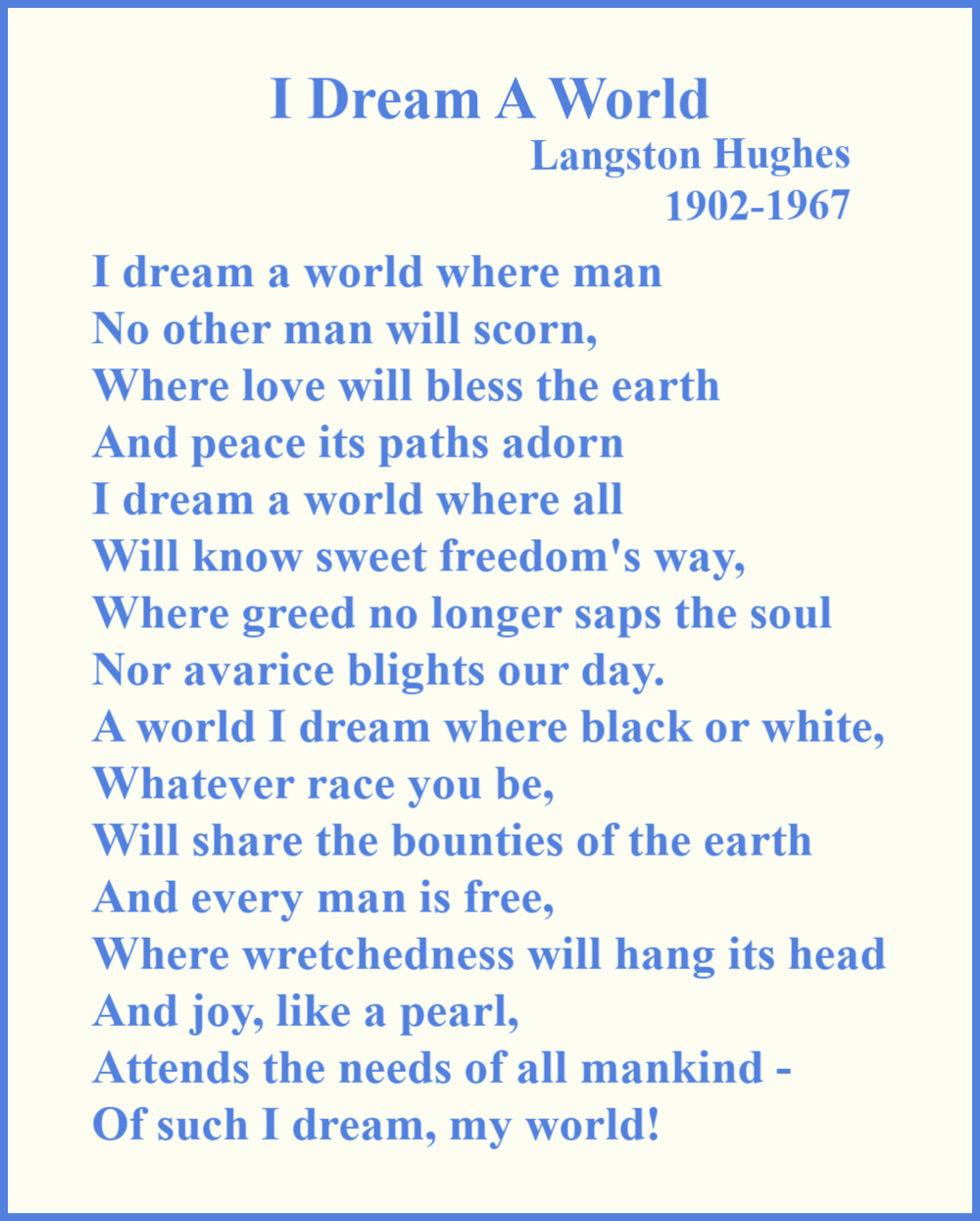
Last Poetry Friday, I posted my personal favorite Langston Hughes poem and the one I used in school to introduce my students to Langston Hughes. It is called "I Dream A World," and as they always pointed out it still resonates in today's world.

This book is recommended for readers age 8+
This book was an ARC gratefully received from the publisher.
Be sure to check out the other Marvelous Middle Grade Monday offerings, now being carried on by Greg at Always in the Middle. 

Friday, February 7, 2020

Poetry Friday: I Dream A World by Langston Hughes


This is one of my favorite Langston Hughes poems and since it is Black History Month, I thought I would share it today. It's also one of the poems I would regularly use in the classroom when I taught in the Bronx. I think it is especially poignant in light of recent events in here and abroad.


Poetry Friday is a weekly blogging event in which poets, writers, readers, and lovers of poetry share blog posts about poetry. Poetry Friday is being hosted today by Laura Purdie Salas at Small Reads for Brighter Days

Tuesday, February 4, 2020

My First Picture Book Roundup of 2020: Celebrating Grandparents


This is my first roundup of 2020 and for it, I chose books about grandparents. My young readers really enjoy picture books about grandmothers and grandfathers and these are some of our favorite books of 2019 that we have been reading over and over again. Have you read them, too?


My Grandma and Me by Mina Javaherbin, 
illustrated by Lindsey Yankey
Candlewick Press, 2019, 32 pages
Now an adult, Mina lovingly remembers her grandmother who was living with her family during her childhood. As a child, Mina loved to do everything her grandma does. Every morning, Mina and her grandmother would greet the day with prayer. Afterward, they would await the delivery of their daily bread, part of which they would share with their neighbors, Mina's best friend Annette and her grandmother. Later, in the garden, while grandmas knitted, Mina and Annette played. When grandma sewed some new chadors, Mina would use the chadors to build a pretend rocket ship, draping them on the table. During Ramadan, Mina always ate with her grandmother, even when she was too young to fast. Grandma sewed Mina's first chador when she was older and together they walked to the mosque. There, grandma prayed that Annette's grandmother would go to heaven, and at church, Annette's grandmother prayed that Mina's grandma would also go to heaven. This warm tribute to her grandmother is also a nice introduction to Islamic traditions and an inclusive Iran unfamiliar to today's kids. The mixed media illustrations are done in soft pastels with lots of Persian elements included. This is an engaging story that should get kids talking about the things they like to do with their own grandparents.
Our Favorite Day written and illustrated by 
Joowon Oh
Candlewick Press, 2019, 32 pages
Every day, an elderly man gets up and follows the same routine: drinking tea, watering plants, tidying up, getting dressed and going downtown. He walks through town, gets an idea, goes to a restaurant for his favorite dumplings, then heads home. The next day, he repeats his routine, except this time he stops in the craft store, gets dumplings to go, and picks some flowers on his way home. Why the change in routine? Thursday is the day his granddaughter visits, and they have a wonderful time together. After eating their dumpling lunch, the two get busy with some new craft supplies, making a beautiful butterfly kite that they take out and fly. Thursdays are definitely their favorite day! This is a debut picture book for Joowon Oh and it is a winner. The illustrations compliment the simple text, and are as sweet as the relationship between grandfather and granddaughter.  

Looking for Yesterday written and illustrated by
Alison Jay
Old Barn Books, 2019, 32 pages
A young boy wishes he could return to yesterday. It was his best day, a day spent with his Grandad, having all kinds of fun and he wants to live it all over again. He spends some time trying to think of ways to go back, like traveling faster than the speed of light to travel counterclockwise, building a time machine, or a super hypersonic rocket. But in the end, nothing seems very plausible, so he asks his Grandad for help. Wise Grandad pulls out his photo album and shows his grandson all the wonderful, happy days he has experienced throughout his life. Granddad's message to his grandson is that the boy still has so many great days ahead of him, there's no need to go back for a do-over since every present moment, every day holds the possibility of being great. The text is fun and a nice blend of science, philosophy and whimsey fully accessible to young readers. Using her signature style, Jay's playful illustrations are done in soft earth tones, adding a coat of crackle varnish to Granddad's old photos to give them an aged look.   

Leila in Saffron by Rukhsanna Guidroz,
illustrated by Dinara Mirtalipova
Salaam Reads, 2019, 26 pages
Sometimes it takes a wise grandma to make a kid see just who she is. Every Friday night, Leila goes to her Naani's house for a family dinner with her mom and dad. One night, Naani tells her that the saffron color buttons on her dress really compliment Leila's dark eyes. The compliment makes her feel very happy. So does spending Friday night with her aunts, uncles, and cousins, looking at Naani's Pakistani ornaments, all the books written in Arabic, and helping her grandmother make the chicken curry for their dinner. One night, just before Leila and her parents leave, Naani takes her upstairs to show her some of her beautiful scarves. Leila loves her grandmother's scarves and asks if she can try one on. The sparkle and shine of the saffron color scarf she picks is perfect for Leila and makes her feel exactly like who she is - a beautiful Pakistani girl proud of her heritage. And this beautiful warm mixed-media illustrated book done in a palette of bold oranges and greens with touches of other colors nicely conveys the Pakistani heritage that Leila loves so much. 

Ojiichan's Gift by Chieri Uegaki,
illustrated by Genevieve Simms
Kids Can Press, 2019, 32 pages
Every summer, Mayumi travels to Japan to visit her grandfather. Together, they work on his lovely garden that Ojiichan had began before Mayumi was born. The garden is made up of large and small stones, and edged with plantings and a sheltered bench for relaxing and sharing a lunchtime onigiri or rice ball bento. Over time, Ojiichan teaches Mayumi everything she needs to know about caring for the garden, and that has become such a special place, loved by granddaughter and grandfather as much as they love each other. But one year, when Mayumi arrives at her grandfather's house, she sees that the garden has been neglected and is overgrown. Grandfather is no longer able to care for it, and in fact, he can no longer live alone his home. As Mayumi's parents pack up the house, she tries to think of a way to keep their beloved garden alive for both of them. Sure enough, using their lacquered bento box that once held their lunch, Mayumi creates a lovely tribute to Ojiichan and their garden. This is a lovely intergenerational affective story with watercolor illustrations that are a gentle and poignant as the text. 
When I Found Grandma by Saumiya Balasubramaniam,
illustrated by Qin Leng
Groundwood Books, 2019, 32 pages
Maya, whose Grandma lives far away in India, really wishes they lived closer together the way her best friend Kim and her grandmother do. But when Grandma comes to visit, Maya's excitement doesn't last very long. When Grandma comes to school to pick her up wearing a colorful sari and lots of bangles, Maya is embarrassed and refuses to let her hold her hand. And why can't Grandma call her Maya instead of Mayalakshmi? But when Grandma wants to go to the temple to pray before going to the amusement park, Maya angrily storms back into her room. Grandma, trying to please Maya, changes her sari for a pair of pants, then buys a red baseball cap, calling it her "all-American hat." Later, when Maya gets lost at the park, it's that red baseball cap that helps her find her way back to her family. That night, Maya decides to give Grandma a second chance. This is a skillful intergenerational story about accepting cultural differences and learning how to compromise. Slowly, Maya goes from angry and embarrassed by her grandmother to feelings of affection and love, and learns to appreciate who her Grandma is. Leng's ink and watercolor illustrations harmonize perfectly with the text, capturing the whole range of Maya and her grandmother's emotions.

Where Are YouFrom? by Yamile Saied Méndez,
illustrated by Jaime Kim
HarperCollins, 2019, 32 pages
When people keep asking a young girl where she's from, and where her mom or dad is from, she tells them all she's from today, like everyone else. When they still aren't satisfied with her answer, she turns to the person whom she believes knows everything - her Abuelo. Going for a walk together, he tells her she is from the Pampas, a region in Argentina. Where she descends "from the gaucho, brave and strong," where there is a cleansing river, that feeds the land, which feeds the people. And she is from Puerto Rico, the land of warm blue oceans, and palm trees, a land "where our ancestors built a home for all, even when they were in chains because of the color of their skin." As her Abuelo answers his granddaughters question, they walk through beautiful two page watercolor spreads of the different landscapes for the places he is telling her about. Told in lyrical prose, this is a loving paean to one child's different cultural roots and "the love of all those before us, from those who dreamt of you because of a song sung under the Southern Cross or the words in a book written under the light of the North Star...You are from all of us." This is just such a beautiful book on understanding the connection between identity and heritage. A perfect book for Americans, almost of all whom come from somewhere else.
Hey Grandude! by Paul McCartney,
illustrated by Kathryn Durst
Random House BFYR, 2019, 32 pages
I don't usually do celebrity books, but I made an exception here because it isn't a famous person ego trip, just a picture book. It's a grey, drizzly day out and Grandude's four grandchildren, whom he calls Chillers, are bored and grumpy. Cheerful Grandude pulls out a pile of postcards and a magic compass, utters the magic words "See the compass needle spin,/let the magic fun begin!" Next thing they know, they find themselves on a sunny beach. And it's great fun until, uh oh, suddenly the beach is crawling with pinchy crabs. Grandude pulls out his magic compass, utters the magic words, and he and the Chillers are off to a warm desert, having fun riding horses until, uh oh, a herd of buffalo comes rushing at them. Granddude repeats the magic words again and it's off to another adventure that also ends unpleasantly. Finally, the fourth adventure brings them home, tired and safely tucked in bed. I wasn't that crazy about this book, but my young readers loved it, so much so, we read it a number of times in one sitting. Their conclusion about the magic compass and the adventures Grandude and the Chillers went on - they didn't really go anywhere, but Grandude made up great stories and they just felt like they had left the house. Their other conclusion - sometimes home is the best place to be. The enthusiasm of my young readers was good enough for me, and it led to a wonderful lesson on the compass and what it is really used for

I Miss My Grandpa 
written and illustrated by Jin Xiaojing
Little, Brown BFYR, 2019, 34 pages
In this lovely picture book, a young girl goes on a journey to find out about the grandfather she never knew. She begins by asking her Grandma what her Grandpa looked like. Grandma's answers send the girl to her Uncle Mason, her Uncle Chang-zi, her Uncle Leo, her Aunt Zai-zi, her cousin Aiden, and finally her mom. Each of these relatives adds more about who her Grandpa was to what her Grandma had said, until finally she tells her granddaughter that he is still living within all these family members, including his grandchild, who also happens to have his hair. This is such a wonderful celebration and tribute to those who are no longer in our lives themselves, but how we nevertheless carry them with us everyday and pass them down to our future generations. My Kiddo never knew my dad because he died when I was still in my teens, but like the young girl in this book, she often asked about him. I read this book with her on her last visit from China and it really generated a different kind conversation about my dad and who he was. Also, the story is translated into Mandarin on the back end papers. My Kiddo read it to me in Chinese and even though I didn't understand everything I heard, it still sounded lovely (and yes, over time I have picked up some Mandarin). Jin Xiaojing's visually textured illustrations, using colored pencil, watercolor, oil pastel and dip pen, are done mainly in blue, red, and yellow shades, adding a dreamlike quality to the text. An original story that celebrates the people who make us who we are, even if they are no longer living.   

You can find even more favorite picture books about grandparents HERE
 
Imagination Designs