Tuesday, October 27, 2020

Where is Our Library? (A Story of Patience & Fortitude #2) by Josh Funk, illustrated by Stevie Lewis


Where is Our Library? (A Story of Patience & Fortitude #2)
written by Josh Funk, illustrated by Stevie Lewis
Henry Holt & Company, 2020, 40 pages

I just love a good New York story and what could be better than a New York City story about the New York Public Library? And that is just what Josh Funk has written. Where is Our Library? is his second book starring those two lovable library lions Patience and Fortitude and a love letter to the NYPL's 92 library branches, as well as a visit to some iconic bookish landmarks in NYC.
 
It all begins late one night when most New Yorkers are asleep. Patience and Fortitude leave their perch and begin their nightly visit to the children's reading room in the 42nd Street library, anticipating a night of reading some good books, but when they arrive, much to their surprise and dismay, the books are all gone.

Baffled and disappointed, Fortitude immediately comes up with a plan and the two companions head out the library door and stealthily take to the streets, heading toward Times Square. No finding the library's books there, they head uptown to Central Park, through the zoo, past the carousel, arriving at the Alice in Wonderland statue, where Alice points them in the direction of the Hans Christian Anderson statue. Hans' suggestion: a list of branch libraries they should visit. Which they do, traveling from Harlem to Chinatown, and even along the High Line, but they still have no luck finding their books. By now, dawn is breaking and Patience and Fortitude need to return to their perch in front of the Schwartzman Building.

Do our literary lions find their missing books before the sun comes up? Yes, indeed. They have been moved across the street to the newly renovated Mid-Manhatten branch on Fifth Avenue and East 41st Street. That branch, Patience and Fortitude learn, now houses the Children's Library.  

Where is Our Library? is a mystery, an adventure, and an announcement. It is written in a rhyme that never loses its rhythm, an important point for a read aloud. Not only does this story make a good read aloud, but kids will really like seeing some of their favorite books on display in the various branches that the two lions visit. You might also notice that the plays shown on the Times Square pages are all kidlit related, even if the timing of their being performed and the present is a little off. And, thanks to COVID-19, most people never even knew that the renovated Mid-Manhatten branch has been renamed the Stavros Niarchos Foundation Library until recently.
 
I read Where is Our Library? as an eARC but I still found the illustrations fun and energetic. I loved Lewis' depictions of the city at night, but I think my favorite is the two page layout of Patience and Fortitude walking through Central Park and all the familiar places they pass though. For those who aren't familiar with New York, the author has included an informative list of all the places the library lions visit.

You can also download a fun 12-page activity kit courtesy of the publisher HERE 

AND you can register for a storytime event WITH author Josh Funk and illustrator Stevie Lewis. Click HERE for details and to register.

This book is recommended for readers age 4+
This book was gratefully received from the author, Josh Funk 

🎂 HAPPY BOOK BIRTHDAY 🎂
WHERE IS OUR LIBRARY?
OCTOBER 27, 2020

Thursday, October 22, 2020

Blog Tour: Sometimes a Wall... by Dianne White, illustrated by Barroux


Sometimes A Wall...written by Dianne White,
illustrated by Barroux
Owlkids, 2020, 32 pages

We hear a lot about walls these days, and they can have different reasons for being, as young readers learn in this new picture book. Kids see that walls can be drawn on with chalk, or they can be a wall of cooling water on a hot summer day, they can even be a rock wall on which to practice climbing.  And sometimes walls can be inclusionary, but they can also be exclusionary.

And sometimes when a wall is exclusionary, the children behind it can be mean, and the child outside the wall can be hurt by their taunts and lies. When one boy inside a wall decides to turn it into a castle, after all the other kids work together to build it, he selfishly shouts MINE and wants all the other children go away. But sometimes, having your own castle surrounded by a wall and no friends can get pretty lonely. Perhaps a new start can turn things around because...


When I first read this book, I loved it, but I was also afraid it might be a little to metaphorical for my young readers. And it was. However, it generated some really good conversations and reflexions regarding what this book says about friendship, inclusion, empathy, kindness, and connection. These are big words and ideas for young kids, but this book so nicely illustrates what they mean using the sparest of text and simple, but expressive illustrations. We've read Sometimes a Wall... a number of times now, and each time it get richer and more meaningful. The kids also had some fun with the two coloring pages (see below for the link) that go with this book. 

Who is Dianne White and why did she write Sometimes a Wall...?
A conversation with a friend got author Dianne White thinking about different kinds of wall, both physical and metaphorical. Sometimes a Wall...is an exploration of these, and with it, an invitation to take down barriers and find common ground. Dianne's other books include Green on Green and Who Eats Orange? A long-time elementary school teacher, she lives with her family in Gilbert, Arizona. To learn more, and to download a discussion guide and more, visit Dianne's website at diannewrites.com
You can also find her on Twitter @diannewrites and on Facebook: Dianne White

Thanks to the publisher Owlkids, you can find a discussion guide for Sometimes a Wall...HERE

This book is recommended for readers age 4+
This book was gratefully received from Barbara Fisch at Blue Slip Media

Teachers and parents may also be interested in looking at A Lesson in 3 Movements...

• Intro to the Unit (PLEASE READ FIRST!)

• What’s Different About Reading Wordless/Nearly Wordless Picture Books?

• 1st Movement : TOGETHER (I Walk with Vanessa by Kerascoët)

• 2nd Movement: APART (Draw the Line by Kathryn Otoshi)

• 3rd Movement: REGRET. NEW START? (Sometimes a Wall … by Dianne White, illustrated by Barroux)


The "Why" behind the book:

·      A LETTER TO PARENTS AND EDUCATORS 

·      A LETTER TO YOUNG READERS


As for those Coloring Pages for younger students:

Artist Barroux lives in Paris, France, and has studies photography, art, sculpture, and architecture. His work has been published in The New York Times and The Washington Post. He believes that the world needs fewer walls and more trees. You can find him on Instagram: @barrouxillustrations

Tuesday, October 20, 2020

🎃 Nine Old and New Favorite Halloween Picture Books


Halloween is coming, but there won't be any trick or treating in most places around the country. This year, my young readers and I will be doing a zoom party. To get ready, we pulled out some of our old favorite Halloween stories, added some new ones into the mix, and came up with these nine that we love to read. 

What are some of your favorite Halloween books?

Happy Halloween from The Very Busy Spider:
A Lift-the-Flap Book
written and illustrated by Eric Carle
World of Eric Carle, 2020, 10 pages
I thought my young readers might be a little old for this lift-the-flap board book, but no. They are big fans of the Very Hungry Caterpillar, and were very happy to see it make an appearance in this book. The text is written, for the most part, in rhyme, and follows the Busy Spider as he looks for his friends on Halloween, who are, of course, under the various flaps. The illustrations appear to be done in Eric Carle's signature collage style - hand-painted tissue paper cut into the desired shapes, and layered for texture. I found that beginning The Very Busy Spider's quest in prose, switching to rhyme, and ending in prose threw me off the first time I read this aloud, so be warned if you use it for a read-aloud. Otherwise, it's a sweet introduction to Halloween for your youngest of readers (and so few sentimental 5-year-olds).

Gustavo, the Shy Ghost 
written and illustrated by Flavia Z. Drago
Candlewick Press, 2020, 40 pages
Gustavo is a shy ghost who loves to do the usual ghostly things like walking through walls and glowing in the dark, but what he really loves is to play the violin. He also has a crush on Alma, a pretty (invisible) monster. But Gustavo has a problem - he can't make friends because he can't speak to any other monsters. He tries all kinds of ways to get noticed, but nothing works. So Gustavo decides to invite them to a Day of the Dead violin concert. And it looks like his fears that no one will like him are true when no one shows up at the concert. Gustavo begins to play his music anyway and next thing he knows, all the other monsters are suddenly there and loving his music. After that, no one ignores Gustavo any more and they even discover what he is a great friend to all of them. Though this isn't a Halloween story per se, my kiddos like it and wanted to include it in our collection of seasonal books we like to read. Though there are pumpkins and monsters throughout the story, it also proved to be a great opportunity to introduce them to the Mexican Day of the Dead and what that means. There's a multiplicity of cultural icons throughout, for example, the traditional papel picado banner and the many calaveras or skulls. Gustavo and his concert is a wonderful story about bravery and friendship, and about being seen and accepted for who you are. And while it is a seasonal story, it can be read and appreciated all year round.

Bears and Boos written by Shirley Parenteau,
illustrated by David Walker
Candlewick Press, 2020, 32 pages
This is the seventh book featuring these four cute, cuddly, pastel colored bears and Big Brown Bear. It's Halloween and there's a big box of items to make into costumes just waiting for four little bears. There's a golden gown, a wizard's hat, a magic wand, even a pirate hat, all up for grabs. And that's just what they do, knocking Floppy Bear down in the process, and leaving nothing for her to make a costume. But when the other bears see what's happened, they not only apologize for knocking Floppy down, but Fuzzy Bear offers her the golden gown she found, Calico Bear gives her the wand he found. and Yellow Bear gives her a necklace. Now, Floppy is the holiday queen and leads the parade of bears out to go trick or treating with Big Brown Bear. And what a good time they all have! This is a sweet Halloween story, told in four stanza rhymes and bearing a message about being kind, considerate, and sharing. What was nice about the bears apologizing to Floppy was that it was spontaneous after they saw that there was nothing left for her and they were not told to do it by Big Brown Bear. It is important for kids to realize the consequences of their actions and take responsibility for them. A particularly good message for anyone, actually, at any age. My young readers are already fans of these little bears, and this book was also sure to be a hit with them when we read it together. 

Moldilocks and the Three Scares: A Zombie Tale
written by Lynne Marie, illustrated by David Rodriguez Lorenzo
Sterling Children's Books, 2019, 42 pages 
In this humorous retelling of the well-known fairy tale Goldilocks and the Three Bears, the Scare family and their blue dog Plasma live in a haunted house with room for four. As Papa Frankenstein makes some soup, he wishes there were a fourth person to eat the fourth portion, Mama Mummy wishes for a lab assistant as she mixes up a potion, and Baby Scare, a vampire, wishes for a playmate. When the soup turns out to be too hot to eat, they take Plasma for a walk while it cools. Enter Moldilocks, a zombie who has been without a family for a long time. Yes, she tries the soup, and eats Baby Scares portion, tries the chairs and breaks Baby Scare's, tries the beds and naps in Baby Scares just right bed. What happens when the Scares return? They see what Moldilocks has done, and finds her still asleep. And it looks like everyone's wish has come true, and Moldilocks finally has a new family. For a retelling, this was a lot of fun to read. There's all kinds of word play going on, and the illustrations, done with pencil in Halloween colors, are more humorous than scary. But is carries a nice message about blended families, acceptance, and just being who you are. I read this to my young readers last Halloween, and a number of times since then. 
  
Herbert's First Halloween written by Cynthia Rylant,
illustrated by Stephen Henry
Chronicle Books, 2017, 36 pages
It's Herbert's first trick or treat Halloween, but he isn't quite sure about it. After all, Halloween can be scary, but luckily, Herbert's father, who is very excited for Herbert, understands that. First, he shows Herbert a photo of his own first Halloween, dressed up as a cowboy. When Herbert says he wants to be a tiger, his dad measures him for a costume. Then, father and son carve a pumpkin with a big jolly smile and put it on the porch. Yet, even after his dad tells him about all the candy, Herbert still looks unsure of things. On Halloween, after putting on his costume, Herbert and his dad go trick or treating with all the other kids. Herbert has such a good time, that he's even looking forward to next year. This is kind of a young book, but I read it to my young readers because some of them were new to this country and didn't know what Halloween was all about. And yes, it can look scary to young kids. But there is such a great message about being brave that I thought this book, along with Llama Llama Trick or Treat would be the perfect combination for talking to them about Halloween. And it worked. It was nice to see a very patient, supportive dad in the position of talking to Herbert about Halloween and even making his costume, strengthening their bond. 

Llama Llama Trick or Treat
written and illustrated by Anna Dewdney
Viking BFYR, 2014, 14 pages
This is the second favorite board book my young readers wanted to revisit. I think it's the simple, but charming rhyme text that makes it memorable for them, since they can still recite the whole book. It's also shows Llama getting ready for Halloween - picking out the perfect costume, finding just the right pumpkin and carving it into a Jock-O'-Lantern, putting candy in a bowl for trick-or-treaters - all the typical things that most kids also do to get ready for Halloween. The rhyme works, the illustrations are sweet and done in Halloween colors.  

At the Old Haunted House written by Helen Ketteman,
illustrated by Nate Wragg
Two Lions, 2014, 32 pages
It's a dark Halloween as a young girl and two small boys walk away from the bright street and homey homes where they have been trick or treating and head toward a dilapidated old house on a hill complete with a graveyard in the front. Inside is a wide array of creepy creatures, all involved in antics with their offspring, beginning with a witch: "At the old haunted house/ In a room with no sun/ lived a warty green witch/ and her wee witchy one." There are also goblins, black cats, werewolves, vampires,   and even bats. Each creature is one associated with Halloween, but the story is told in a really humorous counting rhyme. All their shenanigans end up in a Halloween party that begins just as the three trick or treaters arrive at the house. My young readers love this counting book. We've actually read it so frequently that they know bits of it by heart and recite them enthusiastically. The cartoon-like illustrations, done in a Halloween palette, help elevate this book into silliness so even the most anxious of kids won't get scared. This book is always a winner. 

Halloween Hustle written by Charlotte Gunnufson,
illustrated by Kevan Atteberry
Two Lions, 2013, 32 pages
This is one of our favorite books to revisit every Halloween. A boney skeleton in a orange pumpkin shirt is bopping down the street doing the Halloween Hustle, along his faithful companion. He's having a good old time for himself until he trips and comes apart. A few well-placed rubber bands and he's good to go, again. Getting on a bus, with a bunch of other Halloween creatures, they head to town to get some party clothes, all the while doing the Halloween Hustle. At an old haunted house, everyone is partying and dancing, but oops, the skeleton falls comes apart again. Luckily, a pretty girl skeleton is there to glue him back together, and the party continues as everyone does the Halloween Hustle. The story is told in a four stanza rhyme, with each one ending in a repeat  of "Doing the Halloween Hustle." The illustrations are bright despite being done on a black background and the monsters/creatures aren't at all scary for young readers. You can find some great printable activities to go with this book at the author's website HERE 

Room on the Brook written by Julia Donaldson,
illustrated by Axel Scheffler
Dial Books, 2001, 32 pages
This fun counting book has been a long time favorite mine, so much so, that I've worn out more than one copy, and given away a few, too. A witch holding a caldron and her marmalade cat are contentedly flying on her broomstick when a gust of wind blows the witch's hat off. Retrieved by a spotted dog who asks if there's room on the broom for him. Eventually, the witch and her cat welcome a green bird, and a frog. But when the broom snaps in half from the extra weight, and a hungry dragon catches the witch, a favorite thing of his to ear, it is cat, dog, bird, and frog to the rescue. When the witch fills her cauldron and adds various ingredients, it isn't to make some soup for the cat, the dog, the bird, the frog and herself,. No, indeed, our friendly witch stirs up a nice new broom with comforts for everyone. The whole tale is told in perfect rhyme, with equally wonderful witty, friendly illustrations. Though the witch looks somewhat like a customary witch, she is both kind and friendly, traits that will dispel any fears young readers may have that witches are mean. One nice result of reading this a lot to kids, is that soon you begin to hear an echo of young voices who have memorized the first few lines. You definitely won't want to leave this out of your Halloween reads.  


Sunday, October 11, 2020

Marjory Saves the Everglades: The Story of Marjorie Stoneman Douglas by Sandra Neil Wallace, illustrated by Rebecca Gibbon

 
Marjory Saves the Everglades: The Story of Marjory Stoneman Douglas
written by Sandra Neil Wallace, illustrated by Rebecca Gibbon
Paula Wiseman Books, 2020, 56 pages

By now, most of us recognize the name Marjory Stoneman Douglas because of the tragic 2018 shooting that happened in the high school named in her honor just east of the Everglades. But few of us know why the school was named after Marjory. Now, thanks to the excellent research by Sandra Neil Wallace, we have our answer. 

In this richly illustrated picture book for older readers, Wallace begins her biography with Marjory's first trip to Florida to visit her dad where she fell in love with the sunshine. Returning home, Marjory grew up, attended Wellesley College, got married and divorced, until finally she headed back to Florida to work as a reporter for her father's newspaper, the Miami Herald. It was there that Marjory found the voice she would need later as an activist.

During WWI, Marjory enlisted in the Navy and went to Europe with the Red Cross. But when she retuned to Florida after the war, she was absolutely dismayed to see how much of the Everglades had disappeared as developers dynamited, dug and drained it to expand post-war building. 
But dismay wouldn't save the destruction of the Everglades, It would take a visit by Ernest Coe, a landscape architect, and a meandering trip with him through the glades that made Marjory realize that the Everglades needed to become "a national park to save the birds, the plants, and the other wildlife."
But how to convince the National Park Service, who felt that 'a swamp is a swamp.' Other people just wanted to drain the Everglades to expand the land and build. But, Marjory wondered, were the Everglades really just a swamp, or were they something else? Something beautiful, living and unique? By now middled aged, Marjory was determined to find the answers to her questions, and dedicated the rest of her life to saving her adopted home from hungry developers, including the U. S. Army. 

And although the area became the Everglades National Park in 1947, it didn't stop developers. But through activism and organization, Marjory and the group she formed, Friends of the Everglades, managed to get developers to reverse their destructive building, restoring this unique ecosystem back to what it once was. 

Marjory Saves the Everglades is a such an inspiring story for young readers, showing them what a difference one dedicated voice can make in the world. Marjory lived to be 108 years old, but was an early activist, a suffragette and feminist, before she became involved in saving the Everglades and Wallace has really captured her independent spirit. The book is written in accessible language, and includes quotes by Marjory from various sources including her own work River of Grass. Marjory Saves the Everglades would make a wonderful addition to any STEM classes learning about ecosystems and the environment. 

Rebecca Gibbon's folk-art style illustrations, done with acrylic inks and colored pencils, are the perfect compliment to a book about the Everglades, done in shades of brilliant greens and blues, and including lots of vibrant birds, grasses and flowers throughout.  

Wallace's back matter includes an Author's Note, a page of creatures and plants indigenous to the Everglades, a Timeline of Marjory Stoneman Douglas and the Everglades, some tips for protecting the environment, as well as additional resources for learning more about this amazing, but overlooked woman. 

You can find an in-depth Discussion Guide courtesy of Sandra Neil Wallace HERE
You can also download an Activity Kit courtesy of Sandra Neil Wallace HERE

MEET THE AUTHOR:
Sandra Neil Wallace hope that her stories inspire readers as much as they inspire her. Her book The Teachers March! How Selma's Teachers Changed History was written with her husband, Rich Wallace, and has received three starred reviews to date. Between the Lines: How Ernie Barnes Went From the Football Field to the Art Gallery received the Orbis Pictus Book Award, was an ALA notable Book and a Booklist Top 10 Biography for Youth. Formerly, Sandra was an ESPN reporter and was the first woman to host an NHL broadcast. She continues to break barriers as co-founder of DailyGoodNH.org and lives with her family in New Hampshire. You can find Sandra at

IMO, Marjory's life and work become even more important these days as we hear about developers eyeing National Parks for their natural resources. 

This book is recommended for readers age 7+
This book was gratefully received from Barbara Fisch at Blue Slip Media

Sunday, October 4, 2020

Class Act (sequel to New Kid) by Jerry Craft


Class Act
is, quite simply, everything you could want in a sequel. Jordan Banks returns for his second year at the exclusive RAD (Riverdale Academy Day School) along with his friends Drew Ellis and Liam Landers. Though Jordan and Drew are two of the few African Americans at RAD, they are grappling with different issues. Jordan still would rather go to art school, but his mother insists he get an education at RAD, while his dad is a little more understanding. Jordan is also worried about his physical self. All the other boys are tall and more manly smelling, but Jordan is still much shorter, less developed and has no body odor, not even after a gym workout.  

Drew, on the other hand, returns to school taller and stronger. He also has a new hairstyle, one that some of the non-Black students can't keep themselves from touching no matter how often he asks them to stop. Drew is also having issues about being a Black scholarship student in a predominately white school. Drew, who lives with his hard working grandmother in Co-Op City, must two buses from one part of the Bronx to get to RAD in a wealthy section of the Bronx, while other students arrive by car or limo. What he sees begins to come to a head when his clueless principal tells Drew that RAD is making an effort to promote diversity, equality and inclusion and has adopted an urban sister school and would like Drew to show them around when the students visit. Their visit highlights for Drew the contrast between resources at RAD and their school, which lacks so much including a decent library and cafeteria.  

After he and Jordan visit very wealthy Liam over Thanksgiving break, Drew finds that he is having a hard time with his feelings of the unfairness of things and maintaining his friendship with Liam. As long as their friendship is on campus or at Liam's home, Drew feels uncomfortable. Can he find a way to navigate their friendship so that they are able to see, respect, and support each other mutually?

I loved New Kid so I was really anxious to read Class Act. But it is a great sequel and yet, it can stand alone. I liked the focus on Drew because it allowed Jerry Craft to center the story on him and what his life is like. Jordan is a smart, light-skinned, middle class African American who lives with loving parents; Liam is a smart, very rich, privileged, blond haired white kid who lives in a mansion with an absentee father and a socialite mother; by contrast, Drew is a smart, athletic, dark-skinned working class African American living with his loving grandmother. 

Beside these socioeconomic differences, these three kids also enable Craft to address issues of how differently people are treated based on their skin color. Jordan captures the way teachers and students treat him differently than how they treat Drew in one of his black and white two-page comic commentaries that are scattered through the story.

I was happy to see that Craft address the issue of unwanted hair touching after Drew grows his out. Jordan also illustrates this in his comic commentary. This is something that apparently white people do, but I don't quite understand why, I just know it's wrong. And yes, there are other cringe-worthy microaggressions throughout, especially thanks to Drew's nemesis Andy, who for a period has green skin and is teased about it. Would such an experience change a person? It should.

And while so much of this novel may sound heavy and serious, there is plenty of humor throughout. To begin with, at the beginning of every chapter is a parody of covers from other loved graphic novels, beginning with the Wimpy Kid, and including New Kid.  

I can't recommend this novel and its predecessor highly enough. The format is perfect, the message in spot on and resonates so well in today's world. Don't miss it and if you haven't read New Kid yet, what are you waiting for?

This book is recommended for readers age 9+
This book was an eARC received from Edelweiss+
Be sure to check out the other Marvelous Middle Grade Monday offerings, 
now being carried on by Greg at Always in the Middle.

Friday, October 2, 2020

😷Five Picture Books About Animals and Other Creatures (and what we can learn from them)


Here are five of our favorite stories featuring anthropomorphized animals and other creatures that we have read this year. 
Don't Worry, Little Crab
written and illustrated by Chris Haughton
Candlewick Press, 2020, 48 pages
One day, Very Big Crab tells Little Crab it's time to leave their tide pool and head to the ocean. At first, Little Crab is very excited to be going somewhere, but when they reach the ocean, it's a whole different story. As the waves come nearer and get bigger, so does Little Crab's reluctance and anxiety.  As Very Big Crab gently encourages and reassures Little Crab, the two manage to slowly get closer and closer to the ocean, until enormous wave comes along and washes them down, down, down into the ocean's depths. And once there, Little Crab couldn't be happier or more excited. There are friends to be made, seaweed to eat, hide-and-seek to play. And you guessed it, when Very Big Crab says it's time to go home to their tide pool, Little Crab does not want to leave the ocean. So the very patient and understanding Very Big Crab suggests they take the long way home just to enjoy a little more ocean time. This is a really great for kids who feel anxious when faced with new experiences. 

Some Dinosaurs are Small 
written and illustrated by Charlotte Voake
Candlewick Press, 2020, 32 pages
In this very entertaining book and using spare language, Voake uses a childhood favorite for demonstrating the concept of size and proportion, and teaches readers a little about dinosaurs to boot. The story opens with a very small green dinosaur filling a pill up with fruits to eat later, while nearby lurks a very large dinosaur watching the little one. And yes, you guessed it, the big dinos gang up on the little one and take all his pickings to eat themselves. But is this the end of the story? No indeed it isn't, because size is relative and in this case, it's relative to the age of the dinosaur. And young readers will definitely laugh when they discover that little one's mom is enormous, relative to the large dinos. This is a great book for preschool and beginning readers. The text is simple and large, the unexpected ending is done with age appropriated humor and the quirky, but very appealing watercolor and ink illustrations, done is dusty shades of brown, green, and red, give the story a very prehistoric sense. I read this (repeatedly) to my young readers who loved it, a few of whom are budding dinosaur fans, and I'm pretty sure we will be reading it again and again. 

Cone Cat written by Sarah Howden,
illustrated by Carmen Mok
Owlkids Books, 2020, 32 pages
Jeremy is a cat the really enjoys his freedom. Then, one day, he wakes up after a visit to the vet with a cone covering his head and hampering his freedom of movement, and his super cat senses. Suddenly, Jeremy is plain old clumsy, bumping to things, and no longer able to hunt or even clean himself - PU! But then, Jeremy discovers that he can make the cone work for him. For instance, he can use it to tip a bowl of cereal into the cone, then into his mouth and even saving some cereal for later. Why it even works to get him some ice cream.  But then, one morning, the cone comes off. And Jeremy regains his old freedom of movement - a happy cat, but wondering would freedom ever compare to his glory days with the cone? The story ends on a bit of an ironic note. The moral of Jeremy's cone tale - when life gives you lemons, make lemonade. Or perhaps necessity is the mother of invention. OK, so maybe Jeremy isn't the best example for kids to follow, but that's just the point - Jeremy provides a conduit through which behavior conversations can be opened as well as ways to make the best of a bad situation. Kids will also like the whimsical colorful pastel illustrations, especially Jeremy's melodramatic facial expressions.  

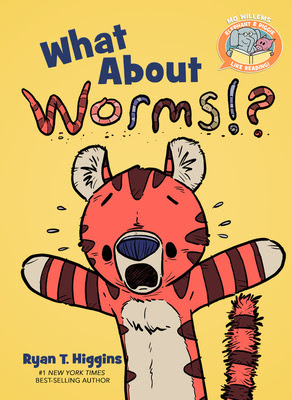
What About Worms!? (Elephant & Piggie Like Reading #7)
written and illustrated by Ryan T. Higgins
Hyperion, 2020, 64 pages
Who doesn't love Elephant and Piggie? And they like to read...and make lots of puns about it while they introduce their latest book all about worms. Tiger is very big and very brave, not afraid of anything. Well, except worms, Tiger does not like slimy, wiggly worms. The only problem is that worms could be in everything Tiger likes. Like the potted flowers that smell so good. But wait, they are in dirt and worms like dirt. Tiger quickly tosses down the flower pot, which breaks. Tiger likes tasty apples, but then he remembers that so do worms, so he tosses it on the floor with the broken flower pot. Worms, he cries, ruin everything. They could even be in the book Tiger would like to read. But it, too, gets tossed away. Worms, it turns out, are afraid of tigers, but they love all the things Tiger has left on the floor. And that book - well, it was all about tigers. After the worms read it, and learn so much about tigers, they decided they like tigers after all. Books, we learn from this work of meta fiction, can teach us so much. Elephant and Piggie may initially draw kids to this book, but it definitely stands on its own with a great message for young, new readers about not judging a book by its cover and about making snap judgements. The message may be serious, but it's delivered with lots of humor, and the bright illustrations really harmonize and compliment the story.

The Last Tiger
written and illustrated by Petr Horáček
Eerdmans BFYR, 2020, 36 pages
When hunters arrive in the jungle and the other animals run and hide, the tiger doesn't. After all, he may be the last tiger, but he haughtily thinks he is strong, fearless and powerful enough to evade capture. How wrong tiger is. Cunningly captured and taken out of the jungle, tiger is put in a cage for people to look at him. No longer free, strong and powerful, the tiger is very unhappy, so much so that he begins to lose weight - lots of weight. One night, he slips through the bars of his cage and finds his way back to the jungle. There, there tiger once again becomes strong and powerful. But now he is a changed tiger, realizing that strength and power mean nothing without the treasured possession of freedom. The vibrant illustrations and the changing expressions on the face of the tiger are just so perfect for this story. The palette is bold vibrant blues, greens, and browns in the jungle, but the colors mute when the tiger is in captivity. The story is a classic example of that old proverb: "Pride goeth before a fall." Unfortunately, it is a little to abstract for my young readers, but for older kids, it is a great book for getting them to talk about what freedom is and why it is important, as well as the up and down sides of pride.  

What are your favorite picture books about animals?
 
Imagination Designs